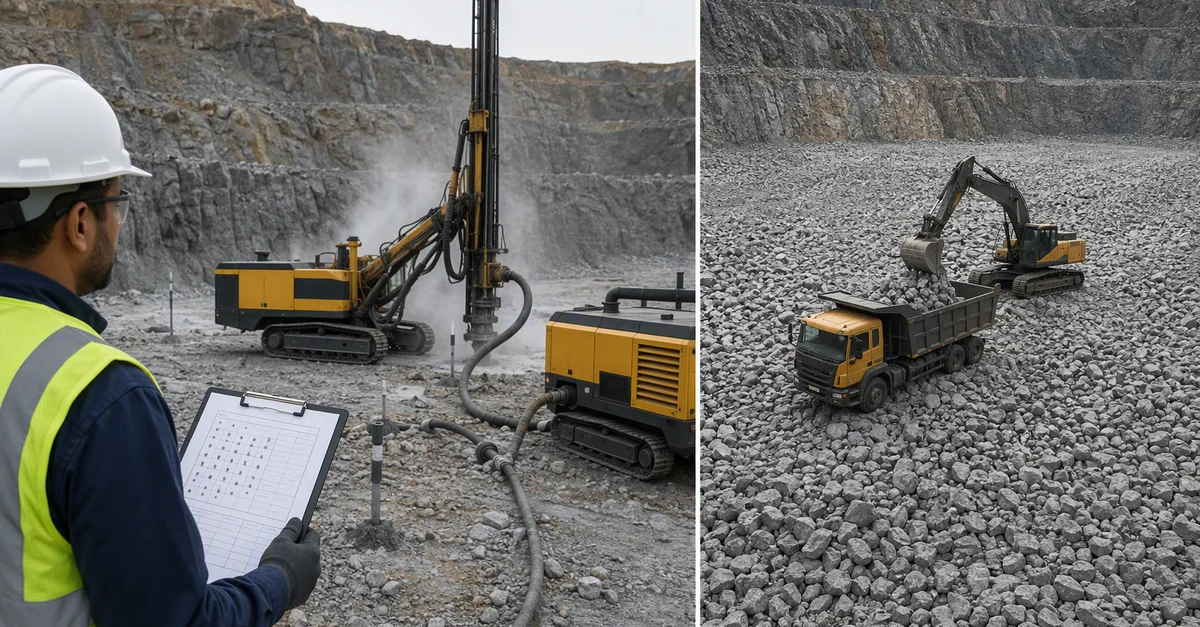
Integrated Quarry Turnkey Drilling: Pattern Design, Equipment Lists, and Blast Efficiency Standards
In aggregate and hard-rock quarrying, drilling and blasting are rarely isolated operations; they are the single upstream engine that dictates primary crusher throughput, loading cycle times, and ultimate cost per tonne. Yet many operators procure drilling rigs, air compressors, and blasting services in silos, only to discover chronic toe ridges, oversize boulders, and escalating secondary breaking costs. This project-level guide establishes the engineering framework for an integrated turnkey drilling operation — moving systematically from geological blast hole pattern design to reverse-engineered equipment bills of quantities, culminating in verifiable blast efficiency benchmarks.
The Turnkey Imperative: Breaking Quarry Procurement Silos
When a quarry operator manages drilling as a standalone equipment purchase and blasting as an outsourced consumable service, operational accountability vanishes in the gap between them. The driller blames the blaster's timing delays for poor fragmentation; the blaster blames drill hole deviation and inaccurate sub-drill for hard toes; the crushing plant manager absorbs the cost of jaw blockages and reduced feed rates.
An integrated turnkey drilling approach shifts the operational paradigm from buying individual machine hours to contracting an engineered fragmentation outcome. In this model, the supplier takes responsibility for the entire rock breakage chain: designing the blast hole pattern based on rock mass structure, supplying matched drilling and compressed air equipment, providing trained operators and consumables, and standing behind measurable muckpile standards at the pit floor.
Actually, treating blast hole pattern design and compressor sizing as separate purchasing decisions is where quarry operating margins are quietly eroded. When the drill rig, flushing air velocity, hole geometry, and explosive charging are engineered as a unified circuit, downstream haulage and crushing bottlenecks evaporate.
Pillar 1: Blast Hole Pattern Design Grounded in Geology
Every turnkey drilling project starts not with machinery, but with rock mass characterization. Compressive strength (UCS), joint spacing, bedding planes, and bench geometry dictate the burden, spacing, and hole diameter. Selecting these parameters requires calculating critical geometric ratios rather than relying on historical rule-of-thumb guesswork.
1. Burden and Spacing Optimization
Burden (B) is the distance from the blast hole to the nearest free face, while Spacing (S) is the lateral distance between adjacent holes along the row. In hard limestone or granite quarrying, the nominal spacing-to-burden ratio (S/B) typically ranges between 1.15 and 1.35 for staggered patterns.
- Excessive Burden: Traps detonation energy within the rock mass, projecting energy upward to cause excessive flyrock, intense ground vibration, backbreak, and massive toe formation at the pit floor.
- Insufficient Burden: Causes premature cratering and venting of high-pressure detonation gases into the atmosphere, producing loud airblast and coarse boulders behind the collar without adequate displacement.
2. Bench Height to Burden (Stiffness Ratio)
The stiffness ratio — bench height (H) divided by burden (B) — governs how easily the rock mass flexes and breaks upon explosive detonation. When H/B falls below 2.0, severe toe problems, uneven fragmentation, and dangerous flyrock risks multiply. Turnkey engineering targets an H/B stiffness ratio between 3.0 and 4.0, which naturally enhances gas expansion efficiency and delivers a uniform muckpile profile. For deep technical calculations on bench geometry, refer to our comprehensive guide on quarry blast hole pattern design.
3. Sub-Drill (J) and Stemming (T) Control
In my experience, over 70% of quarry toe problems are not caused by bad blasting, but by uncalibrated sub-drill and drill hole deviation at the bench toe. Drilling below the planned pit floor level (sub-drill, J) by approximately 0.2 to 0.3 times the burden ensures the shear cone reaches the desired floor datum, preventing costly hydraulic hammer secondary breaking. Concurrently, stemming length (T) must match the burden (typically 0.7 to 1.0 × B) using clean, angular crushed aggregate rather than drill cuttings to prevent stemming blowout.
Pillar 2: The Reverse-Engineered Equipment List
In an integrated project, equipment is never selected from a catalogue based on horsepower alone. The target monthly tonnage and the calculated blast hole pattern dictate the required daily drilled linear metres, which in turn defines the machinery specifications.
1. Crawler DTH Drilling Rigs
For bench heights between 10 and 24 metres requiring hole diameters from 115 mm (4.5 in) to 152 mm (6.0 in), down-the-hole (DTH) crawler drill rigs provide unmatched hole straightness compared to top-hammer alternatives. Key equipment sizing factors include feed force, rotation torque (essential for fractured formations to prevent stuck tools), and an automated rod carousel to reduce non-drilling cycle time.
2. Matched High-Pressure Air Supply
A DTH hammer operates on volume and pressure. The air compressor must not only drive the piston at 18 to 25 bar (260 to 365 psi) to maintain maximum penetration rates, but also deliver sufficient volumetric flow (CFM) to ensure an annular bailing air velocity of 15 to 25 m/s (3,000 to 5,000 ft/min) to clear heavy rock chips out of the hole. Inadequate flushing leads to regrinding, rapid carbide wear, and catastrophic hole collapse. For centralized and multi-rig operations, see our engineering framework on quarry compressor station planning.
3. Consumables and Tooling Package
The equipment bill of materials (BOM) must account for wear life cycles under local rock abrasiveness. A turnkey contract specifies exact reserves of DTH hammers, tungsten carbide button bits (spherical for abrasive sandstone, ballistic for fast penetration in soft limestone), heavy-wall drill pipes, and precision shock absorbers. Full details on lifecycle planning are available in our guide to quarry drilling consumables.
Pillar 3: Measurable Blast Efficiency Standards
How does an operator know if a turnkey drilling contract is successful? Not by counting the linear metres drilled per shift, but by measuring the performance of the muckpile at the primary crusher. A turnkey engineering contract must include contractual key performance indicators (KPIs).
| Performance Dimension |
Target Engineering Benchmark |
Operational Consequence of Non-Compliance |
| Fragmentation (P80 Size) |
≤ 60% - 70% of primary crusher jaw feed opening |
Jaw crusher bridging, downtime, and expensive secondary drop-ball/breaker costs |
| Floor Toe Occurrence |
< 1% of total blasted bench linear foot |
Excessive excavator bucket wear, track damage, uneven floor grading, and delayed haul cycles |
| Muckpile Swell & Profile |
15% - 25% swell factor; semi-tight profile |
Scattered flyrock, excessive dig face travel for loaders, and compromised cycle times |
| Powder Factor Accuracy |
± 5% of calculated kg/m³ design target |
Undercharging creates massive boulders; overcharging creates fines and dust waste |
| Hole Straightness Deviation |
< 1.5% deflection across full hole depth |
Toe convergence or divergence, variable burden at floor level, and violent blowouts |
*Illustrative engineering model only. Actual blast patterns, explosive energy distribution, and equipment sizing must be calibrated to site-specific rock uniaxial compressive strength (UCS), geological jointing, and plant crusher geometry.*
For detailed photographic measurement protocols and digital muckpile image analysis techniques, consult our guide on quarry blast efficiency evaluation.
Project Execution: The Turnkey Delivery Roadmap
Executing an integrated turnkey operation follows a rigid four-stage commissioning sequence:
- Site Audit and Geomechanical Mapping: Acoustic or optical borehole televiewers, bench profiling via drone photogrammetry, and core sampling to determine rock joint sets and bench stability.
- Equipment Deployment and Rig Acceptance: On-site assembly of DTH crawler rigs and air compressors, hydraulic calibration, compressor pressure-drop testing, and operator safety verification. Review the mandatory checks in our DTH drill rig site acceptance and commissioning protocol.
- Trial Blast and Digital Calibration: Drilling initial test patterns with high-precision collar surveying. High-speed video recording of the detonation, blast vibration seismograph monitoring, and 3D drone point-cloud scanning of the post-blast muckpile.
- Continuous Production and KPI Monitoring: Weekly tracking of penetration rates, fuel consumption per drilled metre, bit wear per hundred metres, and primary crusher energy draw (kWh per crushed tonne).
My view is that a drill rig specification sheet is the least important part of a turnkey contract; the binding performance clause on crusher feed throughput is what protects the balance sheet. When a supplier is willing to tie compensation to rock fragmentation and pit floor grade, the entire relationship transforms from vendor to strategic production partner.
Why Welldone Mining
Welldone Mining delivers integrated turnkey drilling operations worldwide, replacing fragmented vendor chaos with predictable, cost-engineered production.
- Engineered Pattern-to-Crusher Alignment: We calculate your burdens, spacings, and charge columns based on your specific primary crusher opening, eliminating oversize before rock ever moves.
- Heavy-Duty DTH Machinery & High-Pressure Compressors: Rigs and matched screw compressors engineered for extreme ambient temperatures, high altitudes, and abrasive formations.
- Total Life-Cycle Accountability: From on-site rig commissioning to tooling maintenance and blast fragmentation auditing, our field engineers guarantee production continuity. Explore our full capabilities under the quarry drilling solution and read about our project-level execution in quarry turnkey drilling projects.
Related Solutions
- Quarry Drilling Solution — Complete equipment fleets and engineering services engineered for modern quarries.
- Quarry Turnkey Drilling Project — Scope of work, risk allocation, and turnkey contract models for mining operators.
- Quarry Blast Hole Pattern Design — In-depth calculation guides for burden, spacing, sub-drill, and stemming.
- Quarry Blast Efficiency Evaluation — Digital image analysis, P80 measurement, and muckpile profiling methods.
- Quarry Compressor Station Planning — Sizing, manifold design, and multi-rig air distribution systems.
- Quarry Drilling Consumables — Carbide selection, button bit re-grinding intervals, and DTH hammer maintenance.
- DTH Drill Rig Site Acceptance Commissioning — Factory-to-pit inspection checklists and handover procedures.
Conclusion
True quarry efficiency is not won by negotiating a ten-cent discount on a drill bit or pushing an old compressor to its thermal limit. It is engineered by synchronizing blast hole patterns, drill rig capabilities, bailing air velocity, and explosive distribution into a unified, measurable system. When drilling precision guarantees blast fragmentation, the entire quarry operates faster, safer, and at a dramatically reduced cost per crushed tonne.
How many hours of primary crusher downtime this month were caused by oversized boulders that could have been eliminated with a properly engineered blast hole pattern?
Website: www.welldonemining.com
Email: info@welldonemining.com
Frequently Asked Questions
What is the difference between hiring a drilling contractor and a turnkey drilling project?
A standard drilling contractor charges an hourly or per-metre fee to drill holes wherever they are marked, with no contractual accountability for hole deviation, blast fragmentation, or secondary breaking. A turnkey drilling provider designs the pattern, supplies the machinery and consumables, supervises drilling straightness, and guarantees muckpile KPIs (such as P80 fragmentation and zero hard toes) directly aligned with your primary crusher throughput.
How do you calculate the optimal blast hole diameter for a quarry?
Hole diameter is governed by bench height, desired powder distribution, and quarry environmental constraints. As an engineering baseline, the ratio of bench height (in millimetres) to hole diameter (in millimetres) should fall between 80:1 and 120:1. For a 15-metre (15,000 mm) bench, hole diameters between 115 mm and 152 mm achieve the optimal balance between drilling productivity and blast energy distribution.
What causes hard toe formation, and how does turnkey engineering eliminate it?
Hard toes occur when explosive energy fails to break rock at the floor level due to excessive front burden (often from crest erosion or hole wander), insufficient sub-drill depth, water-logged holes de-sensitizing ANFO, or improper initiation timing. Turnkey engineering resolves this by 3D laser face profiling to measure actual toe burden, calculating exact sub-drill (typically 0.3 × burden), and using high-stiffness DTH drill strings that minimize in-hole deviation.
Why is bailing air velocity so critical when sizing compressors for DTH rigs?
Bailing air velocity is the upward speed of compressed air carrying drilled rock cuttings through the annular space between the drill pipe and the borehole wall. If the compressor delivers inadequate CFM, the bailing velocity drops below 15 m/s (3,000 ft/min), causing rock cuttings to fall back and be reground. This leads to accelerated bit wear, high diesel consumption, and severe drill string jamming.
Can Welldone Mining design and execute turnkey projects for existing quarries?
Yes. Welldone Mining audits existing quarry operations, analyzes historical fragmentation and crusher power consumption, and engineers a custom turnkey program. Contact our technical team at info@welldonemining.com with your quarry bench specifications and rock properties for a comprehensive feasibility evaluation.