High Altitude DTH Blast Hole Drilling: Compressor Output Correction, Tooling Configuration, and Site Acceptance Criteria
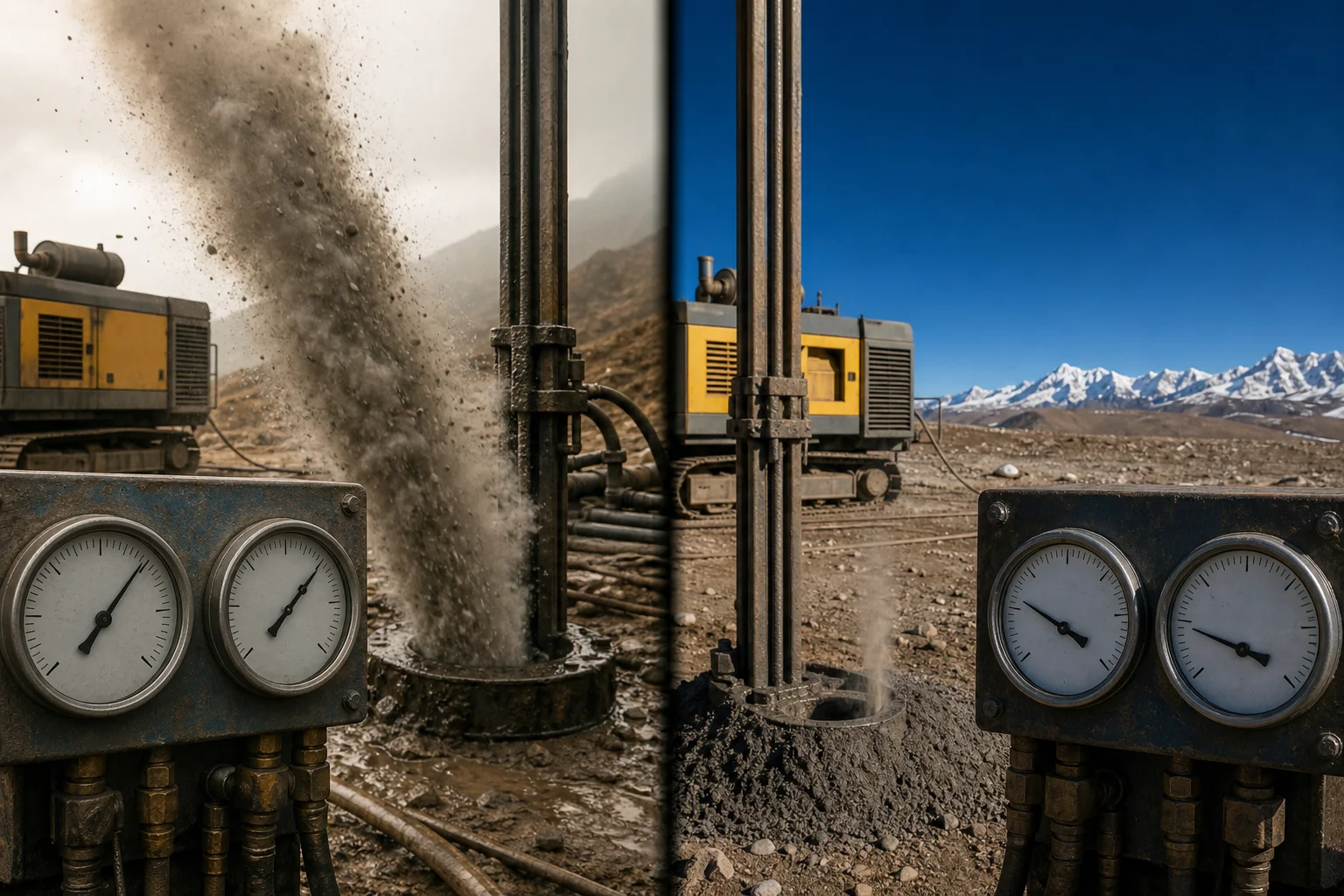
A compressor rated 22 m³/min on the nameplate does not deliver 22 m³/min at 4,000 metres. Most buyers know that. What catches them out is that two separate derating effects stack multiplicatively, and the combined shortfall is roughly double what a single-factor rule of thumb predicts. This article — Part 4 of our crawler drill rig series — covers how to correct compressor output for elevation, how the correction changes tooling selection, and what to physically verify before signing acceptance at a high-altitude site.
A Peruvian Copper Project That Blamed the Bit Supplier
A contractor drilling blast holes at 4,200 metres in the Peruvian Andes had specified a compressor rated 22 m³/min at 24 bar. On paper it was ample for the 115 mm holes they were drilling.
Penetration rate at the site was around 9 metres per hour. The same rig and the same tooling had delivered roughly 22 metres per hour on a project near the coast. The formation was comparable — both competent, both drillable.
The contractor's diagnosis was the bit. He changed carbide grade, then changed bit supplier entirely. Neither made a measurable difference. He then suspected the hammer and requested a warranty inspection.
Nobody had measured the air actually being delivered. When they finally did, the compressor was producing roughly 14 m³/min — about 64 percent of nameplate. The hammer was receiving less air than its minimum operating specification, so it was cycling at reduced frequency and reduced impact energy. The bailing velocity in the annulus had fallen below the threshold needed to lift cuttings, so the hole was partially re-grinding its own cuttings instead of clearing them.
Neither the bit nor the hammer was ever defective. The equipment had been specified at sea-level ratings for a site two-thirds of the way to the height of Everest base camp.
Why the Standard Altitude Rule Understates the Problem
The commonly quoted figure is that compressor output falls roughly 10 percent per 1,000 metres of elevation. That figure is not wrong, but it describes only one of the two effects in play, and using it alone produces a dangerous underestimate.
Effect one — reduced intake air density. A compressor is a volumetric machine. It draws in a fixed volume per revolution, but at altitude that volume contains less air mass because atmospheric pressure is lower. The compressor still moves the same volume of thin air; it simply delivers less actual air.
Effect two — reduced engine power. The diesel engine driving the compressor is breathing the same thin air. A naturally aspirated engine loses roughly 10 percent of rated power per 1,000 metres. A turbocharged engine recovers part of that but still typically loses 4 to 6 percent per 1,000 metres, because the turbo itself is compressing thinner intake air.
The two effects are not additive. They compound. Less intake density reduces what the airend can deliver, and less engine power reduces the airend's ability to maintain rated pressure at whatever flow remains — so at high demand the machine is squeezed from both directions.
| Elevation |
Atmospheric Pressure (approx.) |
Air Density vs Sea Level |
Turbo Engine Power |
Realistic Delivered Output |
| 0 m |
101 kPa |
100% |
100% |
100% of nameplate |
| 1,000 m |
90 kPa |
~90% |
~95% |
~88 – 92% |
| 2,000 m |
80 kPa |
~80% |
~90% |
~78 – 83% |
| 3,000 m |
70 kPa |
~72% |
~85% |
~68 – 74% |
| 4,000 m |
62 kPa |
~64% |
~80% |
~60 – 66% |
| 4,500 m |
58 kPa |
~60% |
~78% |
~56 – 62% |
These are planning figures for scoping, not a substitute for the manufacturer's derating curve for a specific unit. Every machine derates differently depending on airend design, engine, cooling capacity, and control strategy. The point of the table is the shape of the curve: at 4,000 metres you should expect to lose roughly a third of nameplate output, not the 40 percent that a naive 10-percent-per-1,000-metre calculation gives, and certainly not the 10 or 15 percent that most quotations implicitly assume.
Ambient temperature stacks on top of this. High-altitude sites often have wide diurnal swings, and hot afternoon air is less dense again. A site at 3,500 metres reaching 30°C in the afternoon is meaningfully worse than the same site at dawn.
Specifying the Compressor: Work Backwards From the Hammer
The correct sequence is to start from what the hammer needs at the hole, then work backwards through every loss to arrive at a required nameplate rating. Most quotations run the sequence in the wrong direction — starting from a nameplate figure and assuming it arrives intact.
Three deductions apply between the nameplate and the hammer.
Altitude derating as described above — the largest single deduction on a high site.
Line and string losses. Pressure and volume are lost through hose, couplings, the rotary head, and the length of drill string. On deep holes this is not negligible.
Leakage and condition allowance. A machine in service does not perform like a machine on a test bench. Worn couplings, an ageing airend, and a partially loaded intake filter all subtract.
A worked example. Suppose the hammer requires 12 m³/min at 21 bar at the hammer sub, and the site sits at 3,500 metres.
- Required at the hammer: 12 m³/min
- Add allowance for line and string losses and machine condition, roughly 15 percent: 13.8 m³/min needed at the compressor outlet
- Apply altitude derating at 3,500 m, taking delivered output at approximately 65 percent of nameplate: 13.8 ÷ 0.65 ≈ 21.2 m³/min
- Specify a compressor rated at least 22 m³/min at sea level
A buyer who skips the derating step orders a 14 m³/min machine, because on paper 14 covers 12 with margin. On site that machine delivers around 9 m³/min to the outlet and less to the hammer. That is the Peru failure, arrived at by arithmetic rather than by bad luck.
Pressure needs the same treatment as volume. A hammer specified at 21 bar working pressure needs 21 bar arriving at the sub, not leaving the compressor. When the derated machine is already working at the top of its pressure range to make up volume, there is nothing left in reserve for a deep hole.
Bailing Velocity: The Number That Decides Hole Cleaning
Bailing velocity — sometimes called uphole or annular velocity — is the speed at which return air travels up the annulus between the drill pipe and the hole wall. It determines whether cuttings are lifted out of the hole or fall back to be re-ground by the bit.
Insufficient bailing velocity is the mechanism through which an air shortfall becomes a penetration problem. The hammer may still be striking, but if the cuttings are not leaving, the bit spends its energy re-crushing material it has already broken. The symptom is falling penetration with fine, over-ground cuttings — which looks exactly like a worn bit, and gets misdiagnosed as one.
General guidance for DTH drilling is a minimum of roughly 15 metres per second in most formations, rising to around 20 metres per second and above for heavy or dense cuttings. Below that, hole cleaning degrades progressively rather than failing outright, which is why the problem is easy to miss.
Altitude affects this in a way that is not obvious. Bailing velocity depends on the volume of air moving through the annulus. When altitude derating cuts delivered volume by a third, bailing velocity falls by roughly the same proportion. A configuration that gave a comfortable 18 m/s at sea level drops toward 12 m/s at 4,000 metres — below the working threshold, in the same hole, with the same equipment.
There are two levers. Increase delivered air volume, which means a larger compressor or a booster. Or reduce the annular area by using a larger-diameter drill pipe in the same hole size, which raises velocity for the same volume. The second is often cheaper and is routinely overlooked. It is not free, though — larger pipe is heavier to handle and adds to string weight, so there is a practical limit.
Tooling Configuration for Derated Air
Once you know the air that will actually arrive, the tooling has to be selected for that air rather than for the nameplate.
Hammer sizing against real delivered air. A hammer running below its minimum air specification does not simply run slower — it cycles inefficiently, generates more heat, and wears faster. If the derated air cannot support the hammer size you wanted, a smaller hammer running properly will out-drill a larger hammer running starved. This is counter-intuitive to most buyers and it is one of the more useful things to get right on a high site.
Drill pipe diameter as a bailing lever. As above, larger pipe in the same hole raises annular velocity for a given volume. On altitude-constrained sites this is a legitimate design tool, not a compromise.
Bit face and button selection for slower penetration. When penetration rate is limited by available air rather than by rock strength, the bit is in contact with the formation longer per metre drilled. Button wear is time-dependent as well as distance-dependent, so bit life per metre changes. Selecting for wear resistance rather than pure aggression is usually the better trade at altitude.
Booster compressors — when they help and when they do not. A booster raises pressure but does not create volume. If the constraint is pressure — deep holes, high back-pressure, water column — a booster is the right answer. If the constraint is volume, which is the more common altitude problem, a booster raises pressure on air you do not have and solves nothing. Diagnose which constraint you are actually facing before buying one. Booster selection and the diesel-versus-electric decision are covered in Part 1 of our compressor series.
Air treatment is not optional at altitude. Cold high-altitude ambient temperatures mean that any moisture in the compressed air can freeze in the line, the couplings, or the hammer. Ice blockages in a drill string are difficult to clear and can rupture hoses. A dryer producing a sub-zero pressure dew point is a functional requirement on a cold high site, not an efficiency upgrade — the reasoning is set out in our guide to compressed air treatment for drilling.
Site Acceptance: What to Physically Verify Before Signing
Acceptance at altitude should be measured on site, at working conditions, with the actual tooling. A factory test report at sea level tells you nothing about what the machine will do at 4,000 metres, and accepting on paperwork is how the Peru contractor ended up diagnosing his bit supplier.
Verify the following, in this order, before signing off.
- Delivered volume at the compressor outlet, measured at site elevation and at working ambient temperature. Not calculated, not quoted — measured. Compare against the derated figure the supplier committed to in writing.
- Delivered pressure at the hammer sub, with the full drill string made up. Pressure at the compressor outlet is not the number that matters. Measure at the sub, at maximum planned hole depth.
- Engine power behaviour under sustained full load. Run at full drilling load for a minimum of 30 minutes and watch for power fade, rising discharge temperature, or the unit dropping out of its pressure band. Short tests hide thermal problems.
- Discharge temperature at working ambient. Cooling capacity also derates with thin air. A machine that holds temperature at sea level can run hot at altitude, and the high-temperature trip will find you mid-shift rather than during acceptance.
- Penetration rate over a full hole, in the actual formation. Measure metres per hour over a complete hole, not a spot rate over the easy first three metres. Record it as the baseline for the project.
- Cuttings quality at the collar. Angular chips of reasonable size mean the hole is cleaning. Fine over-ground dust means bailing velocity is marginal and the bit is re-grinding. This costs nothing to check and it is the most direct read on hole cleaning available.
- Cold-start capability at the site's minimum ambient. High-altitude sites are cold at night. Verify the unit starts at the lowest temperature the project will see, with whatever cold-start aids are fitted.
The single most valuable item on that list is the first one, because everything downstream depends on it and almost nobody measures it. If delivered volume at elevation is not verified at acceptance, every subsequent performance dispute becomes an argument about whose equipment is at fault, with no baseline to settle it.
Why Welldone Mining
Welldone Mining quotes high-altitude projects against site conditions rather than against catalogue ratings, because a nameplate figure is not a commitment the buyer can hold anyone to.
What high-altitude customers get:
- Derated output stated in the quotation. Tell us your site elevation and ambient temperature range, and our quotation states the expected delivered volume and pressure at those conditions — not just the sea-level rating.
- Tooling specified against derated air. Hammer, bit, and drill pipe selected for the air that will actually reach the hole, including bailing velocity calculated at your elevation and hole geometry.
- Written acceptance criteria before shipment. An agreed measurement protocol and target figures, so acceptance is a check against defined numbers rather than a negotiation after the equipment is already on a remote site.
Related Solutions
- Customized Drilling Solution — High-altitude, extreme-temperature, and restricted-access configurations, including compressor derating and matched tooling packages.
- Quarry Drilling Solution — Blast hole drilling packages with rig, compressor, and tooling matched as one system.
- Diesel vs Electric Air Compressor for Drilling — Cost per meter, altitude and temperature corrections, and when a booster is the right answer.
- Compressed Air Treatment for Drilling — Aftercooler, separator, and dryer selection, including freezing-condition requirements at altitude.
- Aggregate Quarry Drilling — Bit and Compressor Matching — How hammer, bit, compressor, and drill pipe have to match, and what happens when one is specified independently.
- DTH Hammer Failure Modes — Distinguishing genuine tool defects from damage caused by inadequate or contaminated air.
Conclusion
Altitude does not make drilling harder in some vague atmospheric sense. It does one specific thing: it reduces the mass of air the compressor can deliver, and it reduces the engine power available to deliver it, and those two reductions multiply rather than add.
Everything else follows mechanically from there. Less air means the hammer runs below specification. Less air means bailing velocity drops below the threshold for hole cleaning. Cuttings get re-ground, penetration falls, and the symptoms present at the bit — which is why the bit gets blamed.
The Peru contractor changed carbide grade, changed bit supplier, and requested a hammer warranty inspection before anyone put a flow meter on the compressor outlet. The measurement took an afternoon. It should have happened at acceptance, before the first hole.
Website: www.welldonemining.com
Email: info@welldonemining.com
Frequently Asked Questions
How much compressor output do I actually lose at 4,000 metres?
Expect roughly 35 to 40 percent below nameplate as a planning figure, combining reduced intake air density with reduced engine power. The exact figure depends on the specific machine — airend design, whether the engine is turbocharged, and cooling capacity all matter. Ask the supplier for the derating curve for the actual unit at your elevation and ambient temperature, in writing.
Will a booster compressor solve my altitude problem?
Only if your constraint is pressure. A booster raises pressure but does not create volume. The more common altitude problem is insufficient volume, and a booster does nothing for that — it raises the pressure of air you do not have enough of. Diagnose whether you are volume-limited or pressure-limited before buying one, because the two problems look similar at the hole and have completely different solutions.
Why does penetration drop at altitude even though the hammer still sounds normal?
Usually bailing velocity. When delivered volume falls, annular velocity falls proportionally, and below roughly 15 m/s the hole stops clearing cuttings effectively. The bit then re-grinds material it has already broken. The hammer still cycles and still sounds normal, but a significant share of its energy goes into re-crushing rather than into new rock. Look at the cuttings at the collar — fine over-ground dust instead of angular chips confirms it.
What should I measure at site acceptance for a high-altitude project?
At minimum: delivered volume at the compressor outlet measured at site elevation and working ambient temperature, delivered pressure at the hammer sub with the full string made up, sustained full-load running for at least 30 minutes while watching discharge temperature, penetration rate over a complete hole in the actual formation, and cuttings quality at the collar. Agree the target figures in writing before shipment so acceptance is a check rather than a negotiation.
Can Welldone Mining quote a package for our high-altitude site?
Yes. Send your site elevation, ambient temperature range, hole diameter and depth, formation type, and target production to info@welldonemining.com. We return a specification with derated compressor output stated at your conditions, tooling selected against that derated air including bailing velocity at your hole geometry, and a written acceptance protocol.