The scale of construction happening across Saudi Arabia and Egypt right now is difficult to overstate. NEOM, the Red Sea Project, King Salman Park, Egypt's new administrative capital, the Suez Canal industrial corridor — these are not individual projects. They are entire cities and economic zones being built simultaneously, on timelines that are being enforced by government mandate.
Every one of those projects needs construction aggregate. Crushed limestone, granite, dolomite — the raw material of roads, foundations, and concrete structures. That aggregate has to come out of the ground somewhere. It has to be drilled, blasted, crushed, and delivered to site. The quarry contractors who supply it are operating under production pressure that most of them have never experienced before.
The contractors who are winning in these markets are not always the ones with the largest fleets or the longest track records. They are the ones whose equipment is configured to maintain consistent penetration rates in the specific rock formations of the Arabian Peninsula and the Nile Valley — and whose bit and consumable costs stay within the margin their tender price assumed.
Why the Middle East Construction Boom Is Different From Other Markets
Most quarry drilling contractors have worked in multiple markets. They understand how to mobilize equipment, manage site logistics, and maintain production targets under pressure. What many of them underestimate before their first Middle East project is the rock.
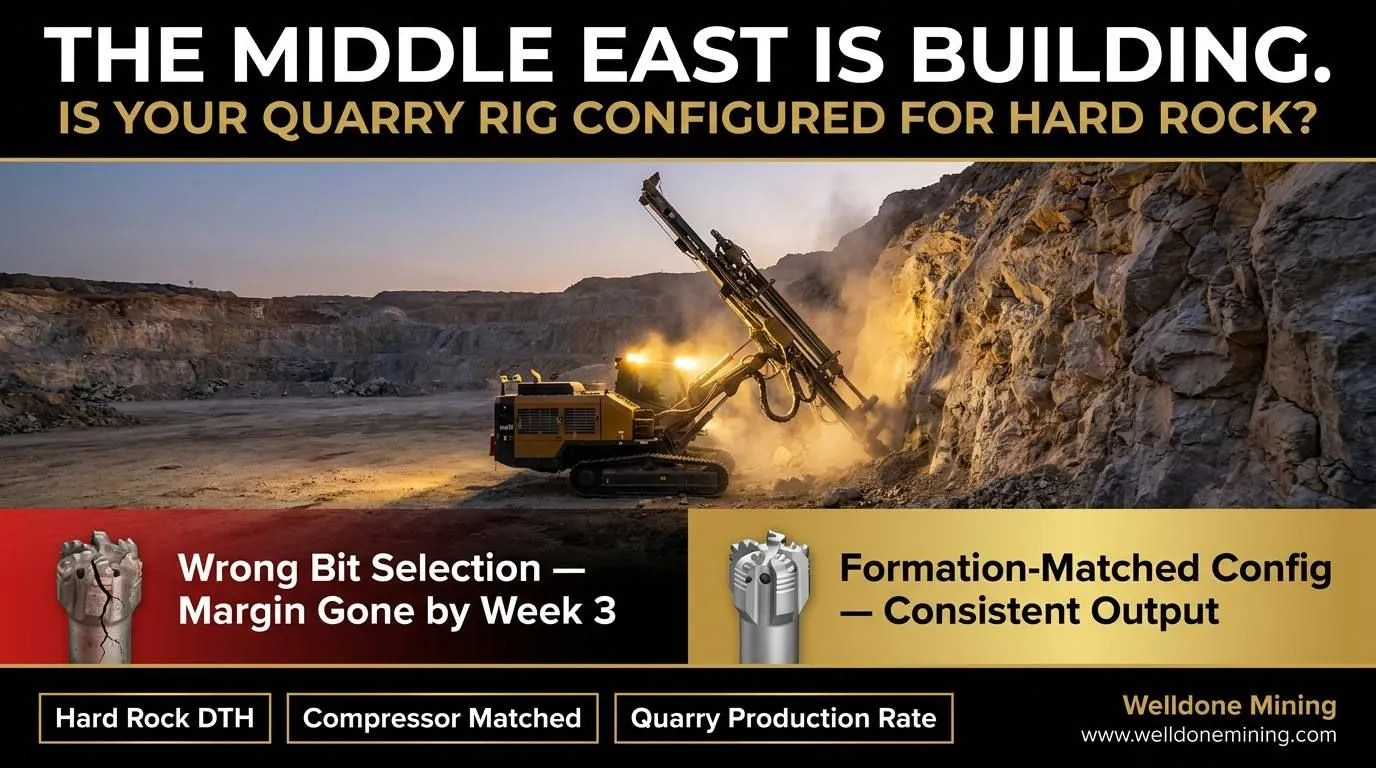
The limestone formations dominant across Saudi Arabia, the UAE, and Egypt are not the same as the limestone in East Africa or Southeast Asia. Hard crystalline limestone in the Arabian Peninsula typically has a silica content above 55 to 65 percent. That silica content is what destroys drill bits. It is abrasive in a way that soft sedimentary limestone is not — and a DTH bit that lasts 10 to 12 days on a project in Kenya may last three to four days on the same hole diameter in a Saudi quarry.
A contractor who priced consumables based on East Africa or South Asia experience will find their bit budget exhausted by week three of a six-week project. The margin does not recover from that. The project timeline does not either — because waiting for replacement bits to clear Saudi customs takes time that was not built into the schedule.
Actually, the consumable cost miscalculation is the single most common reason quarry contractors underperform financially on their first Middle East project. Not logistics. Not labor. Not equipment failure. The rock was harder than the tender assumed, and the bit selection was not configured for it.
The Formation Challenge: Hard Rock Is Not One Thing
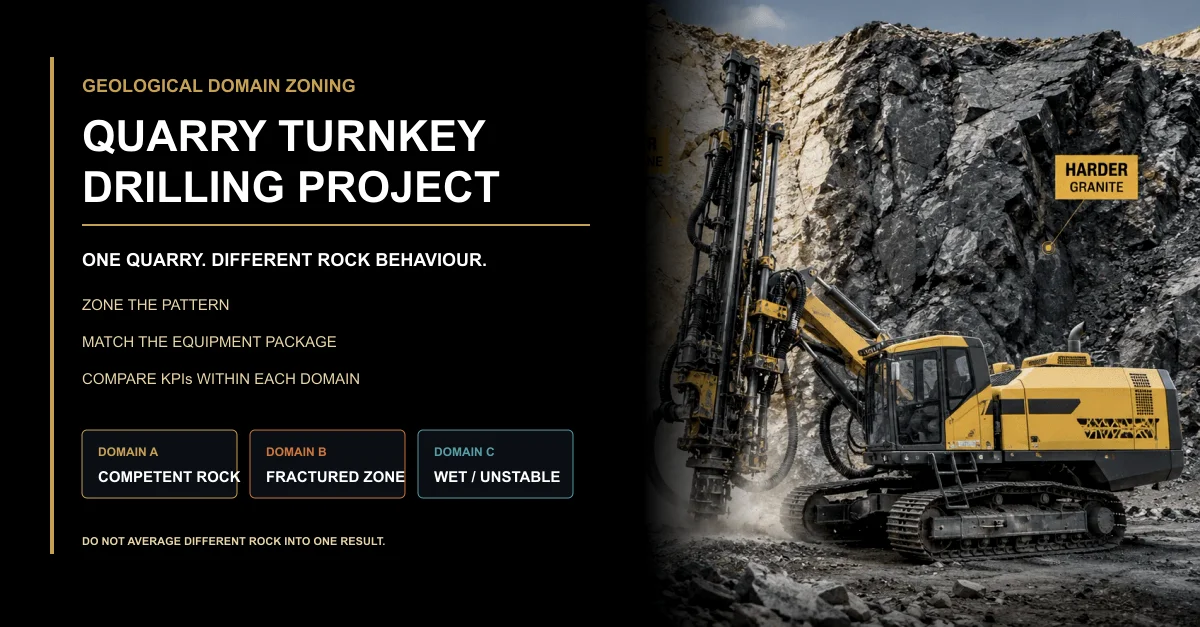
Hard rock is a category, not a specification. The drilling behavior of hard crystalline limestone is different from hard granite. Dolomite presents different challenges from basalt. Even within the same quarry, formation hardness can vary significantly between benches — a top bench that drills at 15 meters per hour may slow to 6 on the bench below it when the formation transitions to a harder, more siliceous layer.
This variability is what makes pre-project formation assessment so important — and so frequently skipped. Contractors receive a site visit, look at the rock face, make a judgment based on visual appearance, and configure their equipment accordingly. Visual assessment of rock hardness is unreliable. A rock that looks similar to formations the contractor has drilled before may behave completely differently under the bit.
The real question is not whether you have drilled hard rock before. The question is whether you have drilled this specific formation, at this specific silica content, with the bit grade and compressor output your current equipment configuration provides.
| Formation Type |
Typical Location |
Drilling Challenge |
Configuration Requirement |
| Hard crystalline limestone (high silica) |
Saudi Arabia, UAE, Jordan |
High bit wear, fast face polishing |
Premium tungsten carbide grade, high impact hammer |
| Dolomite |
Egypt Nile Valley, Red Sea coast |
Abrasive, variable hardness by layer |
Button bit with wear-resistant carbide insert |
| Granite and gneiss |
Egypt Eastern Desert, Sudan border |
Extreme hardness, high compressor demand |
High-pressure compressor, ballistic button bit |
| Soft to medium limestone |
Egypt Delta region, North Africa |
Lower wear but cuttings volume higher |
Standard DTH bit, adequate air volume for hole cleaning |
The Compressor Equation: What Changes When the Rock Gets Harder
Harder rock does not just wear out bits faster. It demands more from the air compressor.
A DTH hammer works by converting compressed air into percussive impact energy at the bottom of the hole. In soft rock, moderate impact frequency and air pressure are sufficient to maintain penetration rate. In hard crystalline limestone with silica above 60 percent, the rock requires significantly higher impact energy per stroke to fracture efficiently. That means higher working pressure at the hammer face — and higher working pressure means the compressor must deliver more bar at the required airflow volume, after accounting for all the pressure losses through the drill string at depth.
A compressor rated at 17 bar that performs adequately in a 120-meter water well in soft sedimentary rock may be running at its practical limit in a 25-meter blast hole in hard Saudi limestone. The hammer is not getting the inlet pressure it needs. Impact frequency drops. The bit starts grinding rather than fracturing — which polishes the face of the rock instead of breaking it, and polishes the bit carbide inserts at the same time.
When a contractor's penetration rate is half what the project schedule assumed, the first instinct is often to blame the equipment. The actual cause, in most cases, is that the compressor was not sized for the formation and depth combination the project is actually running.
- Hard rock quarry applications in Saudi Arabia typically require working pressures of 24 to 30 bar at the hammer, depending on hole diameter and depth.
- A compressor sized for water well drilling at 17 bar will underperform in these conditions without exception.
- Air volume must also be matched to hole diameter — larger holes generate more cuttings and require more air to maintain hole cleaning efficiency.
- Undersized air volume causes cuttings to accumulate in the hole, which leads to regrinding and accelerated bit wear even when pressure is adequate.
Blast Hole Diameter and Production Rate: The Numbers That Define the Tender
Quarry drilling tenders in the Middle East specify hole diameter, bench height, burden and spacing, and required daily production in meters drilled. Those specifications define the equipment configuration needed to deliver the contract — not the equipment the contractor already owns.
A 115mm blast hole in hard limestone at a 12-meter bench height requires a different configuration than a 76mm hole at 8 meters. The air volume needed for adequate cuttings removal scales with hole diameter. The hammer size changes. The drill pipe diameter changes. The rig frame and feed force requirement changes. None of these are minor adjustments to a standard equipment package.
Contractors who bid on Middle East quarry tenders using equipment that was configured for a different hole size or formation type will either win the tender and underdeliver on daily meters, or adjust their penetration rate assumptions and underbid the project. Neither outcome is profitable.
I believe the most common configuration mistake in Middle East quarry projects is using a rig and compressor package originally procured for water well drilling or light construction work and trying to adapt it to hard rock blast hole production. The rig frame may be capable. The compressor almost certainly is not.
| Hole Diameter |
Typical Application |
Air Volume Requirement |
Hammer Size Range |
| 76 to 89mm |
Small quarry, secondary blasting |
8 to 12 m³/min |
3.5 inch DTH hammer |
| 100 to 115mm |
Standard quarry blast hole |
14 to 20 m³/min |
4 to 4.5 inch DTH hammer |
| 127 to 152mm |
Large quarry, primary production |
20 to 30 m³/min |
5 to 6 inch DTH hammer |
Consumable Planning: The Budget Line Most Contractors Get Wrong
In hard rock Middle East quarry projects, consumables — DTH bits, hammer wear parts, drill pipe thread wear — represent a larger share of total project cost than in most other drilling environments. Contractors who build their tender price around consumable consumption rates from softer formation projects will find the actual cost significantly higher.
The practical planning framework is straightforward. Get formation hardness data — UCS (Unconfined Compressive Strength) if available, or local drilling records from contractors who have worked the same quarry. Use that data to estimate bit life at the target hole diameter. Then build your consumable budget around that estimate, not around what you spent on the last project in a different country.
In most cases, contractors working hard limestone in Saudi Arabia or dolomite in Egypt budget for bit replacement every 200 to 400 meters per bit, depending on formation hardness and bit grade. Contractors who budget for 600 to 800 meters per bit — a reasonable assumption in softer East African formations — will run over their consumable budget by 50 percent or more.
The other consumable mistake is not stocking enough bits and hammer parts before mobilization. Saudi Arabia and Egypt have import procedures that take two to four weeks for specialized drilling consumables. If you run out of bits on week three of a six-week project and your replacement order is still clearing customs, your daily production rate drops to zero. That cost — idle equipment, idle crew, potential contract penalties — exceeds the cost of carrying excess stock by a significant margin.
Vision 2030 and the Egypt New Capital: What the Project Pipeline Actually Means for Contractors
Saudi Arabia's Vision 2030 infrastructure program is not a single project with a single timeline. It is a portfolio of megaprojects running simultaneously, each with its own procurement cycle, its own aggregate specification, and its own quarry supply chain. NEOM alone is expected to consume construction aggregate volumes that would require multiple large quarry operations running at full production for a decade.
Egypt's new administrative capital, located 45 kilometers east of Cairo in the Eastern Desert, is being built on hard rock terrain that requires significant quarry development for local aggregate supply. The Suez Canal industrial corridor is driving parallel demand for construction materials across the north Sinai and Ismailia regions.
For quarry drilling contractors, the practical implication is that the project pipeline in these two countries will remain active for five to ten years. Contractors who establish a track record now — who demonstrate consistent daily meter production, controlled consumable costs, and reliable equipment availability — are positioning themselves for long-term repeat work, not just a single tender.
That long-term positioning depends on having equipment that performs consistently in Middle East hard rock conditions from the first project — not equipment that underperforms on the first contract while the contractor figures out what configuration actually works.
What to Confirm Before Committing Equipment to a Middle East Quarry Project
Rock formation and UCS data. Request formation test results or drilling records from the site owner or previous contractors. If no data exists, budget for a pilot hole before configuring consumables for the full project scope.
Required hole diameter and depth. Confirm the blast hole specification — diameter, bench height, burden and spacing pattern — and verify that your compressor can deliver adequate pressure and volume for that diameter at the target depth.
Daily production target in meters drilled. Calculate whether your rig, at realistic penetration rates for the formation, can achieve the contracted daily meters in a standard shift. If it cannot, renegotiate the production clause before signing — not after mobilization.
Local consumable supply chain. Identify whether DTH bits and hammer wear parts for your specific hammer size are available locally or regionally. If lead time for replacement parts exceeds two weeks, stock accordingly before mobilization.
Compressor output at operating temperature. Compressor output ratings are typically specified at 20 degrees Celsius. In Saudi Arabia during summer months, ambient temperatures above 45 degrees Celsius reduce compressor output. Confirm your compressor's derating curve and verify that it still meets formation requirements at peak operating temperature.
| Pre-Project Checklist Item |
Why It Matters |
Risk if Skipped |
| Formation UCS and silica content |
Determines bit grade and expected bit life |
Consumable budget overrun by week 3 |
| Hole diameter and bench specification |
Determines compressor size, hammer size, drill pipe |
Wrong equipment package, production shortfall |
| Compressor output at ambient temperature |
Middle East summer heat reduces compressor output |
Penetration rate drop in peak summer months |
| Local consumable lead time |
Import clearance in Saudi Arabia and Egypt takes 2 to 4 weeks |
Production stoppage waiting for replacement bits |
| Daily production target vs realistic penetration rate |
Contracted meters per day must match equipment capability |
Contract penalty for production shortfall |
Why Welldone Mining
Welldone Mining provides DTH drilling rigs, crawler drilling platforms, air compressors, DTH hammers, drill bits, drill rods, and drilling accessories for quarry, mining, water well, and customized drilling projects. We work with contractors who need equipment configured for real formation conditions — not generic packages built for the average project.
Before we recommend a quarry drilling configuration for a Middle East project, we ask for the formation data, the hole diameter specification, the required daily production target, and the ambient temperature range at the site. Those answers determine the compressor size, the hammer grade, and the bit selection. A contractor who brings us that information leaves the conversation with a configuration that is built for the project — not a standard package that may or may not perform.
We supply complete configured packages — rig, compressor, hammer, bits, drill pipe, and consumable starter kits — calculated for the formation and project scope. For Middle East projects specifically, we build consumable stock recommendations around realistic bit life estimates for the target formation, not around optimistic assumptions.
You can review our quarry and customized drilling configurations:
- Quarry Drilling Solution — blast hole and quarry configurations for hard rock applications across the Middle East, Africa, and construction aggregate markets.
- Customized Drilling Solution — formation-specific packages combining rig, compressor, hammer, and bit selection for complex or variable geology.
- Water Well Drilling Solution — configured systems for borehole and deep well projects across East Africa, South Asia, and the Middle East.
Related Machines
Crawler DTH Drilling Rig — suitable for quarry blast hole drilling and hard rock applications. Available in configurations matched to hole diameters from 76mm to 152mm with appropriate feed force and rotation speed for Middle East limestone and granite formations.
Air Compressor (High Pressure) — matched to rig, hammer, hole diameter, and formation hardness. High-pressure configurations for hard rock quarry applications where standard compressor output is insufficient to maintain penetration rate at depth.
DTH Hammer (Hard Rock Grade) — selected according to formation UCS, hole diameter, and compressor output. Hard rock grade hammers for Saudi Arabian and Egyptian limestone and dolomite applications where standard hammers wear prematurely.
DTH Drill Bit (Premium Carbide) — formation-matched bit selection for hard crystalline limestone and dolomite. Premium tungsten carbide grades for high-silica formations where standard bits fail within the first 200 meters.
Drill Rods and Accessories — matched to rig thread type, hole diameter, and bench depth. Includes stabilizers and sub-adapters for different DTH configurations.
Conclusion
Saudi Arabia and Egypt are not slow-moving markets. The construction timelines are enforced. The aggregate demand is real and sustained. The quarry contractors who establish a track record in these markets over the next two to three years will be well-positioned for a decade of repeat work.
But that track record starts with the first project — and the first project is where most contractors discover whether their equipment configuration was built for Middle East hard rock or built for somewhere else.
A DTH rig, a compressor, a hammer, and a bit that are matched to the specific formation you are drilling, at the specific hole diameter the tender requires, in ambient temperatures that reduce compressor output by 10 to 15 percent during summer — that is not a standard package. That is a configured quarry drilling system. The difference between those two things is the difference between a project that hits its daily meter target and one that is renegotiating production clauses by week four.
If you are planning a quarry drilling project in Saudi Arabia, Egypt, or the broader Middle East, share your formation data, hole diameter, bench height, daily production target, and site temperature range. Welldone Mining will configure a drilling system that is built for what you are actually drilling — and help you build a consumable plan that does not run out before the project does.
Website: www.welldonemining.com
Email: info@welldonemining.com