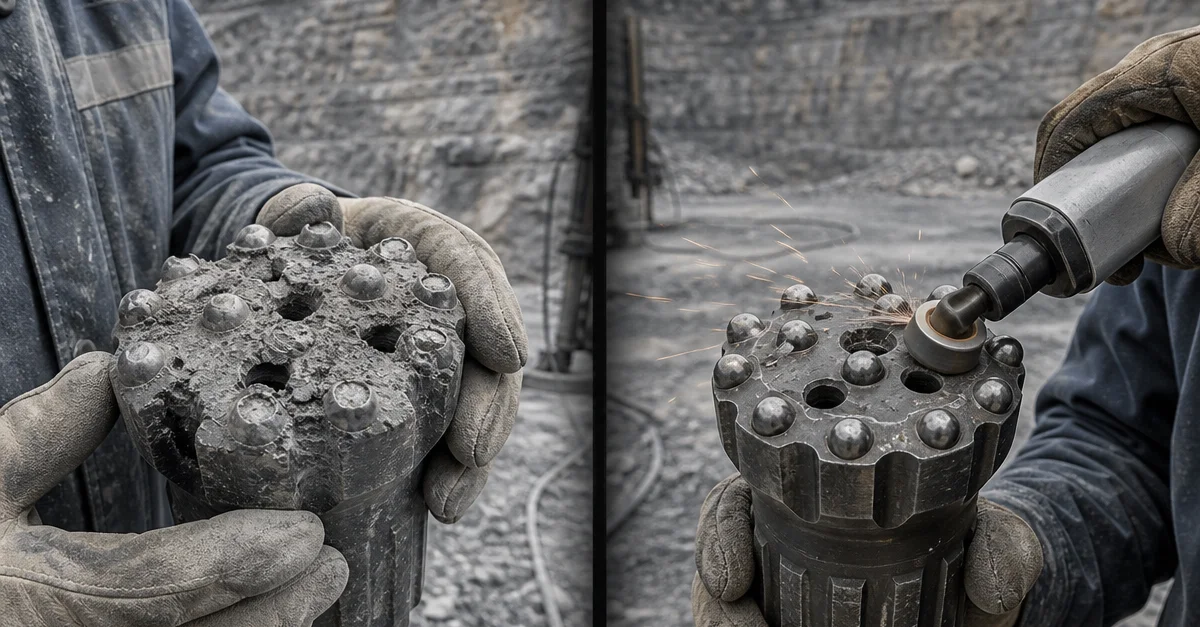
Quarry DTH Drill Bit Wear: What Broken Carbides Tell You About Your Hole Cleaning
When a DTH drill bit comes out of the hole missing its gauge buttons and stripped of its steel face, the first reaction is usually to blame the steel quality or the rock hardness. Usually, neither is the cause. A ruined bit is actually a printed record of what went wrong at the bottom of the hole. This article explains how to read wear patterns to diagnose the air system, the feed pressure, and the operator's water valve.
The Bit That Failed at Sixty Metres
On a hard limestone bench, a driller pulled the string up to find a 115mm bit ruined after just sixty metres. The tungsten carbide buttons on the outer gauge were not just worn; they were ground flat, flush with the steel body, and the steel itself looked as though it had been sandblasted away. The driller requested a bit with harder carbide.
The site manager walked over, looked at the bit, and then looked at the compressor gauge. The air delivery pressure had been sitting low all morning because of a dirty separator element. The rock was not destroying the bit. The lack of air was.
Because the air velocity was too low to lift the cuttings out of the hole, the rock fragments were dropping back down to the bit face. The bit was spending its rotation grinding its own rock chips into powder. That powder became an abrasive paste that polished the carbide flat and scoured the steel body holding it. Harder carbide would not have survived another ten metres in that hole, because the problem was not metallurgical. It was pneumatic.
A DTH bit is the only component that actually touches the rock. When the drilling parameters are wrong, the bit takes the damage. Learning to read that damage is how you stop ruining the replacement.
Reading the Face: Three Distinct Failures
Tungsten carbide does not fail randomly. It fails in specific patterns that map directly to specific operating errors. When inspecting a discarded bit, look for these three distinct signatures.
1. Flat, polished buttons with body wash (The Recirculation Grind)
If the spherical buttons have worn down to flat, polished circles, and the steel body around them is eroded and concave ("body wash"), the bit has been grinding rock it already cut. This happens when the cuttings cannot escape the bit face. It is almost always caused by inadequate bailing air velocity. The culprit is either a worn compressor, a leaking drill pipe joint, or an operator who has opened the water injection valve too far, turning the rock dust into a heavy paste that the air cannot lift. The fix is strictly upstream: restore the air volume or cut the water.
2. Chipped or shattered buttons (The Feed Pressure Shock)
If the carbide inserts are cracked, split in half, or shattered entirely while the steel body remains relatively intact, the bit has suffered mechanical shock. Carbide is extremely hard but brittle. This damage profile means the bit was bouncing against the rock rather than staying pressed firmly into it. It is the classic signature of insufficient feed pressure (hold-down force). Without enough pressure, the hammer piston strikes the bit while it is slightly off the rock face, sending a destructive shockwave through the carbide. The fix is to increase the feed pressure until the drill string stops chattering and runs smooth.
3. Snake-skin or heat-checked carbides (The Friction Burn)
Look closely at the surface of the buttons. If they show a pattern of micro-cracks resembling snake skin, the carbide has suffered thermal fatigue. This happens when the rotation speed is too high for the penetration rate. The buttons are dragging across the rock face, building up intense friction heat, followed by rapid cooling from the exhaust air. These surface cracks quickly propagate, leading to catastrophic button failure. The fix is to slow down the rotation speed so the buttons penetrate and fracture the rock rather than rubbing against it.
The Maintenance Window: When to Regrind
Carbide buttons are meant to be worn, but they are not meant to be run until they are destroyed. The spherical shape of the button concentrates the hammer's impact force into a small point to fracture the rock. As the button wears flat, that force is spread over a larger area, penetration rate drops, and the stress transfers to the steel body and the hammer piston.
I have watched operators run a bit until the buttons are completely flat, believing they are getting maximum life out of the steel. In reality, they are burning diesel to get half the penetration rate, while risking a button shearing off in the hole — which usually destroys the hammer when it strikes the loose carbide.
The economic rule for regrinding is simple: pull the bit and restore the spherical shape with a grinding cup when the wear flat reaches one-third of the button's diameter. A bit that is ground three times at the correct intervals will drill significantly more total metres than a bit run to destruction in a single pass. The tracking of these intervals is what makes the difference on the consumables budget line.
Diagnostic Table: What the Bit is Telling You
| Wear Signature on the Bit |
The Mechanism |
The Operating Fix |
| Buttons worn flat + scoured steel body |
Recirculation: regrinding cuttings that cannot escape |
Increase bailing air velocity; reduce water injection dose |
| Shattered or cracked carbide inserts |
Impact shock: bit bouncing off the rock face |
Increase feed pressure to hold bit firmly to the rock |
| Micro-cracks on button surface (heat checking) |
Friction heat: dragging instead of penetrating |
Decrease rotation speed relative to penetration rate |
| Gauge (outer) buttons wear much faster than face |
Abrasive rock eroding the outer diameter |
More frequent regrinding; switch to ballistic gauge buttons if rock permits |
| Bit body snaps at the shank or splines |
Bending stress or blank-firing (striking without resistance) |
Check hole straightness; stop rotation and air when lifting |
Notice that "buy a different bit" is not the fix for any of the major failures. Most premature wear is a parameter problem, and changing the bit supplier without changing the parameters simply ruins a different brand of steel.
How the Equipment Package Prevents the Damage
Because the bit only reflects the system above it, extending bit life is an exercise in equipment matching. A rig with a weak rotation motor cannot turn a large bit cleanly, and a compressor undersized for the hole diameter guarantees body wash.
This is why bit wear is deeply tied to compressor matching. The upward air velocity in the annulus (the gap between the drill pipe and the hole wall) must exceed 15 metres per second to lift heavy limestone cuttings. If the rig uses 76mm pipe in a 115mm hole, the annulus is large, and the CFM required to maintain that velocity is high. Drop the CFM, and the cuttings stall, fall back, and the bit face becomes a grinding mill. The same failure occurs when dust control water is over-dosed, turning the dust into a heavy mud that the air cannot clear.
Why Welldone Mining
Welldone Mining supplies DTH bits as part of the complete drilling package, precisely because the bit's survival depends on the compressor and the rig operating it. We do not just ship steel; we match the tooling to the air supply.
What a quarry operator gets:
- Matched Bailing Velocity. When we specify a rig and compressor package, the hole diameter and drill pipe size are calculated to ensure the uphole velocity stays above the critical threshold to prevent recirculation wear.
- Button Profiles for the Rock. We supply spherical buttons for hard, abrasive limestone and granite, and ballistic profiles for softer, less abrasive formations to maximise penetration rate without risking shattering.
- Regrinding Workflows. We provide the grinding cups and pneumatic grinders alongside the bits, so the maintenance workflow is physically present on the bench, not just in the manual.
Related Solutions
Conclusion
A discarded DTH drill bit is a free diagnostic report on your drilling operation. Flat, polished buttons with a scoured steel face mean your air velocity is failing to clear the hole. Shattered buttons mean your feed pressure is too low. Surface micro-cracks mean your rotation is too fast.
Treating these as tooling failures guarantees they will happen again. A bit is designed to fail by gradual, even wear across its face. Any other profile is the rock telling you that the parameters on the rig are wrong.
One question for your bench: when your drillers discard a bit, do they throw it in the scrap bin, or do they look at the face to see what the compressor and the feed pressure have been doing for the last two days?
Website: www.welldonemining.com
Email: info@welldonemining.com
Frequently Asked Questions
Why is the steel body of my DTH bit wearing away faster than the buttons?
This is known as "body wash," and it happens when the bit is grinding in a bed of rock cuttings that cannot escape the hole. The highly abrasive rock powder sandblasts the softer steel body away, eventually leaving the carbide buttons unsupported so they fall out. It is caused by poor hole cleaning — either your compressor is not delivering enough air to lift the cuttings, or you are injecting too much water, turning the dust into a heavy, un-liftable paste.
Why do the carbide buttons on my bit keep shattering or cracking?
Carbide is extremely hard but brittle, making it vulnerable to impact shock. Shattered buttons usually mean the bit is bouncing against the rock face rather than staying firmly pressed against it. This is caused by insufficient feed pressure (hold-down force) from the rig. The hammer piston strikes the bit while it is slightly off the rock, sending a destructive shockwave through the carbide. Increase your feed pressure until the drill string stops chattering.
When exactly should I regrind my DTH drill bit?
You should regrind the bit when the flat wear spot on the buttons reaches one-third of the button's total diameter. Do not wait for the buttons to wear completely flat. A flat button spreads the hammer's impact over a wider area, drastically dropping your penetration rate and transferring damaging stress back up into the hammer piston. Frequent, light regrinding yields far more total drilled metres than running a bit to destruction.
Is it better to use spherical or ballistic buttons in a quarry?
It depends on the rock. Spherical (dome) buttons are stronger and resist impact damage better, making them the standard choice for hard, abrasive rock like dense limestone, granite, or quartzite. Ballistic (parabolic) buttons protrude further and penetrate faster, but they are more fragile. They should only be used in softer, less abrasive formations where the risk of the button shattering is low. When in doubt, start with spherical.
Can a dirty compressor filter really ruin a drill bit?
Yes. A blocked intake or separator filter drops the total CFM (air volume) delivered to the hole. Without sufficient air volume, the uphole velocity drops below the threshold needed to blow the rock chips out. The chips fall back to the bottom, the bit grinds them into an abrasive paste, and you suffer rapid recirculation wear (flat buttons and body wash). A £50 filter issue frequently destroys a £300 drill bit.