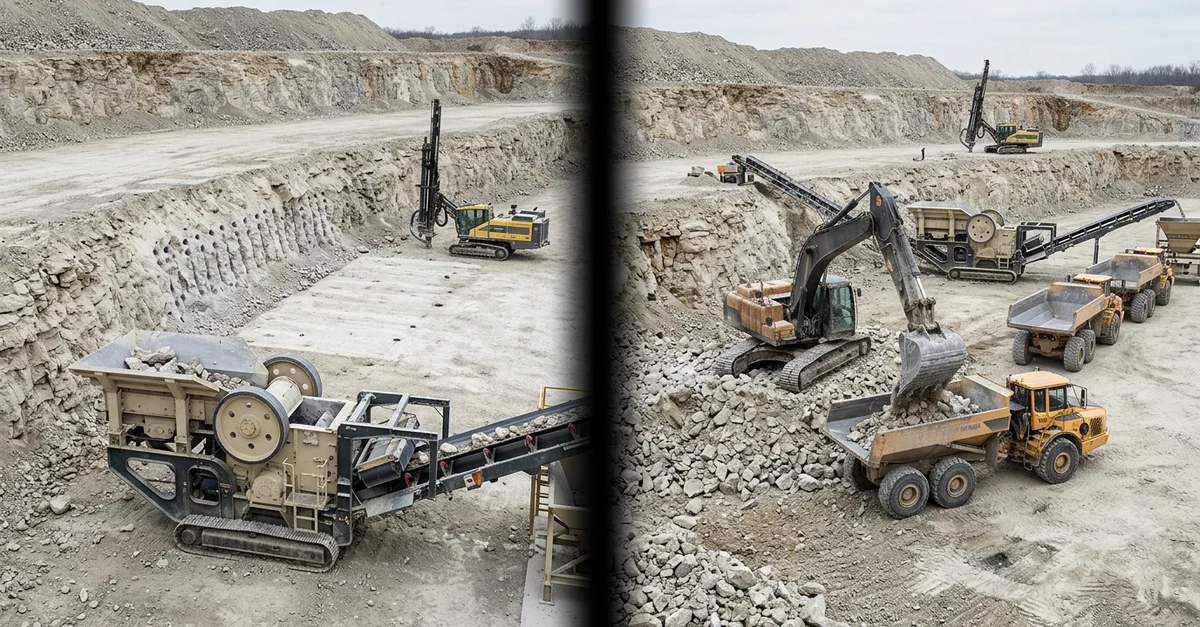
Quarry Drill, Blast and Load Cycles: Why the Crusher Starves Even When Every Machine Hits Its Target
On the shift log, everything was on plan. The rig drilled its metres. The blast happened on schedule. The excavator loaded trucks. Each line in the report was green, and the crusher — the machine the whole operation exists to feed — ran out of rock for an hour in the afternoon. This article looks at the space between those three machines, where the real production loss happens: the gaps in the drill-blast-load cycle.
The Shift That Beat Its Target and Starved the Crusher
A limestone aggregate plant ran a jaw crusher that was designed for a steady feed. The morning shift report read cleanly: rig output at plan, one blast completed in the window, trucks moving, no breakdowns. Every individual machine had done its job.
At two in the afternoon, the feed belt went thin. Then empty. The crusher idled for forty minutes on a trickle, and the hour did not come back. The plant manager's first reaction was the familiar one — the drilling was behind. It was not. The holes had been drilled. They had been blasted. The muck was sitting at the toe of the bench, and the excavator had already pushed part of it toward the crusher.
The problem was not that any machine had failed. It was that the three machines were running on three different clocks. The rig drilled when its shift said, the blast happened when the blasting window said, the excavator pushed when its operator's rhythm said, and the crusher simply ate whatever arrived — which, at two in the afternoon, was not enough.
The symptom of a cycle that is not meshing never shows up on the machine that is slow. It shows up on the machine that is waiting. In a quarry, that is almost always the crusher, and the cost is written as lost crusher hours, not as a drilling problem.
The Cycle Has Three Clocks, and They Are Not the Same Clock
Drilling, blasting and loading each have their own pace, and the pace is set by different things.
Drilling is measured in metres per shift. It runs continuously and produces holes, not rock. A rig can be at 100 percent of its drilling target for the whole shift and still produce zero crushable tonnes until those holes are blasted. Drilling is upstream of everything, and it carries no obligation to the crusher's immediate needs — only to the future blast.
Blasting is measured in cycles per day. It is gated by weather, the safety window, and the number of holes charged. It does not run continuously; it runs in bursts. The muckpile appears only when the burst fires, and that is the moment the crusher's future feed is created. If blasts are spaced too far apart, the muckpile has to last longer between bursts, and eventually it runs out.
Loading is measured in truckloads per hour. It consumes the muckpile and feeds the crusher. It can only run as fast as the muckpile allows and the crusher accepts. If it runs too fast, it burns through the pile and starves the crusher. If too slow, it leaves the pile sitting and the next blast finds no room.
None of the three machines knows about the others unless the site plan makes them. The classic failure is three well-managed departments on three separate clocks, each reporting success against its own unit, while the crusher — the only machine that produces the product — quietly idles.
The Muckpile Is the Buffer That Holds the Cycle Together
The physical object that connects all three clocks is the muckpile at the toe of the bench. It is a buffer — a stock of blasted rock between the intermittent blasts and the continuous loading. The whole cycle depends on that buffer being big enough to absorb the gaps.
Here is the arithmetic that decides whether the buffer works. Between two blasts, the excavator is loading and the crusher is eating, drawing down the pile from the previous blast. If the drawdown in that gap is larger than the pile, the belt goes empty before the next blast refills it. That is the starve hour.
So the question is not "did we blast enough?" It is "does the muckpile from one blast last long enough to cover the loading and crushing demand until the next blast?" If the answer is no, one of three things is true: the blasts are too far apart, the pile is too small (the blast did not move enough rock), or the crusher is eating faster than the design expected. Each has a different fix, and they are not interchangeable.
My view is that the muckpile is the single most useful number a quarry manager can watch, because it is the one that reports the whole cycle in one glance. A pile that is always growing means the cycle is out of balance one way — production is outrunning crushing. A pile that runs out between blasts means it is out of balance the other way — and the crusher is the one paying for it.
Why a Second Drilling Rig Rarely Fixes It
When the crusher starves, the instinct is to add drilling capacity — get more holes in the ground, more rock to blast, more muck. It is the wrong lever for this problem, and it is the most common one.
A second rig produces more holes, not more crushed tonnes. The holes still have to wait for a blast, the blast still has to fire within its safety window, and the muckpile still has to be loaded and crushed. Add a drilling rig to a cycle that is already balanced and you simply build up a larger backlog of uncharged holes — more drilling cost, the same crusher feed. The bottleneck never was the number of holes.
The bottleneck is the gap between when the muckpile is created and when it is consumed. Closing that gap means aligning the three clocks, not accelerating the first one. I have watched a plant pay for an extra rig and then discover the crusher was idling for the same reason it had been idling before — because the blast schedule and the loading rhythm had not moved an inch.
Reading the Muckpile Profile Before You Change Anything
The muckpile does not just tell you that the cycle is off. Its shape tells you where. The full reading of a muckpile — how fragmentation, heave, and a toe ridge each signal a different fault — is in our guide to quarry blast hole pattern design. For cycle balancing, the useful read is simpler: what is the pile doing between blasts?
A pile that the excavator cannot finish before the next blast means loading is slower than production, or the pile is too big — too much rock in one blast for the loader to move in time. The fix is either faster loading or a smaller, more frequent blast. A pile that is empty by the middle of the gap means the opposite: production is not keeping up, and the crusher is eating ahead of supply. The fix is the cycle spacing, not more rock.
Fragmentation matters here more than it looks. A blast that produces oversize boulders means the excavator spends time and loader hours moving material the crusher cannot take, or it has to break the oversize on the pile before loading. That time is drawn out of the buffer without adding any crushable tonnes. A cycle can be "balanced" in volume and still starve the crusher in practice, because part of the pile was never loadable. The drilling and blasting cost behind that oversize is covered in our guide to what a quarry drilling and blasting budget actually contains.
Sizing the Cycle: A Working Example
Illustrative example only. The figures are assumed values to show the shape of the calculation — replace them with your own crusher rate, blast volume, and loader capacity before using the result.
Assume a crusher that runs at 500 tonnes per hour, a loader that can move 400 tonnes per hour, blasts that move 4,000 tonnes each, and a 24-hour day with four blast windows. The question is whether the buffer holds.
| Quantity |
Assumed value |
What it drives |
| Crusher rate |
500 t/h |
The maximum feed the system can consume |
| Loader rate |
400 t/h |
The real feed ceiling — below the crusher rate |
| Rock moved per blast |
4,000 t |
The buffer created each cycle |
| Blasts per day |
4 |
Total supply, 16,000 t, and the gap to cover |
| Gap between blasts |
6 h |
The time the buffer must survive |
| Consumption in one gap |
400 t/h × 6 h = 2,400 t |
Drawn from the pile between blasts |
| Buffer left after the gap |
4,000 − 2,400 = 1,600 t |
Holds — the cycle is sustainable |
| If blasts drop to 3 per day |
8-h gap, 4,000 − 3,200 = 800 t |
Margin thin; one slow loader hour starves the belt |
Read the last two rows together. At four blasts a day the buffer survives each six-hour gap with a comfortable margin. Drop to three blasts a day and the gap stretches to eight hours; the buffer still technically holds, but the margin is thin enough that one slow loading hour — a wet morning, an oversize boulder at the pile, a truck cycle that runs long — eats the rest and the belt goes empty. That is the difference between a cycle that is balanced and one that is one bad hour away from starving the crusher.
Notice also the line that quietly sets the whole ceiling: the loader at 400 tonnes per hour, below the crusher's 500. The crusher can take more than the loader can feed it, so the loader — not the crusher — is the real feed constraint, and any cycle plan built on the crusher's number will overestimate supply. This is the cost-per-metre logic applied to the whole loop: the number that matters is the one on the slowest link, and it is rarely the machine you would guess. The cost view behind each of these lines is in our guide to the real cost per drilled meter.
The Three Levers That Actually Close the Gap
When the crusher starves, there are three levers, and they should be pulled in this order, because each is cheaper than the next.
Lever one: align the blast schedule with the drawdown. Match the number and spacing of blasts to the amount the loader and crusher will consume between them, as the example above does. This is a planning change, and it costs nothing but a spreadsheet and the honesty to use the loader's rate, not the crusher's.
Lever two: fix fragmentation so the pile is actually loadable. If part of every muckpile is oversize that the loader cannot feed, the effective buffer is smaller than the pile looks. Tightening the pattern, the hole spacing, and the hole deviation — the drilling and blast-design levers — makes more of each blast's volume crushable. This is where the drilling specification feeds the cycle, and the pattern and deviation logic is in our blast hole pattern design guide.
Lever three: change capacity — and only last. Adding loading or blasting capacity is the expensive lever and the one to reach for only after the schedule and the fragmentation are both right. A second rig is a version of this and, as above, it addresses the wrong link. Capacity is bought to solve a cycle that the cheaper levers could not close.
The point of the order is that a starving crusher is, in most cases, a planning and a fragmentation problem, not a capacity problem — and the capacity answer is the most expensive version of a fix that the cheaper levers can already make.
What the Drilling Side Owes the Cycle
Drilling does not feed the crusher directly, but it sets two things the whole cycle depends on, and a quarry that ignores them pays for them downstream.
It sets the blast volume, because the hole count and depth determine how much rock one blast can move. A pattern that under-loads the bench produces a smaller muckpile, which is a smaller buffer, which is a thinner margin. And it sets the fragmentation, because hole deviation and the pattern geometry determine how clean the blast breaks the rock. Oversize from a deviated hole is a loader hour and a crusher stop hiding inside a drilling number. The shift target that a rig is held to, and how it is defined against the production it feeds, is where the quarry turnkey drilling project is supposed to start, because the rig is only as useful as the blast it is building holes for.
So the drilling specification that serves the cycle is not "drill fast." It is "drill the holes that make the next blast move a loadable, crushable volume on the schedule the loader can keep." That is a different target, and it is the one that keeps the crusher fed.
Why Welldone Mining
Welldone Mining supplies the drilling half of the cycle, and we specify it against the production it feeds rather than against a standalone metres-per-shift number. When we scope a rig for a quarry, the input list starts with the crusher's feed requirement and the blast schedule, not with the hole depth.
What a quarry operator gets:
- A drilling plan anchored to the blast and the feed. Send the crusher rate, the loader capacity, the rock volume per bench, and the blast windows, and we return a pattern and a rig output sized to keep that buffer alive, with the utilisation assumption stated.
- Fragmentation considered from the hole, not the muckpile. The deviation and pattern choices that keep oversize out of the loader's path are part of the specification, so the pile is loadable when it lands.
- The numbers to watch written down. A short set of cycle metrics — muckpile drawdown per gap, loader versus crusher rate, oversize share — so the manager can see the buffer thinning before the belt goes empty.
Related Solutions
Conclusion
A crusher that starves is not evidence that the drilling was slow. It is evidence that three well-run machines were running on three clocks and never once agreed on one. The rig hit its metres, the blast fired in its window, the loader pushed on its rhythm, and the only machine that produces the product was left waiting for them to line up.
Watch the muckpile, because it is the one number that reports the whole cycle at a glance. Size the blast schedule to the drawdown the loader can actually sustain, fix the fragmentation so the pile is loadable when it lands, and only then consider capacity — because a second rig is the most expensive answer to a problem that is usually a planning and a break-quality problem all along.
One question for your own bench: if you wrote down the tonnes the loader can feed the crusher every hour, and the tonnes the next blast will create, which number is smaller — and do you know, this month, which one your crusher has been waiting on?
Website: www.welldonemining.com
Email: info@welldonemining.com
Frequently Asked Questions
My drilling is on target, so why does the crusher still run out of rock?
Because drilling produces holes, not crushable tonnes, and the crusher only eats what the blast moves and the loader feeds. A rig at 100 percent of its metres target can still feed nothing until those holes are blasted and the muck is loaded. If the blasts are spaced too far apart, or the pile is partly oversize the loader cannot feed, the belt empties between blasts even though every machine individually did its job. The gap, not the drilling rate, is what the crusher is waiting on.
How big should the muckpile buffer be between blasts?
Big enough to cover the full drawdown over the gap between two blasts plus a margin for one bad hour. Work it from the loader's actual feed rate (not the crusher's), multiplied by the gap length, and compare it to the tonnes the previous blast moved. If the drawdown is close to the pile size, the cycle is only one slow loading hour from starving the belt. The arithmetic shape is in the worked example above.
Will adding a second drilling rig fix a starving crusher?
Usually not, because the bottleneck is rarely the number of holes. A second rig builds a bigger backlog of uncharged holes, not more crushed tonnes — the blast schedule, the muckpile drawdown, and the fragmentation are what set the crusher's feed. Adding drilling capacity is the most expensive lever and should be used only after the blast schedule is aligned and the pile is actually loadable. If your drill is genuinely the slowest link, the fix is often utilisation and site organisation, not a second machine.
What role does hole deviation play in keeping the crusher fed?
A deviated hole breaks the rock unevenly and produces oversize, which the loader cannot feed and the crusher cannot take. That oversize draws on the muckpile buffer without adding any crushable tonnes, so it effectively shrinks your buffer between blasts. Tight deviation from a well-set-up rig is a cycle benefit, not just a drilling one — the pattern and deviation logic is in our blast hole pattern design guide.
Can Welldone Mining help me align the drilling side with my blast and crusher schedule?
Yes. Send your crusher feed rate, your loader capacity, the rock volume per bench, your blast windows, and the formation, to info@welldonemining.com. We return a pattern and rig output sized to keep the muckpile buffer alive on your schedule, with the utilisation assumption stated, and the set of cycle metrics to watch so the buffer thinning is visible before the belt goes empty.