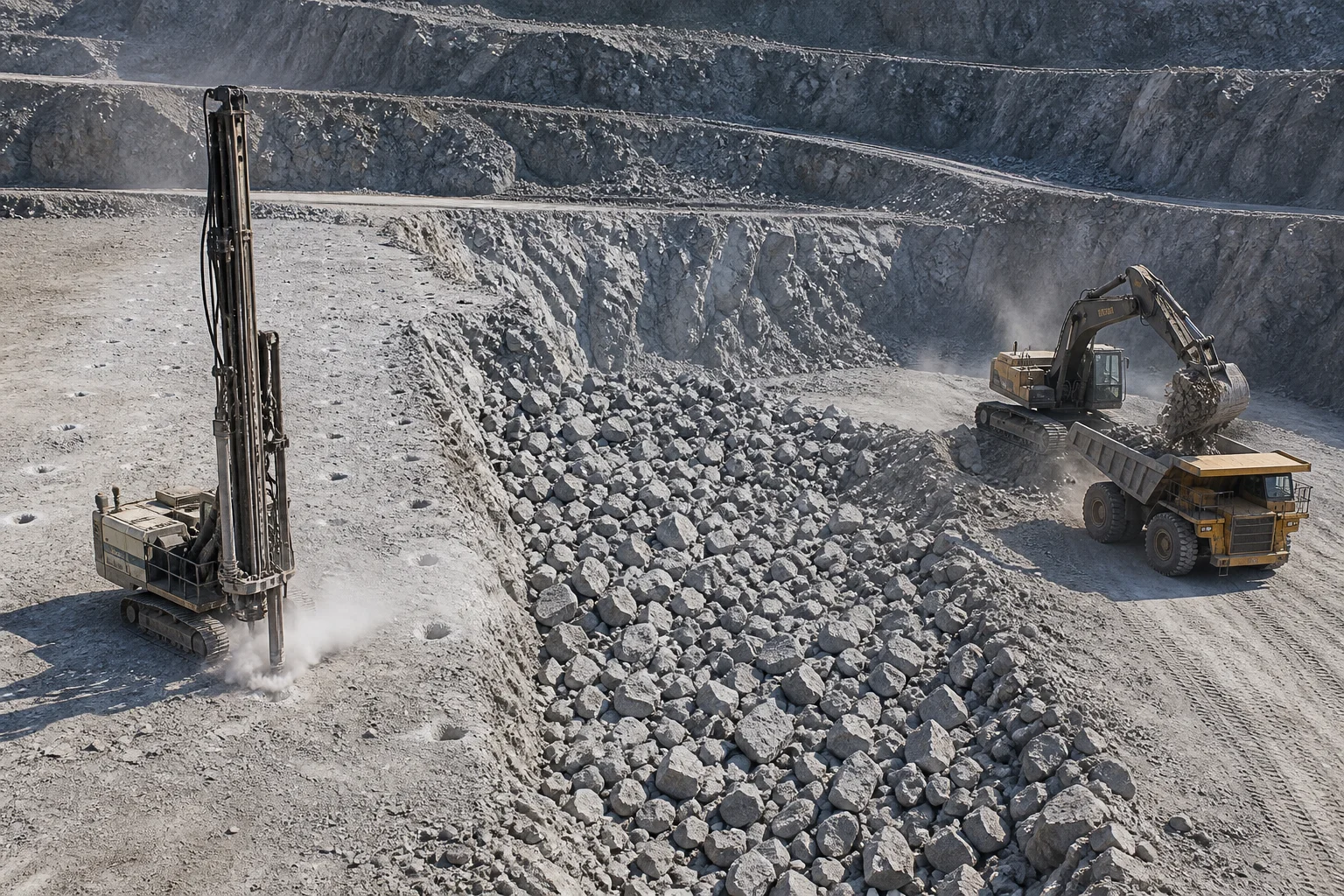
Quarry Drilling and Blasting Cost: Why Three Quotes for the Same Bench Differ by 28% and None of Them Are Wrong
Three contractors submit blast hole drilling and blasting tenders for the same granite bench. The prices differ by 28 percent. All three are quoting honestly. The spread comes from scope boundary decisions — which cost components are included, which are excluded, and how each bidder has priced the fragmentation risk that determines whether the blast produces loadable rock or oversized boulders. This guide maps the real cost structure of a quarry drilling and blasting operation and explains which line items are typically negotiated, which are fixed, and which cost more than buyers expect.
The Egyptian Quarry Manager Who Could Not Compare Three Quotes
A quarry project manager in Upper Egypt showed me three drilling and blasting tenders for a limestone expansion programme — 180,000 cubic metres over eight months. One price at USD 2.10 per cubic metre, one at USD 2.38, one at USD 2.68. All three bidders were credible and had worked in the region before.
He assumed the cheapest bidder had shaved margin. He was wrong on all three. The cheapest bid excluded secondary breaking of oversized rocks, excluded compressor mobilisation, and defined successful blasting as rock displaced from the bench face — regardless of fragment size. The most expensive bid included secondary breaking, included full mobilisation and demobilisation, and guaranteed 95 percent of output below 800mm — a fragmentation specification that determined his crusher's feed capacity.
He could not compare the quotes because they were not pricing the same thing. Nobody had told him that secondary breaking cost alone — the hydraulic breaker time required when fragmentation is poor — typically runs at two to four times the cost of the original drill hole per cubic metre of oversized material processed.
The Six Cost Components That Build a Blasting Budget
A defensible blasting budget contains six line items. Any quotation that does not show all six either excludes some or bundles them in ways that obscure the total.
1. Drill hole cost per metre. Rig operating hours multiplied by rate, plus consumables — bits, hammers, drill pipe wear — allocated per metre drilled. This is the most visible line and frequently the most competitive. It is also the one where cheap bits and poor compressor matching raise the true cost above the quoted figure.
2. Hole loading — explosives and initiation. Explosive quantity is determined by the blast design: burden, spacing, sub-drill depth, and powder factor. Initiation cost covers detonators, shock tube or electronic delay systems, and the blasting engineer's time. This line scales directly with hole volume and powder factor — a bad blast design that increases powder factor by 20 percent raises this line by 20 percent.
3. Secondary blasting and mechanical breaking. This is the line that does not appear in thin quotations and accounts for the largest budget surprises in quarry operations. Every blast produces some oversized rock — fragments too large for the crusher — and processing them requires either additional blasting (secondary shots) or a hydraulic hammer on an excavator. Hydraulic hammer time runs at the excavator's full operating cost, which is typically USD 80 to 180 per hour depending on machine size and location. A blast producing 5 percent oversize on a 50,000-cubic-metre bench can generate several hundred hours of secondary breaking work. That is not a small line.
4. Mobilisation and demobilisation. Moving rigs, compressors, explosive magazines, and safety equipment to site and back. On remote sites this is substantial; on permanent quarries with equipment stationed on site it may be negligible. The distinction matters when comparing a resident contractor against a mobilising one.
5. Supervision, safety, and regulatory compliance. Blasting engineer time, shot firer licences, pre-blast notifications, blast exclusion zone management, and post-blast inspections. In some jurisdictions this is the owner's cost; in others it is the contractor's. Define it in the scope, not in the dispute.
6. Standby and weather delay. Blasting stops for rain, lightning, high winds, and non-blast-zone personnel. A quotation that does not address standby either absorbs the risk in the rate or passes it to the client as a variation. Which one it is will become relevant the first time a blast is delayed three days for weather.
Powder Factor: The Design Decision That Moves Every Line
Powder factor — the weight of explosive consumed per cubic metre of rock blasted — is set by the blast design engineer and drives the entire budget. Most granite quarries run between 0.3 and 0.7 kg per cubic metre. The difference between those extremes is a factor of more than two on explosive cost per cubic metre, and the choice is not arbitrary.
Higher powder factor produces finer fragmentation: smaller, more uniform fragments that feed crushers faster and produce less oversize. Lower powder factor reduces explosive cost but produces coarser fragmentation and more secondary breaking work. The optimal powder factor is not the one with the lowest explosive cost — it is the one with the lowest total cost including secondary breaking and crusher throughput.
In hard, massive granite with few natural fractures, powder factors of 0.5 to 0.7 kg per cubic metre are common because the rock resists fragmentation and requires energy to break uniformly. In well-fractured limestone, 0.3 to 0.4 kg per cubic metre may produce adequate fragmentation, because natural fractures extend the blast's effect. Using a limestone powder factor in granite produces a predictable result: coarse fragmentation, high oversize rate, and a secondary breaking bill that exceeds the explosive savings several times over.
The three Egyptian quotes differed partly because each bidder had estimated powder factor differently — and the cheapest bidder had estimated it the lowest.
Secondary Breaking: The Budget Item That Compounds
Secondary breaking deserves specific treatment because its cost structure is counterintuitive. Most buyers treat it as a minor cleanup item. In practice, it is the line that has the highest variance and the highest unit cost of any activity in the blasting programme.
When blast fragmentation produces oversized rock — fragments too large for the primary crusher — that rock must be processed before it can move. The options are secondary shots (small explosive charges placed in drilled holes) or hydraulic impact hammers mounted on excavators. Both cost significantly more per cubic metre of rock processed than the original blast.
Secondary drilling costs more because the holes are short and scattered, making rig repositioning a high fraction of total time. Hydraulic breaking costs more because excavator hire is expensive and breaking rate is slow — a 1.5-tonne hammer on a 20-tonne excavator processes perhaps 30 to 60 cubic metres per hour of solid granite, while the same machine loads properly fragmented rock at 200 to 400 cubic metres per hour.
The compounding effect is that poor blast design raises oversize rate, which raises secondary breaking cost, which raises the excavator's effective loading rate (because it spends time on breaking rather than loading), which raises haulage cycle time, which reduces daily tonnes moved. A primary blast that is 8 percent cheaper but produces 6 percent oversize does not save money — it transfers cost into secondary breaking and haulage at a higher unit rate.
Hole Pattern Design and Its Effect on Cost Per Tonne
Burden and spacing — the distances between blast holes — directly set the blast's energy distribution and its fragmentation result. Correct burden and spacing for a given rock type and explosive type produces uniform fragmentation. Incorrect values produce either oversize (too wide) or excessive fines and backbreak (too tight).
A blast engineer specifies burden and spacing based on the rock's uniaxial compressive strength, the explosive's energy density, and the bench height. The ratio of spacing to burden typically runs between 1.1 and 1.4 for production blasting. Outside that range, fragmentation degrades measurably.
Buyers who accept a generic "standard pattern" without verifying that it was designed for their specific rock are often accepting a suboptimal burden-spacing ratio. In heterogeneous rock — formations that shift from soft shale to hard siliceous zones — a single pattern across the whole bench will oversize the hard zones while generating excess fines in the soft ones. Zone-specific patterns cost more to design and lay out, and produce better fragmentation per tonne at lower total cost.
The blast design is the highest-leverage intervention in the blasting budget. An experienced blast engineer adjusting burden and spacing reduces secondary breaking cost more reliably than renegotiating the drill hole rate.
What Mobilisation Actually Contains
Mobilisation cost is frequently negotiated as a lump sum without scrutiny, and frequently underestimated by contractors pricing aggressively to win work. Understanding what it contains prevents scope disputes.
A complete mobilisation for a medium-scale quarry programme includes: rig and compressor transport to site, regulatory compliance for explosive transport and storage, site establishment for the mobile magazine and safety exclusion zones, pre-blast survey and establishment of reference monitoring points for vibration management, and crew induction and site-specific safety orientation. Demobilisation reverses most of these steps and includes magazine decommissioning and regulatory sign-off.
On permanent quarries with a resident contractor already on site, most of this cost disappears. On project quarries bringing in a specialist contractor, it can represent 8 to 15 percent of total programme cost on short campaigns and 2 to 5 percent on multi-year programmes. Spreading it across more cubic metres is the straightforward economic incentive for larger contracts.
Reading a Blasting Quotation
A quotation worth comparing against others answers five questions explicitly. If any five of these are missing, ask for them before evaluation:
- What fragmentation specification is the price based on? Maximum fragment size for primary crusher feed, target oversize percentage, and how oversize is handled if the blast exceeds it — contractor risk or client variation order.
- Is secondary breaking included, and on what trigger? At what fragment size does secondary breaking become billable? Who determines whether a fragment is oversized?
- What powder factor is assumed? If the actual rock requires higher powder factor than assumed, who bears the cost difference?
- What does mobilisation include, and is it spread across the programme or charged per campaign?
- What standby rate applies, and what triggers it? Weather, access restrictions, owner-caused delays, regulatory holds.
A quotation that answers all five is a quotation you can hold a contractor to. One that answers none gives the contractor the flexibility to answer them in their favour when the invoice arrives.
Why Welldone Mining
Welldone Mining supplies the drilling side of quarry blasting programmes — rigs, compressors, hammers, bits, and drill pipe matched to your blast design parameters — alongside the engineering support to optimise drill hole cost per cubic metre.
What quarry customers get from us on the drilling side of the budget:
- Drill hole cost per metre quoted against your actual blast design. Burden, spacing, hole diameter, and depth from your blast engineer's pattern — not against a generic hole. The number is the number for your programme, not an average.
- Consumable cost modelling across the programme. Bit life, hammer service intervals, and drill pipe wear estimated against your formation's abrasiveness and the hole count in your programme, so the consumable budget is based on physics rather than optimism.
- Compressor sizing that matches the hole diameter and depth at your site altitude. If your quarry is at elevation, the compressor output is corrected before quotation. The drill hole rate reflects what the equipment actually produces on your site, not what it produces at sea level in a manufacturer's data sheet.
Related Solutions
Conclusion
A 28 percent spread across three blasting quotations is not evidence of dishonest pricing. It is evidence that the tender did not specify fragmentation outcome, secondary breaking scope, mobilisation content, or powder factor assumption — and each bidder resolved those ambiguities differently.
The line items that drive the largest budget surprises are not the visible ones. Drill hole cost is competitive and transparent. Secondary breaking, standby, and the downstream cost of poor fragmentation on crusher throughput are not visible in a unit rate, and that is exactly where the difference between a cheap tender and an expensive programme hides.
The real question when evaluating a blasting budget is not which quote is cheapest per metre drilled. It is which quote has priced the fragmentation outcome your crusher actually needs — and who carries the risk when the blast does not deliver it.
Website: www.welldonemining.com
Email: info@welldonemining.com
Frequently Asked Questions
What is a typical powder factor for granite quarry blasting?
Most hard granite quarries run 0.4 to 0.7 kg of explosive per cubic metre, depending on the rock's fracture density and uniaxial compressive strength. Massive, unfractured granite at the higher end; heavily jointed granite at the lower. Using a powder factor designed for softer rock in hard granite produces predictable oversize and secondary breaking costs that typically exceed the explosive savings several times over.
How much does secondary blasting cost compared to primary blast holes?
Secondary processing — whether secondary shots or hydraulic breaking — typically runs at two to four times the unit cost of the original blast hole per cubic metre of material processed. The high cost comes from scattered short holes (high mobilisation per metre), slow mechanical breaking rates, and lost excavator loading time. A blast producing 5 percent oversize on a 50,000-cubic-metre bench can generate secondary costs comparable to the entire primary drilling budget.
Is mobilisation always a separate line item?
Not always. Resident contractors with equipment permanently stationed at the quarry often absorb mobilisation into their unit rate. Specialist contractors mobilising from another site will usually price it separately — and should, because the cost is real. Confirm which model applies, and for mobilising contractors, confirm whether mobilisation is amortised across the programme or charged per blast campaign.
Who should specify the blast design — the drilling contractor or a separate blast engineer?
In most jurisdictions the blast design must be signed off by a licensed blasting engineer, who may or may not be the drilling contractor's employee. For significant programmes, independent blast engineering gives the quarry owner a design that is optimised for their crusher specification rather than for the contractor's preferred operating parameters. The cost of independent blast engineering is typically recovered in fragmentation improvement within a few campaign blasts.
Can Welldone Mining advise on drill hole cost for our specific blast pattern?
Yes. Send us your blast design parameters — hole diameter, depth, burden, spacing, total hole count, formation type, and site altitude — and we will return a drill hole cost estimate including consumables for your programme. Contact us at info@welldonemining.com.