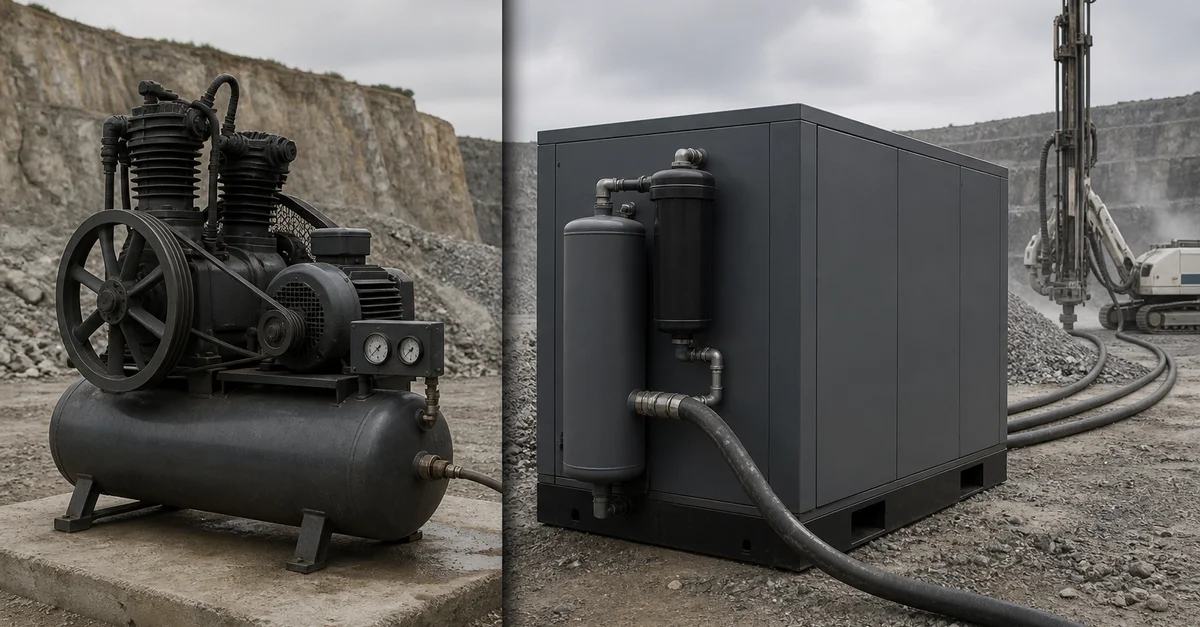
Quarry Compressor Station: Parallel Units, Standby and Planning for the Long Term
A single compressor is a single point of failure. Every metre the quarry drills passes through that one machine, and when it stops — for service, for a fault, or for a filter change at the wrong time — the bench stops with it. This article is about treating the air station as an engineered system rather than a machine purchase, and the difference that makes when the quarry needs to grow.
The Machine That Stopped the Bench
A quarry ran one compressor feeding two DTH rigs. It was sized correctly for both rigs running together, maintained on schedule, and had never given serious trouble. Then the oil separator reached the end of its service life on a Tuesday morning and had to be changed. The replacement part was on the shelf, the fitter was available, and the job took two hours.
Two hours. Both rigs sat idle, the blast scheduled for Thursday was shifted to Friday, the crusher ran on reclaimed stock for an afternoon, and the week's metres came in short. The compressor did not fail. The air station had no standby, and a planned two-hour service window became a two-hour bench stop because nothing existed to cover the gap.
This is the quiet cost of a single-machine air station, and it is different from a breakdown. It is the accumulated cost of every hour the bench cannot drill while the one machine that feeds it is being serviced, warmed up, or cooled down — multiplied by every planned service interval over the machine's life. A correctly planned air station treats each of those hours as a risk to be managed, not an unavoidable tax on having a compressor.
Parallel Units: The Arithmetic of Resilience
The simplest version of a planned air station is two compressors instead of one, sized so that either can cover the minimum drilling demand alone. The two machines run in parallel under normal production, sharing the load evenly, and each acts as the other's backup when one is down for service or fault.
The arithmetic changes when the two share a common air manifold with isolation valves. Each machine can be isolated from the system, serviced, and returned while the other keeps the bench alive. Service windows become planned, scheduled events with zero impact on drilling — not emergencies that stop the rigs while the fitter works. That is the difference between a machine that is maintained and a machine that is serviced, and it is a physical difference in the pipework, not just in the maintenance culture.
Two machines also provide load-sharing flexibility that a single machine cannot. On a light-demand shift — one rig, shorter hours, less heat — one machine can carry the load while the other rests, keeping total running hours on each machine roughly equal and extending both their service lives. A single machine runs every hour regardless of demand; two machines share the wear.
Sizing for Parallel Operation
The sizing logic for a parallel station is different from the logic for a single machine, and the difference matters enough to work through before specifying.
A single machine is sized for peak demand. A parallel pair is sized so that each machine can cover the minimum acceptable bench output alone — typically enough air to keep one rig drilling — while together they cover peak production. This is not the same as buying two machines each rated at half the total demand, because the minimum acceptable output when one machine is down is not half the normal output; it is the output the site can live with for the duration of a service interval.
The result is usually that a two-machine parallel station for a given bench carries more total nameplate capacity than a single machine would, but the extra capacity is not waste — it is headroom, standby cover, and future room in the same capital envelope. The full demand-side sizing that feeds into this calculation is in our quarry air demand guide, and the machine type that fits continuous parallel duty is the rotary screw.
The Manifold, the Valves, and the Pipework
The station is only as flexible as the pipework that connects it to the bench, and pipework is where most air stations are under-specified.
A common air manifold with full-bore isolation valves on each machine inlet is the foundation. It allows any machine to be isolated without stopping the flow to the bench, and it is the physical thing that makes the two-machine duty/standby arrangement work. Without isolation valves, the "standby" machine is just a second machine — stopping one stops them both, because the air paths are permanently joined.
The pipe run from the manifold to the bench is where pressure drop lives, and it costs metres-per-shift invisibly. A long run of undersized pipe, a chain of quick-couplings, and a dozen elbows each take a percentage of the pressure the machines are working to deliver. Size the delivery pipe for the peak flow with room to spare, and the losses that were quietly robbing the hammer go away — without touching the compressors at all. The air-quality items that sit between the manifold and the hammer are in our compressed air treatment guide.
Planning for Growth: The Headroom Question
A quarry that is growing will eventually need more air, and the time to plan for it is before the first machine is installed, not when the second rig arrives and the air station is already full.
Headroom planning has three forms. The first is physical: does the pad have room for a third machine, and is the manifold sized to take one? Retro-fitting a manifold point is not expensive while the pad is being laid; it is much more expensive after everything is built and running. The second is electrical: is the supply circuit rated for an additional motor, or would a third machine require a grid upgrade? The third is mechanical: is the manifold bore large enough to carry the air from three machines without becoming a restriction in itself?
None of these is a major capital item at the planning stage. All of them become significant retrofit costs if they were ignored. A quarry that plans its air station for the fleet it intends to run in five years, not only the fleet it has today, pays for the future expansion in advance at planning prices. Actually, the headroom question is the one that separates an air station from an air machine — the station is designed for the operation, the machine is bought for the job in front of it.
Standby vs Duty: Getting the Roles Right
A two-machine station can be run in two different modes, and the choice between them matters for maintenance and for machine life.
In a true duty-and-standby arrangement, one machine is the designated running unit and the other is idle, ready to start automatically or manually if the duty machine trips. The standby machine runs its weekly test cycle to prove it is available, and switches to duty on a regular rotation so neither machine accumulates all the hours. The duty machine is maintained first; the standby machine is maintained in its idle time without stopping the bench.
In a parallel load-sharing arrangement, both machines run together all the time, each carrying half the load. Neither is the standby in the strict sense, but either can cover the minimum bench demand if the other is taken out of service for maintenance. This arrangement shares the wear more evenly and avoids the low-load idle running that standby machines sometimes suffer, but it removes the true hot-standby capability — when one machine trips, it trips under full load rather than starting fresh from idle.
The right arrangement depends on the criticality of the bench, the service interval, and the site's preference for either maximum uptime or even machine life. Both are valid; neither works if the manifold and valves were not installed to support them.
A Worked Sizing Framework
Illustrative example only. Replace these values with your actual rig fleet, demand profile, altitude, and minimum acceptable output before applying.
| Planning input |
Assumed value |
What it drives |
| Peak simultaneous demand |
Two rigs at full draw, derated for altitude |
Total station capacity required at normal production |
| Minimum acceptable output |
One rig drilling during service |
Each machine must cover this alone |
| Number of machines |
Two in parallel |
Either covers minimum; together they cover peak |
| Manifold sizing |
Rated for three machines with isolation valves |
Third machine can be added without system rebuild |
| Delivery pipe bore |
Sized for peak flow plus 15% headroom |
Pressure drop at the hammer stays within spec |
| Pad footprint |
Three-machine width, poured once |
Future expansion requires no civil work |
The last two rows are the ones most sites skip, because they represent future capacity that is not needed today. But both are cheap at foundation stage and expensive as retrofits — and neither the pipe bore nor the pad width can be changed easily once the station is running. This is the frame behind the argument for planning the station for the operation you intend, not the one you currently have.
Why Welldone Mining
Welldone Mining supplies the air system as part of the drilling package, and the station design is part of that supply. A compressor sold without a station plan is sold without the context that determines whether it will still be feeding the bench reliably in the third year of the project.
What a quarry operator gets:
- A station sized for the site, not the current fleet. The capacity, the machine count, and the manifold are specified for the rig fleet the quarry intends to run, with headroom for the next addition built in at planning prices rather than retrofit costs.
- Manifold and isolation valves as standard. The physical components that make duty-and-standby possible are part of the specification, not an afterthought — because a standby machine without isolation valves is just a second machine that stops the bench alongside the first.
- Delivery pipe and air treatment sized together. The bore from manifold to hammer is calculated for the peak flow, so the pressure the machines produce is the pressure the hammer receives. Together with the air treatment guide at compressed air treatment for drilling, this closes the loop from compressor outlet to hammer face.
Related Solutions
Conclusion
A single compressor is not an air station. It is a machine with no cover, no flexibility, and no room to grow — and every hour it spends being serviced is an hour the bench spends waiting. Two machines on a manifold with isolation valves cost more on the day the pad is poured, and they pay for that difference on the first scheduled service that does not stop the rigs, and on every one after.
Plan the station for the operation you intend, not the one you have today. Pour the pad wide, bore the manifold for three, and run the delivery pipe for peak flow with headroom. The cost of doing this at foundation stage is a fraction of the retrofit, and the return is a bench that keeps drilling when the air system breathes.
One question for your own site: when the compressor goes in for its next service, does the bench keep drilling — or does everything wait for it to come back?
Website: www.welldonemining.com
Email: info@welldonemining.com
Frequently Asked Questions
Why should I run two compressors instead of one large one?
Because a single machine is a single point of failure. When it is serviced, faulted, or warming up, the bench stops. Two machines on a manifold with isolation valves mean either one can be taken out of service without stopping the other — planned service windows have no impact on drilling, and a fault on one machine does not stop the whole bench. The extra capital buys uptime, not just extra air.
What is an air manifold and why does it matter?
A common air manifold is a header pipe that all the compressors feed into, with a full-bore isolation valve on each machine's outlet. It is the physical component that makes duty-and-standby possible: any machine can be isolated and removed from the system without stopping the air flow to the bench. Without it, the "two-machine" station is just two machines permanently connected — stop one and the flow to the bench drops by half or stops entirely.
How much headroom should I build into the compressor station?
Enough to cover the next rig addition without rebuilding. The practical answer: pour the pad for three machines when installing two, bore the manifold for the same three, and run the delivery pipe for peak flow plus fifteen percent. None of this costs much at foundation stage, and all of it is expensive to retrofit. Plan for the fleet you intend to run in five years, and the expansion costs almost nothing when it happens.
Should I run both compressors all the time or keep one as a standby?
Both arrangements work, and the choice depends on your priorities. Load-sharing — both running all the time at half load — keeps wear even and avoids standby idle running, but removes the true hot-standby capability. Duty-and-standby keeps one machine fresh for fast cover and lets maintenance happen on the standby without stopping the bench, but requires discipline around rotation to keep machine hours balanced. Either works; neither works without the manifold and isolation valves in place to support it.
Can Welldone Mining design the air station as part of the drilling package?
Yes. The station design — machine count, manifold sizing, isolation valves, delivery pipe bore, and pad footprint — is part of what we specify when we supply the air system. Send your rig fleet, peak and minimum demand, altitude, growth plan, and site layout to info@welldonemining.com and we return a station specification that covers the bench you have today and the one you plan for tomorrow.