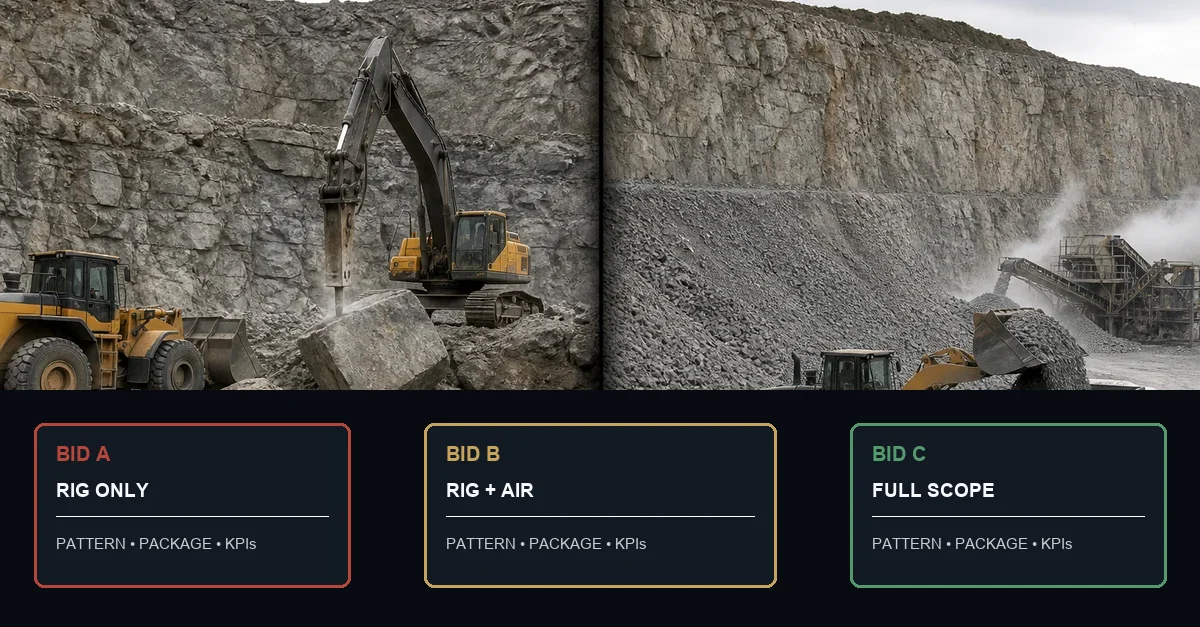
A quarry does not lose money because the rig is slow. It loses money at the seam between three decisions that were budgeted by three different people: the hole pattern, the air supply, and the tool string. This is how to close that seam before the first hole is collared.
Why quarry projects break at the seam, not in the machine
It is 06:40 and the rig rolls onto the bench. By 09:00 the operator is fighting a hole that has walked off line, the compressor is sitting on its relief pressure, and the loader is pushing boulders off the muckpile because the back row came out in blocks instead of broken rock.
Nothing on that bench is a manufacturing defect. The rig is new. The compressor is new. The bits are new. What failed is the interface between them:
The blast designer set a 127 mm pattern because that is what the last contractor drilled.
The rig buyer ordered a rig by hole diameter and depth , which is how rigs are sold.
The compressor was specified by whoever had the air contract, using the rule "more bar is better".
Three defensible decisions, one broken system. The 127 mm hole now has too much annulus for the air it is getting, so the cuttings sit in the bottom of the hole and get ground twice. The fine powder that comes back out is not rock removal, it is rock being destroyed a second time at the operator's expense.
A turnkey approach is not a procurement wrapper. It means the hole pattern, the air volume, the hammer, the bit and the production benchmark are calculated as one chain before a single machine is quoted. If your supplier cannot show you that chain, you are buying three machines and hoping they agree with each other.
A crawler DTH rig collaring on a hard-rock bench. The dust coming out of the collar is the only real-time readout of whether the air volume under the hole matches the hole being drilled.
Hole pattern design: the four numbers that set your fragmentation
Blast pattern design starts from the hole diameter and works outward. Four numbers decide whether the muckpile comes out as rock or as boulders. They are the same four numbers on every bench, in every country.
1. Burden (B): the rock between the hole and the free face
Burden is the distance from the hole to the nearest free face. It is the single largest driver of fragmentation. The practical starting rule for surface blasting is a burden-to-diameter ratio (B/D) between 20 and 40 . Take the low end of that range for hard, dense, competent rock where hole straightness matters and your air supply is adequate rather than generous; take the upper end for softer, jointed or abrasive formations.
2. Spacing (S): the distance to the next hole in the row
Spacing is expressed as a multiple of burden, and the multiple depends on the pattern geometry rather than on preference:
Square pattern: S = 1.0 x BEquilateral triangle: S = 1.15 x BStaggered row: S = 1.25 x B
3. Subdrill (J): the extra depth below grade
Subdrill is drilled below the bench floor and filled with explosive, not stemming. Without it the toe stays unbroken and you leave a hard lip that a hydraulic hammer has to come back for. Typical starting value is 0.3 x B , with a practical range of 0.2 to 0.5 x B. Too little subdrill leaves the toe; too much wastes drilling metres and explosive on rock that was already going to move.
4. Stemming (T): the inert column at the top
Stemming confines the gas for long enough to do work on the rock instead of on the air. Typical starting value is 0.7 x B , with a practical range of 0.5 to 1.0 x B.
Putting it together on a real bench
Take a granite bench: 115 mm holes, 15 m bench height, rock density 2.7 t/m3 , ANFO at 0.85 t/m3 . Working the rules above and solving for a powder factor that suits hard rock gives the following pattern.
Worked example: 115 mm blast hole pattern on a 15 m granite bench
Parameter Value Derivation What it controls
Hole diameter (D)
115 mm
Set by required production and available rig
Drilling rate, and the minimum air volume the whole system must supply
Burden (B)
3.4 m
B/D = 29.6, inside the 20-40 surface range
Fragmentation quality and flyrock risk
Spacing (S)
3.9 m
1.15 x B, equilateral pattern
Rock volume broken per hole
Bench height (H)
15 m
Site geometry
Stiffness ratio , and therefore fragmentation uniformity
Subdrill (J)
1.0 m
0.3 x B, rounded up
Whether the toe breaks or needs a second visit
Hole depth
16.0 m
H + J
Drilled metres per hole, and therefore cost per metre
Stemming (T)
2.4 m
0.7 x B, rounded up
Gas confinement, air overpressure, flyrock
Charge column
13.6 m
Hole depth minus stemming
Charge mass per hole
Charge mass per hole
120.1 kg
0.0104 m2 x 13.6 m x 850 kg/m3
Explosive cost per hole
Rock volume per hole
198.9 m3
B x S x H = 3.4 x 3.9 x 15
Production per hole
Powder factor
0.60 kg/m3
120.1 kg / 198.9 m3
Energy per cubic metre, at the high end for hard rock
Tonnes per hole
537 t
198.9 m3 x 2.7 t/m3
How you convert drilling metres into cost per tonne
Drilled metres per 1,000 t
29.8 m
16.0 m / 537 t x 1,000
The number to put in your drilling tender
Why the pattern only works if the holes are straight. A burden of 3.4 m assumes the hole actually finished 3.4 m from the free face. Drill 1.5% off line over 16 m and the toe moves 240 mm; drill 3% off line and the toe moves nearly half a metre into the next burden, which is where oversized boulders and cut-off rows come from. Deviation is a pattern-design input, not a workshop statistic.
Powder factor for surface blasting typically falls between 0.3 and 1.0 kg/m3 . The figure above sits at 0.60 kg/m3 , which is where dense hard rock belongs. If your current blast is running at 0.35 kg/m3 in granite and still producing oversize, the problem is rarely the explosive budget. It is usually the pattern geometry, the hole deviation, or the fact that the holes were drilled in the wrong place.
Hole deviation: the pattern's hidden variable
Deviation is measured as a percentage of drilled depth, and it compounds with depth. This is where the drilling method stops being a preference and becomes a blast-design constraint:
Hole straightness by drilling method, and what it costs at the muckpile
Criteria DTH (down-the-hole) Top hammer
Rock hardness range
f = 6-20, all hardness
f = 6-14, soft to medium only
Hole straightness
Around plus or minus 0.5% deviation
Around plus or minus 2-3% deviation
Useful depth without accuracy loss
15-50 m
Degrades beyond 15 m
Hole diameter range
50-200 mm
30-115 mm
Where the percussion energy is delivered
At the bit face, in the hole
Through the rod string, from the surface
The difference is mechanical, not commercial. A DTH hammer travels down the hole with the bit, so percussion energy is delivered at the rock face and no energy is lost through the rod string. A top hammer sends its energy down the string, and every rod joint takes a small share of it. On a 15 m bench in granite, that difference shows up as hole straightness, and hole straightness shows up as your oversize tonnage.
The quarry and blast hole drilling solution covers this as a matched platform rather than a rig catalogue: rock type, hole diameter range, hole depth and deviation target are stated together, because on a quarry bench they are one decision.
The air calculation most quarry tenders skip
Ask five suppliers what compressor a 152 mm blast hole needs and you will get five answers based on pressure alone. Pressure sets the hammer's impact energy. It does not clean the hole. Volume cleans the hole, and volume is decided by two diameters you already fixed when you chose the pattern.
The controlling figure is the annular return velocity — the speed of the air travelling back up the space between the drill string and the hole wall, carrying the cuttings with it. It is calculated from the free air delivered by the compressor, converted into the annulus area:
Metric form: V (m/min) = Q / [0.7854 x (D2 - d2 )]
Imperial form: BV (ft/min) = 183.35 x ACFM / (D2 - d2 )
Q = free air delivered (m3 /min) | ACFM = free air delivered (ft3 /min) | D = hole diameter | d = drill pipe diameter (both in the same unit)
Industry guidance for that return velocity sits between roughly 15 m/s and 35 m/s (about 3,000 to 7,000 ft/min) for normal cuttings, with higher velocities needed for wet or heavy cuttings and for high penetration rates. Below the floor, cuttings are not lifted and get reground. Above the ceiling, you are burning fuel to erode the hole wall and the annulus.
Worked example: the same compressor across the hole range
The table below uses the onboard screw compressor figures for two integrated rigs and a typical drill pipe diameter for each hammer class. Confirm the drill pipe diameter against your actual tool string before using these numbers in a tender.
Annular return velocity by hole diameter, drill pipe diameter and free air volume
Rig and air supply Hole diameter Drill pipe diameter Annulus area Free air Annular return velocity Verdict
KT5H, 13 m3 /min at 18 bar
115 mm
76 mm
0.0059 m2
13 m3 /min
2,222 m/min (37.0 m/s)
Above the ceiling: throttle the air or move up a hole size
KT5H, 13 m3 /min at 18 bar
127 mm
76 mm
0.0081 m2
13 m3 /min
1,599 m/min (26.6 m/s)
In range
KT15C, 22 m3 /min at 24 bar
152 mm
89 mm
0.0119 m2
22 m3 /min
1,845 m/min (30.7 m/s)
In range
KT15C, 22 m3 /min at 24 bar
190 mm
114 mm
0.0181 m2
22 m3 /min
1,212 m/min (20.2 m/s)
In range, close to the floor in wet ground
Legacy 10 m3 /min compressor
152 mm
89 mm
0.0119 m2
10 m3 /min
839 m/min (14.0 m/s)
Below the floor: regrinding, stuck tools, rising cost per metre
Read the first and last rows together. The same 152 mm pattern that works at 22 m3 /min fails at 10 m3 /min — and it fails quietly. Nothing on the machine alarms. The penetration rate drops a little. The bit comes out a little hotter. The cuttings at the collar look a little finer than they should. Three weeks later the operator is pulling a stuck string out of a hole that has filled with its own reground powder.
The two failure modes, priced
Under-sized air (below about 15 m/s): cuttings are not lifted, they fall back and get ground again. The visible symptom is fine powder at the collar instead of chips. The cost is a higher penetration rate penalty on every metre, accelerated bit and hammer wear, and the occasional multi-hour recovery of a stuck drill string.Over-sized air (above about 35 m/s): fuel burn rises with no fragmentation benefit, the annulus erodes where the formation is soft or fractured, and the extra velocity strips the hole wall and loads the muckpile with unwanted fines.
This is why air selection belongs to the same calculation as the pattern. If you are matching a compressor to a rig you already own, the custom drilling solution for unusual hole diameters and complex ground is built around exactly this problem: air pressure and air consumption matched to the hole, the formation and the tool string rather than to a pressure headline.
Rig assembly, where the air end and the hammer class are fixed as a pair. A machine assembled without a stated hole pattern is a machine whose annulus velocity was never calculated.
Equipment list for a turnkey quarry drilling package
A quarry drilling package is not a rig plus a compressor. It is six lines on a specification sheet, and each line constrains the others. Below is the structure with the actual machine ranges Welldone builds for quarry work.
Quarry drilling package: what the specification actually has to state
Package line What the specification must state What breaks if it is left generic
Drilling rig
Hole diameter range, economic hole depth, engine power, carrier type and gradeability, dust collection method
Rig is either under-powered for the hard bands in the bench or oversized for the transport limits on the haul road
Air supply
Free air volume, working pressure, and the resulting annular return velocity at the design hole diameter
Regrinding and stuck tools, or fuel burn with no fragmentation gain
DTH hammer
Hammer class matched to hole diameter, shank type, working pressure, air consumption at that pressure
Impact energy mismatched to the formation; hammer body wear or deviation from an oversized bit
Drill bits
Bit diameter, face design for the formation, button configuration, gauge protection
Gauge wear opens the hole under size, deviation climbs, bits consumed faster than planned
Drill string
Pipe diameter and length, connection type, and the annulus area the pipe creates in the design hole
Wrong pipe diameter silently changes the return velocity the whole air calculation was built on
Spares and consumables
Hammer seal kits, bit and rod holding quantity, air freight availability, warranty terms
A single seal failure stops the bench for the length of a sea freight cycle
Welldone rig range for quarry benches
Welldone quarry drilling rig range
Model Type Hole diameter Working depth Onboard air or power Weight Best fit
HB70
Electric DTH drill rig
50-80 mm
Up to 15 m
3 kW motor
175 kg
Small quarries, narrow benches and ground a crawler cannot reach
KG420T / KG420TH
Surface crawler DTH rig
90-152 mm
Up to 25 m
58-73.5 kW, external air supply
5,050-5,350 kg
Medium to large quarries, folding mast for fast relocation, slopes up to 30 degrees
KT5H
Integrated surface DTH rig
90-127 mm
24 m economic depth
Onboard screw compressor, 13 m3 /min at 18 bar, 162 kW
9,500 kg
Production blast holes and pre-splitting with automatic rod handling and dry dust collection
KT15C
Integrated surface DTH rig
140-190 mm
35-36 m
Two-stage screw compressor, 22 m3 /min at 24 bar, 298 kW
24,800 kg
Deep holes, hard rock and large open-pit benches where a separate air fleet is not economical
Hard-rock quarry applications on the Welldone platform run across granite, basalt and gneiss at 90-200 mm hole diameter and depths up to 45 m with DTH, and across limestone and dolomite at 64-140 mm with top hammer. If your project is a full production package rather than a single machine, the mining and quarry drilling solutions overview sets out how rig, air, tooling and consumables are scoped together.
Pre-shipment testing of the air and hydraulic systems. This is the last point at which a mismatched air end can be corrected without a crane, a vessel booking and a lost production month.
Blasting efficiency benchmarks you can audit weekly
Drilling and blasting performance is usually argued with opinions because nobody agreed the numbers up front. Fix the benchmarks in the contract and the argument ends. These are the figures worth writing down, and what each one tells you when it moves.
Quarry drilling and blasting performance benchmarks
Benchmark Target or reference value How to measure it What a miss means
Hole deviation
Under 1.5% of drilled depth; around plus or minus 0.5% is achievable with DTH in hard rock
Inclinometer or downhole survey on a sample of holes each blast
Burden is not what the pattern says; expect oversize and toe problems
Drilled metres per shift
180-240 m per 8-hour shift is a realistic quarry target
Rig hour meter against the shift production log
Air mismatch, bit wear or excessive relocation time between holes
Powder factor
0.3-1.0 kg/m3 for surface blasting; hard rock at the upper end
Explosive mass loaded divided by rock volume broken
Either paying for explosive that the pattern geometry cannot use, or under-charging and buying secondary breaking instead
Secondary breaking load
Up to 40% reduction is achievable after correcting deviation and pattern against a misaligned baseline
Hydraulic hammer hours per 1,000 tonnes of muckpile
Fragmentation is being fixed at the muckpile instead of at the drill
Bit consumption
Track cost per metre; a bit-rig mismatch can consume consumables around three times faster than necessary
Bit log with metres drilled, hole diameter check and gauge measurement
Gauge wear opening the hole, or regrinding from insufficient air volume
Drilling cost per metre
Contract-specific; the number that converts to cost per tonne
Total drilling cost including fuel, consumables and labour, divided by metres
The single figure that hides or exposes every decision above it
Unplanned rig downtime
Every idle hour at the bench is volume that cannot be recovered; operators commonly price it at around 5,000 USD per day
Hour meter against planned drilling hours, with a reason code per stop
The crusher line is waiting, and the contract deadline is moving closer
Five of those seven rows are measured before the shot is fired. That is the point. Fragmentation is decided at the drill, and the muckpile is only where you find out what you decided.
What correcting a deviation problem looks like in numbers
A medium-sized hard granite quarry in Southeast Asia replaced an ageing top hammer fleet with three KG420T units drilling 115 mm blast holes. Hole straightness moved from about plus or minus 2.8% to about plus or minus 0.6%, and re-drilling downtime fell by 34%.
Read that as an accounting entry rather than a specification: the rig change removed the second visit to holes that had walked out of the pattern. No blast design change, no explosive change, no new crusher. The cost sat in re-drilling, and it came out of the schedule.
Deviation is not always the binding constraint. In a road construction project on sandstone in the Middle East, the requirement was precision pre-splitting, and the constraint was mobilisation: an integrated rig with its own onboard compressor removed the need to transport and connect a separate air supply, cutting mobilisation cost by around 18,000 USD on that project.
Two different projects, two different constraints, and in both cases the fix was a decision made before the equipment order rather than after commissioning.
Three selection mistakes that survive every budget review
Mistake 1: a bigger hole is a cheaper hole
Larger hole diameter reduces drilled metres per tonne, which looks like a straight saving on the drilling line. It also increases the annulus area, which raises the air volume the compressor must deliver to hold the same return velocity, increases charge mass per hole, and widens the burden the blast has to move. If the compressor is not upgraded at the same time, the larger hole produces a lower return velocity and more regrinding on every metre — the saving on drilling metres is paid back at the bit and at the muckpile.
Mistake 2: air is a commodity, so buy on price per cubic metre per minute
Air is only a commodity at a fixed pressure and a fixed hole diameter. Change the pipe diameter and the same free air volume produces a materially different annulus velocity. Air should be specified as an outcome — the return velocity required at the design hole diameter — and then traced back to a free air figure. A compressor bought on the pressure headline is a compressor matched by accident.
Mistake 3: hole deviation matters on deep holes, not on a 12 m bench
Deviation is a percentage, so the absolute error grows with depth — but the error is compared against a burden of two to four metres, which does not grow with depth. On a 16 m hole, 1.5% is 240 mm against a 3.4 m burden: under one tenth, and tolerable. At 3% it is nearly half a metre, which is enough to change the burden on the next row and produce the cut-off row and oversize boulders that everyone then blames on the explosive.
And one open question to take back to your own bench
Take your current pattern: hole diameter, burden, spacing, bench height and pipe diameter. Calculate the annulus velocity of the air you are actually delivering, not the pressure on the gauge. If the answer lands between roughly 15 m/s and 35 m/s, your air is matched. If it lands below, you are paying for regrinding on every metre — and you can put a number on it this week without buying anything.
Why quarry operators bring the package to Welldone
Welldone builds the whole chain rather than one link of it: crawler and integrated DTH rigs, the screw air end that drives the hammer, and the hammers, drill pipes and bits that sit between them. That matters less as a product range and more as an accountability boundary — when the return velocity comes out wrong at the design hole diameter, there is no adjacent supplier to point at.
Four things carry the weight in a production quarry:
Air and tooling matched as one calculation. Hole diameter, pipe diameter and formation are fixed together, and the annular return velocity is stated as an outcome on the specification sheet rather than left to the compressor brochure.Integrated air where mobilisation dominates. The KT5H and KT15C carry their own screw compressor, which removes a separate air fleet, its transport and its fuel from the site logistics — the difference that showed up as roughly 18,000 USD on one pre-splitting project.Hole straightness treated as a blast parameter. DTH delivers percussion energy at the bit face so accuracy does not decay with depth, which is what keeps a 15 m hole inside the burden the blast designer specified.Support that reaches the bench. Every technical enquiry gets a dedicated engineer response within 48 hours regardless of time zone, video-guided commissioning in English from day one, air freight for urgent wear parts, and a 12-month warranty on main components.
How a package gets built, in order
Working condition confirmation. Drilling purpose, rock formation, hole diameter, drilling depth and site environment.Requirements analysis. Air pressure, air consumption, power source and any special working requirement — this is the step where the annulus calculation is done.Solution matching. Rig specification, air specification, tool string and options, captured against the budget and the working condition.Configuration lock. The specification is frozen before manufacture, so the air end and the hammer class cannot drift apart between quotation and delivery.Production and assembly, then testing and inspection. Machine performance, hydraulic system, air system and drilling operation are tested before shipment.Delivery, then installation, training and long-term support.
Related equipment for quarry and drilling projects
Equipment Role in the package Where to start
KT5H integrated surface DTH rig
90-127 mm production blast holes and pre-splitting, 24 m economic depth, onboard 13 m3 /min at 18 bar, automatic rod handling, dry dust collection
Quarry and blast hole solution
KT15C integrated surface DTH rig
140-190 mm deep-hole hard rock drilling, 35-36 m depth, two-stage 22 m3 /min at 24 bar, 298 kW
Custom drilling solution
KG420T and KG420TH crawler DTH rigs
90-152 mm holes to 25 m with external air, folding mast for fast relocation, slope access to 30 degrees
Quarry and blast hole solution
HB70 and HB120 electric DTH rigs
50-80 mm holes in narrow benches and high-altitude sites without grid power, compact footprint for benches a crawler cannot enter
Quarry and blast hole solution
Diesel and electric screw air compressors
High-pressure air supply matched to hammer class and hole diameter, as a separate fleet or as an onboard air end
Custom drilling solution
DTH hammers, drill pipes and bits
Tool string matched to hole diameter, formation and connection type, with spare seal kits held for air freight
Custom drilling solution
Water well drilling rigs
FY300A and FY600 full hydraulic rigs for irrigation, community water supply and engineering projects up to 600 m, where hole straightness and water output dominate instead of fragmentation
Water well drilling solution
If your project is drilling for water rather than for broken rock, the constraint set is different — well depth, water output and casing, not burden and powder factor. That path starts from the water well drilling solution , where the same rig-plus-air-plus-tools logic is applied to a different acceptance criterion.
Conclusion: the pattern, the air and the tools are one decision
Go back to that bench at 09:00. The hole that walked off line, the compressor resting on its relief pressure and the loader clearing boulders are three symptoms of one cause: a pattern designed without an air calculation, and equipment bought without a pattern.
None of it requires new technology. It requires writing four numbers on one sheet — hole diameter, burden, pipe diameter and required return velocity — and refusing to sign an equipment order until the arithmetic agrees. Do that and the metrics follow: straighter holes, less secondary breaking, fewer bits per thousand tonnes, and a crusher line that is not waiting on a bench.
If you would rather audit the arithmetic before you spend, send the pattern you are running now. Hole diameter, bench height, rock type, pipe diameter and the compressor you already own are enough for a return-velocity calculation and a straight answer on whether your current air supply is cleaning the hole or grinding it.
Frequently asked questions
How do I know if my compressor is too small for my blast hole diameter?
Calculate the annular return velocity: free air volume divided by the annulus area, where the annulus area is 0.7854 multiplied by the difference between the square of the hole diameter and the square of the drill pipe diameter. If the result is below roughly 15 m/s, the air is too small for that hole. The practical symptoms are fine powder at the collar instead of chips, a penetration rate that drops through the shift, and bits that come out hotter than they should.
What is a normal burden-to-diameter ratio for quarry blasting?
For surface blasting, a burden-to-diameter ratio between 20 and 40 is the usual working range. Hard, dense, competent rock where hole straightness matters sits toward the lower end; softer, jointed or abrasive formations sit toward the upper end, provided the air supply can support the wider annulus.
Is hole deviation really a problem on a 15 m bench?
Yes, because the error scales with depth while the burden does not. A 1.5% deviation on a 16 m hole is about 240 mm against a 3.4 m burden, which is tolerable. A 3% deviation is roughly half a metre, which changes the burden on the following row and is a common root cause of cut-off rows and oversized boulders that get blamed on the explosive.
Do I need a separate compressor, or is an integrated rig enough?
It depends on what dominates your cost. An integrated rig with an onboard screw compressor removes a separate air fleet, its transport between sites and its fuel — that is decisive when mobilisation cost dominates, as it did on a sandstone pre-splitting project where the integrated configuration saved around 18,000 USD. A separate compressor makes more sense where one air unit is shared across several rigs on a fixed site.
What powder factor should a granite quarry be running?
Surface blasting generally runs between 0.3 and 1.0 kg/m3 , with hard dense rock at the upper end. The worked example on this page lands at 0.60 kg/m3 for a 115 mm hole in granite at 2.7 t/m3 . If you are well below that and still producing oversize, the constraint is usually pattern geometry or hole deviation rather than explosive budget.
How many drilled metres should a quarry rig produce in a shift?
180 to 240 metres per 8-hour shift is a realistic target for quarry production drilling. Persistent shortfall against that band usually traces back to an air and hole diameter mismatch, bit gauge wear, or relocation time between holes rather than to the rig's rated penetration rate.
Which machines does Welldone supply for a complete quarry package?
The package can cover the rig, the air supply, the DTH hammers, drill pipes, bits and the spare consumables as one matched set, from the HB70 and HB120 electric rigs through the KG420T and KG420TH crawler rigs to the integrated KT5H and KT15C machines with onboard screw compressors. The four quarry application types, rig models and support terms are set out on the quarry and blast hole drilling solution page.
Send us your bench, not your wish list
Hole diameter, bench height, rock type, drill pipe diameter and the air you already have. That is enough for a return-velocity calculation and a package specification you can put in front of your board — rig, air end, hammer, drill string and consumables, matched as one chain.
See the quarry and blast hole drilling solution
Website: www.welldonemining.com info@welldonemining.com
Written by: Jason — Content Lead, Welldone Mining Equipment. Covers blast hole drilling, air and tooling selection and quarry production economics for aggregate, cement and hard-rock operations.
Technical review: Welldone Drilling Engineering Team — rig, air-compressor and DTH tool matching, including annular return velocity calculations and hole deviation targets.
Market context: Field deployments across granite, basalt and limestone operations in Southeast Asia, South Asia and the Middle East, covering production blast holes, pre-splitting and aggregate quarry applications.