In DTH drilling projects, many buyers first ask about air compressor pressure. A common question is: How many bar does the compressor have? Air pressure is important, but it is not the whole answer.
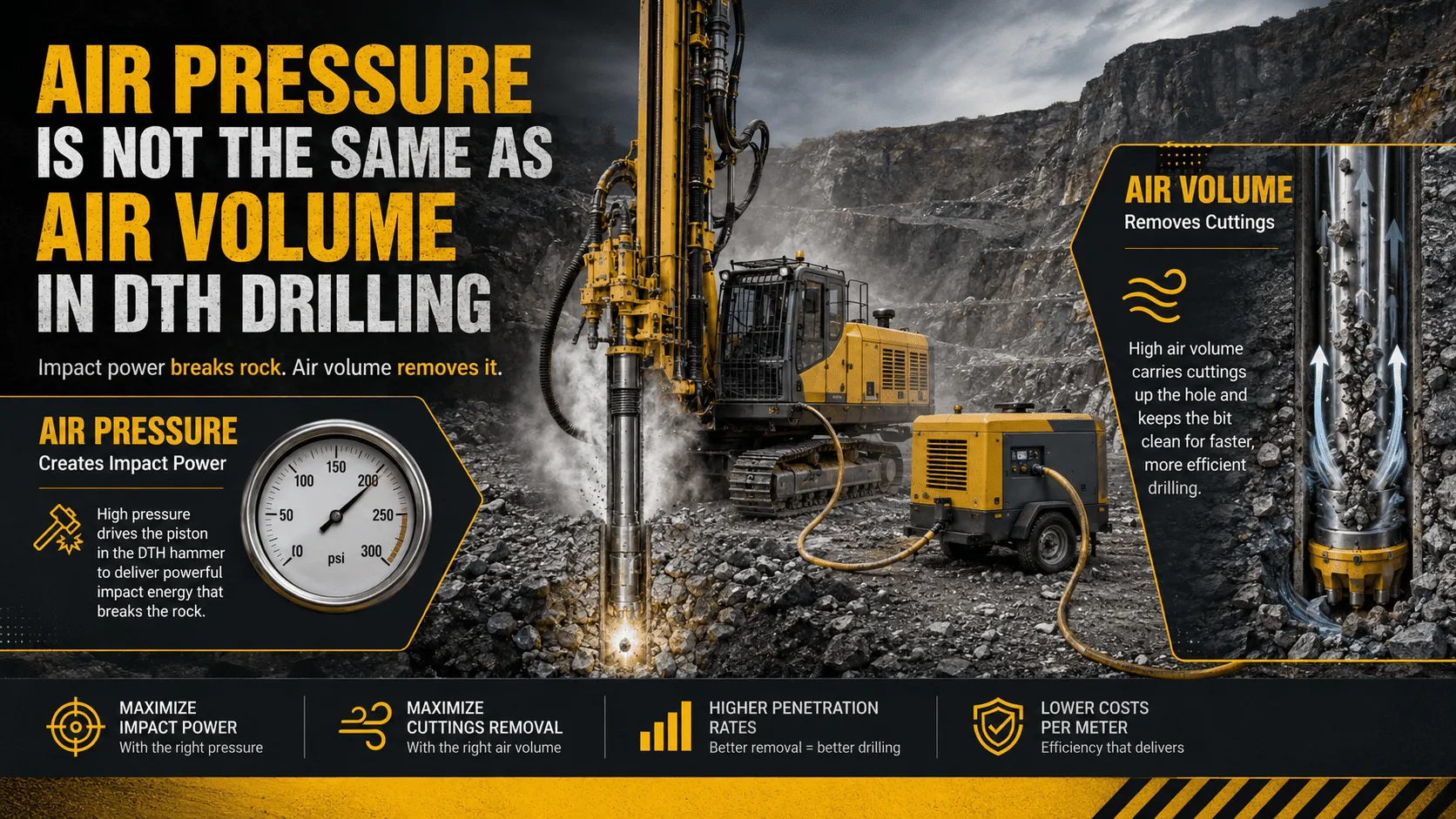
For DTH drilling, the air compressor must provide two things at the same time: enough air pressure and enough air volume. Air pressure helps drive the DTH hammer impact. Air volume helps remove cuttings from the hole.
If buyers only compare air pressure and ignore air volume, the drilling system may still face slow penetration, poor hole cleaning, faster drill bit wear, tool sticking risk, higher fuel consumption, and more downtime. That is why air pressure vs air volume in DTH drilling is one of the most important topics in compressor matching.
Why Air Pressure and Air Volume Are Not the Same
Air pressure and air volume are often discussed together, but they do different jobs in the DTH drilling system. Air pressure is related to force. Air volume is related to flow.
In simple terms, air pressure helps the hammer strike with enough impact energy. Air volume helps carry broken rock chips, dust, and cuttings out of the borehole. Both are necessary for stable DTH drilling performance.
| Air Factor | Main Function | What Happens if It Is Not Enough? |
| Air Pressure | Drives the DTH hammer impact power | Weak impact, slow penetration, poor rock breaking |
| Air Volume | Moves cuttings out of the hole | Poor hole cleaning, tool sticking risk, faster wear |
| Stable Air Supply | Keeps hammer impact and cuttings removal continuous | Unstable drilling speed and higher operating cost |
What Air Pressure Does in DTH Drilling
In DTH drilling, compressed air enters the DTH hammer and drives the internal piston. The piston repeatedly strikes the drill bit, creating impact energy that breaks the rock. This is why air pressure is closely connected with hammer performance.
If the air pressure is too low, the hammer may not strike strongly enough. The drill bit may contact the rock, but the impact energy is weak. This can reduce penetration rate and make the drilling rig work longer to achieve the same depth.
For hard rock quarry drilling, weak air pressure may lead to slow drilling and higher fuel consumption. For deeper water well drilling, insufficient pressure may reduce hammer efficiency and make rock layers more difficult to drill.
What Air Volume Does in DTH Drilling
Air volume is responsible for moving air through the drilling system and carrying cuttings out of the hole. When the drill bit breaks rock, the broken material must leave the borehole quickly. If cuttings remain inside the hole, the bit may re-grind broken rock instead of breaking fresh formation.
This creates extra resistance. The drilling system may still run, but drilling efficiency becomes lower. More energy is wasted, tool wear increases, and the risk of tool sticking becomes higher.
Good air volume helps keep the bottom of the hole cleaner. A cleaner hole allows the drill bit to maintain better contact with fresh rock and improves drilling stability.
| Air Volume Condition | Drilling Result | Project Impact |
| Enough air volume | Cuttings move out smoothly | Cleaner hole and more stable drilling |
| Low air volume | Cuttings remain inside the hole | Slow penetration and higher tool wear |
| Unstable air volume | Hole cleaning becomes inconsistent | Unstable performance and more downtime risk |
Why Pressure Alone Cannot Decide Compressor Selection
Some buyers compare air compressors mainly by pressure. For example, they may ask whether the compressor is 16 bar, 18 bar, 20 bar, or 25 bar. This is useful, but it is not enough to decide whether the compressor fits the project.
A compressor with high pressure but insufficient air volume may drive the hammer, but it may not clean the hole well. A compressor with large air volume but unsuitable pressure may remove cuttings, but the hammer impact may still be weak.
The right compressor must match both the impact requirement and the cuttings removal requirement. This depends on hole diameter, drilling depth, hammer size, drill bit diameter, rock condition, and working environment.
Hole Diameter Affects Air Volume Demand
Hole diameter has a direct effect on air volume demand. Larger holes produce more broken material. More broken material means stronger cuttings removal is needed.
If the hole diameter is large but the air volume is too small, cuttings may not be removed efficiently. This can cause slow penetration, poor hole quality, and higher wear on the drill bit and hammer.
| Hole Diameter | Air Demand Feature | Matching Focus |
| Small hole diameter | Lower cuttings volume | Efficient pressure and stable air flow |
| Medium hole diameter | Balanced pressure and air volume demand | Match compressor with hammer and bit size |
| Large hole diameter | Higher cuttings volume | Requires enough air volume for hole cleaning |
| Special hole requirement | Project-specific air demand | Needs customized compressor and tool matching |
Drilling Depth Changes Air Delivery Requirements
Drilling depth also affects air compressor selection. As the hole becomes deeper, air must travel a longer distance through the drill rods to reach the hammer and then carry cuttings back up to the surface.
In deeper holes, unstable air delivery can reduce hammer performance and weaken cuttings removal. This may cause cuttings accumulation, tool sticking, unstable drilling speed, and higher operating cost.
For deep DTH drilling, buyers should not only ask about maximum rig depth. They should also confirm whether the compressor, hammer, bit, and drill rods can work together at the required depth.
| Depth Condition | Air Supply Challenge | Possible Risk |
| Shallow drilling | Shorter air travel distance | Usually easier to clean, but still needs matching |
| Medium depth drilling | Requires stable air flow and correct tool matching | Unstable performance if compressor is undersized |
| Deep drilling | Longer air path and higher cuttings removal demand | Cuttings buildup, low efficiency, and tool sticking risk |
DTH Hammer Size Changes Pressure and Volume Demand
Different DTH hammer sizes require different air pressure and air volume. A larger hammer may need more air to operate properly. If the compressor cannot meet the hammer demand, the hammer cannot deliver the expected performance.
Choosing a larger hammer without checking compressor capacity can create problems. The hammer may work weakly, drilling speed may drop, and fuel consumption may increase because the system is not working efficiently.
At the same time, choosing a compressor that is much larger than needed may increase purchase cost, fuel cost, transport difficulty, and maintenance cost. The goal is not always to choose the biggest compressor. The goal is to choose the right compressor for the hammer and project.
Rock Condition Also Affects Air Requirement
Rock condition changes both impact demand and cuttings removal difficulty. Hard rock usually needs stronger impact energy. Abrasive rock may increase tool wear. Mixed ground can make drilling resistance and cuttings behavior change during operation.
In hard rock, insufficient pressure may reduce hammer impact. In fractured or mixed ground, insufficient air volume may make hole cleaning unstable. In loose formations, poor cuttings removal may increase blockage or hole stability problems.
| Rock Condition | Pressure Requirement | Air Volume Requirement |
| Soft formation | Moderate impact may be enough | Stable cleaning to avoid blockage |
| Medium-hard rock | Balanced hammer impact | Enough flow for continuous cuttings removal |
| Hard rock | Higher impact demand | Strong cleaning to remove broken chips quickly |
| Abrasive rock | Stable hammer impact | Efficient cleaning to reduce abnormal wear |
| Mixed ground | Flexible impact support | Stable flow under changing formation conditions |
How Wrong Compressor Matching Increases Drilling Cost
Wrong compressor matching does not only affect drilling speed. It can increase the total project cost through fuel consumption, tool wear, downtime, maintenance, and delayed progress.
An undersized compressor may reduce hammer impact and cuttings removal. An oversized compressor may increase fuel consumption and investment cost without improving real output. Both situations can hurt project efficiency.
| Wrong Matching | Possible Site Problem | Cost Impact |
| Pressure too low | Weak hammer impact and slow rock breaking | Longer drilling time and higher fuel cost |
| Air volume too small | Poor hole cleaning and cuttings buildup | Faster tool wear and tool sticking risk |
| Compressor too large | Unnecessary fuel use and higher maintenance | Higher operating cost without equal productivity gain |
| Hammer and compressor mismatch | Hammer cannot work at proper efficiency | Lower penetration rate and more downtime |
| No spare parts plan | Small failures may stop the whole system | Urgent replacement cost and project delay |
Air Pressure and Air Volume in Quarry Drilling
Quarry drilling usually focuses on blasting holes, production speed, hole quality, and drilling cost per meter. In hard rock quarry projects, both impact power and cuttings removal are important.
If pressure is not enough, the hammer may not break rock efficiently. If air volume is not enough, broken rock chips may stay inside the hole and reduce penetration speed. This can affect daily drilling output and blasting preparation.
A practical quarry drilling solution should match the drilling rig, air compressor, DTH hammer, drill bit, drill rods, and wearing parts according to hole diameter, rock hardness, and production target.
Air Pressure and Air Volume in Water Well Drilling
Water well drilling may pass through soil, sand, gravel, limestone, sandstone, and hard rock layers. Because the formation changes, compressor matching must consider both hammer impact and hole cleaning.
When drilling through rock layers, suitable pressure helps the hammer work efficiently. When drilling deeper holes, enough air volume helps carry cuttings out of the borehole. If either one is not matched, the drilling process may become unstable.
A complete water well drilling solution should consider ground layers, depth, hole diameter, compressor capacity, DTH hammer, drill bit, drill rods, and spare parts together.
Air Pressure and Air Volume in Mining and Construction Drilling
Mining and construction drilling projects may include blasting holes, slope support, foundation drilling, anchoring, and engineering drilling. These projects often have different hole diameters, depths, working angles, and rock conditions.
For these applications, compressor matching should not be treated as a separate decision. It should be selected together with drilling method, rig capacity, hammer size, bit diameter, drill rod configuration, and site environment.
For special working conditions, a customized drilling solution can help buyers build a more practical equipment package according to actual project needs.
Common Mistakes Buyers Should Avoid
Many air compressor matching problems come from focusing on one parameter only. The following mistakes are common in DTH drilling equipment selection.
| Common Mistake | Possible Problem | Better Solution |
| Only asking compressor pressure | Ignores air volume and cuttings removal | Check both pressure and air volume |
| Choosing compressor only by price | May not match hammer, depth, or hole diameter | Match compressor with the full drilling system |
| Using one compressor for every job | Different projects need different air demand | Confirm project type, hole size, depth, and rock condition |
| Ignoring drill rod air delivery | Air supply to the hammer becomes unstable | Match rod size and connection quality with depth demand |
| No spare parts preparation | Filters, hoses, tools, or hammer parts may stop the project | Prepare wearing parts according to project intensity |
What Information Should Buyers Provide Before Compressor Matching?
To recommend a suitable air compressor and complete DTH drilling package, buyers should provide clear project information. This helps avoid general recommendations and improves matching accuracy.
- Project type: quarry, mining, water well, construction, foundation, or exploration
- Required hole diameter
- Required drilling depth
- Rock or ground condition
- DTH hammer size if already selected
- Drill bit diameter and shank type if available
- Drill rod size and thread type if available
- Expected drilling method
- Working environment and altitude if relevant
- Diesel or electric power preference
- Expected working hours and project duration
- Spare parts and maintenance requirements
How Welldone Mining Helps Buyers Match Air Compressors
Welldone Mining provides drilling equipment and drilling tools for quarry, mining, water well, construction, and customized drilling projects. We help buyers match air compressors according to real project conditions, not pressure alone.
Our support can include drilling method evaluation, drilling rig selection, air compressor matching, DTH hammer and drill bit configuration, drill rod planning, spare parts preparation, delivery support, and after-sales guidance.
| Welldone Mining Support | How It Helps Buyers |
| Project Requirement Analysis | Confirms hole diameter, depth, rock condition, site environment, and drilling target |
| Air Compressor Matching | Matches air pressure and air volume with hammer, hole size, and depth |
| DTH Hammer Matching | Selects hammer size according to hole diameter, rock hardness, and compressor output |
| Drill Bit Configuration | Matches bit diameter, shank type, face design, and rock condition |
| Drill Rod Planning | Matches rod size, thread type, and quantity for stable air delivery |
| Spare Parts Planning | Prepares filters, hoses, hammer parts, drill bits, rods, adapters, and wearing parts |
| After-Sales Guidance | Supports technical communication, troubleshooting, and maintenance advice |
Conclusion
Air pressure is not the same as air volume in DTH drilling. Pressure helps create hammer impact power. Air volume helps remove cuttings from the hole. Both are necessary for stable drilling performance.
If buyers only compare compressor pressure, they may ignore cuttings removal demand. If they only look at compressor size, they may increase cost without solving the real drilling problem. The better approach is to match pressure, air volume, hammer size, bit diameter, hole diameter, drilling depth, and rock condition together.
The smarter choice is not only buying a compressor with high pressure. The smarter choice is building a complete drilling system that breaks rock efficiently and removes cuttings smoothly.
If you are planning a DTH drilling project, you can share your project type, hole diameter, drilling depth, rock condition, DTH hammer size, drill bit diameter, and expected working hours. Welldone Mining can help you match the suitable drilling rig, air compressor, DTH hammer, drill bit, drill rods, spare parts, and after-sales support for your project.
Website: www.welldonemining.com
Email: info@welldonemining.com