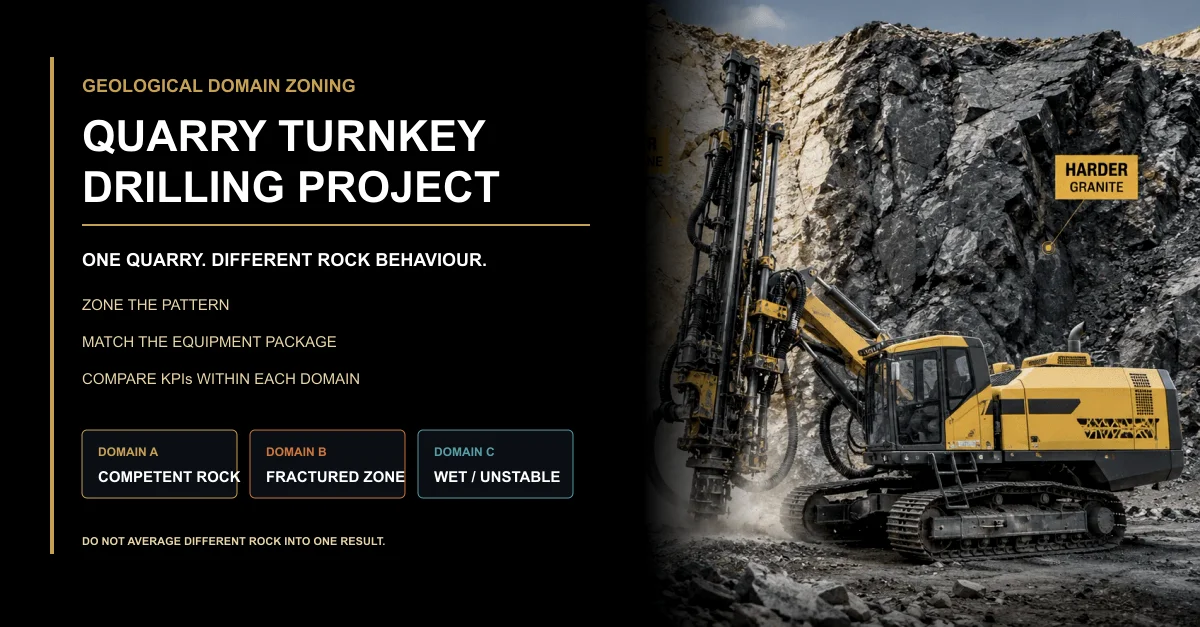
In DTH drilling projects, many buyers first focus on the drilling rig.
They compare drilling depth, engine power, crawler structure, machine weight, and quotation.
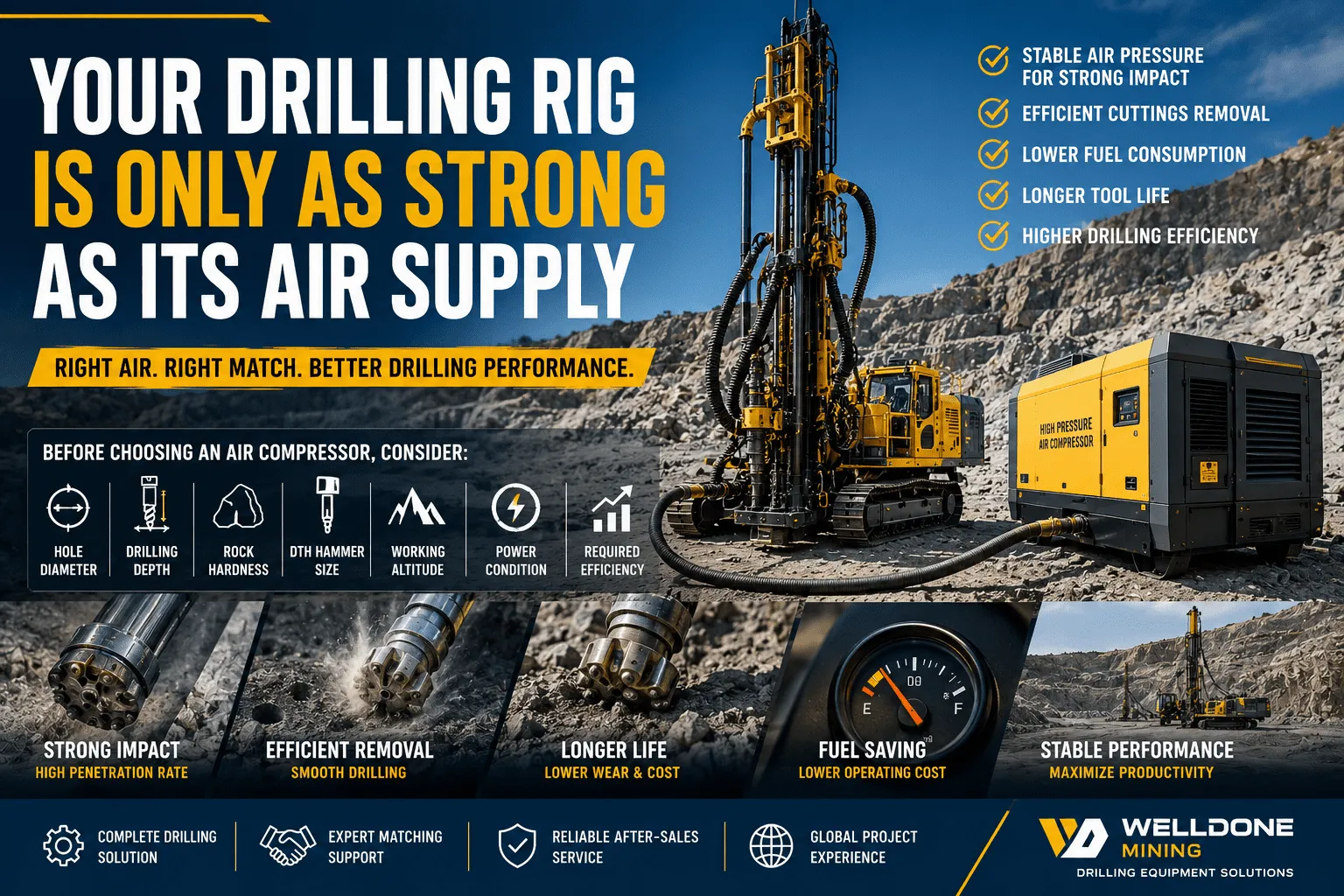
However, in real quarry, mining, water well, and construction drilling operations, the air compressor often decides whether the whole drilling system can work efficiently.
A drilling rig with the wrong air compressor may still face many problems, such as weak hammer impact, slow penetration speed, poor cuttings removal, high fuel consumption, fast tool wear, and unstable drilling performance.
That is why air compressor matching for DTH drilling should not be treated as a small accessory issue.
It is a key part of the complete drilling equipment package.
Why Air Compressor Matching Matters in DTH Drilling
For DTH drilling, compressed air is not only used to support the machine.
It powers the DTH hammer, removes rock cuttings from the hole, cools the drilling tools, and helps keep the drilling process stable.
If the air pressure is too low, the DTH hammer cannot provide enough impact energy.
If the air volume is too small, cuttings may not be discharged smoothly.
If the compressor is too large, the buyer may face unnecessary fuel consumption, higher maintenance cost, and more difficult transportation.
In real drilling projects, the best compressor is not always the biggest one.
The best compressor is the one that matches the drilling rig, DTH hammer, drill bit, hole diameter, drilling depth, rock condition, and site environment.
Main Functions of Air Compressor in a DTH Drilling System
Before choosing an air compressor, buyers should understand what compressed air actually does during drilling.
This helps avoid choosing equipment only by price, size, or general power specifications.
| Compressor Function |
How It Affects Drilling |
Possible Problem if Mismatched |
| Powering DTH Hammer |
Provides impact energy for rock breaking |
Weak hammer impact and low penetration rate |
| Cuttings Removal |
Pushes rock chips and dust out of the hole |
Poor cuttings removal and unstable drilling |
| Tool Cooling |
Helps reduce heat during high-intensity drilling |
Faster tool wear and shorter service life |
| Drilling Stability |
Supports continuous hammer performance |
Unstable operation and lower drilling efficiency |
| Operating Cost Control |
Affects fuel consumption and daily running cost |
Higher fuel cost if compressor capacity is not suitable |
Air Pressure and Air Volume: Two Key Parameters
When selecting an air compressor for DTH drilling, two important parameters must be considered:
air pressure and air volume.
Air pressure affects the impact force of the DTH hammer.
Air volume affects cuttings removal and the ability to keep the hole clean during drilling.
Both are important, and they must be matched together.
| Parameter |
Main Role |
Selection Impact |
| Air Pressure |
Drives the DTH hammer impact |
Affects rock breaking ability and penetration speed |
| Air Volume |
Removes cuttings and supports continuous air flow |
Affects hole cleaning, drilling stability, and depth performance |
| Compressor Type |
Diesel or electric power source |
Affects mobility, operating cost, and site adaptability |
| Working Efficiency |
Stable air output under real site conditions |
Affects fuel use, tool life, and long-term operation |
A common mistake is choosing a compressor only by air pressure.
However, if the air volume is not enough, even high pressure may not deliver stable drilling performance.
Another mistake is choosing a compressor only by size, without checking whether it matches the hammer and hole diameter.
What Happens if the Air Compressor Is Too Small?
An undersized air compressor is one of the most common reasons for poor DTH drilling performance.
The drilling rig may look suitable, but the hammer cannot work efficiently because the air supply is not strong enough.
- Weak DTH hammer impact
- Slow drilling speed
- Poor cuttings removal
- Higher risk of tool sticking
- Faster drill bit and hammer wear
- Longer working hours and higher labor cost
- Unstable performance in deeper holes
For quarry and hard rock drilling projects, this problem becomes more serious because hard rock requires stable impact energy and strong air support.
If the compressor cannot keep up with the hammer demand, the whole drilling system loses efficiency.
What Happens if the Air Compressor Is Too Large?
Some buyers think a bigger compressor is always better.
However, an oversized compressor may also increase project cost if the drilling requirement does not need that capacity.
A compressor that is much larger than necessary may bring higher fuel consumption, higher maintenance cost, more difficult transportation, and unnecessary investment pressure.
| Oversized Compressor Issue |
Possible Result |
Better Selection Idea |
| Higher Fuel Use |
Daily operating cost increases |
Match capacity with actual hammer and hole requirements |
| Higher Purchase Cost |
Initial investment becomes heavier |
Evaluate total project needs before selecting compressor size |
| More Maintenance Pressure |
Service cost may increase over time |
Choose practical capacity for long-term operation |
| Transportation Difficulty |
Remote sites may face moving and access problems |
Consider road condition and project mobility |
Key Factors Before Choosing an Air Compressor
Air compressor selection should follow the real drilling project requirement.
Before choosing a model, buyers should confirm the basic drilling data and site conditions.
| Selection Factor |
What to Confirm |
Why It Matters |
| Hole Diameter |
Required drilling hole size |
Affects hammer size, drill bit size, and air demand |
| Drilling Depth |
Target working depth and stable depth range |
Affects air volume demand and cuttings removal ability |
| Rock Hardness |
Soil, limestone, granite, sandstone, or hard rock |
Affects required hammer impact and compressor pressure |
| DTH Hammer Size |
Hammer model and air consumption |
Compressor must match hammer air demand |
| Working Altitude |
Lowland, mountain area, or high-altitude site |
Air output performance may change with altitude |
| Power Condition |
Diesel preferred or electric power available |
Determines diesel or electric compressor selection |
| Project Duration |
Short-term project or long-term continuous operation |
Affects maintenance plan and spare parts preparation |
Air Compressor Matching for Quarry Drilling
Quarry drilling usually involves hard rock, blasting holes, limestone, granite, and continuous outdoor operation.
In this type of project, air compressor matching directly affects penetration speed and tool life.
For quarry projects, buyers should pay attention to the complete DTH drilling system:
drilling rig, high-pressure air compressor, DTH hammer, drill bit, drill rods, and wearing parts.
A practical quarry drilling solution can help match these parts together according to real rock conditions.
Air Compressor Matching for Water Well Drilling
Water well drilling projects may involve mixed soil, sand, gravel, limestone, or deeper rock layers.
The compressor must support both depth performance and cuttings removal, especially when drilling conditions change during operation.
For water well contractors, the right compressor depends on drilling depth, hole diameter, ground condition, rig capacity, and site mobility.
A complete water well drilling solution should consider rig selection, compressor matching, drilling tools, and spare parts together.
Diesel or Electric Air Compressor: Which One Should You Choose?
Diesel and electric air compressors are suitable for different working conditions.
The choice should depend on power availability, site mobility, operation cost, and maintenance ability.
| Compressor Type |
Suitable Site |
Main Advantage |
| Diesel Screw Air Compressor |
Remote quarry, mining, water well, and outdoor sites |
High mobility and independent power supply |
| Electric Screw Air Compressor |
Sites with stable electricity and fixed working areas |
Lower operating cost and stable long-term use |
| High Pressure Screw Air Compressor |
Hard rock DTH drilling and deeper drilling applications |
Stronger air support for hammer impact and cuttings removal |
Common Mistakes in Air Compressor Selection
Many buyers face drilling problems because the compressor was not selected according to the real drilling requirement.
These mistakes can reduce efficiency and increase long-term cost.
- Choosing the air compressor only by price
- Ignoring hole diameter and DTH hammer air demand
- Using low air volume for deeper drilling projects
- Choosing oversized compressor without cost calculation
- Not considering altitude and site environment
- Ignoring diesel or electric power conditions
- Buying drilling rig and compressor separately without matching support
- Not preparing filters, lubricants, and common maintenance parts
Why Compressor, Rig, and DTH Tools Should Be Selected Together
The air compressor should not be selected separately from the drilling rig and DTH tools.
These parts work as one complete drilling system.
If one part is mismatched, the whole project may face performance problems.
The drilling rig provides mobility, feed force, and rotation.
The air compressor provides hammer power and cuttings removal.
The DTH hammer transfers impact energy.
The drill bit breaks the rock.
The drill rods transfer torque and air.
As I see it, real drilling performance does not come from one machine alone.
It comes from the correct matching of the complete drilling equipment package.
How Welldone Mining Helps Match Air Compressors for Drilling Projects
Welldone Mining provides drilling equipment solutions for quarry, mining, water well, construction, and customized drilling projects.
Instead of only recommending one machine, we help buyers match the complete system according to real project conditions.
Our support can include drilling rig selection, air compressor matching, DTH hammer and drill bit configuration, drill rod planning, spare parts preparation, delivery support, and after-sales guidance.
| Welldone Mining Support |
How It Helps Buyers |
| Project Requirement Analysis |
Confirms hole diameter, drilling depth, rock condition, and site environment |
| Compressor Matching |
Matches air pressure and air volume with DTH hammer and drilling demand |
| Complete Equipment Package |
Matches drilling rig, compressor, DTH tools, drill rods, and spare parts together |
| Cost Control Support |
Helps avoid undersized, oversized, or mismatched compressor selection |
| Spare Parts Planning |
Supports long-term operation with maintenance and wearing parts preparation |
| After-Sales Guidance |
Supports technical communication, troubleshooting, and maintenance advice |
What Information Should Buyers Provide?
To recommend a suitable air compressor and drilling equipment package, buyers should provide clear project information.
This helps avoid general recommendations and improves matching accuracy.
- Project type: quarry, mining, water well, construction, or exploration
- Required hole diameter
- Required drilling depth
- Rock or ground condition
- DTH hammer size or expected drilling method
- Site location and altitude if available
- Power condition: diesel preferred or electric power available
- Expected working hours and project duration
Conclusion
Your drilling rig is only as strong as its air supply.
For DTH drilling projects, the air compressor affects hammer impact, cuttings removal, drilling speed, fuel consumption, tool life, and long-term operating cost.
For quarry drilling, the right compressor can support stronger hard rock penetration.
For water well drilling, it can improve depth performance and cuttings removal.
For customized projects, the compressor should be matched with the drilling rig, DTH hammer, drill bit, drill rods, and real site conditions.
The smartest choice is not always the biggest compressor or the lowest-priced compressor.
The better choice is the compressor that matches your actual drilling project.
If you are planning a drilling project, you can share your project type, hole diameter, drilling depth, rock condition, site location, power condition, and expected drilling efficiency.
Welldone Mining can help you match the suitable drilling rig, air compressor, DTH hammer, drill bit, drill rods, spare parts, and after-sales support for your project.
Website: www.welldonemining.com
Email: info@welldonemining.com