Many buyers start their drilling equipment search with one simple question:
How much is the drilling rig?
Price is important, especially for contractors, quarry operators, mining companies, and water well drilling teams that need to control project investment.
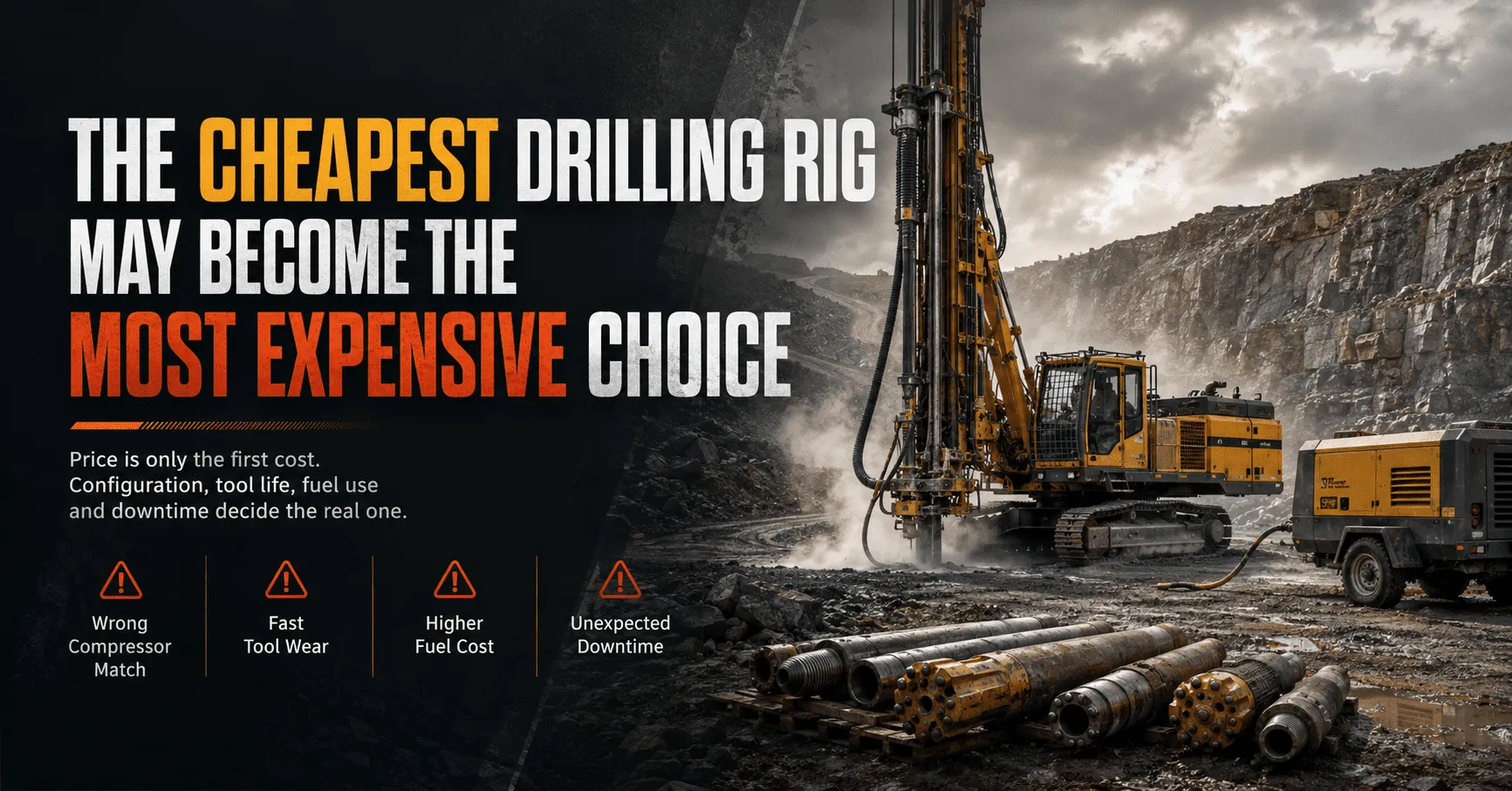
However, the cheapest drilling rig may not always be the most economical choice.
In real drilling projects, the purchase price is only the first cost.
The real cost appears during operation, including fuel consumption, tool wear, drilling speed, downtime, maintenance, spare parts, and after-sales support.
Actually, many expensive project problems do not come from the machine price itself.
They come from wrong equipment matching at the beginning.
If the drilling rig, air compressor, DTH hammer, drill bit, drill rods, and site conditions are not matched correctly, a low-cost machine may become a high-cost decision.
Why the Lowest Price Can Be Risky in Drilling Projects
Drilling projects are different from simple equipment purchases.
A drilling rig must work together with the air compressor, drilling tools, spare parts, and real job site conditions.
If one part is not suitable, the whole drilling system may lose efficiency.
For example, a low-priced rig may look attractive in the quotation stage.
But if the compressor is too small, the DTH hammer cannot provide stable impact power.
If the drill bit does not match the rock condition, tool wear may increase quickly.
If spare parts are not prepared, a small component can stop the whole project.
More importantly, downtime in quarry, mining, and water well projects can cost far more than the price difference between two drilling rigs.
Purchase Price vs. Real Project Cost
When comparing drilling rigs, buyers should not only look at the machine price.
They should evaluate the total cost of ownership, including operation, maintenance, drilling tools, spare parts, and project efficiency.
| Cost Factor |
What Buyers Often See |
What Actually Affects Project Cost |
| Machine Price |
Initial quotation and payment amount |
Only the first part of the total project cost |
| Fuel Consumption |
Often ignored during quotation comparison |
Affects daily operating cost and long-term profit |
| Drilling Speed |
Not always clear from basic specifications |
Determines working hours, project progress, and labor cost |
| Tool Wear |
Usually treated as accessory cost |
Can become a major long-term operating expense |
| Downtime |
Often not calculated before purchase |
Can delay projects and increase hidden losses |
| After-Sales Support |
Sometimes ignored if the price is low |
Affects troubleshooting, spare parts, and operation stability |
Where Hidden Costs Usually Come From
A cheap drilling rig may become expensive when the equipment package is not designed around the real project.
These hidden costs often appear after the machine starts working on site.
Wrong Air Compressor Matching
For DTH drilling, the air compressor directly affects hammer impact, cuttings removal, drilling speed, and fuel consumption.
If the compressor is too small, the hammer may work weakly.
If the compressor is too large, the buyer may pay more for fuel and maintenance than necessary.
Fast Drill Bit and DTH Hammer Wear
Drill bits and DTH hammers are not simple accessories.
They directly contact the rock and affect penetration rate.
If the tools are not matched with rock hardness, hole diameter, and air pressure, replacement cost may increase quickly.
Low Drilling Efficiency
A machine with a lower price may not have the right configuration for the required project.
Slow drilling means longer working hours, higher labor cost, higher fuel cost, and slower project delivery.
Unexpected Downtime
Downtime is one of the most expensive problems in drilling projects.
It may come from spare parts shortage, wrong tool matching, compressor issues, or weak after-sales support.
How a Cheap Rig Can Increase Total Cost
| Low-Price Decision |
Possible Site Problem |
Long-Term Cost Impact |
| Choose rig only by low price |
Machine may not match real drilling depth or rock condition |
Lower efficiency and higher operation pressure |
| Use undersized air compressor |
DTH hammer impact becomes weak |
Slower drilling speed and longer working hours |
| Buy low-cost drill bits |
Fast wear in hard or abrasive rock |
Frequent replacement and higher tool cost |
| Ignore spare parts package |
Small parts stop the whole project |
Downtime, delayed work, and urgent replacement cost |
| Ignore supplier matching support |
Rig, compressor, and tools may not work as a system |
Difficult troubleshooting and unstable performance |
Different Projects Need Different Cost Judgement
Not every drilling project should use the same equipment configuration.
Buyers should evaluate cost according to the application, not only according to the machine price.
Quarry and Hard Rock Drilling
For quarry drilling, limestone drilling, granite drilling, and open-pit mining projects, drilling efficiency and tool durability are critical.
A cheaper machine may cost more if it cannot maintain stable performance in hard rock.
For this type of project, buyers should pay attention to the complete system:
drilling rig, high-pressure air compressor, DTH hammer, drill bit, drill rods, and wearing parts.
A practical quarry drilling solution can help reduce wrong configuration risk.
Water Well Drilling
For water well drilling, buyers should not only compare the drilling rig price.
They should consider drilling depth, ground layers, mobility, compressor matching, and maintenance ability in local markets.
A low-priced water well drilling rig may become costly if it cannot handle mixed soil, gravel, limestone, or deeper drilling requirements.
A complete water well drilling solution should be selected according to real ground conditions.
Customized Drilling Projects
Some drilling projects have special site conditions, limited working space, remote locations, or mixed applications.
In these cases, choosing only by price can be risky because a standard product recommendation may not solve the real problem.
In most cases, customized projects need a complete drilling system built around site conditions, not only a low-cost machine.
What Buyers Should Compare Before Choosing a Drilling Rig
Instead of asking only for the lowest price, buyers should compare several key factors.
This helps evaluate whether the drilling equipment can support stable long-term operation.
| What to Compare |
Key Question |
Why It Matters |
| Project Matching |
Does the equipment match the project type? |
Different applications require different configurations |
| Hole Diameter and Depth |
Can the rig work efficiently under the required range? |
Affects rig model, compressor, hammer, bit, and rods |
| Rock Condition |
Is the machine suitable for the ground or rock formation? |
Affects drilling method, tool wear, and operating cost |
| Compressor Matching |
Is the air pressure and air volume suitable? |
Directly affects DTH hammer performance and slag removal |
| Tool Package |
Are the DTH hammer, bits, and rods properly matched? |
Affects penetration rate, tool life, and replacement cost |
| Spare Parts Support |
Are wearing parts prepared before operation? |
Reduces downtime and urgent maintenance pressure |
| Supplier Experience |
Can the supplier support equipment configuration? |
Helps avoid wrong selection before delivery |
Why Complete Equipment Matching Saves More Than a Cheap Price
A suitable drilling equipment package may not always be the lowest quotation, but it can help buyers reduce long-term operating risk.
The right combination can improve drilling speed, reduce tool wear, lower downtime, and make maintenance easier.
- Match the drilling rig with real hole diameter and depth
- Choose the air compressor according to DTH hammer and rock condition
- Select drill bits based on rock hardness and abrasiveness
- Prepare drill rods according to depth and working intensity
- Plan spare parts according to project duration
- Use supplier experience to avoid wrong configuration
A complete customized drilling solution helps buyers evaluate equipment as a system instead of comparing single machine prices.
How Welldone Mining Helps Buyers Control Real Project Cost
Welldone Mining provides drilling equipment solutions for quarry, mining, water well, construction, and customized drilling projects.
We do not only focus on selling one machine.
We help buyers match the complete drilling system according to real site requirements.
Our support can include drilling rig selection, air compressor matching, DTH hammer and drill bit configuration, drill rod planning, spare parts preparation, delivery support, and after-sales guidance.
| Welldone Mining Support |
How It Helps Buyers |
| Project Condition Analysis |
Helps understand application, hole diameter, drilling depth, and rock condition |
| Equipment Matching |
Matches drilling rig, compressor, DTH tools, drill rods, and spare parts together |
| Cost-Oriented Configuration |
Helps buyers avoid oversized, undersized, or mismatched equipment |
| Spare Parts Planning |
Reduces downtime and supports long-term operation |
| After-Sales Support |
Supports technical communication, troubleshooting, and maintenance advice |
| Export Project Experience |
Helps overseas buyers prepare equipment packages more efficiently |
What Information Should Buyers Provide?
To avoid choosing equipment only by price, buyers should provide complete project details before asking for a recommendation.
This helps build a practical configuration and reduces the risk of wrong selection.
- Project type: quarry, mining, water well, construction, or exploration
- Required hole diameter
- Required drilling depth
- Rock or ground condition
- Site location and terrain
- Power condition: diesel preferred or electric power available
- Expected working hours and project duration
- Spare parts and maintenance requirements
Conclusion
The cheapest drilling rig may become the most expensive choice if it causes slow drilling, fast tool wear, high fuel consumption, unexpected downtime, or difficult maintenance.
For real drilling projects, buyers should look beyond the initial purchase price and evaluate the complete equipment system.
For quarry projects, the key is hard rock efficiency and tool durability.
For water well projects, the key is depth capacity and ground adaptability.
For customized projects, the key is matching the equipment package with real site conditions.
As I see it, the smarter choice is not always the cheapest quotation.
The smarter choice is the drilling solution that can work reliably, reduce hidden costs, and support long-term project operation.
If you are planning a drilling project, you can share your project type, hole diameter, drilling depth, rock condition, site location, power condition, and project duration.
Welldone Mining can help you match the suitable drilling rig, air compressor, DTH hammer, drill bit, drill rods, spare parts, and after-sales support for your project.
Website: www.welldonemining.com
Email: info@welldonemining.com