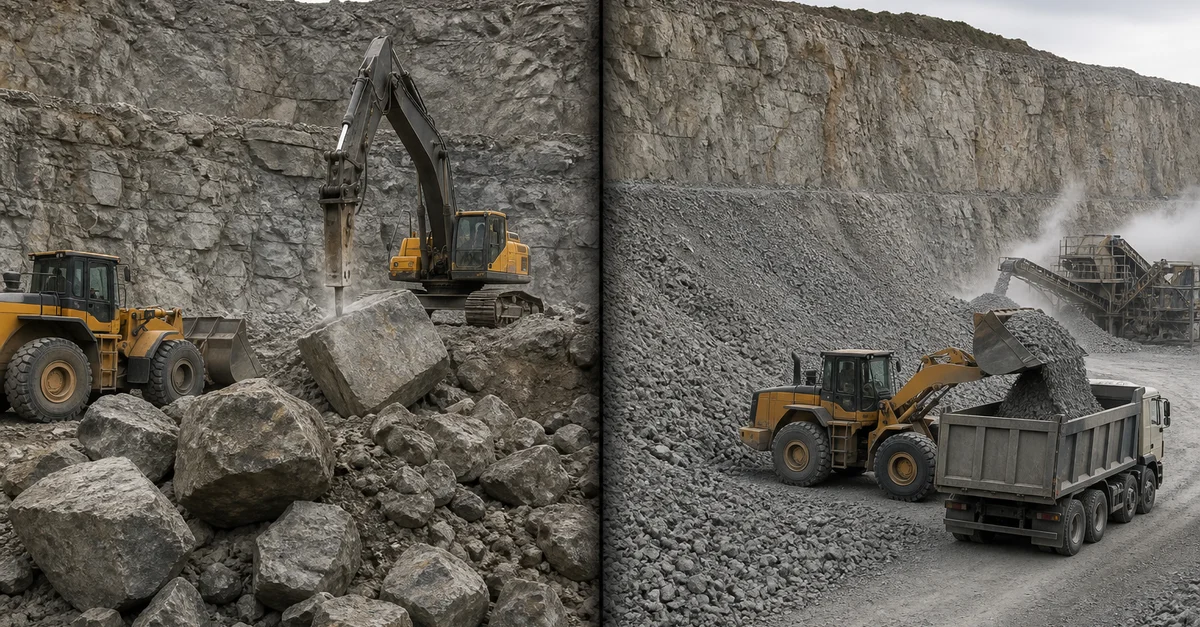
Quarry Blast Efficiency: Judge the Muckpile, Not the Noise
A blast that shakes the office windows and heaves the bench ten metres looks like a success. Then the loader spends the morning picking at oversized boulders, the breaker has to be called in, and the crusher idles waiting for rock it can actually swallow. This article is about the difference between a blast that feels good and a blast that is cheap per tonne — and the few numbers that separate the two.
Two Ways to Judge a Blast
On most quarry benches, a blast is judged the moment the dust clears, by two things: how loud it was, and how far the rock moved. A big report and a big heave read as money well spent. Neither of them is a measure of efficiency, and neither appears anywhere in the cost per tonne.
The loud blast and the big heave are outputs of energy, and energy is exactly what the quarry pays for in powder. What the quarry is actually buying with that powder is not noise or movement — it is fragmentation: a muckpile broken small enough that the loader can feed it and the crusher can take it, in one pass, without a breaker. Judge a blast by anything else and you are rewarding the detonation for the wrong job.
Efficiency has a definition here, and it is not technical jargon. An efficient blast is the one that produces the cheapest tonne of rock at the crusher's feed point, counting the cost of the powder, the drilling, the loading, and the secondary breakage of anything too big to feed. The blast itself is only the middle step. The metric has to reach past it.
Powder Factor: The Number Everyone Quotes and Few Read
Powder factor is the amount of explosive used per unit of rock broken, usually expressed in kilograms of explosive per cubic metre, or per tonne. It is the most quoted number in blasting, and it is routinely misread in one specific way: the quarry treats a lower powder factor as automatically better, because it means less powder per cubic metre.
That logic stops at the blast. Powder factor only describes the input — how much explosive went in — and says nothing about whether the output was loadable. A blast can use a very lean powder factor and still be the most expensive shot of the month, if the rock comes out in boulders that need an hour of breaker work and a second pass by the loader. A slightly higher powder factor that buys uniform fragmentation is usually the cheaper blast overall, because the savings happen downstream, in the loading and crushing that the blast was supposed to make easy.
The correct reading of powder factor is always against fragmentation. The two belong on the same line of the report, because a powder factor is only efficient or wasteful in relation to what it produced. Split the two and the number becomes a vanity metric — quoted to look frugal, while the oversize tax quietly collects behind it.
Fragmentation: The Output Nobody Sieves
The quarry's real product from a blast is a size distribution, not a pile. The number that matters is how much of the muckpile is already small enough to feed the crusher without further breaking, and how much is oversize. A common shorthand is the P80 — the size at which 80 percent of the rock passes — but the line that actually costs money is the oversize fraction, the boulders too big for the crusher's jaw or grizzly.
Almost no quarry measures this routinely. The reasoning is that fragmentation is hard to assess by eye, which is true, and that therefore it cannot be assessed at all, which is false. A muckpile photograph taken from a consistent spot after every blast, compared against a simple size-reference grid, will tell you more about blast performance over six months than any number of window-rattling reports. Sieving a sample is better still, but the photograph alone will catch the trend — and the trend is what the budget feels.
My view is that fragmentation is the single most under-measured output in quarrying, precisely because it is the one that converts directly into loader hours and crusher feed. A quarry that tracks oversize percentage after every blast, even crudely, will make better blasting decisions than one that tracks only powder factor and noise.
The Oversize Tax
Oversize rock is a tax, and like most taxes it is collected quietly and repeatedly. When a blast leaves boulders too big for the crusher, every one of them has to be handled twice — first by a breaker or a secondary shot, then again by the loader. Each handling step is a machine hour and a diesel burn that the blast was supposed to make unnecessary.
The cost is not just the breaker. Oversize stalls the loading rhythm, and loading rhythm is what feeds the crusher. When the loader has to stop and wait while a boulder is broken, the feed belt thins, and the crusher — the machine the whole operation exists to feed — idles. The chain from a badly fragmented blast to an idle crusher is the exact mechanism described in our drill-blast-load cycle guide, and it starts at the same oversize fraction that the powder-factor report does not show.
Toe: The Leak at the Bottom of the Bench
There is a specific failure that shows up at the bottom of every poor blast, and it has a name: toe. Toe is the ridge of unbroken rock left at the base of the bench face, where the burden was too great or the holes too shallow or the sub-drill too little for the rock at the bottom. It looks like a small detail from a distance; it is not.
Toe is the most expensive rock on the bench, because it cannot be loaded at all until it is broken, and breaking it means drilling and shooting again in the least convenient place — at the foot of a face, on uneven ground, for a small volume. Toe also leaves the next bench's floor uneven, which tilts the next row of holes and carries the error forward. A blast that leaves toe is not finished; it has simply deferred part of its cost to a slower, more awkward operation. The burden and sub-drill decisions that prevent toe are part of the blast hole pattern design, and the toe itself is the pattern's report card.
Flyrock and Vibration: The Metrics That Protect the Licence
Two blast outputs matter for reasons that have nothing to do with cost per tonne and everything to do with whether the quarry is allowed to keep blasting. Flyrock and ground vibration are the metrics the neighbours and the regulator feel, and they are the ones that get a site shut down.
Flyrock is usually a stiffness problem — a bench too low, or a burden too small, or a hole that deviated toward the face — that lets the blast throw material beyond the exclusion zone. Vibration is a charge-per-delay problem, with air overpressure and ground movement travelling well past the boundary. Neither is cosmetic. A single flyrock incident can stop blasting for weeks, and weeks without blasting is weeks without muck, which is weeks the crusher cannot make up.
The point of measuring these is not engineering pride; it is protecting the licence to operate. An efficient blast is one the quarry is allowed to repeat next week. The blast that fractures rock beautifully but throws a boulder over the boundary has failed its job as completely as one that left the bench unbroken.
Two Blast Designs: A Worked Comparison
Illustrative example only. The figures are assumed to show the shape of the trade-off — replace them with your own powder costs, loader rates, and measured fragmentation before using the result.
| Metric |
Design A — lean powder |
Design B — higher powder |
| Powder factor |
0.28 kg/m³ |
0.42 kg/m³ |
| Explosive cost per m³ |
Lower — looks frugal on paper |
Higher — looks wasteful on paper |
| Oversize share of muckpile |
~18% needs secondary breaking |
~4% needs secondary breaking |
| Breaker hours per blast |
High — boulders handled twice |
Low — muckpile loads in one pass |
| Loader feed to crusher |
Interrupted — idles waiting on breaker |
Continuous — crusher stays fed |
| True cost per tonne at the crusher |
Higher once breakage and idle are counted |
Lower once breakage and idle are counted |
Read the bottom row. The lean powder factor won the line that the quarry watched, and lost the line that actually mattered — the cost per tonne at the point where the rock becomes product. The extra powder in Design B bought fragmentation that eliminated the breaker hours and kept the loader moving, and the blast's modest extra cost was paid back several times over before the muckpile was gone. This is why the powder factor and the fragmentation have to be read on the same line.
The cost lines behind each side of that table — powder, drilling, loading, and the breakage that sits between them — are set out in our drilling and blasting cost structure guide.
Building an Evaluation You Can Repeat
A blast efficiency standard is only worth having if it is simple enough to be applied after every shot, by the people on the bench, not just by a consultant once a year. Four checks, every blast, give you a trend within a season.
- Photograph the muckpile from a fixed point. Same spot, same angle, after every shot. Against a reference grid, the oversize fraction becomes visible over time, and a bad trend shows up long before the budget feels it.
- Record powder factor and oversize on the same line. Never report one without the other. Powder factor without fragmentation is a vanity metric; fragmentation without powder factor is an anecdote.
- Check the toe. Walk the face after loading and look for the ridge at the base. Toe is the pattern's report card, and it tells you whether the sub-drill and burden were right before you spend the next blast's powder.
- Log any flyrock or vibration complaint. These are not blast metrics so much as licence metrics. A quiet quarter of complaints is the most valuable efficiency number the quarry owns, because it is the one that keeps the whole operation running.
None of these needs a specialist or a laboratory. Together they convert a blast from a loud one-off event into a measured, repeatable process — and the process is where the cost per tonne actually improves.
Why Welldone Mining
Welldone Mining supplies the drilling side of the blast, and we treat the blast result as the specification's own report card. A blast that leaves oversize or toe is not a blasting failure in isolation; it is usually the pattern and the hole quality upstream that failed, and those are the parts we control.
What a quarry operator gets:
- Holes that hold the design. A blast design only works if the holes are where the plan put them, at the depth and angle specified. Hole deviation is the silent killer of fragmentation, and the rig setup that keeps holes straight is part of what we specify.
- Pattern and equipment matched to the rock. Burden, spacing, and sub-drill are sized against the site's drillability, so the powder factor buys fragmentation rather than noise. The rate and rock assumptions behind that sizing are in our penetration rate forecast guide.
- A complete picture, not a rig in isolation. Because the blast's efficiency is decided from the first hole to the crusher feed, the drilling package is specified against the blast design and the loading plan, not sold as a standalone machine.
Related Solutions
Conclusion
A blast is judged by the pile it leaves, not the noise it makes. The report that shakes the windows and the heave that moves the bench are the energy leaving the site; the fragmentation, the toe, and the oversize fraction are what that energy actually bought. Reward the wrong one and the quarry pays twice — once for the powder, and again for the breaker and the idle crusher that a better blast would have made unnecessary.
Put powder factor and fragmentation on the same line, photograph the muckpile every shot, and check the toe before the next hole is drilled. The standard is not complicated. It is just a habit of looking at the one output that turns a blast into cheap tonnes instead of a loud afternoon.
One question for your own bench: when the dust cleared from the last shot, did anyone walk the muckpile and count the boulders the loader would have to wait on — or did the office just note that the windows rattled and mark the blast a success?
Website: www.welldonemining.com
Email: info@welldonemining.com
Frequently Asked Questions
What is a good powder factor for quarry blasting?
There is no universal number, because the right powder factor depends on the rock, the hole diameter, the bench height, and the fragmentation the crusher needs. Typical quarry values fall across a range that shifts with the rock's strength and the burden — but the important point is that a powder factor is only good or bad when read against the fragmentation it produced. A low powder factor that leaves oversize is usually more expensive overall than a higher one that breaks the rock small enough to load in one pass.
How do I measure blast fragmentation without a laboratory?
Start with a fixed-point photograph of every muckpile, taken from the same spot and angle after every shot, and compare it against a simple size-reference grid or a known object in frame. This will show the oversize trend clearly within a season. Sieving a sample gives you a more precise distribution, but the photograph alone is enough to catch a blast pattern drifting bad before it shows up on the budget.
Why do I keep getting toe at the bottom of my bench?
Toe is usually a pattern problem: too much burden at the base, holes not drilled deep enough (insufficient sub-drill), or holes that deviated away from the face so the bottom charge is not where the rock is hardest. Because toe is expensive to re-break and tilts the next bench's floor, it should be treated as the pattern's report card — walk the face after every shot and adjust the sub-drill and burden before the next one.
Is a louder blast with a bigger heave more efficient?
No. Noise and heave are the visible release of the blast's energy, not a measure of what the energy achieved. The quarry is buying fragmentation — rock broken small enough to feed the crusher in one pass. A blast can be loud, throw rock far, and still leave oversize boulders and toe that cost more in breaker hours and idle loading than the blast ever saved. Judge the muckpile, not the report.
Can Welldone Mining help me improve blast efficiency through the drilling side?
Yes. The blast result is largely decided before the first hole is fired, by pattern, burden, sub-drill, and hole straightness. Send your bench heights, rock strength and quartz content, hole diameter, and current fragmentation problems to info@welldonemining.com. We return a drilling specification matched to your blast design — burden, spacing, and a rig setup that holds hole deviation — so the powder you spend buys fragmentation instead of oversize and toe.