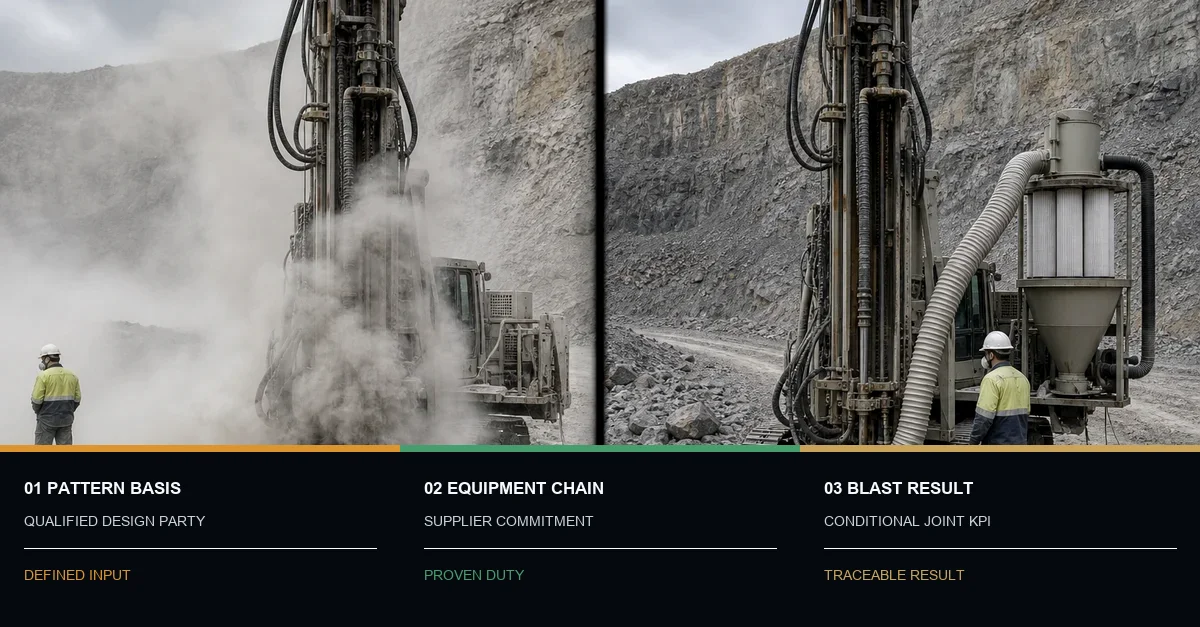
Quarry Crusher-to-Hole Root-Cause Audit: Pattern, Equipment, and Blast Efficiency
When crusher feed becomes unstable, the first reaction is often to blame the blast or buy more drilling capacity. A better investigation starts with the downstream symptom, preserves the blast-batch identity, and traces the evidence backward through the muckpile, as-drilled pattern, and connected equipment chain.
Table of Contents
The Crusher Shift That Started an Argument
The drilling shift finished every planned hole. The blast cleared. Two hours later, the loader operator was picking around boulders while the crusher stopped for manual intervention.
The drill crew pointed to completed metres. The blasting team pointed to its approved records. Maintenance checked the crusher. Each team had evidence that its own task was complete, but nobody could connect the affected feed back to individual rows of holes.
The quarry had data. It did not have traceability.
The real question is not which department should be blamed first. It is which upstream condition could realistically create the exact downstream symptom observed in that batch.
Why the Audit Must Run Backward
A forward review starts with the rig and asks whether it drilled. A backward review starts with the production loss and asks what evidence would confirm or eliminate each possible cause.
That change in direction matters. A crusher blockage, a starving feed bin, a hard floor, and slow bucket fill do not point to the same problem. They create different diagnostic paths.
A common mistake is to adjust pattern, tooling, compressor settings, and blast practice together. The next batch may improve, but the quarry still cannot explain why.
Observed Symptom
First Evidence to Preserve
Upstream Questions
Do Not Assume
Crusher blockage or manual intervention
Batch identity, feed photos, interruption time, and rejected rock
Is oversize concentrated by location, row, geological zone, or loading sequence?
Every large fragment came from a wide pattern or weak drilling
Crusher starvation
Feed gaps, truck arrivals, loader wait, muckpile access, and blast schedule
Was usable rock unavailable, inaccessible, mixed, or simply delivered too late?
Another drilling rig will solve a cycle-balancing problem
Hard floor or toe
Affected bench location, excavation resistance, remaining profile, and hole IDs
Were depth, inclination, deviation, design assumptions, and regulated blast inputs within range?
The nominal hole depth proves the bottom geometry was correct
Slow bucket fill or difficult digging
Loader position, digging direction, muckpile profile , bucket fill, and delays
Is the pile tight, poorly cast, excessively coarse, or constrained by access?
Fragment size alone explains loading performance
Classify the Downstream Symptom Before Changing Anything
The audit begins by separating three kinds of loss: material-size loss, material-position loss, and timing loss. They may occur together, but each requires different evidence.
Material-size loss includes oversize and excessive fines. Material-position loss includes toe, tight digging, poor heave, or an inaccessible pile. Timing loss includes gaps between drill, blast, load, haul, and crush activities.
This classification prevents the most expensive diagnostic error: treating every poor crusher shift as a fragmentation problem.
Loss Family
Typical Site Signal
Evidence Owner
Likely Next Check
Material size
Oversize handling, bridging, fines, or inconsistent feed
Loading and crushing teams, linked to blast batch
Distribution by location, as-drilled geometry, geology, and regulated blast record
Material position
Toe, high face, poor throw, tight pile, or difficult access
Survey, loading, drilling, and qualified blasting teams
Floor profile, depth, inclination, deviation, free-face condition, and blast design assumptions
Timing
Crusher starvation despite acceptable rock quality
Production planning, dispatch, drilling, blasting, loading, and haulage
Buffer inventory, cycle timing, equipment availability, and access constraints
Blast Efficiency: Preserve Evidence at the Muckpile
The blast result must be captured before the pile is blended, moved, or partially crushed. Once material from different zones is mixed, the quarry loses the connection between the symptom and its possible cause.
Record the blast identity, location, visible toe, coarse zones, fines zones, pile shape, loading resistance, oversize handling, and crusher interruptions. The measurement method must remain consistent between batches.
More importantly, a KPI should answer an operating question. “Fragmentation improved” is weak. “Manual oversize handling fell in the same measured area while floor cleanup and crusher interruptions did not worsen” is decision-grade evidence.
The verified article on quarry blast efficiency evaluation covers fragmentation, oversize, toe, muckpile condition, compliance-related evidence, and repeatable comparisons.
Blast Evidence
Record at the Site
Diagnostic Value
Common Contamination
Coarse-rock location
Face zone, row direction, elevation, pile edge, and linked hole group
Tests whether the problem is local, geological, geometric, or distributed
Mixed stockpiles or loader relocation before documentation
Toe and floor
Remaining profile, excavation resistance, cleanup effort, and survey reference
Directs attention to bottom-hole delivery, design assumptions, geology, and regulated inputs
Floor cleanup completed before the affected area is mapped
Muckpile response
Pile shape, access, digging direction, bucket fill, and equipment waiting
Separates size problems from position and accessibility problems
Different loader, operator, route, or digging strategy
Crusher response
Feed restrictions, bridging, stops, manual intervention, and corresponding batch
Shows whether the blast result created a downstream production constraint
Crusher condition, feeder setup, and blended material from other sources
Hole Pattern: Compare Design With As-Drilled Geometry
A designed grid does not prove that the rock received that geometry. The investigation needs both the approved pattern and the as-drilled record.
Compare collar position, actual depth, inclination, deviation evidence where required, replacement holes, blocked holes, and geological observations. Then map the exceptions against the downstream symptom.
If oversize clusters beside holes with recorded deviation or shallow delivery, drilling is a credible hypothesis. If the holes were within the agreed tolerance, attention moves toward design assumptions, geology, regulated blast inputs, or downstream handling.
The quarry blast hole pattern design guide explains the relationship among burden, spacing, subdrill, stemming, deviation, air demand, and the equipment package. Site-specific blast design must remain with qualified professionals.
Pattern Evidence
Question
Possible Finding
Next Action
Collar map
Were holes set out and drilled at the intended locations?
Local burden or spacing changed in the affected zone
Verify survey control, setup access, and exception handling before changing the full pattern
Depth and floor reference
Did actual depth correspond to the intended bottom geometry?
Shallow, blocked, collapsed, or uncertain holes align with toe
Confirm measurement, drilling condition, and approved corrective response
Inclination and deviation
Did the hole path preserve the intended spacing at depth?
Surface collars look correct while bottom spacing changes
Review setup, mast alignment, tooling, ground response, and measurement validity
Replacement and abandoned holes
Can every change be traced to the final blast layout?
The actual geometry differs from the drawing without a controlled record
Reconstruct the as-drilled map before drawing a cause conclusion
Equipment List: Test the Whole Drilling Chain
The rig is only one part of the drilling evidence. Air supply, hammer, bit, rods, adapters, hoses, lubrication, dust control, setup method, wear condition, measuring tools, maintenance, and operator practice can all change hole delivery.
A weak air path may slow cleaning and destabilize drilling. Worn or unsuitable tooling may change penetration behaviour and hole control. A mast setup problem may create a directional error even when the machine remains productive.
Treating completed metres as proof that the equipment chain was correct confuses output with evidence. Productivity tells the quarry that holes were made. It does not prove geometry, cleanliness, or consistency.
Welldone Mining’s verified customized drilling solution describes the rig, compressor, bits, rods, hammers, accessories, spares, and support as a connected system matched to depth, diameter, formation, air demand, and site conditions.
Equipment Chain Check
Evidence
Failure Signature
Diagnostic Decision
Rig setup and feed system
Setup condition, mast reference, operating record, and visible movement
Directional inconsistency, unstable feed, or repeated setup correction
Inspect setup, ground contact, alignment, controls, and operator method
Air supply and path
Specified compressor, operating condition, hoses, connections, leakage, and air at duty
Poor cleaning, unstable drilling, heat, slow progress, or recurring blockage
Test the complete air path before replacing the rig or widening the pattern
Hammer, bit, and rods
Connection, size, wear, damage, service history, and formation match
Uneven wear, unstable penetration, poor hole control, or short component life
Match failure location to tooling condition and the affected hole group
Measurement and records
Depth method, alignment checks, hole IDs, exception logs, and data completeness
The team cannot link a bad result to verified hole delivery
Improve evidence capture before changing expensive hardware
Maintenance and operator practice
Checks, lubrication, wear limits, alarm response, shift notes, and training
Performance changes by shift or worsens as wear accumulates
Separate equipment condition from crew method through controlled comparison
Change One Cause at a Time
The audit should end with ranked hypotheses, not a list of complaints. Each hypothesis needs supporting evidence, contradicting evidence, a controlled test, and a decision rule.
Do not widen the pattern, change the bit, increase air, and alter regulated blast inputs in the same comparison. If the result changes, the quarry will not know which action created the improvement.
In my view, the cheapest valid test is often better than the largest correction. It narrows uncertainty without creating a new production problem.
Hypothesis
Supporting Evidence
Contradicting Evidence
Controlled Test
Local hole deviation contributed to coarse rock
Coarse zone aligns with measured or recorded hole-path exceptions
Comparable holes within tolerance show the same result
Verify setup and hole path in a limited comparable zone while holding other inputs constant
Air-path limitation affected hole delivery
Cleaning issues, leakage, unstable duty, or depth-related performance loss
Verified air condition and clean, consistent holes across the affected duty
Correct or instrument the air path without changing the approved pattern
Pattern assumptions did not match the local zone
As-drilled holes are compliant, but the problem follows a geological or face-condition boundary
The same zone performs normally under the same approved design
Qualified parties review a limited design adjustment while preserving drilling and measurement controls
Crusher or handling condition created the apparent blast problem
Material meets the agreed upstream measure but the symptom changes with plant or loading condition
The same downstream setup processes comparable batches without the symptom
Hold the material source constant and verify the downstream operating condition
Build a Weekly Symptom-to-Cause Scorecard
The weekly scorecard should connect blast batches to production symptoms and investigation status. It is not a league table for departments.
Track the affected batch, symptom family, location, as-drilled completeness, equipment exceptions, geological notes, regulated record availability, downstream context, active hypothesis, test action, and closure evidence.
Keep “unknown” visible. A missing measurement should not be quietly converted into an equipment failure or a blast-design failure.
Scorecard Field
Purpose
Escalation Trigger
Batch and location
Preserves the link among rock, holes, blast, loading, and crusher response
Material is mixed or identity is lost before evidence capture
Symptom and operational impact
Defines the problem in observable terms rather than assigning blame
Repeated interruption, unsafe condition, licence risk, or production constraint
Evidence completeness
Shows whether pattern, drilling, equipment, regulated, and downstream records are available
A decision is requested without the minimum evidence
Hypothesis status
Separates suspected, supported, contradicted, and confirmed causes
Multiple changes are proposed before the current hypothesis is tested
Corrective action and closure
Links the action to a cause and verifies the result in a comparable batch
The symptom returns or the comparison conditions are not controlled
Why Welldone Mining
Welldone Mining supports the drilling side of root-cause work by treating the rig, compressor, hammer, bit, rods, accessories, spares, commissioning, training, and maintenance evidence as one operating chain.
Application-based configuration: The package is matched to formation, depth, diameter, air demand, access, and environment.Connected evidence: Equipment condition, tooling wear, air path, operating records, and hole delivery can be reviewed together.Cause-based correction: Recommendations target the supported failure mode rather than replacing equipment by assumption.
Review the verified quarry drilling solution for quarry applications, drilling methods, equipment categories, and operating constraints.
Conclusion
A crusher symptom is the end of a chain, not the start of a blame decision.
Preserve the batch. Classify the symptom. Inspect the muckpile evidence. Compare the designed and as-drilled pattern. Test the connected equipment chain. Then change one supported cause at a time.
If the next crusher blockage happens tomorrow, can your team trace that material back to a hole group and test one cause without changing three others?
Frequently Asked Questions
Does crusher blockage always mean poor blasting? No. Oversize may contribute, but crusher condition, feed control, stockpile mixing, loading sequence, and material from other sources must also be checked.
Which drilling records are most useful in root-cause analysis? Hole identity, collar position, depth, inclination or deviation evidence where required, replacement holes, blocked holes, geological notes, equipment condition, and exceptions.
Should we change the hole pattern after one poor blast? Not before verifying batch identity, measurement consistency, as-drilled geometry, geology, equipment exceptions, regulated blast records, and downstream operating context.
How does compressor matching enter the investigation? The air path can affect drilling stability and cuttings removal. Review the compressor, hoses, connections, leakage, pressure and flow at duty, tooling, and hole condition as one chain.
Can Welldone Mining diagnose the complete blast result? Welldone Mining can support the drilling-equipment and as-drilled evidence review. Site-specific blast design, regulated inputs, and legal responsibility remain with qualified local professionals.
Trace the Production Loss Before You Change the Machine
Send the formation, hole range, approved pattern basis, as-drilled records, equipment configuration, observed muckpile condition, and crusher symptom. Welldone Mining can help assess the drilling-side evidence and configuration.
Website: www.welldonemining.com
Email: info@welldonemining.com