Quarry Turnkey Drilling Project: How to Evaluate the Plan, Not Just the Rig
A supplier sends a proposal. The cover shows a drill rig with a specification table and a price. The quarry manager reads the rig's parameters, finds nothing obviously wrong, and approves it. Three months into the project the blast results are poor, the schedule is slipping, and the arguments are about which machine to blame. The machine is usually fine. The missing piece was the plan — the blast hole pattern, the equipment list built around it, and the efficiency standard that the whole project should be held to. This article is about reading a turnkey proposal for what it leaves out.
The Proposal That Showed One Machine
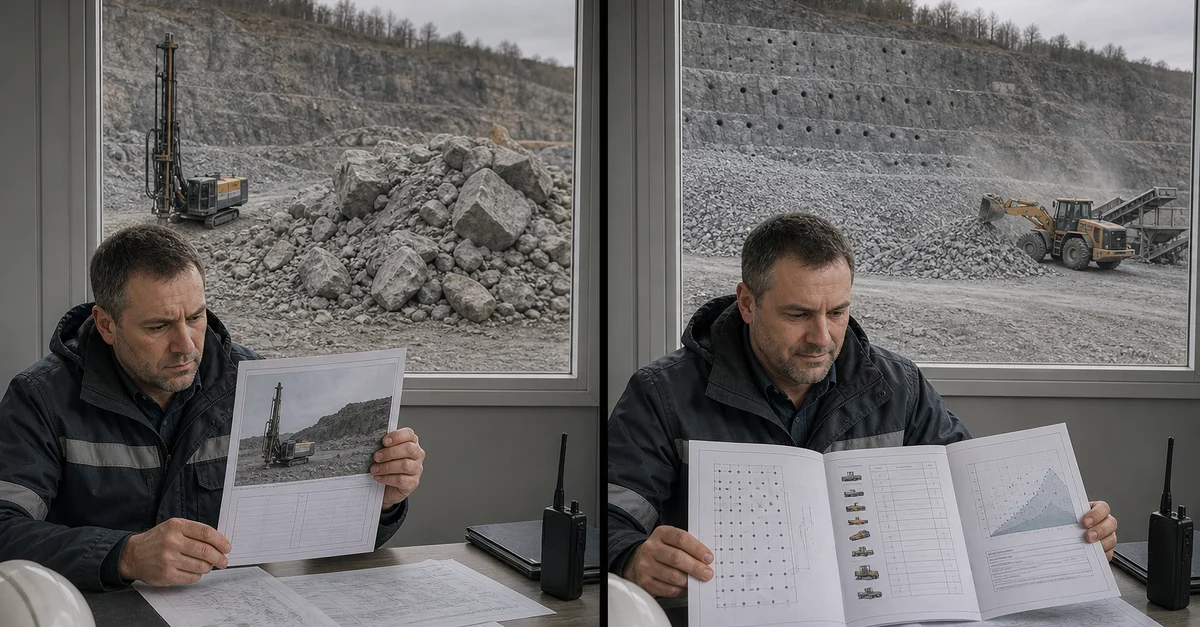
A quarry in hard limestone received competing proposals for a turnkey drilling and blasting contract. One proposal ran to four pages: rig model, air pressure, hole diameter, and a price per metre. Another ran to twelve: the same rig specification, plus the blast hole pattern with burden and spacing calculated for the formation, an equipment list that included the compressor, tooling, and dust control matched to the pattern, and an efficiency evaluation table showing the fragmentation standard, the powder factor target, and the metrics the contractor was committing to deliver.
The four-page proposal was cheaper per metre. The twelve-page proposal was cheaper per tonne at the crusher. The quarry chose the four-page one on price, and spent the next six months arguing about whose responsibility the oversize and the toe were. The twelve-page proposal had a clause covering both.
A turnkey drilling project is an integrated outcome, not a machine rental with blasting on the side. Evaluating it by the rig's specification sheet is like commissioning a building by reading the concrete mix design — technically relevant, and entirely beside the point of whether the building will stand.
The Three Legs the Proposal Must Cover
A complete turnkey drilling proposal for a quarry has three interdependent components, and a proposal that is missing any one of them is incomplete regardless of how detailed the other two are. The three are the blast hole pattern, the equipment list built around that pattern, and the blast efficiency standard the project will be held to. Each one is meaningless without the others, and together they are the plan.
The blast hole pattern is the technical specification the whole project executes. It sets the burden, spacing, hole diameter, inclination, and sub-drill depth for the rock type and bench geometry. It determines the explosive load, the fragmentation, and the risk of toe and flyrock. Everything downstream — the rig size, the compressor rating, the bit, the blast result — follows from the pattern. A proposal without a pattern is not a plan; it is an equipment list without instructions for use.
The equipment list is the supplier's statement that they have assembled the machines and tooling to execute the pattern. The rig must be sized for the hole diameter and depth the pattern requires. The compressor must deliver the air volume the rig and hole need. The tooling must be matched to the rock. If the equipment list is a single rig model followed by a compressor with a big enough nameplate number, it has not been built around the pattern — it has been quoted independently, and the buyer is left to hope they match.
The blast efficiency standard is how the project will be judged when it is running. It names the fragmentation target — the maximum oversize fraction the pattern is designed to deliver — the powder factor range, the toe standard, and the acceptable vibration and flyrock limits. Without this, there is no agreed basis for deciding whether the blasts are working, and when they are not, there is nothing to hold the contractor to except the rig's metres and the explosive cost.
Reading the Pattern: What the Design Is Actually Claiming
The blast hole pattern is the most technically dense part of the proposal, and the most commonly glossed over by buyers who do not drill for a living. Three numbers in the pattern deserve close reading, because each one is a claim about what the blast will deliver.
Burden. The distance from the hole to the free face is the number that most directly determines whether the blast breaks cleanly or leaves toe. A burden set at the design rock strength will perform differently on a harder-than-expected zone; the pattern should state whether it was calculated for the average formation or the worst case, and what happens to the efficiency standard if the formation changes.
Spacing. The distance between holes in the same row governs fragmentation — too wide and the rock between holes is over-burdened and breaks coarsely; too tight and the charges interact. The ratio of spacing to burden should be explicit in the pattern, and it should match the formation. A spacing ratio quoted without a formation assumption is a ratio without a context.
Sub-drill. The depth drilled below the design floor is what prevents toe, and it is the number most often under-specified in a budget-minded proposal. A sub-drill cut by ten percent to save drilling cost will leave a toe ridge on nearly every shot in hard rock, and the secondary breaking cost will return many times the saving. The full logic behind burden, spacing, and sub-drill in the context of a quarry bench is in our blast hole pattern design guide.
Reading the Equipment List: Is It Built Around the Pattern?
The equipment list should be traceable back to the pattern. Every item on it should have a reason that is visible in the pattern specification, and that reason should be checkable.
The rig's hole diameter should match the pattern's specified diameter. The compressor's rated output should be verified against the air velocity required to flush the hole diameter at the hole depth — not just a number that is larger than the rig's intake rating. The tooling — bit, hammer, and rods — should be specified for the rock's drillability and the penetration rate the schedule assumes. If the compressor is sized by guessing one model up from the previous project, the air-velocity arithmetic that confirms it will clear the hole is missing, and it can only be found in the bit and compressor matching guide.
The penetration rate used in the schedule should match the formation, not the rig's brochure. A schedule built on the brochure rate in rock that is harder or more abrasive than the brochure assumed will slip from the first shift. The derating chain that turns a rated penetration into a real one is in our penetration rate forecast guide.
The Efficiency Standard: What the Project Is Committing To
The blast efficiency standard is the contractual expression of what the pattern was designed to deliver. It is the part of the proposal that most directly protects the buyer's interests, and the part most often absent from the proposals that cause disputes.
A well-drawn efficiency standard names four things. First, the maximum oversize fraction — the share of the muckpile above the crusher's maximum feed size — that the blast design is committed to deliver. Second, the powder factor range — the minimum and maximum explosive charge per cubic metre of rock — that the blaster will operate within, so the buyer can see whether the cheapest blend of powder is being used at the expense of fragmentation. Third, the toe standard — the maximum height of unbroken rock at the bench base that is acceptable, and the protocol for re-drilling and re-blasting when it is exceeded. Fourth, the vibration and flyrock limits that protect the operating licence and the site boundary.
Each of these numbers should be derived from the pattern, not from a generic standard. A toe limit of 200mm on a 10m bench is different from a 200mm limit on a 30m bench. A fragmentation target that does not name the crusher's maximum feed size is a fragmentation target that cannot be measured. The full metrics for evaluating a real blast against these standards are in our blast efficiency evaluation guide.
The Consistency Check: Do the Three Legs Match?
The most revealing test of a turnkey proposal is to check whether the three legs are internally consistent — whether the equipment list was actually built around the stated pattern, and whether the efficiency standard could actually be delivered by that equipment on that pattern.
| Check |
What to ask |
Red flag |
| Pattern ↔ Rig |
Does the rig's hole diameter match the pattern spec? |
Rig is a different diameter from the pattern without explanation |
| Pattern ↔ Compressor |
Is the compressor's CFM verified against the hole air velocity? |
Compressor sized by nameplate match, not air-velocity calculation |
| Pattern ↔ Schedule |
Is the penetration rate in the schedule derived from the rock's drillability? |
Schedule uses the rig's brochure rate, not a site-specific forecast |
| Pattern ↔ Efficiency standard |
Is the oversize target consistent with the burden and spacing in the pattern? |
Efficiency standard is generic, not derived from the specific pattern |
| Efficiency standard ↔ Budget |
Can the stated powder factor deliver the fragmentation target in this rock? |
Low powder factor and fine fragmentation standard — inconsistent combination |
A proposal that passes all five checks is one where the supplier has done the integration work and can defend each number. A proposal that fails even one is one where an assumption was made in isolation, and the buyer will discover which one on the bench. The cost-structure side of this check — what each of these items represents in the budget — is in our drilling and blasting cost structure guide.
Why the Cheaper Proposal Is Often the More Expensive Project
The four-page proposal at the lower per-metre price looks compelling until the project is running. The omissions are not visible on the price page; they appear later, in secondary breaking charges that were not in the contract, in re-drilling costs for toe that was not covered by the efficiency standard, and in schedule extensions that the original metres-per-day forecast never absorbed.
My view is that the correct unit for evaluating a turnkey drilling proposal is not price per metre — it is cost per tonne of rock at the crusher, counting the oversize and the secondary breaking. The cheapest metres are occasionally the most expensive tonnes, and the difference lives in the pattern, the equipment list, and the efficiency standard that the four-page proposal did not write.
The total cost discipline that converts a per-metre price into a per-tonne cost is in our cost per drilled metre guide. The frame above it — what a complete turnkey project looks like from the buyer's side — is in our quarry turnkey drilling project guide.
Why Welldone Mining
Welldone Mining writes the twelve-page proposal. The pattern, the equipment list, and the efficiency standard are not documents produced on request — they are the basis from which we price the project, because a price that is not derived from those three documents is a number that cannot be defended when the bench results come in.
What a quarry operator gets:
- A pattern matched to your rock. Burden, spacing, sub-drill, and hole diameter derived from your formation, your bench height, and your crusher's feed specification — not from a standard template adapted with a different header.
- An equipment list traceable to the pattern. Every item justified by the pattern's hole size, depth, and air demand. The compressor CFM verified against the hole-flushing requirement. The penetration rate in the schedule derived from your formation's drillability, not our rig's brochure.
- An efficiency standard with numbers in it. Oversize fraction, powder factor range, toe limit, and vibration boundary — all derived from the pattern and stated in the proposal, so the buyer has a basis to hold the project to before the first hole is drilled.
Related Solutions
Conclusion
A turnkey drilling proposal has three parts: the pattern, the equipment list, and the efficiency standard. A proposal that shows the equipment without the pattern has skipped the instructions. A proposal with a pattern and an equipment list but no efficiency standard has delivered the setup without agreeing what success looks like. All three have to be present, they have to be internally consistent, and the buyer's job is to check whether they are before the price is the only thing left to compare.
The four-page proposal and the twelve-page proposal are not quoting the same thing, even if they describe the same rig. One is quoting a machine. The other is quoting an outcome, with the logic written down. On a production bench, those are very different purchases.
One question for your own project: the last supplier proposal you received — did it show how the burden was derived from your rock, or did it show you a rig that was already in their fleet?
Website: www.welldonemining.com
Email: info@welldonemining.com
Frequently Asked Questions
What should a complete quarry turnkey drilling proposal include?
Three interdependent documents: a blast hole pattern showing burden, spacing, sub-drill, hole diameter, and inclination derived from your rock and bench geometry; an equipment list traceable to that pattern — rig, compressor, tooling — each item justified by the pattern's requirements; and a blast efficiency standard with named numbers for oversize fraction, powder factor range, toe limit, and vibration boundary. A proposal missing any one of the three is incomplete regardless of how detailed the other two are.
How do I check if the equipment list matches the pattern?
Three checks. First, the rig's hole diameter should match the pattern's specified diameter. Second, the compressor's rated air output should be verified against the air velocity required to flush that hole diameter at that depth — not just matched by nameplate size. Third, the penetration rate used in the schedule should be derived from your formation's drillability, not taken from the rig's brochure. If any of these checks requires an assumption the proposal does not state, the list was not built around the pattern.
Why is a blast efficiency standard important in a turnkey contract?
Because without it, there is no agreed basis for deciding whether the blasts are performing correctly, and no contractual ground to stand on when they are not. An efficiency standard with numbers — oversize fraction, powder factor range, toe limit — converts a vague "good fragmentation" expectation into a measurable outcome the contractor is committed to. It also protects the buyer from a low-powder-factor blast that delivers cheap metres and expensive oversize, because the fragmentation target is written down before the first shot is fired.
Why is a cheaper price per metre not always the best choice?
Because the price per metre does not include the secondary breaking, re-drilling, and schedule extensions that a proposal without a proper pattern and efficiency standard frequently generates. The correct evaluation unit is cost per tonne of rock at the crusher, counting the oversize and the secondary breaking that a four-page proposal did not price. Occasionally the cheapest metres are the most expensive tonnes.
Can Welldone Mining provide a complete integrated proposal?
Yes. The pattern, the equipment list, and the efficiency standard are the basis from which we price every project. Send your formation description, bench heights, rock strength and quartz content, crusher feed specification, and blast schedule requirements to info@welldonemining.com. We return a complete proposal with the burden derived from your rock, the compressor verified against the air demand, the schedule built on a real penetration rate, and the efficiency standard stated before the first hole is drilled.