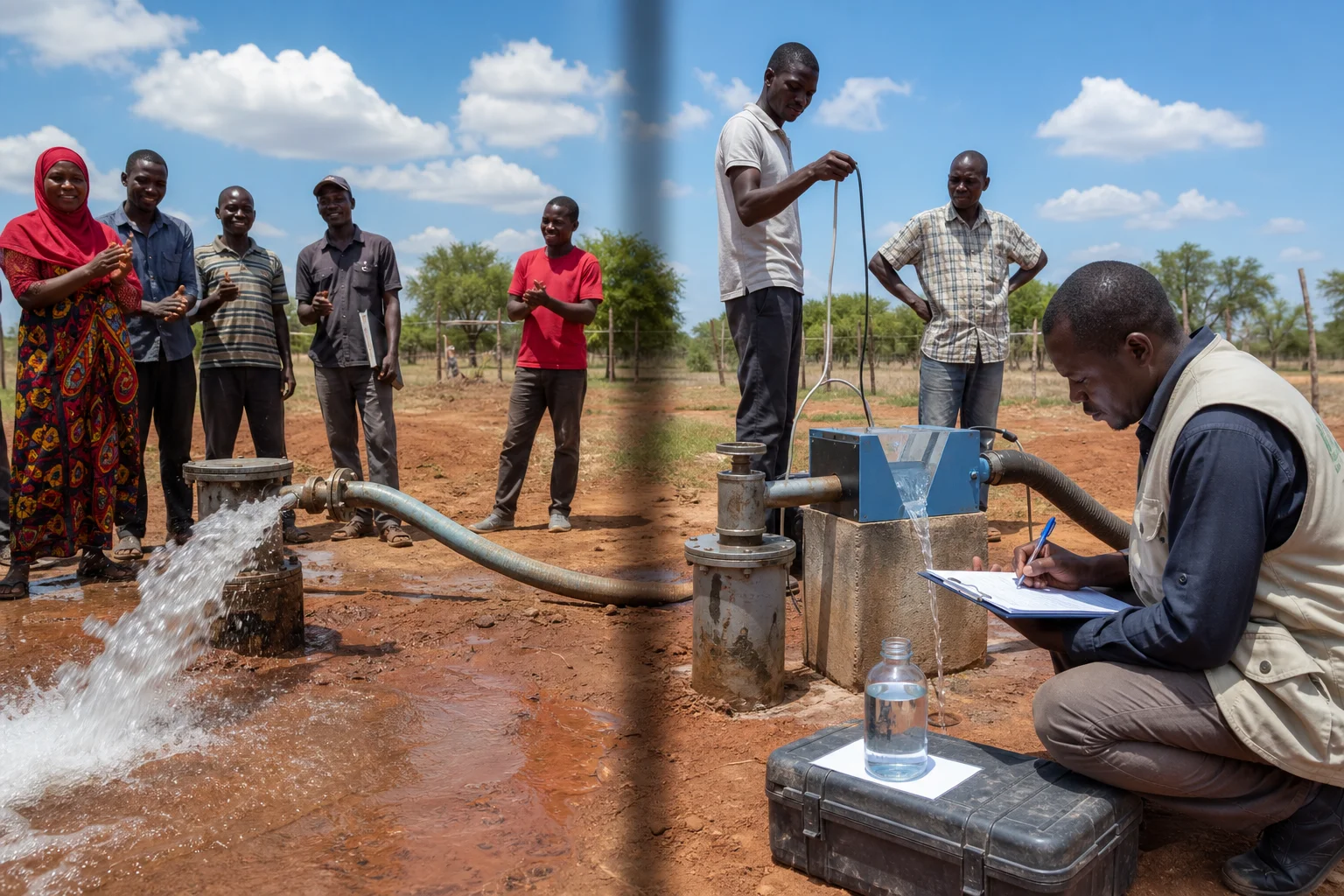
Water Well Project Acceptance: Yield, Water Quality, Verticality, and a Self-Acceptance Checklist
A borehole that produces water on handover day is not the same as a borehole that produces water in year three. Most acceptance disputes trace back to two measurements that were never taken properly — sustainable yield, and hole verticality. This article covers what to actually test before signing, why a two-hour pump test proves almost nothing, and provides a self-acceptance checklist a contractor can run before the client arrives.
A Nigerian Community Well That Passed Acceptance and Failed Three Months Later
A contractor completed a 90-metre community supply borehole in Nigeria. On handover day they ran the pump for two hours and measured 8 m³/h at the discharge. The client's representative watched the water flow, signed the acceptance form, and the crew moved to the next site.
Three months later the pump was running dry and cutting out on low-level protection. The actual sustainable yield of that borehole was closer to 3 m³/h. The 8 m³/h measured on handover day was largely water that had been sitting in the borehole column and in the fractures immediately around it — stored water, not recharge.
The same well had a second problem that surfaced during the remediation attempt. When the crew tried to lower a replacement submersible pump to 60 metres, it jammed against the casing wall and would not go further. Nor would it come back up easily. The hole had drifted roughly 2.8 percent off vertical — enough that the pump body could no longer pass. The borehole was ultimately abandoned and redrilled.
Both failures were measurable on handover day. Neither was measured.
Yield: Why a Short Pump Test Measures the Wrong Thing
The most common acceptance error in water well projects is treating discharge rate as yield. They are not the same thing, and the difference only becomes visible over time.
When pumping starts, the water coming out of the borehole has three possible sources: water standing in the borehole column itself, water stored in the immediate fracture network around the hole, and water flowing in from the wider aquifer. In the first hours, the first two dominate. This is wellbore storage, and it can produce an impressive flow rate from a borehole with almost no long-term capacity.
Sustainable yield is only the third source — what the aquifer can deliver continuously. Measuring it requires letting the first two deplete.
The diagnostic is the drawdown curve, not the flow meter. Drawdown is the drop in water level inside the borehole below its static (pre-pumping) level, measured while pumping at a constant rate.
- Drawdown falls quickly, then flattens and holds steady. The aquifer is supplying the pumped rate. This is a sustainable rate — provided the flat section is held long enough to be meaningful.
- Drawdown continues to descend without stabilising. The pumped rate exceeds what the aquifer can supply. You are drawing down stored water, and the yield figure is fiction. Reduce the rate and test again.
- Drawdown stabilises, then begins descending again later in the test. Usually indicates a boundary effect — a limited fracture system or an aquifer edge. This is exactly the failure that shows up months later, and only a longer test reveals it.
A practical protocol for a community or irrigation supply well: run a step test first at three or four increasing rates to find the approximate limit, then run a constant-rate test at the selected rate for a minimum of 24 hours, holding the rate steady and logging water level throughout. After stopping, log the recovery — water level returning toward static — for at least as long as it takes to recover 90 percent, which is itself a strong indicator of aquifer connectivity.
My position on this is firm: a two-hour test is not an abbreviated version of a proper test. It measures a different quantity entirely, and reporting its result as "yield" is not conservative estimation — it is the wrong measurement presented with the right units.
Two supporting rules worth writing into the acceptance protocol. The pump rate must be held constant throughout the constant-rate test; a rate that drifts makes the drawdown curve uninterpretable. And the discharge must be piped far enough from the borehole that it cannot recirculate back into the ground near the hole, which otherwise inflates the apparent yield.
Water Quality: What to Sample, and When
Water quality sampling at acceptance has one procedural rule that determines whether the result means anything: sample after the pumping test, not before or during the early stage.
Water drawn in the first hours carries drilling residue, fines from the formation, and disturbance from well development. A sample taken then reflects the construction process rather than the aquifer. Sample once the discharge has run clear and the drawdown has stabilised.
What to measure at handover falls into three groups.
Field measurements, taken on site at the discharge: turbidity, electrical conductivity or total dissolved solids, pH, and temperature. These are cheap, immediate, and they establish a baseline the client can re-check later. A conductivity reading in particular is worth recording, because a rise over subsequent months indicates saline intrusion or a changing contribution from different fracture sets.
Laboratory analysis, sent from a properly collected sample: the parameter list depends on the intended use and the local regulatory requirement, which varies by country. For drinking water supply, the governing standard is normally the national drinking water regulation, which in many countries is based on WHO guideline values. Confirm the applicable standard with the client before sampling, because it determines which parameters must be tested and what limits apply.
Physical observation, recorded in writing: colour, odour, presence of sand or fines in the discharge after clearing, and whether any of these change over the course of the test. Sand production that persists after development points to a screen or gravel pack problem, and it will destroy a pump impeller over time.
One caution on responsibility. A driller can deliver a hole that produces water and can document what that water contains. Whether that water meets a drinking standard is a property of the aquifer, not of the drilling work. This distinction should be explicit in the contract before drilling starts, because it is a common source of dispute after the laboratory results arrive.
Verticality and Alignment: The Criterion That Decides Whether a Pump Fits
Verticality is the most under-tested acceptance criterion in water well work, and the one whose failure is least recoverable. A borehole with marginal yield can sometimes be deepened or rehabilitated. A borehole that will not accept a pump usually cannot be fixed.
Two related properties matter, and they are not the same.
Verticality (or deviation) is how far the hole departs from true vertical, expressed as a percentage of depth or as an offset in metres at the bottom.
Alignment (or straightness) is whether the hole is straight — free of doglegs and abrupt bends. A hole can be consistently inclined but perfectly straight, which a pump will tolerate. A hole that is vertical on average but contains a sharp bend will not pass a rigid pump body, even though its overall deviation figure looks acceptable.
This distinction catches people out. Deviation is reported as a single number and alignment is not reported at all, so a hole passes on paper and fails in practice.
For reference, our own water well drilling solution specifies a hole deviation tolerance below 1.5 percent for municipal and community supply wells — the application class where a submersible pump must be installed reliably and where remediation is least practical.
| Well Type |
Typical Deviation Tolerance |
Why This Level |
| Shallow rural well, under 30 m |
Relatively tolerant |
Short pump setting depth; small absolute offset even at higher percentage |
| Farm irrigation well |
Moderate |
Pump must install reliably but installation depth is usually modest |
| Municipal / community supply |
Below 1.5% |
Deep submersible installation; long service life expected; remediation impractical |
| Deep well with long pump column |
Tightest requirement |
Deviation accumulates with depth; column alignment affects pump and shaft wear |
The practical field verification is a dummy test, and it should be standard on every well where a submersible pump will be installed. Lower a rigid dummy — a section of pipe matching or slightly exceeding the pump's outside diameter and length — to the intended pump setting depth. If it passes freely and returns freely, the hole will accept the pump. If it snags, you have found the problem while it is still cheap to find.
Deviation itself is controlled during drilling, not corrected afterwards. Levelling the rig before collaring, maintaining feed alignment, using stabilisers or drill collars appropriately, and controlling feed pressure through changing formations are the practices that keep a hole straight. The relationship between hole diameter, tooling configuration, and drilling stability is set out in our guide to how hole diameter affects drilling equipment configuration.
Well Construction Items That Belong in the Acceptance Record
Yield, quality, and verticality are the headline criteria, but several construction items determine whether the well survives, and they are only verifiable at handover.
Casing and screen placement. The record should state casing material, diameter, wall thickness, and the depth intervals of both blank casing and screen. Screen positioned against the wrong interval is a permanent yield limitation.
Gravel pack. Where used, the record should state grading and the volume actually placed against the volume calculated. A significant shortfall means bridging occurred in the annulus, which leaves voids and eventually causes sand production.
Sanitary seal. A grout or bentonite seal in the upper annulus prevents surface contamination reaching the aquifer along the outside of the casing. Its depth and material should be recorded. This is the single most important item for a drinking water well and the easiest to omit unseen.
Well development. Method used, duration, and the condition of the discharge at completion. Under-development is the most common cause of a well that yields below its potential — the formation immediately around the screen remains clogged with drilling fines.
Drilling log. Formation encountered by depth interval, water strikes and the depth at which each occurred, and any losses or difficulties. This is the document that makes future rehabilitation possible, and it is worthless if reconstructed from memory after the fact.
Static water level. Measured before pumping begins, after the well has stood undisturbed. This is the baseline against which all future monitoring is compared.
The Self-Acceptance Checklist
Run this before the client arrives, not with the client watching. Everything on it is verifiable by the drilling crew with equipment that should be on the truck, and every item that fails is cheaper to address before handover than after.
Before the pumping test
- Total depth confirmed by measurement, not by rod count
- Static water level measured and recorded after the well has stood undisturbed
- Dummy test run to intended pump setting depth — passes freely down and up
- Casing and screen depths recorded against the drilling log
- Gravel pack volume placed recorded against volume calculated
- Sanitary seal placed, with depth and material recorded
- Well development completed, with method and duration recorded
- Discharge line routed far enough from the borehole to prevent recirculation
During the pumping test
- Step test completed to identify the approximate yield limit
- Constant-rate test run at the selected rate for the agreed duration, minimum 24 hours for a supply well
- Pump rate verified as constant throughout, not assumed
- Water level logged at defined intervals throughout, not only at start and end
- Drawdown curve plotted during the test, so a non-stabilising trend is caught while the test is still running
- Discharge observed for sand or fines, and any change over time noted
After the pumping test
- Recovery logged until water level returns to at least 90 percent of static
- Water sample collected after discharge ran clear and drawdown stabilised, using clean containers and correct procedure
- Field parameters measured and recorded: turbidity, conductivity or TDS, pH, temperature
- Laboratory sample dispatched against the standard agreed with the client
- Sustainable yield stated as a rate with the test duration attached, never as a bare number
- Wellhead completed and secured against surface contamination
- Complete well record assembled: drilling log, construction detail, test data, water level records
The last item is worth more than it appears. A well record is what makes the difference between diagnosing a declining well in year five and guessing at it. Most contractors treat it as paperwork for the client. It is closer to the as-built drawing of an asset that will be in service for decades.
What the Equipment Contributes
Two of the three headline acceptance criteria are influenced directly by the drilling equipment, which is why acceptance problems often trace back to the specification stage.
Verticality is a rig and tooling outcome. Rig stability, mast alignment, feed control, and drill string configuration determine whether the hole stays straight. A rig that cannot be levelled properly on the available ground, or a string without appropriate stabilisation for the formation, will produce deviation regardless of operator skill.
Yield depends partly on hole cleaning during drilling. Inadequate air volume means cuttings are not lifted efficiently, which slows penetration and can smear fines into the formation face — reducing the very permeability the well depends on. Matching compressor capacity to hole diameter and depth is covered in why cuttings removal matters in DTH drilling.
Depth capability must include margin. A rig operating at the limit of its rated depth has no reserve when the water strike comes deeper than the survey suggested. The common selection errors here are set out in seven mistakes buyers make when choosing drilling equipment.
Why Welldone Mining
Welldone Mining specifies water well drilling packages against the acceptance criteria the contractor will have to meet, rather than against depth capability alone.
What water well contractors get:
- Rig and tooling specified for your target well class. Tell us the depth range, hole diameter, formation, and the deviation tolerance your contracts require, and we specify the rig, compressor, and drill string configuration to meet it — including the stabilisation needed for straight holes at depth.
- Compressor matched to hole geometry. Air volume sized for cuttings removal at your hole diameter and depth, so hole cleaning does not become a yield problem.
- Spare parts package for continuous field operation. Wear parts specified against your formation and project duration, so a stopped rig does not become a missed handover date.
Related Solutions
Conclusion
Water well acceptance fails in a specific pattern. The criteria that are easy to observe — water flowing, hole reaching depth — get checked. The criteria that require instruments and patience — sustainable yield over a full test, verticality against a dummy, a sample taken at the right moment — get skipped, and those are precisely the ones that determine whether the well is still working in year five.
The Nigerian borehole produced water on handover day. It produced 8 m³/h of water that was already in the ground around the hole, and it could not pass a replacement pump past 60 metres. Both facts were measurable that morning. A 24-hour test and a dummy run would have cost one extra day on site and saved an entire redrill.
Acceptance is not a ceremony at the end of drilling. It is the last opportunity to find a problem while it is still someone's responsibility to fix.
Website: www.welldonemining.com
Email: info@welldonemining.com
Frequently Asked Questions
How long should a water well pumping test run?
For a community or municipal supply well, run a step test to find the approximate limit, then a constant-rate test of at least 24 hours at the selected rate, followed by recovery monitoring. Shorter tests measure wellbore storage rather than aquifer capacity. For shallow low-demand wells a shorter test may be acceptable, but the duration should be agreed with the client in writing before drilling starts rather than decided on handover day.
What verticality tolerance should a water well meet?
It depends on the well class and the pump installation. Our water well drilling solution specifies below 1.5 percent deviation for municipal and community supply wells, where a submersible pump must install reliably at depth. Shallow rural wells tolerate more because the absolute offset stays small. Regardless of the percentage figure, run a dummy test to the intended pump setting depth — that is the only verification that directly answers whether the pump will fit.
When should the water sample be taken?
After the pumping test, once the discharge has run clear and drawdown has stabilised. A sample taken early in the test reflects drilling residue and development fines rather than the aquifer. Record field parameters — turbidity, conductivity, pH, temperature — on site, and send a properly collected sample for laboratory analysis against the standard the client's application requires.
Is the driller responsible if the water fails a drinking water standard?
Water chemistry is a property of the aquifer, not of the drilling work. A driller is responsible for delivering the specified hole, constructing it properly including the sanitary seal, and documenting what the water contains. Whether that water meets a drinking standard is a separate matter and should be addressed explicitly in the contract before drilling begins — it is one of the most common sources of post-handover dispute.
Can Welldone Mining specify a rig for our water well contracts?
Yes. Send your typical depth range, hole diameter, formation type, the deviation tolerance your contracts require, and your daily production target to info@welldonemining.com. We specify the rig, matched compressor, and drill string configuration for those requirements, including the stabilisation needed to hold verticality at your working depth.