Three things happened in the past six months that most drilling equipment buyers have not fully connected yet.
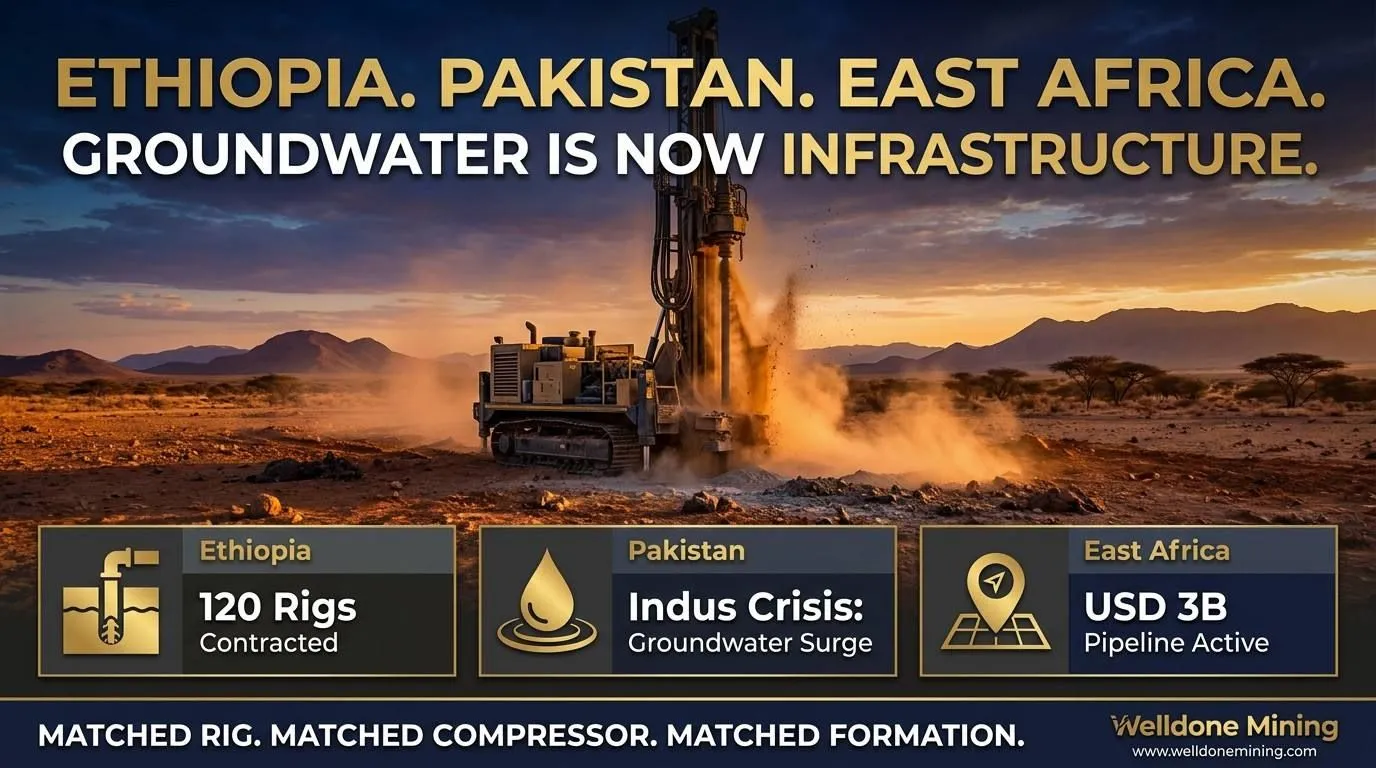
Ethiopia signed a USD 95 million contract covering 120 borehole drilling rigs under its national rural water supply program. The World Bank approved the Horn of Africa Groundwater Resilience Program, creating a pipeline of 50 to 100 new borehole contracts across the region. And Pakistan — reacting to India's suspension of the Indus Waters Treaty — accelerated its own groundwater development agenda, prioritizing domestic water independence.
These are not isolated procurement events. They are signals of something structural: governments that once treated groundwater as a long-term aspiration have started treating it as immediate national infrastructure. Budget lines are being drawn. Contractors are being mobilized. Equipment is being sourced on timelines that leave little room for configuration mistakes.
For drilling contractors and equipment buyers, the opportunity is real. But so is the risk. The geology in these markets is unforgiving, the project timelines are tight, and the cost of a mismatched rig configuration does not show up in the quotation — it shows up at 150 meters depth, when penetration rate collapses and bit life drops to three days.
Why These Three Markets Are Moving at the Same Time
What makes this moment unusual is not that one region is growing. It is that three distinct markets — East Africa, the Horn of Africa, and South Asia — are accelerating simultaneously, driven by different forces but creating similar procurement pressure on drilling equipment supply chains.
In Ethiopia, the driver is a national rural water access program backed by government budget and international financing. In Pakistan, the driver is geopolitical: the suspension of the Indus Waters Treaty forced a rapid shift toward domestic groundwater development. In East Africa broadly, the driver is a structured USD 3.05 billion groundwater investment pipeline across seven IGAD member states, with financing arrangements already in place.
Three different triggers. Three different buyer profiles. But the same equipment need: water well drilling rigs, matched air compressors, DTH hammers, and drill bits configured for the actual formations these projects will encounter.
| Market |
Primary Driver |
Scale |
Buyer Profile |
| Ethiopia |
National rural water supply program |
120 rigs, USD 95M contracted |
Government contractors, program operators |
| Pakistan |
Indus Waters Treaty suspension, Green Pakistan Initiative |
Expanding borehole program, Punjab and Sindh focus |
Agricultural contractors, provincial water authorities |
| East Africa (7 IGAD states) |
AU-backed groundwater investment pipeline |
64 projects, USD 3.05B pipeline |
NGOs, government contractors, regional operators |
Ethiopia: The Largest Single Procurement Event
In March 2025, Ethiopia's Ministry of Water and Energy signed contracts to drill 49 deep boreholes as part of a broader national program ultimately targeting 120 rigs across the country. This is not a pilot program. It is a national rollout with defined timelines, performance benchmarks, and penalty clauses for delays.
The geology in Ethiopia's main drilling zones varies significantly — and that variation is what catches contractors off guard. The Rift Valley region involves volcanic basalt formations that require high air pressure and premium DTH bits rated for hard rock. The highland zones present fractured granite that demands precise bit selection to avoid premature wear. The lowland sedimentary areas, while softer, require careful water management during drilling to prevent borehole collapse.
A contractor who entered this cycle with a generic rig configuration — standard compressor output, mid-grade DTH hammer, one-size bit selection — discovered the problem at 80 meters depth, not before shipping. Replacing a mismatched DTH hammer on a remote site in Oromia takes two weeks and costs more than the margin difference between the right configuration and the wrong one.
The real question is not whether you can get a rig into Ethiopia. It is whether that rig — with its specific compressor output, hammer rating, and bit grade — can drill the formation it will actually encounter at the target depth, across multiple sites, without the kind of consumable failure that turns a 20-day project into a 60-day one.
| Ethiopian Formation Zone |
Typical Formation |
Key Configuration Requirement |
Risk if Mismatched |
| Rift Valley |
Volcanic basalt, hard rock |
High air pressure, premium hard rock DTH bit |
Fast bit wear, low penetration rate |
| Highland zones |
Fractured granite |
Precision bit selection, adequate hammer impact |
Premature bit failure, increased consumable cost |
| Lowland sedimentary |
Soft formation, water-sensitive |
Controlled air volume, borehole stability management |
Borehole collapse, project delay |
Pakistan: When Politics Creates a Drilling Market
The suspension of the Indus Waters Treaty in 2025 created something that no market forecast predicted: a policy-driven surge in domestic groundwater development across Pakistan's Punjab and Sindh provinces.
When surface water allocation from Indian-controlled tributaries became uncertain, Pakistani agriculture — which depends on irrigation for over 90 percent of food production — faced an immediate supply risk. The government's response was the Green Pakistan Initiative multi-canal project combined with a significant expansion of borehole drilling for agricultural irrigation wells.
Pakistani geology in the alluvial plains is relatively driller-friendly — deep sedimentary layers with predictable water tables. But depth requirements are increasing as shallow water tables drop from overextraction. Wells that once hit water at 50 meters now require 120 to 180 meters in some districts. That depth range changes the compressor requirement significantly.
A contractor using an air compressor configured for 80-meter wells finds their penetration rate collapsing in the 150-meter section. Not because the rig is failing. Because the compressor cannot maintain adequate working pressure at the hammer after accounting for pipe friction losses over 150 meters of drill string. The hammer is starved of air. Impact energy drops. Penetration rate drops from 8 meters per hour to 2. A project scoped for three weeks takes ten.
This is a market where demand is politically guaranteed for the next several years. The contractors who position themselves now — with the right depth capability and compressor configuration — are the ones who will capture the repeat business as the program expands.
East Africa: A USD 3 Billion Pipeline That Most Contractors Have Not Found Yet
In February 2026, UNDP and the African Union announced a pipeline of 64 bankable groundwater projects worth USD 3.05 billion across seven IGAD member states. These are structured investment packages with financing arrangements already in discussion — not conceptual proposals waiting for funding.
Kenya allocated significant water infrastructure budget increases in its July 2025 fiscal year and implemented a nationwide e-procurement system that digitizes all government water investment contracts. That system makes it easier for regional drilling contractors to bid on national tenders — but it also means the specification requirements are more precise, the documentation requirements are stricter, and the competition is more visible.
Tanzania and Mozambique are seeing dual drivers: groundwater development for rural water supply and borehole drilling support for expanding agricultural and industrial zones near the coast. Uganda and Sudan have active programs tied to international development financing that requires equipment documentation, performance specifications, and in some cases, local service partner agreements.
The contractors who win in this environment are not necessarily the largest. They are the ones who can demonstrate formation-matched equipment, documented penetration rates from comparable geology, and a consumables supply chain that does not depend on six-week shipping windows from overseas suppliers.
The Formation Challenge: What the Project Brief Does Not Tell You
Every drilling project brief specifies a target depth and a required yield. Almost none of them give you accurate formation data for every meter between surface and target.
That matters because a water well drilling rig does not drill "in general." It drills a specific formation with a specific bit at a specific air pressure delivered by a specific compressor. Change any one of those variables and you change your penetration rate, your bit life, and your project economics.
In Ethiopia's Rift Valley, the same 200-meter borehole might pass through 40 meters of soft alluvium, 60 meters of volcanic tuff, and 100 meters of hard basalt. Three different formations. Potentially three different optimal bit grades. A contractor running a single bit type from surface to target will either burn through bits on the hard section or drill inefficiently through the soft section — and both outcomes cost money that was not in the project budget.
In Pakistan's Punjab, water table depth varies by 40 to 80 meters between sites within the same district. A rig configured for 100-meter wells may need to drill 180 meters on the next site. That is not a minor adjustment. It is a different compressor requirement, a different drill rod quantity, and a different hammer selection for the deeper formation.
| Formation Variable |
Effect on Configuration |
Consequence if Ignored |
| Hard rock (basalt, granite) |
Requires higher air pressure, premium bit grade |
Fast bit wear, low penetration rate, cost overrun |
| Fractured formation |
Requires stable air volume for cuttings removal |
Cuttings accumulation, stuck tools, borehole instability |
| Soft sedimentary |
Requires controlled air to prevent borehole collapse |
Hole instability, casing problems, project delay |
| Depth increase |
Increases pipe friction loss, reduces hammer inlet pressure |
Penetration rate collapse in deep sections |
| Mixed formation (multiple layers) |
May require bit change strategy across depth sections |
Single bit type underperforms in at least one section |
The Configuration Trap: What Happens When the Equipment Does Not Match the Job
The most common mistake contractors make when entering a new market is buying a rig based on rated specifications without mapping those specs to the specific formations, depths, and conditions of their target projects.
A rig rated to 300 meters does not mean it will drill 300 meters efficiently in hard rock with the air compressor it ships with. Maximum rated depth is a mechanical limit, not an operational guarantee. The depth you can drill profitably depends on compressor output at the hammer face — not at the compressor outlet — and that number drops as depth increases because of pipe friction losses.
In most cases, the problem does not show itself in the first 50 meters. It shows up between 100 and 150 meters, when the formation gets harder, the compressor is working at its pressure limit, and penetration rate drops from 8 meters per hour to 2. At that rate, a project scoped for 20 working days takes 80. The contractor does not recover from that margin hit. Neither does the client relationship.
- Rated depth is a mechanical limit. Profitable drilling depth depends on compressor output at the hammer face.
- Air pressure drops with depth due to pipe friction. A compressor sized for 100-meter wells cannot maintain working pressure at 200 meters.
- Wrong bit grade on hard rock means replacing bits every three days instead of every ten. That consumable cost adds up faster than the rig payment.
- Penetration rate is the number that determines project profitability. A rig that drills at 2 meters per hour instead of 8 is not a drilling tool. It is a liability.
Compressor Matching: The Variable That Determines Everything Else
The air compressor is not auxiliary equipment in a DTH drilling system. It is the power source that determines how hard the hammer hits, how fast cuttings clear the hole, and whether the system can maintain performance across the full depth range of the project.
DTH stands for Down-The-Hole. The hammer sits at the bottom of the drill string, converting compressed air into percussive energy that breaks rock. Without sufficient air pressure and volume at the hammer face — after accounting for all losses through the drill string — the hammer does not hit hard enough to drill efficiently.
For a 200-meter water well in hard basalt, a typical requirement might be 24 bar working pressure at 20 cubic meters per minute of airflow at the hammer. A compressor rated at 17 bar and 12 cubic meters per minute will not deliver that at depth. The contractor will know they have a problem when they pull the hammer out after three days and find the bit face polished smooth instead of sharp — a sign the hammer was not delivering enough impact energy to break fresh rock.
Welldone Mining does not quote compressors and rigs as separate line items. We configure them as systems — because a rig without a matched compressor is not a drilling solution. It is a collection of components that may or may not work together at the depth and formation you need.
| Compressor Parameter |
What It Affects |
Risk if Undersized |
| Working pressure (bar) |
Hammer impact energy at depth |
Penetration rate collapse, polished bit face |
| Air volume (m³/min) |
Cuttings removal efficiency |
Cuttings accumulation, stuck drill string |
| Pressure at hammer face |
Actual usable impact energy after pipe losses |
Mismatch between rated and actual performance |
| Sustained output capacity |
Performance consistency across a full shift |
Overheating, performance drop after 4 to 6 hours |
What Contractors Should Confirm Before Committing Equipment
Before a contractor commits equipment to Ethiopia, Pakistan, or East Africa, five questions determine whether the project will be profitable — or painful.
What is the confirmed formation geology at target depth? Get this from the tender document, the client's hydrogeological survey, or local drilling records. If no data exists, budget for a pilot borehole before committing your full equipment configuration to the project.
What air pressure and volume does that formation require at target depth? Calculate required hammer inlet pressure at target depth, accounting for drill pipe friction losses. Then confirm your compressor can deliver that pressure and volume — not at surface, but at depth.
What is the local supply chain for bits and consumables? In Ethiopia and East Africa, shipping replacement bits from overseas takes four to six weeks. If your bit selection is wrong or your hammers wear faster than expected, that lead time becomes a project delay. Either carry three times the consumables you expect to use, or work with a supplier who can support you regionally.
What is the water table depth variation across your project sites? In Pakistan's Punjab region, water table depth varies by 40 to 80 meters between sites within the same district. Confirm your depth flexibility before committing to a fixed-price contract with uniform depth assumptions.
Who provides technical support if something needs adjustment on site? Remote sites in Ethiopia or rural Pakistan do not have local drilling technicians. Your supplier's actual ability to resolve problems remotely within 48 hours — not their warranty terms, but their real response capability — directly affects your project timeline when something unexpected happens.
Why Welldone Mining
Welldone Mining provides water well drilling rigs, DTH drilling rigs, crawler drilling platforms, air compressors, DTH hammers, drill bits, drill rods, and drilling accessories for quarry, mining, water well, and customized drilling projects.
We work with contractors who need equipment that is configured for real conditions — not factory demos. Before we recommend any configuration, we ask about formation geology, target depth, required yield, hole diameter, and site conditions. If you do not have complete formation data, we help you identify what you need to find out before finalizing the equipment package.
We do not consider a project complete when the equipment ships. We consider it complete when the rig is drilling at the expected penetration rate, the compressor is matched to the hammer at the target depth, and the consumable consumption is tracking within the project budget.
You can review our drilling solutions and typical configurations:
- Water Well Drilling Solution — complete configured systems for borehole and deep well projects across East Africa, South Asia, and the Middle East.
- Customized Drilling Solution — formation-specific configurations for complex or variable geology, combining rig, compressor, hammer, and bit selection.
- Quarry Drilling Solution — blast hole and quarry configurations for construction aggregate and open-pit applications.
Related Machines
Welldone Mining supports a range of drilling equipment for different project types and formation conditions.
Crawler Water Well Drilling Rig — suitable for rural water supply, agricultural irrigation, and borehole projects in East Africa, South Asia, and the Middle East. Configured with matched compressor and DTH system for target depth and formation.
DTH Drilling Rig — designed for hard rock formations in quarry, mining, and blast hole applications. Available in multiple rig frame configurations with compressor and hammer matching.
Air Compressor (Diesel and Electric) — matched to rig, hammer, hole diameter, and target depth. Diesel compressors for remote and mobile sites. Electric compressors for fixed or semi-fixed sites with stable power supply.
DTH Hammer and Drill Bit — selected according to rock formation, hole diameter, and compressor output. Formation-matched selection prevents premature wear and maintains penetration rate across the project depth range.
Drill Rods and Accessories — matched to rig thread type, hole diameter, and depth requirement. Includes stabilizers, adapters, and sub-adapters for different drilling configurations.
Conclusion
The groundwater infrastructure push in Ethiopia, Pakistan, and East Africa is not a temporary procurement spike. It is a structural shift driven by climate stress, geopolitical realignment, and governments that have run out of patience for slow-moving water development plans.
For drilling contractors, this moment represents real opportunity. But only for those who enter these markets with configurations that match what they will actually drill. The geology is unforgiving. The project timelines are tight. The margin for equipment error is narrow.
A rig, a compressor, a hammer, and a bit that work together correctly in the formation you are drilling — that is not a specification detail. That is the difference between a profitable project and a project you are still trying to recover from six months after completion.
If you are planning a water well drilling project in Ethiopia, Pakistan, East Africa, or any other high-demand groundwater market, share your target depth, formation geology, hole diameter, mobility requirement, and project timeline. Welldone Mining will help you configure a drilling system that is built for what you are actually drilling — not what looks good on a quotation sheet.
Website: www.welldonemining.com
Email: info@welldonemining.com