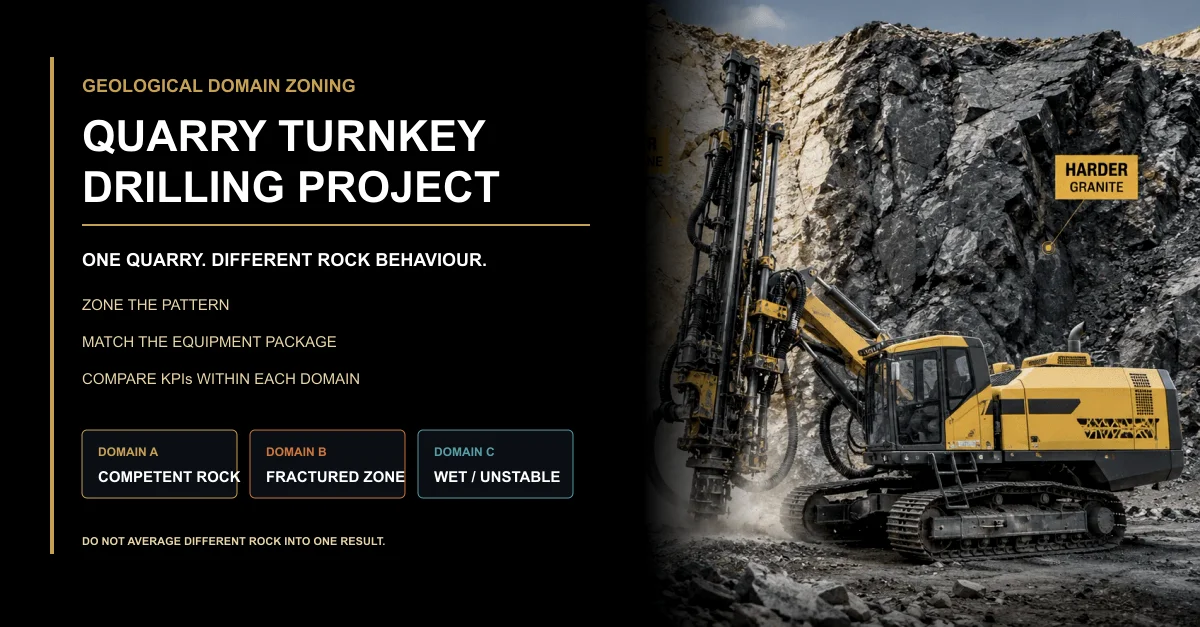
In DTH drilling projects, the air compressor is not just an auxiliary machine.
It directly affects hammer impact, cuttings removal, drilling speed, fuel consumption, and overall drilling cost.
When buyers prepare a drilling equipment package, one common question is:
should we choose a diesel air compressor or an electric air compressor?
There is no single answer for every project.
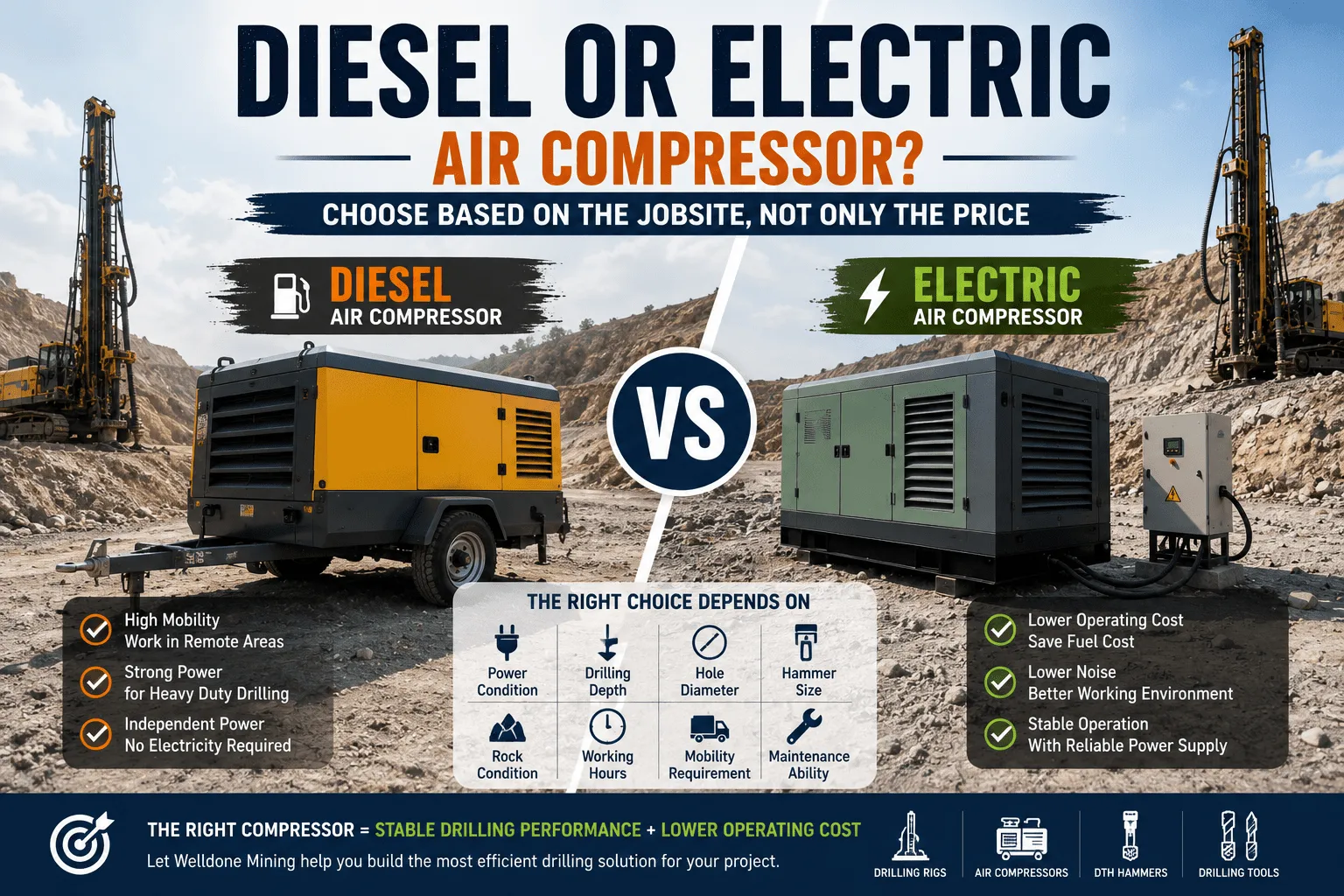
A diesel air compressor may be the better choice for remote sites where stable electricity is not available.
An electric air compressor may be more economical for fixed sites with reliable power supply.
The right choice depends on the real jobsite, drilling depth, hole diameter, hammer size, rock condition, working hours, mobility demand, and maintenance ability.
That is why diesel vs electric air compressor for DTH drilling should not be decided by price alone.
It should be selected as part of a complete drilling system, together with the drilling rig, DTH hammer, drill bit, drill rods, and spare parts.
Why Air Compressor Selection Matters in DTH Drilling
In DTH drilling, the air compressor provides the air pressure and air volume needed for the hammer and hole cleaning.
Air pressure helps drive the DTH hammer impact.
Air volume helps remove cuttings from the hole.
If the compressor does not match the project, the whole drilling system may lose efficiency.
A mismatched compressor can cause slow penetration, weak hammer impact, poor cuttings removal, fast drill bit wear, tool sticking risk, higher fuel or electricity cost, and more downtime.
This is why compressor selection should be considered before purchasing the full drilling equipment package.
| Compressor Role |
How It Affects Drilling |
Possible Risk if Mismatched |
| Air Pressure |
Supports DTH hammer impact power |
Weak rock breaking and slow penetration |
| Air Volume |
Removes cuttings from the hole |
Poor hole cleaning and tool sticking risk |
| Power Source |
Decides mobility, operating cost, and site flexibility |
Power failure, fuel logistics pressure, or limited movement |
| Compressor Matching |
Connects rig, hammer, bit, depth, and hole diameter |
Higher cost per meter and unstable performance |
What Is a Diesel Air Compressor?
A diesel air compressor uses a diesel engine to generate compressed air.
It does not depend on site electricity, so it is widely used in remote drilling projects, quarry areas, mining sites, road construction, mountain areas, and water well drilling projects.
The biggest advantage of a diesel compressor is mobility.
It can move with the drilling rig and continue working even when there is no stable power supply.
This makes it practical for outdoor drilling jobs where the site changes frequently.
However, diesel compressors also require fuel supply, engine maintenance, filters, lubricating oil, cooling system care, and regular service.
If fuel logistics are difficult or maintenance is ignored, operating cost and downtime may increase.
When Is a Diesel Air Compressor More Suitable?
A diesel air compressor is often suitable when the project needs independent power and strong site mobility.
For many quarry, mining, and water well drilling projects, the compressor must follow the drilling rig across rough terrain or remote areas.
| Suitable Situation |
Why Diesel May Work Better |
Project Benefit |
| Remote drilling site |
No need for stable grid electricity |
Independent operation |
| Quarry or mining area |
Can move with the drilling rig |
Better site flexibility |
| Water well drilling in rural areas |
Works where power supply is limited |
Suitable for changing job locations |
| Mountain or open field projects |
Does not depend on cable layout |
Faster site preparation |
| Temporary drilling projects |
No need to build electrical infrastructure |
Lower setup difficulty |
Advantages of Diesel Air Compressors
Diesel air compressors are popular because they are practical in difficult jobsite conditions.
They give buyers more flexibility when the drilling site is far from a stable power source.
- High mobility: suitable for outdoor sites and changing drilling locations.
- Independent power: can work without grid electricity.
- Suitable for remote projects: useful for quarry, mining, mountain, and water well drilling jobs.
- Flexible site setup: no need for long cable layout or electrical preparation.
- Good match for mobile rigs: can move together with crawler drilling rigs or truck-mounted rigs.
Limitations of Diesel Air Compressors
Although diesel compressors are flexible, they are not always the lowest-cost choice.
Buyers should also consider long-term fuel consumption, maintenance requirements, and local fuel availability.
| Limitation |
Possible Impact |
What Buyers Should Check |
| Fuel consumption |
Higher daily operating cost if fuel price is high |
Local diesel price and daily working hours |
| Engine maintenance |
Filters, oil, cooling system, and engine parts need service |
Maintenance ability and spare parts availability |
| Noise and emissions |
May be restricted in some working environments |
Local environmental or site requirements |
| Fuel logistics |
Remote sites need stable fuel delivery |
Fuel supply plan before project starts |
What Is an Electric Air Compressor?
An electric air compressor uses electrical power to generate compressed air.
It is often used in fixed sites or projects where stable electricity is available.
Compared with diesel compressors, electric compressors may have lower energy cost, lower noise, and simpler daily operation.
However, electric compressors depend strongly on power supply.
If the voltage is unstable, the cable layout is difficult, or the site does not have enough electrical capacity, drilling performance may be affected.
This means electric compressors are not only about lower operating cost.
They also require proper site infrastructure and stable power conditions.
When Is an Electric Air Compressor More Suitable?
An electric air compressor may be suitable for fixed drilling sites, factories, tunnels, mines with electrical infrastructure, or quarry sites with stable power supply.
It can be a good choice when mobility demand is lower and power cost is more favorable than diesel fuel cost.
| Suitable Situation |
Why Electric May Work Better |
Project Benefit |
| Stable power supply available |
Can operate without diesel fuel |
Lower energy cost in many sites |
| Fixed or semi-fixed drilling site |
Less need for frequent movement |
Simpler compressor placement |
| Noise-sensitive area |
Usually quieter than diesel engine operation |
Better working environment |
| Long working hours |
May reduce fuel-related operating cost |
Better long-term cost control |
| Indoor or controlled worksite |
No diesel exhaust at the compressor engine |
Cleaner operation environment |
Advantages of Electric Air Compressors
Electric compressors can be a practical choice when the site has reliable power.
They may help buyers reduce fuel logistics pressure and simplify daily operation.
- Lower operating cost in suitable sites: electricity may be cheaper than diesel fuel.
- Lower noise: better for controlled or noise-sensitive jobsite conditions.
- Simpler daily operation: no diesel engine fuel system to manage.
- Cleaner working environment: no diesel engine exhaust from the compressor.
- Good for fixed sites: suitable when the drilling location does not change frequently.
Limitations of Electric Air Compressors
Electric compressors depend on power supply conditions.
If the site power is not stable, the compressor may not work reliably.
This can cause drilling interruption, lower productivity, or even equipment risk.
| Limitation |
Possible Impact |
What Buyers Should Check |
| Power availability |
Cannot work without suitable electricity |
Grid access or generator support |
| Voltage stability |
Unstable voltage may affect compressor performance |
Site voltage and electrical protection |
| Cable layout |
Long cables may create setup and safety issues |
Distance from power source to drilling area |
| Mobility limitation |
Less flexible for changing drilling locations |
Whether the project needs frequent movement |
Diesel vs Electric Air Compressor: Key Comparison
Diesel and electric compressors can both support DTH drilling, but they fit different jobsite conditions.
The right choice depends on whether the project values mobility, independent power, lower energy cost, quieter operation, or fixed-site efficiency.
| Comparison Item |
Diesel Air Compressor |
Electric Air Compressor |
| Power Source |
Diesel engine |
Electric motor |
| Mobility |
High mobility, suitable for remote sites |
Depends on cable layout and power source |
| Operating Cost |
Depends on diesel fuel price and engine efficiency |
May be lower if electricity is stable and affordable |
| Site Requirement |
Needs fuel supply and maintenance plan |
Needs stable power supply and electrical setup |
| Maintenance Focus |
Engine, filters, oil, fuel system, cooling system |
Motor, electrical system, control cabinet, power protection |
| Best Fit |
Remote, mobile, outdoor drilling projects |
Fixed sites with reliable power supply |
Do Not Choose Compressor Type by Price Alone
Some buyers choose a compressor by comparing purchase price only.
This can be risky because the compressor affects long-term drilling cost.
A cheaper compressor may create higher operating cost if it does not match the site or drilling tools.
For example, a diesel compressor may be more expensive to operate if fuel cost is high and the site has stable electricity.
An electric compressor may look economical, but it may create problems if the site power is unstable or the drilling area changes frequently.
The correct selection should compare total cost, including purchase cost, fuel or electricity cost, maintenance, downtime, movement, power supply, and productivity.
How Site Power Condition Affects the Decision
Power condition is one of the first things buyers should confirm.
If the site has no stable electricity, diesel is usually more practical.
If the site has reliable power and the compressor will stay in one area for long working hours, electric may offer better operating cost.
| Site Power Condition |
Compressor Selection Direction |
Reason |
| No grid power |
Diesel compressor |
Independent power source |
| Unstable voltage |
Diesel or carefully protected electric setup |
Protects drilling continuity |
| Stable industrial power |
Electric compressor may be suitable |
Potential lower operating cost |
| Frequent movement between holes |
Diesel compressor often more flexible |
Easier mobility without cable limitations |
| Fixed work area |
Electric compressor may be practical |
Power connection can be arranged more easily |
How Drilling Depth and Hole Diameter Affect Compressor Choice
Drilling depth and hole diameter affect air pressure and air volume demand.
Larger holes create more cuttings, so more air volume may be needed for hole cleaning.
Deeper holes require stable air delivery over a longer distance.
Whether the compressor is diesel or electric, it must provide enough air pressure and air volume for the DTH hammer, drill bit, hole diameter, and drilling depth.
If the compressor type is correct but the capacity is wrong, the project may still face poor performance.
| Drilling Factor |
Effect on Compressor Selection |
What to Check |
| Hole Diameter |
Affects cuttings volume and air flow demand |
Required air volume |
| Drilling Depth |
Affects air delivery and hole cleaning difficulty |
Pressure, volume, and rod configuration |
| DTH Hammer Size |
Decides air consumption range |
Hammer air demand and compressor output |
| Rock Condition |
Affects impact requirement and cuttings behavior |
Hardness, abrasiveness, and formation changes |
Diesel or Electric for Quarry Drilling?
Quarry drilling often requires mobility, strong air supply, and stable daily production.
If the quarry drilling area changes frequently or the site does not have stable power near the drilling area, a diesel compressor may be more practical.
If the quarry has stable power infrastructure and the drilling work is concentrated in a fixed area, an electric compressor may help reduce operating cost and noise.
A practical quarry drilling solution should match the drilling rig, compressor type, compressor capacity, DTH hammer, drill bit, drill rods, and wearing parts according to rock hardness, hole diameter, and production target.
Diesel or Electric for Water Well Drilling?
Water well drilling projects often happen in rural areas, remote villages, farms, mountain regions, or places where electricity is not always available.
In these cases, diesel compressors are often more flexible because they can move with the drilling rig.
However, if the water well project is near a stable power source or uses a fixed drilling station, electric compressors may also be considered.
The key is whether the site power can support the compressor continuously during drilling.
A complete water well drilling solution should consider ground layers, drilling depth, hole diameter, compressor type, air demand, drilling tools, drill rods, and spare parts together.
Diesel or Electric for Mining and Construction Projects?
Mining and construction drilling projects may have different site conditions.
Some open-pit mining projects need high mobility and independent power.
Some underground or fixed mining areas may already have electrical infrastructure.
Some construction sites may have power access but limited cable layout space.
For these applications, compressor selection should be based on site access, movement frequency, power condition, safety requirement, working hours, and drilling method.
For special working conditions, a customized drilling solution can help buyers match the compressor type and complete equipment package according to the real jobsite.
Common Mistakes Buyers Should Avoid
Many compressor selection problems come from focusing on one factor only.
Buyers should avoid choosing diesel or electric compressors without checking the full project condition.
| Common Mistake |
Possible Problem |
Better Solution |
| Choosing only by compressor price |
May increase long-term operating cost |
Compare total cost and project suitability |
| Choosing electric without checking power stability |
Voltage problems may interrupt drilling |
Confirm site power capacity and protection |
| Choosing diesel without planning fuel supply |
Fuel logistics may delay operation |
Prepare fuel and maintenance plan |
| Ignoring compressor capacity |
Correct type but wrong output still causes poor drilling |
Match pressure and air volume with hammer and hole demand |
| Ignoring spare parts |
Filters, hoses, oil, or maintenance parts may stop the project |
Prepare compressor and drilling tool spare parts together |
What Information Should Buyers Provide Before Selection?
To recommend a suitable diesel or electric air compressor, buyers should provide clear project information.
This helps avoid general recommendations and improves equipment matching accuracy.
- Project type: quarry, mining, water well, construction, foundation, or exploration
- Whether stable electricity is available at the jobsite
- Site voltage, frequency, and power capacity if choosing electric
- Fuel supply condition if choosing diesel
- Required hole diameter
- Required drilling depth
- Rock or ground condition
- DTH hammer size if already selected
- Drill bit diameter and shank type if available
- Drill rod size and thread type if available
- Expected working hours per day
- Whether the compressor needs to move frequently
- Local maintenance and spare parts conditions
How Welldone Mining Helps Buyers Choose the Right Compressor
Welldone Mining provides drilling equipment and drilling tools for quarry, mining, water well, construction, and customized drilling projects.
We help buyers choose diesel or electric air compressors according to real jobsite conditions, not only price.
Our support can include drilling method evaluation, drilling rig selection, diesel or electric compressor matching, DTH hammer and drill bit configuration, drill rod planning, spare parts preparation, delivery support, and after-sales guidance.
| Welldone Mining Support |
How It Helps Buyers |
| Jobsite Condition Analysis |
Checks power supply, mobility demand, site environment, and working hours |
| Compressor Type Recommendation |
Helps choose diesel or electric based on real project conditions |
| Air Pressure and Volume Matching |
Matches compressor output with hammer, hole diameter, depth, and cuttings removal demand |
| DTH Hammer and Drill Bit Matching |
Selects tools according to rock condition, hole size, and compressor capacity |
| Drill Rod Planning |
Matches rod size, thread type, and quantity for stable air delivery |
| Spare Parts Planning |
Prepares filters, hoses, oil, hammer parts, bits, rods, adapters, and wearing parts |
| After-Sales Guidance |
Supports technical communication, troubleshooting, and maintenance advice |
Conclusion
Diesel and electric air compressors both have their advantages.
Diesel compressors are often better for remote, mobile, and outdoor drilling projects without stable electricity.
Electric compressors may be more economical for fixed sites with reliable power supply.
The right choice should not be based on price alone.
It should be based on site power condition, mobility requirement, hole diameter, drilling depth, DTH hammer size, rock condition, working hours, maintenance ability, and total operating cost.
The smarter choice is not simply diesel or electric.
The smarter choice is the compressor that keeps the drilling system stable, efficient, and cost-controlled.
If you are planning a drilling project, you can share your project type, power condition, hole diameter, drilling depth, rock condition, DTH hammer size, mobility requirement, and expected working hours.
Welldone Mining can help you match the suitable drilling rig, diesel or electric air compressor, DTH hammer, drill bit, drill rods, spare parts, and after-sales support for your project.
Website: www.welldonemining.com
Email: info@welldonemining.com
'''
file_path = "/mnt/data/diesel-vs-electric-air-compressor-dth-drilling-article-body.txt"
with open(file_path, "w", encoding="utf-8") as f:
f.write(html_body)
file_path