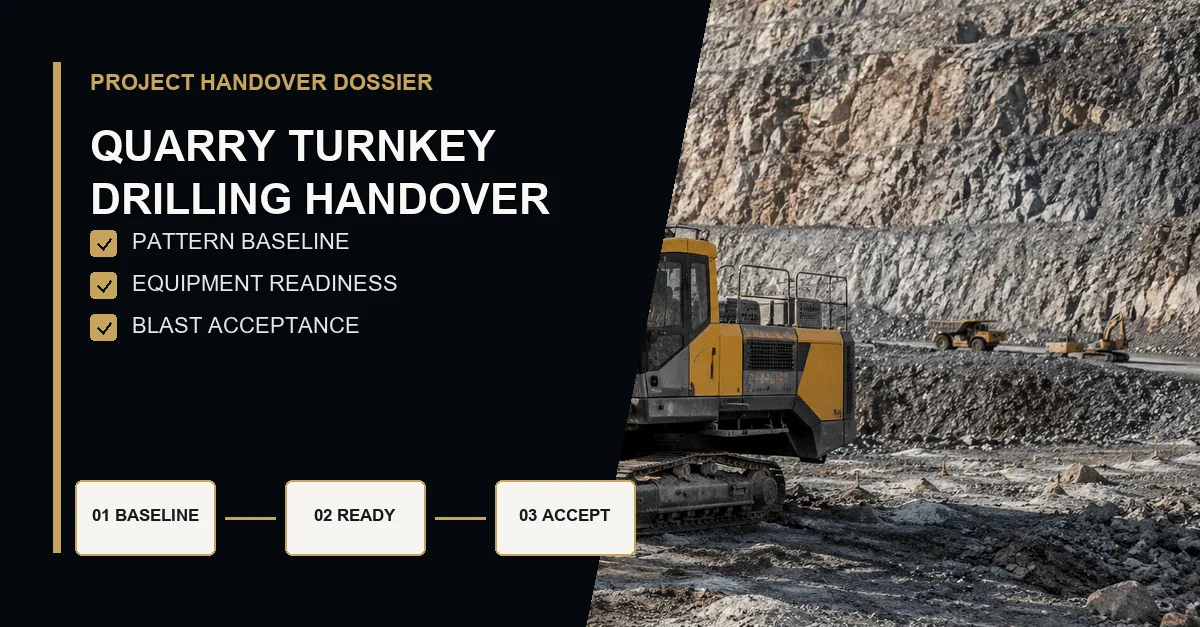
Quarry Turnkey Drilling Handover: Pattern Baseline, Equipment Readiness, and Blast Acceptance
A quarry handover is not complete when the rig starts. It is complete when the approved hole pattern, the equipment readiness record, and the first-blast acceptance evidence describe the same project — with the same revision, responsibilities, and stop conditions.
Table of Contents
One Hour Before the First Production Hole
The drill operator was in the cab. The compressor had passed its start-up check, the rods were beside the rig, and the blast crew was preparing its own work area. Then the surveyor opened the drawing and found two pattern revisions carrying the same project name.
One drawing showed the current collar grid. The equipment checklist referenced the earlier hole diameter. The post-blast inspection sheet had no agreed field for recording replacement holes.
Everything looked ready from the bench road. Nothing was ready from the project record.
The real question is not whether the machine can begin drilling. It is whether the quarry can later prove which pattern was drilled, which equipment configuration was used, what changed in the field, and why the first blast was accepted or rejected.
A Handover Dossier Is a Control System, Not an Archive
Cross-border quarry projects often separate design, procurement, shipment, commissioning, drilling, and blasting across different companies and time zones. The handover dossier is the common operating language between those teams. It must work on the bench, not only in a document folder.
A practical dossier has three linked files. The pattern baseline states what should be drilled. The equipment readiness register proves that the drilling system can reproduce it. The blast acceptance record captures what the completed holes delivered downstream.
A common mistake is to collect documents by supplier instead of by project decision. The rig manual sits in one folder, compressor tests in another, and the blast report with a third contractor. When toe or oversize appears, nobody can follow one chain from drawing revision to actual hole and then to crusher response.
Dossier File
Question It Must Answer
Required Owner
Failure if Missing
Pattern baseline
Which approved grid, hole schedule, and exception rules govern this drilling round?
Quarry technical authority and the responsible licensed blasting or design party
The crew may drill the wrong revision, and the blast result cannot be compared with the intended design
Equipment readiness
Can the complete rig, air, tooling, support, and operator system execute the approved duty?
Equipment supplier, commissioning lead, and quarry operations representative
A machine may start while a hose, adapter, service tool, spare, or data record still blocks production
Blast acceptance
Did the as-drilled holes deliver an acceptable floor, fragmentation, muckpile, and crusher response?
Quarry manager with the responsible licensed blasting and monitoring parties
A visually impressive blast may be accepted despite hidden secondary breaking or crusher losses
File 1: Freeze the Pattern Baseline
The pattern baseline is the controlled reference for one drilling round. It should identify the drawing revision, coordinate or survey reference, bench and free-face assumptions, hole identifiers, planned collar positions, depths, inclinations, and the procedure for blocked, wet, abandoned, or replacement holes.
The file should distinguish design fields from field records. Planned values belong to the approved baseline. Actual collar, depth, inclination, condition, delay, and exception information belong to the as-drilled record. Mixing them on one unversioned sheet makes it impossible to see where execution departed from the plan.
Field usability matters. If operators identify holes by handwritten marks, the same identifier must appear on the drawing, drilling log, and pre-charge inspection. If the bench changes after scaling or cleaning, the revision must show who approved the updated grid and which earlier document became obsolete.
In my view, the most important line in the pattern file is the exception rule. Normal holes rarely create a responsibility dispute. A blocked hole discovered near shift change does — unless the record states who stops work, who approves a replacement, and who updates the final hole map.
The verified guide to quarry blast hole pattern design explains how burden, spacing, deviation, free face, and muckpile behaviour connect. The handover file makes those design relationships traceable at field level.
File 2: Prove Equipment Readiness
Equipment readiness is broader than a successful engine start. The register must show that the drilling platform, air system, drill string, consumables, dust or water controls, site utilities, service tools, critical spares, operator training, and maintenance responsibilities are ready for the approved hole duty.
The check must follow the operating chain. The selected bit and hammer must connect to the rods and adapters. The air supply must be reviewed for the stated duty and site conditions. Hoses, fittings, lubrication, lifting arrangements, and starter stock must be physically available, not merely shown on a quotation.
More importantly, the register should separate three statuses: delivered, inspected, and production-ready. A crate can be delivered but unopened. A machine can be inspected but waiting for an interface supplied by the quarry. Only the third status allows the complete system to support drilling without a known open item.
Readiness Block
Evidence to Attach
Bench-Side Check
Stop Condition
Rig and mast
Configuration record, inspection result, operating and safety documentation
Setup, movement, feed, rotation, mast positioning, rod handling, controls, and visible leaks or damage
The rig cannot reproduce the approved position, depth, inclination, or access requirement
Air system
Matched-duty statement, connection layout, inspection record, and maintenance requirements
Compressor, hoses, manifold or connections, lubrication, drainage, and operating stability
The complete air path cannot support stable drilling under the agreed conditions
Drill string
Approved bit, hammer, rods, adapters, and connection list
Correct interfaces, wear condition, thread protection, handling tools, and replacement availability
Any incompatible or unavailable connection can stop the drilling chain
Consumables and spares
Commissioning stock, operating starter stock, critical-spares list, and reorder ownership
Physical count, storage, identification, and access during the operating shift
The project can commission but cannot sustain the agreed initial operating period
People and records
Training attendance, competency sign-off, drilling-log template, maintenance handover, and escalation contacts
Operators can identify holes, record exceptions, stop unsafe work, and report equipment changes
The machine is ready but the operating and reporting system is not
Welldone Mining’s verified customized drilling solution describes project-based matching of crawler rigs, compressors, bits, rods, DTH hammers, accessories, spares, commissioning, training, and support around site conditions.
File 3: Define Blast Acceptance Before the Blast
The acceptance record must exist before drilling starts. Otherwise, the project chooses metrics after seeing the result. That turns technical acceptance into negotiation.
The pre-blast section should reference the approved pattern revision and as-drilled map. It should record exceptions that the responsible licensed blast team has reviewed, the agreed inspection method, the monitoring obligations required by the approved plan, and the people authorized to release or hold the work.
The post-blast section should capture the floor and toe condition, fragmentation assessment, oversize requiring secondary work, backbreak or crest condition where relevant, muckpile shape and diggability, loader observations, crusher interruptions, and required safety or environmental records. Numerical limits must be set by the project’s qualified parties for the actual bench, rock mass, explosive system, equipment, receptors, and local regulation.
The record should not ask only, “Did the blast pass?” It should ask which evidence supports the decision and what happens next. Accept for production, repeat because evidence is incomplete, or revise a controlled variable and run another trial.
The verified quarry blast efficiency evaluation guide covers fragmentation, oversize, toe, powder factor , flyrock, vibration, and repeatable post-blast assessment.
Build One Traceability Matrix From Hole to Crusher
The three dossier files become useful when their fields share the same identifiers. Pattern revision, bench, row, hole ID, equipment configuration, drilling date, exception code, blast event, and inspection record should connect without relying on memory.
Consider a hard toe found after excavation begins. The quarry should be able to locate the affected area, identify the relevant holes, check actual depths and exceptions, confirm the drilling configuration used, and review the accepted blast record. If the chain stops at “the operator remembers a difficult hole,” the project has data but no traceability.
A short matrix with consistent identifiers is more valuable than a large report assembled after the problem. It helps the team separate pattern assumptions, drilling execution, equipment condition, geological change, and regulated blasting decisions without assigning blame before reviewing evidence.
Shared Field
Pattern File
Readiness File
Acceptance File
Revision and date
Approved drawing version
Configuration valid for that version
Version evaluated after the blast
Bench, row, and hole ID
Planned location and duty
System and operator assigned to the work
Area linked to the observed result
Exception code
Approved response rule
Equipment or process issue recorded
Exception considered during result review
Responsible signatory
Technical approval
Commissioning and operating release
Production release or corrective action
Control Exceptions and Revisions Without Stopping Learning
A quarry cannot freeze geology. Fractures, water, weathered seams, access changes, and equipment wear will create exceptions. The dossier should make controlled change easier, not punish the crew for reporting reality.
Each exception needs a location, time, description, immediate action, approver, affected document, and closeout decision. If a replacement hole is approved, the as-drilled map changes. If the drill string changes, the readiness record changes. If the measurement method changes, the acceptance record changes.
The rule is simple: one change, one recorded reason, one responsible approval, and one result that can be reviewed. Without that discipline, the project may improve the next blast but lose the knowledge needed to repeat it.
Use Evidence to Close the Commercial Scope
Shipment documents prove that equipment moved. They do not prove that the quarry received a production-ready drilling system. Commercial closeout should therefore distinguish delivery acceptance, equipment commissioning, operator handover, and first-blast performance review.
The supplier should be accountable for the equipment and support scope stated in the contract. The quarry should provide the site utilities, access, operating inputs, and responsibilities assigned to it. Licensed blasting parties remain responsible for explosives work, authorization, exclusion zones, and monitoring under local law.
Evidence protects all sides. An open interface becomes a visible action rather than a later argument. A completed item carries a signed record rather than a verbal assurance. The project closes when the agreed scope and records are complete — not because the calendar reached the planned handover date.
Why Welldone Mining
Welldone Mining’s verified quarry and customized-solution pages start with the drilling application, formation, hole diameter, depth, working environment, air demand, and support requirement. That input-led process supports a handover dossier because each equipment decision can be traced to a stated project duty.
Matched package review: Rig, compressor, drill string, accessories, starter stock, and critical spares are checked as one drilling chain.Commissioning evidence: Testing, inspection, installation guidance, operator training, and maintenance handover can be built into the readiness record.Long-term operating support: Tooling, spares, maintenance responsibilities, and reporting routines are discussed before the initial site period begins.
For the wider application framework, review the verified quarry drilling solution .
Conclusion
A quarry turnkey handover needs three records that agree with each other. The pattern baseline defines the intended holes. The equipment readiness register proves the drilling chain can execute them. The blast acceptance record decides whether the result is fit for production.
Three files. One version-controlled project truth.
If the first blast produced toe tomorrow, could your team trace the affected area from the crusher observation back to the accepted blast record, the actual holes, the equipment readiness status, and the approved pattern revision?
Frequently Asked Questions
What belongs in a quarry drilling handover dossier?
At minimum, include the approved pattern baseline, as-drilled recording method, equipment and interface readiness register, commissioning and training records, exception log, first-blast acceptance method, required safety and environmental records, and named signatories.
When should the equipment readiness register be signed?
Sign it after delivered items have been inspected, connected, tested under the agreed procedure, and checked against the approved drilling duty. Delivery alone is not production readiness.
Who approves the blast acceptance record?
The contract and local law should define the signatories. Quarry management and the qualified licensed parties responsible for blast design, execution, authorization, and monitoring must retain their proper legal responsibilities.
How should a blocked or replacement hole be documented?
Record the hole ID, location, condition, time, immediate action, approving authority, replacement details where applicable, and the revised as-drilled map. The responsible blasting team must review the final hole condition before its regulated work proceeds.
Can Welldone Mining help prepare the equipment portion of the dossier?
Welldone Mining can support the matched equipment list, configuration record, testing and inspection evidence, commissioning plan, training, tooling, spares, and maintenance handover for the supplied drilling scope. Site-specific blast design and legal approval remain with the quarry’s qualified licensed professionals.
Build the Handover File Before the Rig Reaches the Bench
Send your drilling application, formation, planned hole depth and diameter, bench conditions, operating schedule, available power or fuel, and support requirements. Welldone Mining can structure the equipment and readiness scope around those verified inputs.
Website: www.welldonemining.com
Email: info@welldonemining.com