Quarry Turnkey Drilling Bid Leveling: Compare the Pattern, Equipment Scope, and Blast KPIs
Three turnkey quotations can show similar totals while covering three different projects. A technical bid-leveling sheet exposes that difference before contract award by placing the hole-pattern basis, equipment boundaries, site responsibilities, and blast-performance evidence on one comparison line.
Table of Contents
Three Prices, Three Meanings of Turnkey
The procurement team placed three offers on the meeting table. Their totals were close enough to invite a simple ranking. Then engineering opened the attachments.
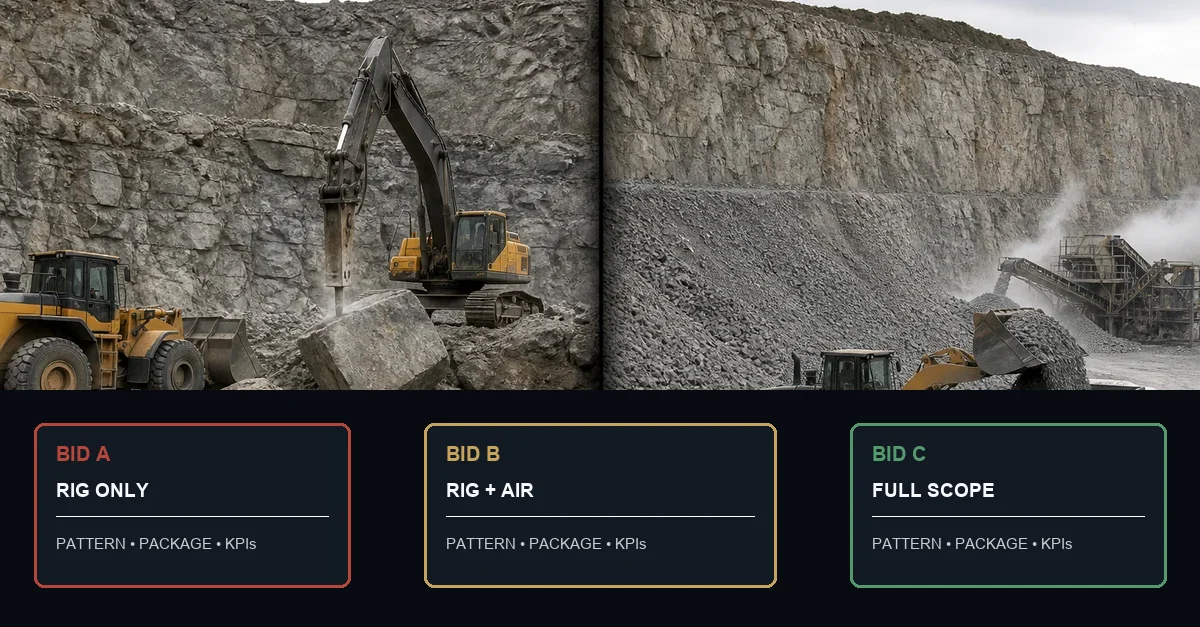
Bid A included a drill rig and standard tooling but treated the compressor, connection hoses, commissioning consumables, and site trial as owner supply. Bid B included the rig and air source but did not identify which drill-string connections or starter wear parts belonged in the price. Bid C cost more and included a matched package, field start-up records, training, and an agreed method for reviewing the first production result.
The cheapest number was not yet the cheapest project. It was the quotation with the largest unanswered scope.
The real question is not which supplier placed the lowest total on page one. It is which offer can execute the same approved hole pattern and produce evidence against the same downstream acceptance standard.
The Rule: Normalize Scope Before Price
A bid-leveling sheet is a comparison document that forces every bidder to answer the same technical and commercial questions. It converts marketing descriptions into comparable lines: included, excluded, optional, owner-supplied, subject to confirmation, or not offered.
The sheet should be issued with the request for quotation, not created after a preferred supplier has already emerged. Late clarification often protects the selected bid instead of testing it.
A common mistake is to compare equipment model names before confirming that all bidders received the same site basis. If one supplier assumes shallow holes in competent rock and another allows for variable benches, restricted access, dust control, and sustained multi-shift work, their prices describe different duties.
Leveling Layer
Question to Standardize
Typical Hidden Gap
Required Bid Response
Design basis
What bench, formation, hole geometry, access, schedule, and operating constraints govern the offer?
The bidder prices a convenient drilling duty rather than the owner’s actual duty
Confirmed assumption, stated deviation, or formal exception
Equipment chain
Which rig, air source, drilling tools , accessories, controls, spares, and services are included?
A major interface appears only after delivery
Itemized inclusion, quantity basis, interface owner, and readiness evidence
Blast outcome
How will drilling conformity and downstream blast performance be reviewed?
“Successful trial” has no agreed evidence or operating consequence
Measurement method, responsibility boundary, and acceptance record
Commercial boundary
Which exclusions can create owner cost, delay, or another purchase order?
A low bid transfers mobilization and production-readiness cost to the buyer
Priced option, owner supply, excluded duty, lead time, and closeout owner
Level 1: Use One Pattern Design Basis
Every bidder should price against one controlled design basis. At minimum, that basis should state the application, representative formation, bench geometry, required hole range, intended inclination, survey reference, access constraints, environmental controls, operating schedule, and the process for abnormal holes.
The owner does not need to freeze every future hole before tender. The owner does need to remove ambiguity about the drilling duty. Otherwise, a bidder may select equipment for nominal hole depth while overlooking edge access, rod handling space, repositioning time, unstable collars, or the need to record deviations.
The leveling sheet should separate “design responsibility” from “equipment capability.” A supplier may help translate site inputs into a drillable pattern and specify equipment around it. Final regulated blast design, charging, initiation, authorization, and monitoring remain with qualified and licensed professionals under local law.
In my view, pattern assumptions belong beside the quoted equipment, not in a separate appendix nobody checks. A change in hole geometry can alter reach, feed requirements, air demand, tooling, consumable planning, and daily production logic.
Use the verified guide to quarry blast hole pattern design when clarifying burden, spacing, free-face conditions, deviation, and muckpile objectives.
Pattern Input
Owner Basis
Bidder Confirmation
Commercial Impact if Different
Bench and access
Working width, face condition, edge restrictions, travel route, and setup area
Rig can access, position, drill, and relocate under stated constraints
Bench preparation, alternate rig class, slower movement, or additional support equipment
Hole duty
Required diameter and depth range, inclination, and expected formation variability
Quoted platform, feed, drill string, hammer, and bit cover the duty
Tooling replacement, lower productivity, extra passes, or redesign
Field control
Survey method, hole identification, logging, and exception approval
Operator workflow and records can support the required traceability
Additional survey support, data system, supervision, or rework
Operating environment
Dust, water, temperature, altitude, utilities, fuel, and shift expectations
Configuration and service plan are suitable for the stated environment
Auxiliary systems, derating review, consumables, or maintenance capacity
Level 2: Compare the Complete Equipment Chain
A turnkey equipment list should follow the energy and material path from the power source to the bit face. The list is incomplete if it names the drill rig but leaves air supply, connections, drilling tools, handling aids, dust or water controls, starter consumables, critical spares, commissioning, and training undefined.
More importantly, each line needs a status. “Included” means priced and supplied. “Optional” requires a quoted price and lead time. “Owner supply” needs an interface specification. “By others” must identify the responsible party. Blank means unresolved.
Do not accept “standard accessories” as a final answer. The phrase does not establish quantities, connection types, wear allowance, commissioning stock, or which service tools will be available when the machine reaches the bench.
The verified customized drilling solution shows why rigs, compressors, bits, rods, hammers, adapters, spare parts, and support need to be matched around depth, diameter, formation, air demand, and working conditions.
Package Line
Bid A
Bid B
Bid C
Clarification Required
Drilling platform
Included
Included
Included
Configuration, duty basis, transport, setup, and inspection evidence
Air supply and connection path
Owner supply
Included; interface open
Matched scope
Operating duty, hoses, fittings, lubrication, drainage, and responsibility at connection points
Hammer, bit, rods, and adapters
Standard set
Quantity not stated
Itemized starter package
Connection compatibility, quantities, wear basis, handling tools, and replacement lead time
Dust or water control
Excluded
Optional
Included for stated duty
Method, utilities, consumables, local requirements, and maintenance responsibility
Commissioning and training
Remote manual
Start-up guidance
Defined activities and records
Duration, personnel, language, travel, test conditions, sign-off, and open-item closure
Critical spares and service tools
Not listed
Recommended later
Priced list
Initial operating period, quantities, storage, replenishment, and response path
Illustrative comparison only. The Bid A/B/C entries above are not supplier quotations or customer data; replace them with the actual tender responses.
Level 3: Price Every Interface and Exclusion
Most budget surprises sit between equipment lines. A rig and compressor may both be included while the connection standard, hose length, pressure loss review, fuel arrangement, lifting plan, or site preparation remains outside both scopes.
The leveling sheet should convert each exclusion into one of four outcomes: owner-supplied with a specification, supplier-priced option, separate contractor package, or design issue requiring closure before award. Leaving the cell blank does not make the requirement disappear.
Site mobilization deserves its own section. Compare transport split, export packing, unloading, lifting, assembly, commissioning utilities, test materials, permits, visas where applicable, accommodation, return visits, and demobilization. The quote total is only comparable after those boundaries are visible.
A second section should cover data and documents: manuals, inspection reports, interface drawings, parts lists, training records, commissioning sheets, warranty start point, and the format of drilling or trial records. Missing documents may not stop customs clearance, but they can stop field acceptance.
Level 4: Normalize Blast-Efficiency Evidence
The technical comparison should not ask an equipment bidder to guarantee a blast result it does not control. It should ask each bidder to explain how the supplied drilling system supports the required hole duty, what conformity evidence it can produce, and what support it includes during the agreed trial period.
The quarry’s licensed blasting team defines the regulated blast plan and site limits. The owner then connects drilling evidence to downstream operating measures: floor and toe condition, fragmentation, material requiring secondary breaking, muckpile diggability, loader behaviour, crusher interruptions, feed stability, and all required compliance records.
A phrase such as “good blasting result” cannot be leveled. Neither can “customer satisfaction.” Each bidder should be compared against the same measurement method, responsibility boundary, trial duration, data owner, and process for changing a controlled variable.
The useful bid distinction is not a promised percentage. It is whether the supplier defines a repeatable route from approved duty to configuration, field records, trial support, and corrective action.
The verified article on quarry blast efficiency evaluation explains why fragmentation, oversize, toe, muckpile behaviour, and crusher response need consistent measurement.
Performance Line
Common Weak Wording
Leveling Question
Comparable Evidence
Hole conformity
Accurate drilling
What planned-versus-actual records and exception process are included?
Controlled hole IDs, status, depth, inclination where required, and approved departures
Fragmentation
Uniform rock size
Who measures, where, when, and by which repeatable method?
Agreed sampling or image method tied to the same trial area and downstream requirement
Oversize and toe
Minimal secondary breaking
What qualifies as oversize or unacceptable floor condition for this quarry?
Site-defined threshold, inspection record, affected location, and secondary-work log
Loading and crushing
Higher productivity
Which operating observations show that the result fits the loader and crusher?
Diggability notes, bridging or interruption records, feed stability, and operating context
Compliance
Safe blast
Which licensed party owns approvals, execution, exclusion zones, and required monitoring?
Records required by the approved blast plan and local regulation
Convert Scope Gaps Into Commercial Questions
A scope gap becomes useful only when procurement assigns a consequence. Ask whether it creates an extra purchase, additional contractor, owner labour, longer mobilization, operational risk, or an unpriced acceptance dispute.
Do not fill the sheet with invented cost allowances when quotations are incomplete. Request a firm inclusion, priced option, or written exclusion. If the owner must estimate the gap for internal comparison, label the allowance, source, assumptions, and uncertainty separately from the bidder’s submitted price.
The lowest evaluated bid may still be the lowest tender. The process simply prevents an incomplete price from being mistaken for an efficient project.
Commercial Question
Bidder Response Needed
Owner Evaluation
Is the item in base price?
Included quantity, model or specification, delivery point, and tax or freight basis
Comparable base scope or adjustment required
Is it optional?
Firm option price, validity, lead time, and effect on other equipment
Select before award or reserve a documented later decision
Is it owner-supplied?
Interface specification, required date, inspection responsibility, and consequence if unavailable
Budget, schedule, contractor, and coordination provision
Is performance conditional?
Explicit site, operator, maintenance, consumable, and utility assumptions
Confirm achievable conditions or revise the comparison basis
What closes acceptance?
Required records, test procedure, responsible signatories, open-item process, and remedy boundary
Tie commercial release to verifiable evidence
Run the Clarification Meeting Line by Line
Issue the draft leveling sheet before the clarification meeting. Ask bidders to mark every line rather than reply with a revised brochure. During the meeting, record the answer, responsible person, due date, and whether the response changes price or delivery.
After clarification, issue one controlled commercial and technical schedule. Do not rely on meeting minutes alone when they conflict with the proposal. The final contract should identify which document prevails.
Unresolved items should remain visible at award. A “to be confirmed later” cell needs a decision owner and closure date; otherwise it becomes a site problem assigned to whoever is standing closest to the machine.
The verified quarry drilling solution provides a practical reference for quarry applications, drilling methods, rig categories, air systems, tooling, and support topics that should appear in the clarification schedule.
Why Welldone Mining
Welldone Mining structures drilling discussions around the actual site duty: application, formation, hole depth and diameter, terrain, air demand, operating environment, and support needs. That approach helps procurement compare a connected operating package instead of isolated model names.
Matched configuration: The rig, compressor, hammer, bit, rods, adapters, and accessories are reviewed as one drilling chain.Scope transparency: Included items, owner interfaces, optional equipment, starter consumables, spares, commissioning, and training can be identified before award.Readiness support: Inspection records, operation guidance, maintenance planning, and escalation paths can be incorporated into the project handover.
Conclusion
A tender comparison becomes reliable only after every bidder prices the same drilling duty, equipment boundary, site interface, support scope, and performance evidence. Until then, the totals are not competing answers to one question. They are prices for different projects.
Normalize first. Compare second. Award last.
If your preferred bidder won tomorrow, which blank cell in its quotation would become your first variation order?
Frequently Asked Questions
What is a quarry turnkey drilling bid-leveling sheet?
It is a controlled comparison table that places every bidder against the same design basis, equipment list, interface boundary, support scope, performance evidence, and commercial response category.
Should the lowest price be adjusted for missing scope?
First ask the bidder to confirm an inclusion, firm option, or written exclusion. If the owner uses an internal allowance, keep it separate from the submitted price and document its source, assumptions, and uncertainty.
How detailed should the equipment list be?
It should be detailed enough to show the full operating chain: drilling platform, air source, connections, drilling tools, controls, service tools, consumables, critical spares, commissioning, training, documentation, and owner-supplied interfaces.
Can an equipment supplier guarantee blast performance?
Not as a stand-alone promise. Blast results also depend on geology, actual drilling, regulated blast design, explosives, initiation, execution, and operating conditions. Compare the supplier’s drilling capability, conformity evidence, trial support, and responsibility boundary.
What information should I send for a comparable quotation?
Provide the drilling application, formation, bench and access conditions, planned hole depth and diameter, inclination needs, operating schedule, available utilities, dust or water constraints, required records, site responsibilities, and expected support scope.
Send One Bid Basis, Receive a Comparable Project Scope
Share your site duty, pattern assumptions, required equipment modules, owner-supplied interfaces, operating schedule, and acceptance expectations. Welldone Mining can prepare a matched drilling package and itemized clarification response for technical evaluation.
Website: www.welldonemining.com
Email: info@welldonemining.com