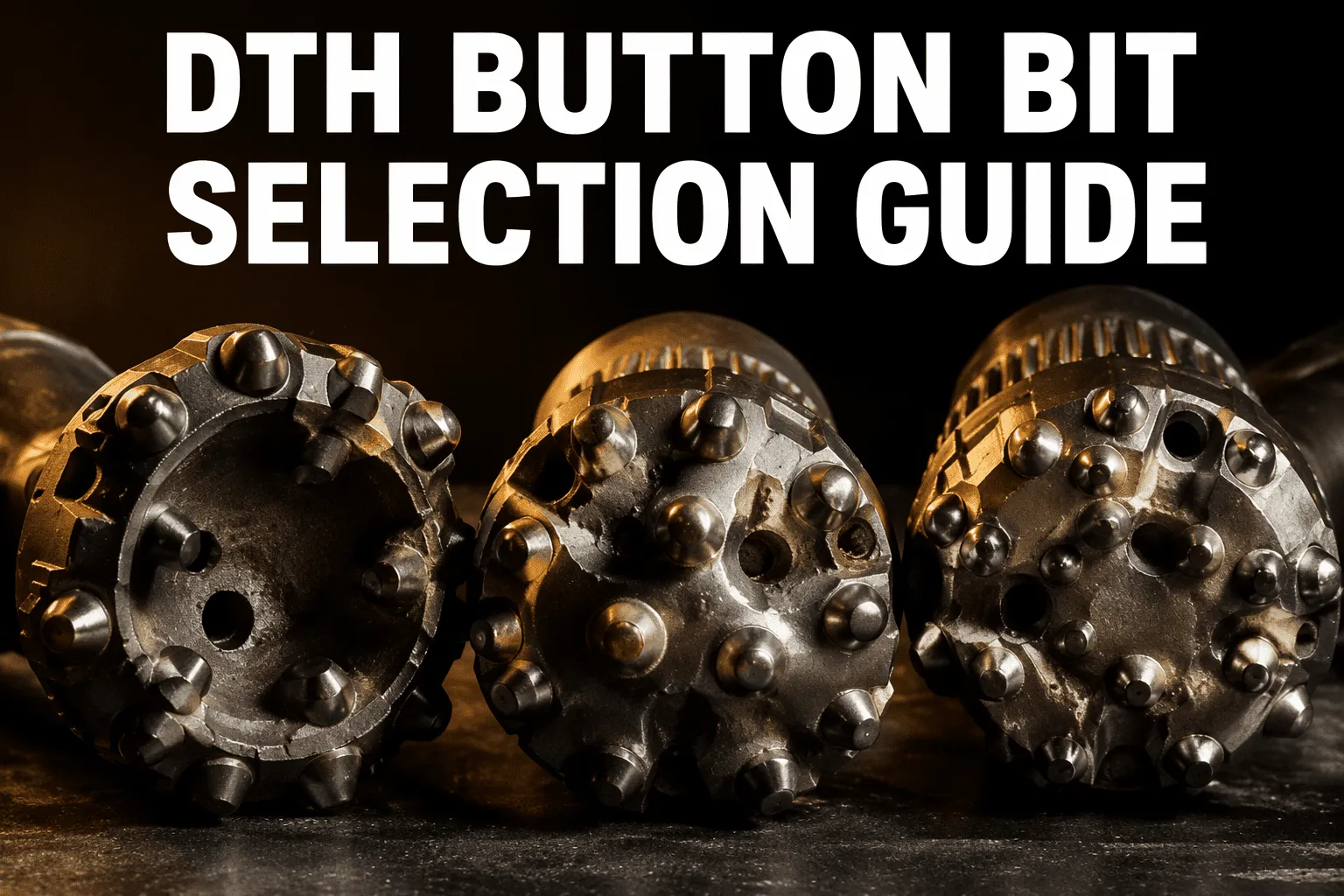
DTH Button Bit Selection: A Practical Guide to Face Design, Carbide Grades, and Rock Matching
Most drilling contractors select DTH bits by diameter, thread, and price — then wonder why their cost per meter is double what a competitor pays. This article — Part 3 of our DTH drilling series — walks through the six decisions that determine whether your bits drill 50 meters or 500 meters, and gives you a field test any driller can run on used bits to diagnose the wrong grade.
Seven Dead Bits on a Steel Table in Bloemfontein
A site manager at a granite quarry outside Bloemfontein walked me over to a steel table next to his rig last month. Laid out in a row were seven DTH bits, all 6-inch, all the same shank. Every one of them was dead.
"Four weeks," he said. "Same hole pattern, same compressor, same crew."
I picked up the first one. Concave face. The center buttons were rounded off — not worn, melted. The carbide had sat in a pool of its own cuttings for three days straight and given up. On 180 MPa granite.
That is a face design mismatch, not a bit quality problem. And it is the single most common bit failure I see on hard-rock sites — because the supplier shipped whatever was on the shelf, and nobody asked about the rock.
Face Design: The Shape of the Steel Before the Carbide Touches Rock
The face profile controls how impact energy transfers from the piston through the buttons into the rock. Three designs dominate the market, and each has a specific job.
Concave face centers the rock-breaking zone. The recessed center traps cuttings briefly, forcing the peripheral buttons to re-grind them. On soft to medium formations — shale, limestone, dolomite — the re-grinding produces finer particles that flush out cleanly. Put that same concave face on hard granite and the center buttons never escape the debris. They sit in abrasive soup, overheating, rounding off. Bloemfontein's seven dead bits, exactly.
Convex face pushes the center buttons forward first. On hard, abrasive formations — granite, quartzite, basalt — this concentrates impact energy into a smaller contact area, and the convex profile sheds cuttings outward instead of pooling them at the center. Almost always the right starting point above 120 MPa.
Flat face distributes impact evenly across all buttons. It works on homogeneous medium-hard rock — the kind where the formation does not change for 200 meters. On fractured ground, a flat face bounces because too many buttons hit uneven surfaces at once, and vibration eats energy that should be going into the rock.
If you drill one formation all year, face design is a one-time decision. On mixed ground — weathered overburden on top, hard granite at depth — start with convex and monitor button wear at 100 meters.
Button Shape: Day-One Speed vs. Month-Two Endurance
Button geometry is a trade-off between penetration rate and wear life. Every driller wants both. Physics gives you one or the other.
Ballistic buttons have a bullet-shaped tip. They penetrate 15 to 20% faster than hemispherical in medium rock because the sharp profile concentrates impact energy into a tiny contact area. On abrasive quartzite, that sharp tip rounds off in 40 to 50 meters. Penetration drops by a third. You are now drilling with what is effectively a worn hemispherical button that cost more. Fast for two days, slow for ten — that math does not work.
Hemispherical buttons are the workhorse. Half-sphere geometry means more carbide volume behind the contact face. Slower in soft rock, but on abrasive granite a hemispherical button holds its profile for 150 to 200 meters — three to four times longer than ballistic. If bit life is your primary cost driver, this is almost always the right answer.
Parabolic buttons split the difference. A softer curve than ballistic but sharper than hemispherical. About 10% faster than hemispherical with most of the wear resistance retained. For medium-hard, moderately abrasive formations — sandstone, dolomite — parabolic is often the optimal balance.
A common mistake is specifying ballistic buttons for "faster drilling" without checking the quartz content of the formation. The bit supplier does not ask. The order goes through. Forty meters later, the expensive ballistic buttons are round.
Carbide Grade: When Harder Means Weaker
Carbide grade is the single most misunderstood specification in button bit purchasing. Many buyers ask for "the hardest grade available." Harder equals longer life, right? Wrong — at least, not in the way they think.
Tungsten carbide hardness and toughness move in opposite directions. Cobalt is the binder. Higher cobalt — 10 to 12% — produces tougher carbide that absorbs impact without cracking. Lower cobalt — 6 to 8% — produces harder carbide that resists abrasion but fractures under high impact. A DTH hammer delivers 1,500 to 2,200 blows per minute. Each blow is a shock wave through the button. A hard, brittle button will chip at the tip or snap before it wears down.
In abrasive but solid rock — tight sandstone — higher hardness grades hold their edge. In broken, blocky ground where buttons take uneven impact, tougher grades survive. The right grade is the one that wears evenly, not the one that stays sharpest.
Read Your Used Buttons Before You Order the Next Set
This is the highest-value 60-second inspection in DTH drilling, and almost nobody does it. Pull a used bit off the rack and look at the button tips.
- Small chips or cracks at the tip = your carbide grade is too hard for your impact conditions. Move to a higher-cobalt grade.
- Buttons mushrooming or flattening without chipping = your grade is too soft for your abrasion level. Move to a lower-cobalt grade.
- Even wear with a slight rounding of the tip profile = you are in the sweet spot. Reorder the same specification.
- Center buttons melted or scorched, outer buttons still sharp = face design mismatch, not a carbide problem. You are running concave on hard rock, or convex on soft rock.
- Gauge buttons worn down more than face buttons = your formation is more abrasive than the standard gauge can handle. Move to heavy-duty gauge.
Photograph the wear pattern on every retired bit. Over a few orders, the pattern will tell you more about your rock than any lab report.
Gauge Design: The 10% That Saves Your Shift
Gauge buttons sit around the outer diameter of the bit and cut the hole wall. Standard gauge uses the same button size as the face buttons. Heavy-duty gauge uses larger buttons with 15 to 20% more protrusion and more carbide behind each contact point. It costs about 10% more.
On solid, competent rock, standard gauge is fine. On fractured formations, the hole wall laps against the gauge row constantly. Standard gauge buttons wear down, the body diameter shrinks, the hole tapers. The next bit jams. The crew spends an hour pulling stuck steel — and depending on how hard they torque it, the hammer and rod threads may be damaged too.
Heavy-duty gauge is not an upgrade. It is insurance against a problem that costs more than the entire bit order. If you drill fractured basalt, weathered granite, or highly abrasive sandstone, pay the 10%. The first time it prevents a stuck bit, it pays for itself twenty times over.
Flushing Holes: Keeping the Face Clean
Flushing holes direct compressed air through the bit body to blow cuttings out of the hole. Their number, angle, and diameter determine whether the bit face stays clean or packs with debris.
A bit with inadequate flushing regrinds cuttings instead of breaking new rock. Buttons hammer through the same crushed material repeatedly. Insert temperature spikes. Carbide grade that would normally last 400 meters starts failing at 80. In wet conditions, poor flushing leads to bit balling — wet cuttings pack into a paste that plugs the holes and stops the bit from cutting at all.
Most standard DTH bits use three to five flushing holes angled outward. For holes beyond 150 meters, or wet conditions, bits with larger hole diameters or additional peripheral flushing grooves maintain cleaner faces. The trade-off is structural: more holes mean less steel in the bit body.
Match flushing configuration to your compressor output — a bit designed for high airflow will choke on a marginal compressor. This is where bit selection connects directly to compressor sizing, which we covered in Part 2 of this series.
Shank: Standard vs. Spline Drive
The shank connects the bit to the hammer's driver sub and transmits rotation torque. Two designs dominate.
Standard shank uses two drive flats or lugs that engage slots in the driver sub. Simpler, cheaper, adequate for straight-hole drilling in consistent rock. Under high torque — deep holes or broken ground — the limited lug contact area concentrates stress, and the lugs can deform after extended use, especially above 8-inch diameter.
Spline drive replaces lugs with eight to twelve longitudinal splines around the shank circumference. Torque distributes across a much larger contact area. Spline drive bits tolerate higher rotational loads without shank deformation, making them the standard for deep holes, directional work, and large-diameter applications. For holes beyond 100 meters in broken ground, lug deformation on a standard shank can end the bit's life before the buttons wear out.
This is not a performance debate. It is a torque distribution problem. If your driller is fighting rotation resistance at depth, check the shank before blaming the hammer.
Match Bit to Formation: Three Questions That Cover 90% of Decisions
Most drillers describe their formation as "hard," "broken," or "soft." Bit selection needs more precision than that. Three questions clarify almost every decision.
First — what is the unconfined compressive strength (UCS)? Under 50 MPa — soft limestone, shale, claystone — concave face with ballistic buttons. Above 150 MPa — granite, quartzite, basalt — convex face with hemispherical or parabolic buttons. Between 50 and 150 MPa, parabolic buttons on a flat or slightly convex face cover most ground.
Second — how fractured is the formation? Solid rock transmits impact energy cleanly. Broken ground absorbs it unevenly, and buttons take side loads that chip carbide. On fractured ground, convex face, tougher carbide grades, and heavy-duty gauge are non-negotiable.
Third — how abrasive? High quartz content means high wear. Hemispherical buttons with moderate cobalt grades last longest. If the rock is both hard and abrasive, convex face + hemispherical buttons + heavy-duty gauge is the standard combination. Not exciting, but it drills the most meters per bit — and meters per bit is what pays the invoices.
If you do not know your formation's UCS, spend USD 200 on a core test. A USD 200 lab report that prevents a USD 2,000 bit from failing at 40 meters is one of the highest-return investments in drilling.
Cost Per Meter: The Only Number That Counts
Bit price is the number on the invoice. Cost per meter is the number that determines whether your drilling program makes money.
A USD 500 bit that drills 100 meters costs USD 5.00 per meter. A USD 350 bit that drills 50 meters costs USD 7.00 per meter. The cheaper bit costs 40% more where it counts.
Bit life is only half the equation. Penetration rate matters too. A bit that drills 10 m/hr for 150 meters consumes 15 hours of rig time, fuel, labor, and compressor hours. A bit that drills 7 m/hr for 200 meters consumes 28.5 hours. The slower bit lasts longer but may cost more overall.
The optimal bit is the one with the lowest total cost per meter — bit price plus rig operating cost, divided by total meters drilled. Not the cheapest bit. Not the longest-lasting. Track both meters drilled and meters per hour, then divide total drilling cost by total meters. That single number tells you more than any catalog specification.
The Question to Take to Your Next Bit Supplier
"What is the price per bit?" is a purchasing question. Every supplier can answer it. Try this instead:
"What face design, button shape, and carbide grade do you recommend for my formation — and can you back it with reference site data at a similar UCS and abrasiveness?"
If the supplier's next question is your UCS, fracture pattern, quartz content, hole depth, and hammer model — you are dealing with someone who specifies bits. If the supplier's next question is diameter and thread — you are dealing with someone who ships stock. Stock bits produce stock results: average penetration, average life, and a cost per meter that averages out to more than it should.
Why Welldone Mining
Welldone Mining manufactures DTH bits in our own facility — carbide button pressing, heat treatment, machining, and final assembly under one roof. That gives us control over two things most resellers cannot touch: carbide grade formulation and face design optimization for specific rock types.
What our DTH bit customers get:
- Application-matched carbide, not one-grade-fits-all. Five standard carbide grades in stock. We select the grade based on your reported UCS, abrasiveness, and fracture characteristics — not the same bit we ship to the last customer.
- Four-question specification profile before manufacturing. Formation type and UCS, hammer model and shank, compressor output, hole depth range. That profile produces a bit spec matched to your actual drilling conditions, not a catalog default.
- Post-sale wear analysis. Send us photos of your used bits. Our engineering team reads the wear pattern — button chipping, gauge rounding, face washout — and adjusts future orders. Bit selection improves over time because we learn your rock alongside you.
Related Solutions
DTH button bit selection is one decision inside a full drilling system. Buyers evaluating a bit order typically look at these solution pages together:
- Quarry Drilling Solution — Blast hole drilling packages for hard-rock quarries, with high-pressure compressors, heavy-duty DTH hammers, and hole-deviation control.
- Water Well Drilling Solution — Complete water well drilling packages for depths from 80 to 400 meters, with rig, hammer, compressor, and drill pipe matched to formation and target diameter.
- Customized Drilling Solution — Complex formations, mixed hole diameters, non-standard depth targets. One engineering owner from spec to acceptance.
Conclusion
Bit selection is not about finding the "best" bit. It is about matching the bit to your rock, your hammer, your compressor, and your cost structure. Face design, button shape, carbide grade, gauge, flushing, and shank all interact. Change one and the others shift.
If your driller can describe his formation in terms of UCS, fracture pattern, and quartz content — not just "hard" or "soft" — you are already ahead of 80% of the market. The next step is ordering bits that are specified, not just purchased.
The real question is not which bit brand is best. It is whether the bit arriving at your site was specified against your rock — or picked off a shelf against your diameter.
Website: www.welldonemining.com
Email: info@welldonemining.com
Frequently Asked Questions
What is the most common reason DTH button bits fail prematurely?
Face design mismatch with rock hardness. A concave face on hard granite causes the center buttons to sit in abrasive cuttings, accelerating wear. A convex face on soft shale concentrates too much impact energy in too small an area and over-penetrates without efficient rock removal. Both failures look like "bad carbide" to the operator — the actual cause is the face profile.
How often should DTH button bits be resharpened?
Resharpen when the button wear flat reaches approximately one-third of the button diameter. Waiting longer reduces the carbide available for future resharpenings and increases the risk of button fracture during grinding. A bit resharpened at the right interval typically delivers two to three resharpening cycles before retirement.
Can I use the same bit for water well drilling and quarry blasting?
Only if the formation is identical. Water well drilling often encounters mixed overburden, weathered zones, and alternating hard/soft layers. Quarry blasting typically targets one homogeneous rock mass. Face design and carbide grade requirements differ substantially. For water well projects, see our Water Well Drilling Solution for system-level guidance.
What information should I provide when ordering DTH bits?
Formation type and UCS, hole diameter and depth range, hammer model and shank type, compressor output (CFM/bar), and whether the ground is solid or fractured. Five data points. Without them, your supplier is guessing. With them, bit specification becomes engineering, not gambling.
Is it worth paying extra for heavy-duty gauge buttons?
In abrasive or fractured rock: yes, almost always. The 10% price premium buys 30 to 50 extra meters of consistent hole diameter and eliminates the risk of a stuck bit from a tapered hole. The cost of one stuck-bit recovery operation typically exceeds the gauge upgrade cost for an entire order of bits. Contact us at info@welldonemining.com with your formation abrasiveness data for a gauge recommendation.