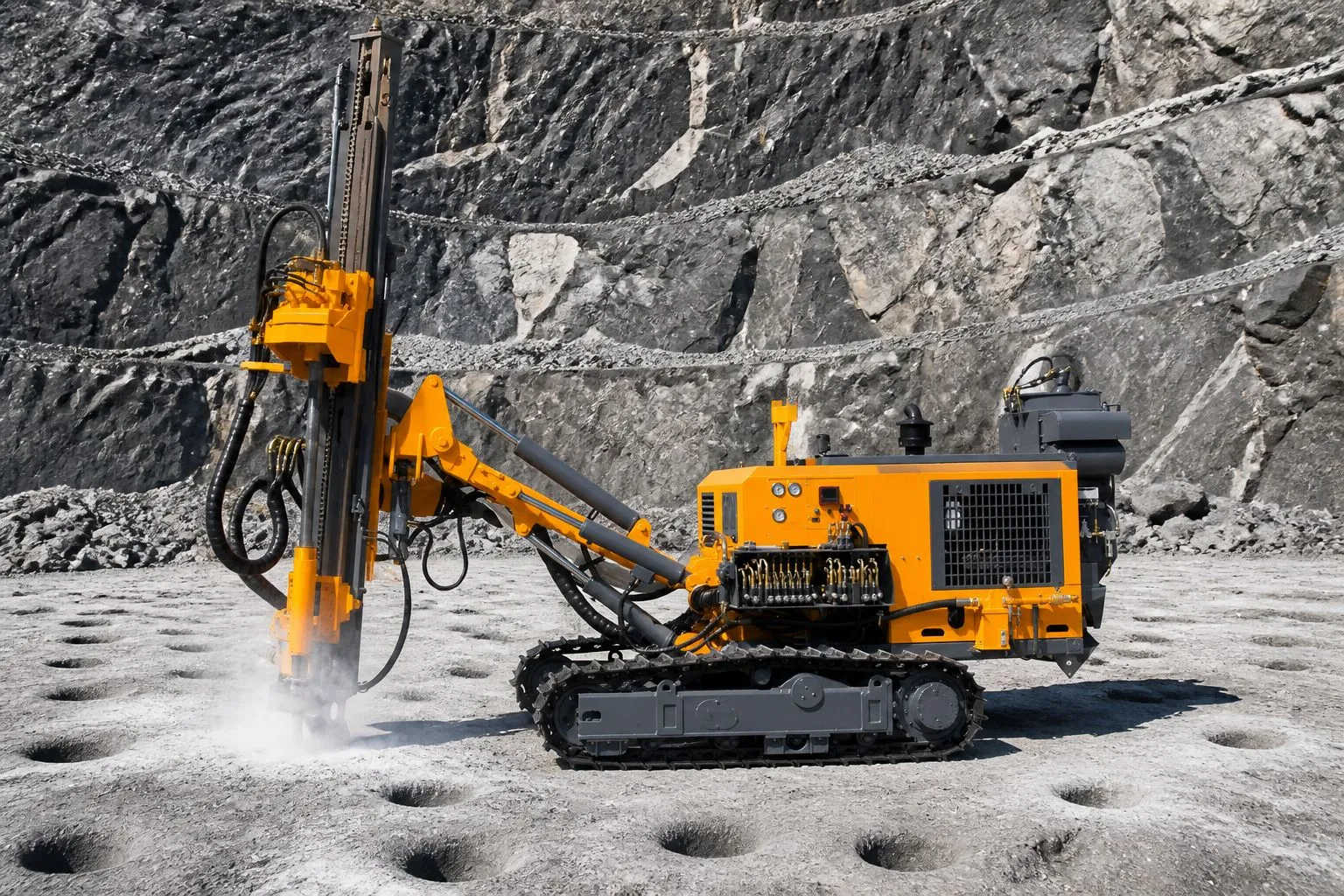
Crawler vs Wheeled DTH Drilling Rig for Quarry Blast Holes: Ground Pressure, Slope Traction, and Hole Diameter
Most quarry drilling decisions come down to "crawler or wheeled" — and most buyers resolve that question by asking about slope rating alone. Slope rating tells you whether a rig can climb a ramp. It does not tell you whether a rig can hold position on fractured bench rock under drilling load, how long it takes to reposition between blast rows, or whether its air consumption matches the compressor you already own. This guide — Part 1 of our crawler drilling rig series — covers the four parameters that actually separate the two platforms.
The 28-Degree Slope That Stopped a Wheeled Rig
A quarry manager in the Ethiopian highlands called last year. He was running a wheeled DTH rig on a basalt quarry — flat benches, straightforward blast pattern, no terrain issues for two years. Then the quarry expanded into a new face with a 28-degree approach slope to the working bench.
The wheeled rig made three attempts in dry conditions. Each time, the drive wheels spun on loose basalt chips at around 24 degrees and the rig slid back. The operator tried lower tire pressure. Then rock-fill on the slope. Then a cable winch. None of it held reliably enough for safe daily operation.
A crawler rig arrived on site the following week. It walked the slope on the first attempt, positioned on the bench, and drilled the day's blast holes without incident.
The wheeled rig was correctly specified for the original site. The decision to expand the quarry face changed the terrain requirement, and wheeled traction could not follow it. The crawler solved a problem the original rig was not built for — at a cost that was substantially less than the lost production from six weeks of improvised access solutions.
Ground Pressure: The Parameter Nobody Calculates at Purchase
Slope rating is the specification buyers compare. Ground pressure is the specification that determines whether the rig stays where it is positioned under drilling load on real ground.
Ground pressure is simply machine weight divided by total track contact area. A crawler rig weighing 4,150 kg with a total track contact area of approximately 1.2 square meters exerts around 34 kPa on the surface beneath it. This matters in two distinct ways on quarry sites.
On soft or loose ground — stockpile areas, haul road shoulders, freshly blasted bench surfaces before cleanup — low ground pressure prevents the rig from sinking and bogging. Standard safe limits for soft ground are typically in the 50 to 70 kPa range; most crawler rigs operate well within that. Wheeled rigs concentrate load on four contact patches and routinely exceed those limits on loose ground.
On slopes, the relationship is less intuitive. Lower ground pressure reduces slip risk not through friction coefficient — that depends on track material and rock surface — but by distributing load more evenly across the contact length, reducing the point-loading that initiates slip at the leading edge of the track. A wheeled rig on a 25-degree granite slope is essentially balanced on four small contact patches. A crawler distributes the same weight over a long track surface that wraps the contour of the rock beneath it.
The practical result: crawler rigs hold position on slopes that are well below their rated maximum, and they hold that position under the lateral and vertical forces of a DTH hammer driving steel into rock. A rig that climbs a slope on its own power can still shift during drilling if the ground pressure distribution does not match the drilling load. Slope rating does not account for this. Ground pressure does.
Repositioning Speed: Where Wheeled Rigs Win Back Time
If ground pressure and slope favour crawlers, repositioning speed runs the other direction.
A wheeled rig drives between hole positions at road speed — typically 15 to 25 km/h on site roads. Between holes on a flat bench, it moves, locks its stabilisers, positions the mast, and starts drilling within a few minutes of completing the previous hole. On a well-organised flat bench with a consistent blast pattern, hole-to-hole cycle time is fast and predictable.
A crawler rig travels at 2 to 2.5 km/h. On a bench with 50 holes spread across 200 meters, the travel time between holes is a real production cost. Over an eight-hour shift, repositioning time can consume a significant fraction of available drilling time that a wheeled rig would spend drilling.
The trade-off is simple: if your benches are flat, your ground is firm, your blast pattern is dense, and your quarry access is good sealed road — a wheeled rig is often faster. If your terrain is variable, your benches are irregular, your slopes require regular access, or your ground conditions are unpredictable — the crawler's stability and traction usually recover its repositioning penalty in reduced downtime and fewer stuck-rig incidents.
Hole Diameter Matching: The Specification Buyers Read Wrong
Crawler drill rigs in the 90 to 130mm hole diameter range are the core of open-pit quarry blast hole work. Understanding how the diameter specification works in practice saves both undersizing and oversizing errors.
The rig's stated hole diameter range — 90 to 115mm on a standard unit, 90 to 130mm on a heavier platform — refers to the bit size the hammer and rotation system can drive efficiently. Within that range, the rig can vary hole diameter by changing bit and hammer. A rig quoted for 90 to 130mm can drill 90mm blast holes in limestone and 130mm anchor holes in the same site with equipment changes, not machine changes.
The limit at the top of the range is not the rig's structural limit — it is the point at which the hammer requires more air volume than the rig's onboard compressor or the matched external compressor can supply. Hole diameter and air demand are linked directly: a 130mm hole in granite requires substantially more flushing volume than a 90mm hole, and the compressor must supply it or the cuttings will not clear.
The practical implication: do not specify hole diameter without confirming air supply. A rig rated to 130mm with a compressor sized for 90mm holes will produce poor cuttings evacuation, slow penetration, and accelerated bit wear at the top of its diameter range — while performing well at the bottom. The interlock between hole diameter, hammer size, and air volume is covered in detail in our quarry drilling solution.
Four Site Characteristics That Decide the Platform
Rather than comparing specifications in isolation, match platform to site type. These four characteristics cover the large majority of quarry configurations.
| Site Characteristic |
Favours Crawler |
Favours Wheeled |
| Bench access slope |
Above 20° or irregular terrain |
Flat to 15°, good site roads |
| Ground condition |
Loose, blasted rock, variable surface |
Firm, compacted, consistent |
| Blast pattern density |
Sparse pattern, long travel between rows |
Dense pattern, short repositioning distances |
| Quarry layout |
Multiple working faces, irregular geometry |
Single face, consistent bench geometry |
Sites that score consistently on one side of this table have a clear answer. Sites that split across both columns — flat benches on irregular ground, or dense patterns on sloped access — usually resolve in favour of crawlers, because traction and stability failures cause production losses that repositioning speed cannot offset.
Dust Collection: The H-Series for Dry Blasting Regulations
An increasing number of quarry operations — particularly in markets with active dust and silica regulation — cannot vent dry cuttings directly to atmosphere. Dry basalt, granite, and quartzite dust from blast holes contains respirable crystalline silica, and regulators in several Middle Eastern and African markets are progressively tightening site dust limits.
Standard crawler drill rigs vent cuttings through the borehole collar with no collection. H-series rigs — designated by the H suffix in the model line — include an integral dust collection system, typically fitted with a multi-cartridge filter unit at the collar. Dust is captured rather than dispersed, and the filtered air is returned to atmosphere clean.
The H-series carries a higher unit cost and slightly higher on-site maintenance burden for filter cartridge replacement and cleaning. The trade-off is avoided regulatory exposure and lower site dust levels that affect operator health and neighbouring community relations. For projects subject to environmental impact assessment requirements, or in markets where dust regulations are tightening, the H-series is worth specifying from the outset rather than retrofitting later.
The Solar and Photovoltaic Application
One of the fastest-growing crawler drill applications in several markets is hillside solar farm pile hole drilling. Mountain and hillside photovoltaic installations require anchor holes for pile foundations — typically 150 to 250mm diameter, 1.5 to 3 meters deep — drilled across slopes that range from moderate to steep.
Crawler rigs handle this work well for the same reasons they handle irregular quarry terrain: slope capability, self-levelling or wide-range mast adjustment, and stable positioning without stabiliser outriggers that require level ground. Specialised GF-series (光伏 / photovoltaic) variants exist for this application, with geometry optimised for shallow-angle pile holes rather than steep blast-hole angles.
Quarry contractors considering fleet diversification into solar construction work should check whether their existing crawler rig geometry accommodates shallow-angle drilling before investing in a dedicated GF unit. Many standard blast-hole rigs can manage the angles with mast adjustment; the GF configuration primarily optimises cycle time for shallow high-volume hole patterns.
Three Questions Before You Specify
Question 1 — "What is the maximum slope angle to any working bench in this quarry, including during seasonal operations?"
Not the current average. Quarries expand, and the face that requires a 28-degree approach typically appears after the flat benches are exhausted. If there is any likelihood of terrain increasing over the quarry life, specify for the worst case now.
Question 2 — "What hole diameter does my blast design require, and what compressor does that diameter need at my formation hardness?"
Blast designers specify burden, spacing, and hole diameter to achieve target fragmentation. That diameter drives the hammer, which drives the air requirement. Confirm all three are consistent before purchase.
Question 3 — "Do my project's environmental or regulatory requirements include dust collection?"
Retrofitting dust collection after delivery is expensive and rarely achieves the same integration as factory-built H-series units. Ask the question before specification, not after the first site inspection.
Why Welldone Mining
Welldone Mining manufactures crawler DTH drilling rigs across a full range for quarry, mining, and infrastructure applications — from compact 4,150 kg units for 90 to 115mm holes to heavier platforms for 130mm blast holes, in both standard and H-series dust-collection configurations.
What quarry customers get:
- Site-matched specification, including ground pressure calculation. Tell us your worst-case bench slope, your ground conditions, and your blast hole diameter, and we calculate the ground pressure and traction requirement before recommending a platform.
- Air package matched to hole diameter and formation. Rig, hammer, and compressor specified together against your blast design — not as three separate catalog selections that may or may not match.
- H-series dust collection assessment. We assess regulatory requirements in your target market and recommend dust collection specification where regulatory or project requirements justify it.
Related Solutions
- Quarry Drilling Solution — Complete blast hole drilling packages for hard-rock quarries, with rig, compressor, hammer, and drill string matched to formation and target diameter.
- Customized Drilling Solution — Non-standard hole diameters, mixed terrain, photovoltaic pile drilling, or integrating a new rig into an existing air package.
- DTH System Selection Guide — How rig, compressor, hammer, drill pipe, and bit parameters lock together, and the single calculation sheet that separates a system from a pile of compatible parts.
- Air Compressor Selection Guide — Delivered energy cost per meter, altitude and temperature corrections, and when a booster solves the problem instead of a larger primary unit.
Conclusion
The crawler-versus-wheeled decision is not primarily about slope rating. It is about whether your site's ground conditions, access geometry, and terrain variability over the quarry's operating life can be reliably served by a platform that concentrates load on four contact patches — or requires one that distributes it across two long tracks.
Slope rating tells you the maximum angle a rig can climb on a clean hard surface. Ground pressure tells you whether it holds position while drilling on fractured bench rock. Repositioning speed tells you how much of each shift goes to movement versus drilling. Hole diameter and air matching tells you whether the output is what the blast design requires.
The manager in Ethiopia who needed a crawler did not discover that until six weeks into an expansion. Specifying against the quarry's worst-case terrain from the outset costs nothing extra if you were going to need the crawler anyway — and avoids the production loss that teaches the lesson instead.
Website: www.welldonemining.com
Email: info@welldonemining.com
Frequently Asked Questions
What is the typical slope limit for a crawler DTH drilling rig?
Most crawler drill rigs are rated to 30 degrees of slope on firm ground. Practical traction on loose blasted rock or dusty granite is typically lower — around 22 to 25 degrees — because track-to-surface friction reduces on fine loose material. If your site regularly requires access slopes above 25 degrees in variable ground conditions, confirm traction performance with the manufacturer against your specific surface rather than relying on rated maximum slope alone.
Can a standard crawler blast-hole rig be used for photovoltaic pile drilling?
Often yes, for the slope capability and stability. The geometric constraint is mast angle: pile holes for solar foundations are shallow (typically 5 to 15 degrees from vertical rather than near-vertical blast holes), and not all blast-hole rigs have sufficient mast articulation range to reach those angles efficiently. Check the mast range specification before assuming a blast-hole rig covers the photovoltaic application.
How does the H-series dust collection system affect drilling productivity?
Filter cartridge maintenance adds a daily or shift-based task that standard rigs do not require. On well-managed sites with fresh cartridges and correct procedure, dust collection does not materially reduce hole-per-shift output. On sites where cartridge maintenance is neglected, filter restriction eventually reduces collar suction and the system performs poorly. Budget for cartridge replacement in the operating cost, not just the capital cost.
What is the minimum compressor output for 90mm blast holes in hard granite?
As a planning figure, a 90mm hole in hard rock typically requires around 10 to 14 m³/min at 10 to 17 bar at the bit. Actual requirement depends on hammer model, hole depth, and formation abrasiveness. Confirm the specific hammer's air demand against your compressor's corrected output at your site altitude before committing to a specification.
Can Welldone Mining supply the compressor separately from the rig?
Yes. We supply compressors as standalone units and as part of matched rig packages. When supplying separately, we calculate the air demand for the rig and hammer you are running and confirm whether your existing compressor covers it before quoting. Contact us at info@welldonemining.com with your rig model and target hole specification.