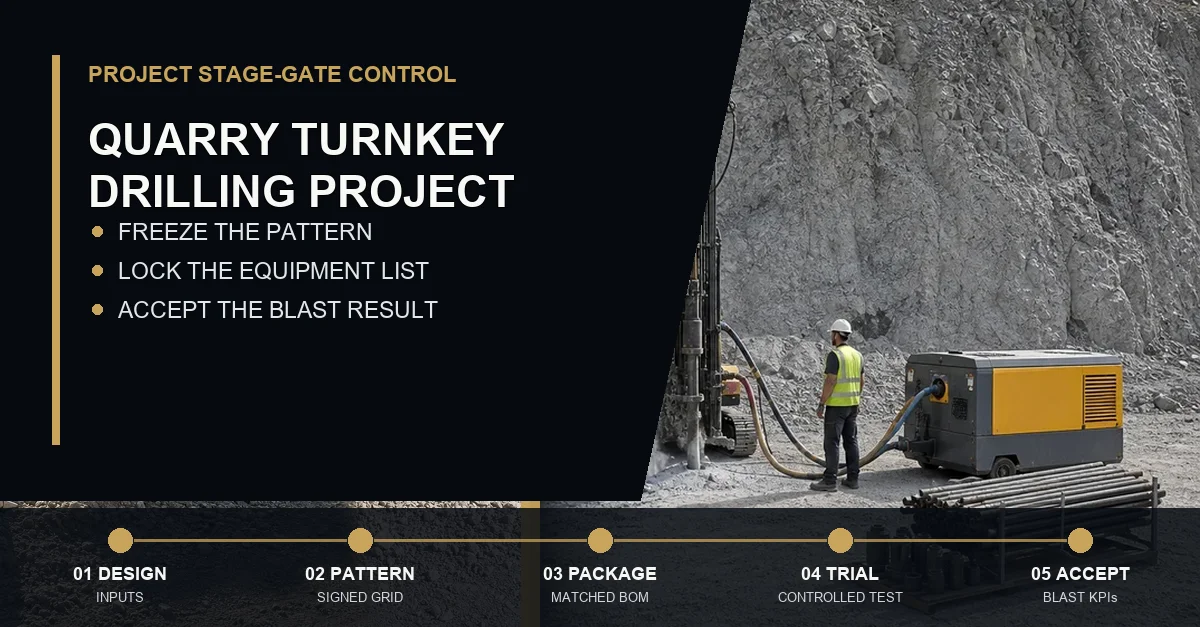
Quarry Turnkey Drilling Stage Gates: Freeze the Pattern, Lock the Equipment, Accept the Blast
A turnkey quarry project should not move forward because the next machine, shipment, or blast date is already booked. It should move forward only when the evidence required for that stage has been reviewed, signed, and handed to the next responsible team.
Table of Contents
The Equipment Arrived Before the Project Was Ready
The crawler rig was already on the bench. The compressor had been connected, the drill rods were stacked beside the machine, and the operator was waiting for the collar marks. Yet the project team was still debating the burden, the surveyor had not issued a signed grid, and nobody had agreed how oversize would be measured after the blast.
The machines were ready. The project was not.
This is how a turnkey package becomes a collection of equipment. Procurement measures delivery, the drilling crew measures metres, the blasting team measures explosive consumption, and the quarry manager measures crusher interruptions. Each party can meet its own target while the quarry misses the production result.
The real question is therefore not, “Have we bought everything?” It is, “What evidence allows this project to pass into the next stage?”
Why a Stage-Gate Model Changes the Project
A stage gate is a formal hold point between two phases. The next phase cannot begin until named inputs, drawings, responsibilities, and acceptance criteria have been reviewed. In practical terms, it prevents the quarry from ordering equipment against an unapproved pattern or accepting a blast without an agreed measurement method.
The logic is simple: each stage creates information that the next stage needs. Site data creates the design basis. The design basis creates the hole pattern. The pattern creates the equipment duty. The installed package creates trial data. The trial data supports production acceptance.
A common mistake is to treat these activities as parallel tasks that can be “aligned later.” Parallel work can shorten a schedule only when the interfaces are already controlled. If the hole diameter changes after the compressor and drill string are locked, speed gained in procurement can reappear as rework on the bench.
Gate
Required Evidence
Release Decision
Hold Condition
1. Design inputs
Site data sheet, production target, bench and crusher constraints, responsibility list
The project basis is clear enough to develop the initial pattern
Critical geology, access, capacity, or compliance assumptions remain unstated
2. Hole pattern
Approved pattern drawing, survey basis, hole schedule, deviation and blocked-hole procedure
The pattern is drillable and its assumptions are recorded
The grid cannot be reproduced by the proposed drilling method or site controls
3. Equipment package
Matched bill of materials, duty assumptions, interfaces, starter consumables, spares and commissioning plan
The complete package can execute the approved pattern and production plan
Any required interface, accessory, service item, or responsibility is missing
4. Controlled trial
Site acceptance record, operator readiness, as-drilled data, approved trial protocol and safety authorization
A controlled trial may proceed under the approved local blast plan
Equipment readiness or the data-capture method is incomplete
5. Blast acceptance
Post-blast inspection, fragmentation record, oversize and toe record, loading and crusher observations
Release to production, repeat the trial, or revise one controlled variable
The result cannot be traced to as-designed and as-drilled conditions
Gate 1: Freeze the Design Inputs
The first gate stops the project from designing around an incomplete site description. The signed input sheet should state the drilling application, formation range, intended hole diameter and depth, bench geometry, access restrictions, available power or fuel, operating schedule, dust and water conditions, local maintenance capability, and the downstream crusher requirement.
Separate confirmed facts from assumptions. “Hard rock quarry” is not a complete formation description, and “high production” is not a measurable duty. If the quarry has not confirmed a variable, the document should name who will confirm it, by what method, and before which gate.
This gate also fixes the responsibility boundary. Survey control, blast design, explosive selection, charging, initiation, exclusion zones, and regulatory monitoring must remain with the qualified and licensed parties defined by local law. The equipment supplier can support the drilling system without claiming authority over regulated blasting work.
Welldone Mining’s verified quarry drilling solution identifies rock type, drilling method, depth, diameter, and working conditions as configuration inputs. Those inputs belong in the project file before a model number becomes the centre of the discussion.
Gate 2: Approve a Drillable Hole Pattern
The second gate tests whether the proposed grid can be reproduced on the real bench. Burden, spacing, sub-drill, inclination, row sequence, and collar positions create a geometric promise. The rig, survey method, ground condition, and operator controls determine whether that promise survives contact with the site.
The design review should ask operational questions. Can the rig set up safely at the first and last collar? Can the mast hold the planned inclination? Can each hole be identified after drilling? What happens when fractured ground blocks a hole or water changes the hole condition? Who approves a replacement hole, and who updates the record?
In my view, the signed as-designed drawing is only half of Gate 2. The release package also needs a method for creating the as-drilled record. Without that comparison, poor fragmentation becomes an argument between the pattern, the drilling crew, and the blast crew.
The verified guide to quarry blast hole pattern design covers the relationship between burden, spacing, deviation, free face, and muckpile response. The project gate converts that engineering logic into a document-control decision.
Gate 3: Lock the Matched Equipment List
Gate 3 releases procurement only after the equipment list can be traced back to the approved drilling duty. The bill of materials should not begin and end with a rig and compressor. It should include every item needed to drill, measure, service, and restart the system under the stated working conditions.
Equipment Package
What Must Be Locked
Acceptance Evidence
Drilling platform
Drilling method, working hole range, mast arrangement, feed and rotation control, mobility and operator protection
Configuration sheet tied to the approved pattern and site access conditions
Air supply
Required operating pressure and flow, losses through hoses or manifold, ambient conditions, power source and redundancy philosophy
Matched duty statement and connection diagram
Drill string
Hammer, bit, rods, adapters, connections and lubrication requirements
Tooling list matched to hole diameter, depth, method and formation
Consumables and spares
Commissioning quantity, production starter stock, critical failure items, reorder trigger and storage responsibility
Separate commissioning, operating and critical-spares lists
Dust, water and site support
Collection or suppression scope, hoses, fittings, service tools, lifting needs and site utilities
Interface checklist showing supplied, site-provided and excluded items
Data and commissioning
Inspection records, operator training, daily drilling log, maintenance handover and trial support
Approved commissioning plan with named signatories
More importantly, “included” is not the same as “ready for production.” A starter set may be sufficient for commissioning but insufficient for the first operating period. Combining those two quantities under one vague consumables line hides the moment when the quarry becomes responsible for replenishment.
For special access, depth, diameter, formation, or air-demand conditions, the verified customized drilling solution shows how rigs, compressors, bits, rods, hammers, accessories, and support are matched around actual project requirements.
Gate 4: Release the Controlled Trial
The fourth gate confirms that the project is ready to learn from the trial. The rig may start, drill, and move correctly, yet the trial still produces weak evidence if collar positions, actual depths, hole conditions, interruptions, and abandoned holes are not recorded.
Before release, verify the machine acceptance record, operator readiness, survey marks, drilling log, hole-identification method, inspection responsibilities, post-blast measurement plan, and legal authorization held by the responsible blasting team. The test must have a baseline against which the result can be judged.
The trial should not be used to prove that every assumption was right. It should expose which assumptions need correction before full production. That requires discipline: where practical, revise one controlled variable at a time and preserve the previous record.
Gate 5: Accept the Blast Result
Gate 5 closes the loop between the approved pattern, the actual holes, and the downstream result. A photograph of a dramatic blast is not acceptance evidence. The project needs a repeatable record of fragmentation, oversize requiring secondary work, toe and floor condition, muckpile diggability, loading behaviour, crusher response, and the safety and environmental observations required by the approved plan.
The numerical limits must be site-specific. Bench geometry, rock mass, explosive system, loader, crusher opening, nearby receptors, and local regulation determine the correct thresholds. Values copied from another quarry can create false confidence because the operating system is different.
A practical decision has three possible outcomes: release the pattern and equipment package to production, repeat the controlled trial because the evidence is incomplete, or revise a defined variable and retest. Acceptance should not be reduced to “the blast looked good.”
The verified blast efficiency evaluation guide explains the roles of fragmentation, oversize, toe, powder factor , flyrock, vibration, and repeatable post-blast assessment.
Control Changes Without Losing the Evidence
Quarry conditions change. The mistake is not changing the plan; it is changing it without preserving the reason, the approval, and the result. A controlled revision should identify the trigger, the affected drawing or equipment duty, the responsible reviewer, and the data required to judge the outcome.
For example, a formation change may alter penetration behaviour or hole condition. The response may affect the drill setup, tooling, operating procedure, or pattern review. If several changes enter one trial without a revision record, the next team inherits a result but not the lesson.
The most valuable output of the first production blasts is not a perfect photograph. It is a verified operating window: which pattern, equipment setup, procedures, and site conditions produced an acceptable result.
Connect Payment to Evidence, Not Calendar Dates
Calendar milestones are easy to invoice: deposit paid, machine shipped, equipment arrived, commissioning visit completed. They do not prove that the project has passed the technical gate associated with that payment.
A stronger commercial schedule ties each milestone to named deliverables. Pattern approval requires the signed drawing and assumptions. Equipment release requires the matched bill of materials and interface list. Site acceptance requires inspection and training records. Trial acceptance requires the agreed post-blast evidence.
This structure reduces arguments rather than creating more paperwork. Both parties know what “complete” means before the deadline arrives. Missing evidence becomes visible while it can still be corrected, not after the machine is waiting on the bench.
Why Welldone Mining
Welldone Mining’s verified solution process moves from application confirmation and requirements analysis to solution matching, configuration lock, production, testing, delivery, installation, training, and support. That sequence aligns naturally with a stage-gate project structure.
Site inputs before model selection: Formation, depth, diameter, access, air demand, and operating conditions define the package.Matched operating chain: Rig, compressor, drill tools , accessories, starter stock, and critical spares are reviewed as connected duties.Evidence-led handover: Configuration sheets, testing, commissioning, training, and maintenance records support the move from delivery to production.
For the broader scope and quotation framework, review the verified quarry turnkey drilling project guide.
Conclusion
A turnkey quarry project becomes controllable when every phase has a visible entry condition and a signed release. Freeze the inputs before designing the pattern. Approve the drillable pattern before locking equipment. Prove readiness before the trial. Accept the result with evidence from the hole to the crusher.
Five gates. One traceable chain.
If your equipment arrived tomorrow, which signed document would authorize the first production hole — and which document would stop the project if the system were not ready?
Frequently Asked Questions
What is a stage gate in a quarry turnkey drilling project?
It is a formal hold point between project phases. The next phase begins only after named technical inputs, documents, responsibilities, and acceptance evidence have been reviewed and signed by the appropriate parties.
Which document should be approved before ordering the rig and compressor?
The project should first approve the design basis and a drillable preliminary pattern. The matched bill of materials can then be tied to hole diameter, depth, drilling method, formation, air duty, site access, production schedule, and support requirements.
Does “turnkey” include blasting responsibility?
Not automatically. The contract must state the boundary. Explosive design, charging, initiation, exclusion zones, blast authorization, and required monitoring must remain with qualified and licensed professionals under local law. Equipment supply and drilling support should not blur that responsibility.
What evidence should be collected during the controlled trial?
Collect the approved pattern, collar and depth records, hole condition, interruptions, abandoned or replacement holes, equipment settings permitted by the project procedure, post-blast fragmentation observations, oversize, toe, floor condition, loader response, crusher response, and required safety or environmental records.
Can Welldone Mining structure a package around these gates?
Welldone Mining can match rigs, compressors, tooling, accessories, spares, testing, commissioning, training, and support around the stated application, formation, depth, diameter, site conditions, and production goal. The quarry and its licensed blasting professionals retain approval of site-specific blast design and regulatory controls.
Define the Gate Before You Release the Order
Send your drilling application, formation, bench geometry, target depth and diameter, operating schedule, site access, available power or fuel, and crusher requirement. Welldone Mining can use those inputs to structure a matched equipment and support scope.
Website: www.welldonemining.com
Email: info@welldonemining.com