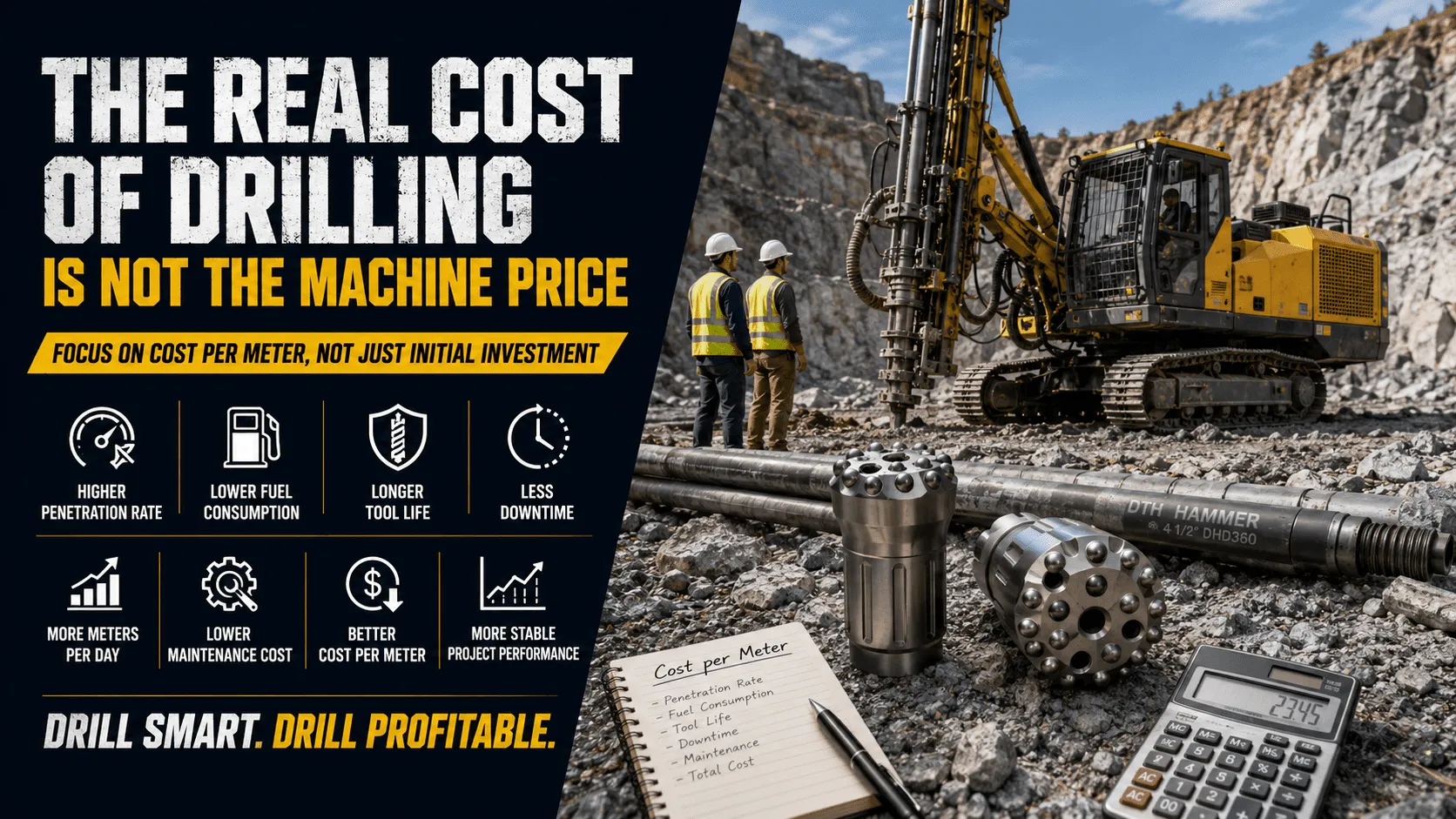
When buying drilling equipment, many buyers first compare the machine price.
This is normal because the initial investment is easy to see.
However, in real drilling projects, the more important number is often not the purchase price.
It is the drilling cost per meter.
A drilling rig with a lower price may look attractive at the beginning.
But if the rig, air compressor, DTH hammer, drill bit, drill rods, and spare parts are not matched correctly, the project may face slow penetration, high fuel consumption, fast tool wear, unstable drilling, poor hole cleaning, and more downtime.
In that situation, the “cheaper” equipment may become more expensive during operation.
That is why buyers should evaluate the real cost of drilling, not only the machine price.
What Does Drilling Cost Per Meter Mean?
Drilling cost per meter means the total operating cost needed to drill one meter of hole.
It is a more practical way to evaluate drilling equipment performance because it connects equipment selection with real project output.
The machine price is paid once.
But fuel, drill bits, DTH hammer parts, drill rods, maintenance, labor, downtime, and replacement parts continue during the whole project.
If the equipment package is not suitable, these operating costs may become much higher than expected.
| Cost Factor |
How It Affects Drilling Cost Per Meter |
Why Buyers Should Care |
| Fuel Consumption |
Higher fuel use increases daily operating cost |
Fuel cost repeats every working day |
| Drill Bit Life |
Short bit life increases replacement frequency |
Tool wear can strongly affect cost per meter |
| Penetration Rate |
Slow drilling reduces meters drilled per day |
Lower output makes each meter more expensive |
| Downtime |
Machine stops reduce project efficiency |
Waiting time creates hidden cost |
| Spare Parts |
Missing parts delay maintenance and repair |
Small parts can stop the whole project |
| Equipment Matching |
Wrong matching causes poor performance and higher wear |
Correct system matching controls long-term cost |
Why Machine Price Alone Can Be Misleading
A lower machine price does not always mean a lower project cost.
If the drilling rig is not suitable for the rock condition, hole diameter, drilling depth, or working environment, it may consume more fuel and drill fewer meters per day.
For example, a rig may have an attractive price, but if its feed force, rotation system, compressor matching, or tool configuration cannot support the project properly, the buyer may lose money through slow progress and frequent tool replacement.
In real projects, a slightly higher initial investment may be more economical if it gives better penetration rate, longer tool life, lower downtime, and more stable performance.
Main Factors That Decide Drilling Cost Per Meter
Cost per meter is not decided by one part only.
It is the result of the whole drilling system working together.
Buyers should evaluate the rig, compressor, hammer, bit, rods, rock condition, and spare parts plan together.
| Factor |
Influence on Cost |
Better Selection Logic |
| Drilling Rig |
Affects stability, mobility, feed force, and operating efficiency |
Select according to application, terrain, depth, and hole diameter |
| Air Compressor |
Affects hammer impact and cuttings removal |
Match pressure and air volume with hammer and drilling depth |
| DTH Hammer |
Affects impact energy and penetration speed |
Match hammer size with hole diameter and rock hardness |
| Drill Bit |
Affects rock breaking, wear rate, and hole quality |
Select bit face and button design based on formation |
| Drill Rods |
Affect torque transfer, air delivery, and connection stability |
Match rod size, thread type, and quantity with depth demand |
| Spare Parts |
Affect maintenance speed and downtime control |
Prepare wearing parts before the project starts |
Penetration Rate Directly Affects Daily Output
Penetration rate is one of the most important factors in drilling cost per meter.
If a rig drills more meters per day with stable performance, the cost per meter becomes lower.
If drilling speed is slow, labor, fuel, machine time, and compressor running time all increase.
Low penetration rate can be caused by many reasons, including weak hammer impact, wrong drill bit design, undersized compressor, hard rock condition, poor cuttings removal, or unstable drill rods.
This is why buyers should not only ask whether a drilling rig can reach the required depth.
They should also ask whether the complete equipment package can reach the required depth efficiently.
Fuel Consumption Is a Long-Term Cost
Fuel cost is often underestimated during equipment purchasing.
The machine price is paid once, but fuel is used every working day.
If the equipment is mismatched, the rig and compressor may work harder while drilling fewer meters.
For DTH drilling, an oversized compressor may increase fuel cost without improving real productivity.
An undersized compressor may reduce hammer impact and cuttings removal, causing slow drilling and longer working hours.
Both situations can increase cost per meter.
| Fuel Cost Situation |
Possible Cause |
Cost Result |
| High fuel use with low output |
Rig, compressor, and tools are not matched |
Higher cost per meter |
| Oversized compressor |
More air capacity than the project needs |
Unnecessary fuel consumption |
| Undersized compressor |
Weak hammer impact and poor cuttings removal |
Longer drilling time and higher total fuel use |
| Wrong drilling method |
Method does not fit rock condition or depth |
Low efficiency and wasted operating cost |
Drill Bit Life Has a Big Impact on Cost Per Meter
Drill bits are wearing parts.
Their life directly affects the cost of each meter drilled.
If the bit wears too quickly, the buyer must replace it more often, stop the machine more frequently, and spend more on spare tools.
Fast drill bit wear may be caused by hard rock, abrasive formation, wrong bit face design, unsuitable button shape, weak cuttings removal, or mismatched hammer impact.
In some projects, the drill bit cost can become a major part of the total drilling cost.
The goal is not only to buy a cheaper drill bit.
The goal is to choose a bit that matches the rock condition and delivers more stable meters before replacement.
Air Compressor Matching Affects Both Speed and Cost
In DTH drilling, the air compressor is one of the most important parts of the system.
Air pressure supports hammer impact.
Air volume supports cuttings removal.
If the compressor is wrong, the whole drilling system may lose efficiency.
A compressor with insufficient pressure may cause weak hammer impact.
A compressor with insufficient air volume may cause poor hole cleaning and tool sticking risk.
A compressor that is much larger than necessary may increase fuel consumption, maintenance cost, and transportation pressure.
A practical compressor choice should be based on hole diameter, drilling depth, DTH hammer size, drill bit diameter, rock condition, site altitude, and expected working hours.
Cuttings Removal Can Reduce or Increase Operating Cost
When the drill bit breaks rock, broken material must leave the hole quickly.
If cuttings remain in the hole, the bit may re-grind broken rock instead of cutting fresh formation.
This wastes energy and increases tool wear.
Poor cuttings removal can lead to slow penetration, higher fuel consumption, faster bit wear, poor hole quality, and tool sticking.
These problems all increase drilling cost per meter.
| Cuttings Removal Condition |
Drilling Result |
Cost Impact |
| Good cuttings removal |
Cleaner hole and stable bit contact |
Better efficiency and lower wear |
| Poor cuttings removal |
Cuttings stay inside the hole |
Slow drilling and higher tool cost |
| Unstable cuttings removal |
Drilling performance changes during operation |
Higher downtime risk |
Downtime Is a Hidden Cost Many Buyers Ignore
Downtime can be more expensive than many buyers expect.
When the rig stops, the project does not produce meters.
Operators wait, fuel may still be used, schedules are delayed, and the project owner may face pressure from the next construction or blasting step.
Downtime may come from missing spare parts, poor maintenance planning, wrong tool matching, air compressor problems, drill rod failure, hammer parts wear, or unsuitable site preparation.
Reducing downtime is one of the most effective ways to reduce drilling cost per meter.
That is why spare parts planning should be part of the original equipment package, not an afterthought.
Cost Per Meter in Quarry Drilling
Quarry drilling usually focuses on blasting holes, production efficiency, daily output, and cost per meter.
A stable drilling system helps the quarry prepare blasting holes faster and keep production more predictable.
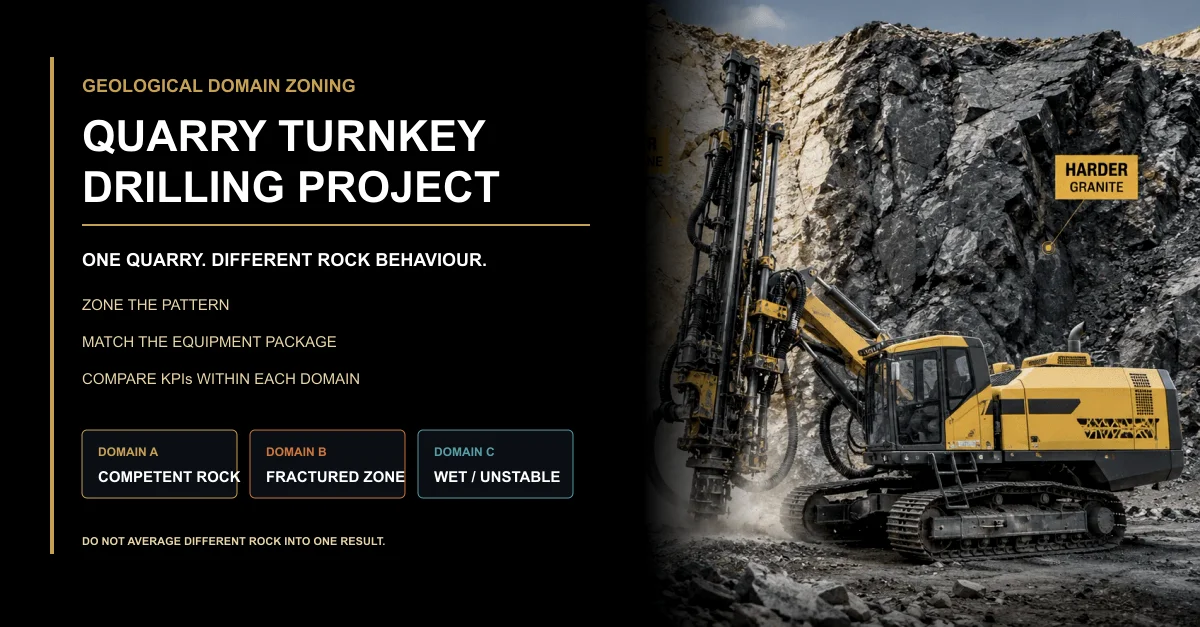
For hard rock quarry projects, cost per meter is affected by rock hardness, hole diameter, drilling depth, hammer impact, drill bit life, compressor matching, and cuttings removal.
If any part is mismatched, daily drilling output may drop.
A practical quarry drilling solution should not only recommend a rig model.
It should match the drilling rig, air compressor, DTH hammer, drill bit, drill rods, and wearing parts according to the real quarry condition.
Cost Per Meter in Water Well Drilling
Water well drilling projects often face changing ground layers.
Soil, sand, gravel, limestone, sandstone, and hard rock may appear in the same hole.
This makes equipment matching more important.
If the drilling method, compressor, hammer, bit, and rods are not suitable for the formation, the project may face delays, unstable hole cleaning, tool wear, or slower progress.
These problems increase cost per meter and reduce project profit.
A complete water well drilling solution should consider ground layers, hole diameter, drilling depth, air supply, drilling tools, drill rods, casing plan, and spare parts together.
Cost Per Meter in Mining and Construction Drilling
Mining and construction drilling projects may include blasting holes, slope support, foundation drilling, anchoring, or engineering drilling.
These projects often require stable hole quality, controlled schedule, and reliable equipment performance.
In these applications, cost per meter is affected by more than machine price.
Site access, rock condition, working angle, hole accuracy, tool matching, fuel consumption, and downtime all matter.
For special working conditions, a customized drilling solution can help buyers build the drilling equipment package around the real project requirement.
Common Mistakes That Increase Drilling Cost Per Meter
Many cost problems start before the equipment arrives at the site.
If the wrong equipment package is selected, the buyer may spend more money during daily operation.
| Common Mistake |
Possible Problem |
Better Solution |
| Choosing only by machine price |
Equipment may not match project demand |
Compare cost per meter and total operating cost |
| Ignoring rock condition |
Wrong hammer or bit selection |
Match tools with hardness and abrasiveness |
| Ignoring compressor matching |
Weak impact or poor cuttings removal |
Match pressure and air volume with hammer and hole size |
| Using low-quality wearing parts |
Fast replacement and more downtime |
Choose parts based on tool life and project intensity |
| No spare parts plan |
Small failures stop the whole project |
Prepare common wearing parts before drilling starts |
What Information Should Buyers Provide Before Selection?
To estimate the real drilling cost and recommend a suitable equipment package, buyers should provide clear project information.
This helps avoid general recommendations and improves matching accuracy.
- Project type: quarry, mining, water well, construction, foundation, or exploration
- Required hole diameter
- Required drilling depth
- Rock or ground condition
- Rock hardness and abrasiveness if available
- Expected drilling method
- DTH hammer size if already selected
- Drill bit diameter and shank type if available
- Air compressor pressure and air volume if available
- Expected working hours per day
- Target meters per day if available
- Local fuel condition and maintenance support
- Spare parts and wearing parts requirements
How Welldone Mining Helps Buyers Reduce Cost Per Meter
Welldone Mining provides drilling equipment and drilling tools for quarry, mining, water well, construction, and customized drilling projects.
We help buyers match the complete drilling system according to real site conditions.
Our goal is not only to supply one machine.
Our goal is to help buyers build a practical drilling package that can improve penetration rate, reduce fuel waste, extend tool life, reduce downtime, and control long-term operating cost.
| Welldone Mining Support |
How It Helps Buyers |
| Project Requirement Analysis |
Confirms application, hole diameter, depth, rock condition, and site environment |
| Drilling Rig Selection |
Matches rig capacity with project demand and working conditions |
| Air Compressor Matching |
Matches pressure and air volume with hammer, hole size, and depth |
| DTH Hammer and Bit Matching |
Selects tools according to hole diameter, rock hardness, and cost control target |
| Drill Rod Planning |
Matches rod size, thread type, and quantity for stable drilling and air delivery |
| Spare Parts Planning |
Prepares wearing parts to reduce downtime and urgent replacement cost |
| After-Sales Guidance |
Supports technical communication, troubleshooting, and maintenance advice |
Conclusion
The real cost of drilling is not only the machine price.
It is the cost per meter during real operation.
A cheaper machine may become expensive if it causes slow penetration, high fuel consumption, short tool life, unstable drilling, and more downtime.
For quarry drilling, water well drilling, mining, and construction projects, buyers should evaluate the complete drilling system.
The drilling rig, air compressor, DTH hammer, drill bit, drill rods, spare parts, rock condition, hole diameter, and drilling depth all affect cost per meter.
The smarter choice is not only reducing purchase cost.
The smarter choice is selecting equipment that helps drill more meters with lower total cost.
If you are planning a drilling project, you can share your project type, hole diameter, drilling depth, rock condition, drilling method, target output, and expected working hours.
Welldone Mining can help you match the suitable drilling rig, air compressor, DTH hammer, drill bit, drill rods, spare parts, and after-sales support for your project.
Website: www.welldonemining.com
Email: info@welldonemining.com