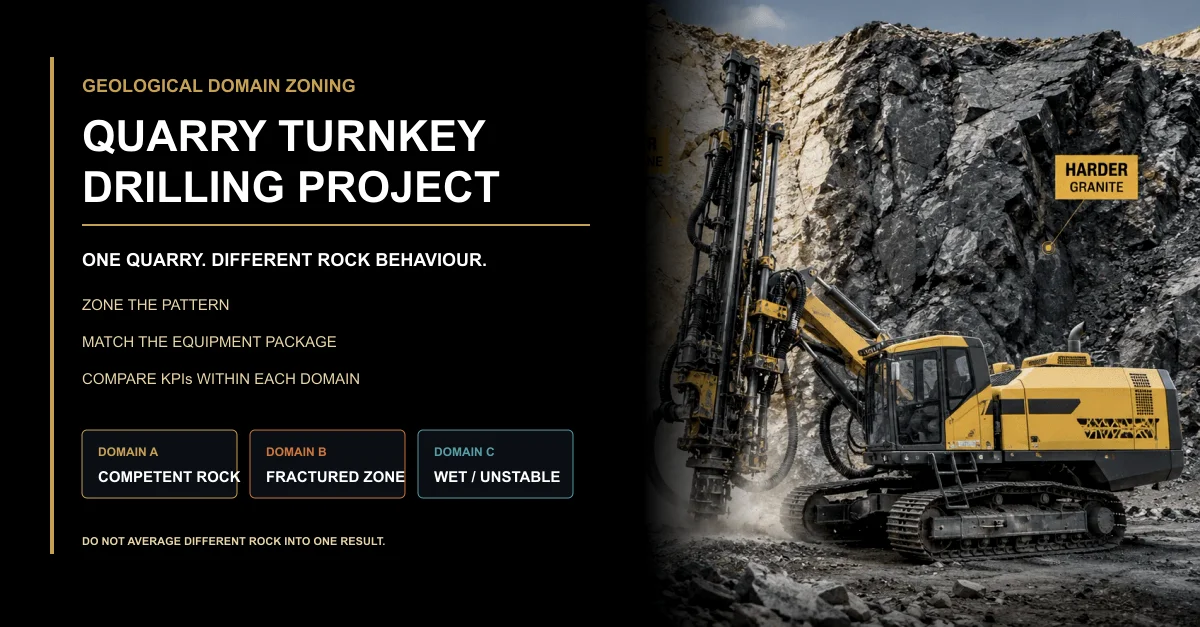
In many drilling projects, buyers first focus on the drilling rig, air compressor, DTH hammer, drill bits, and quotation.
These are important parts of the equipment decision.
However, after the machine starts working on site, another factor becomes very important:
spare parts planning.
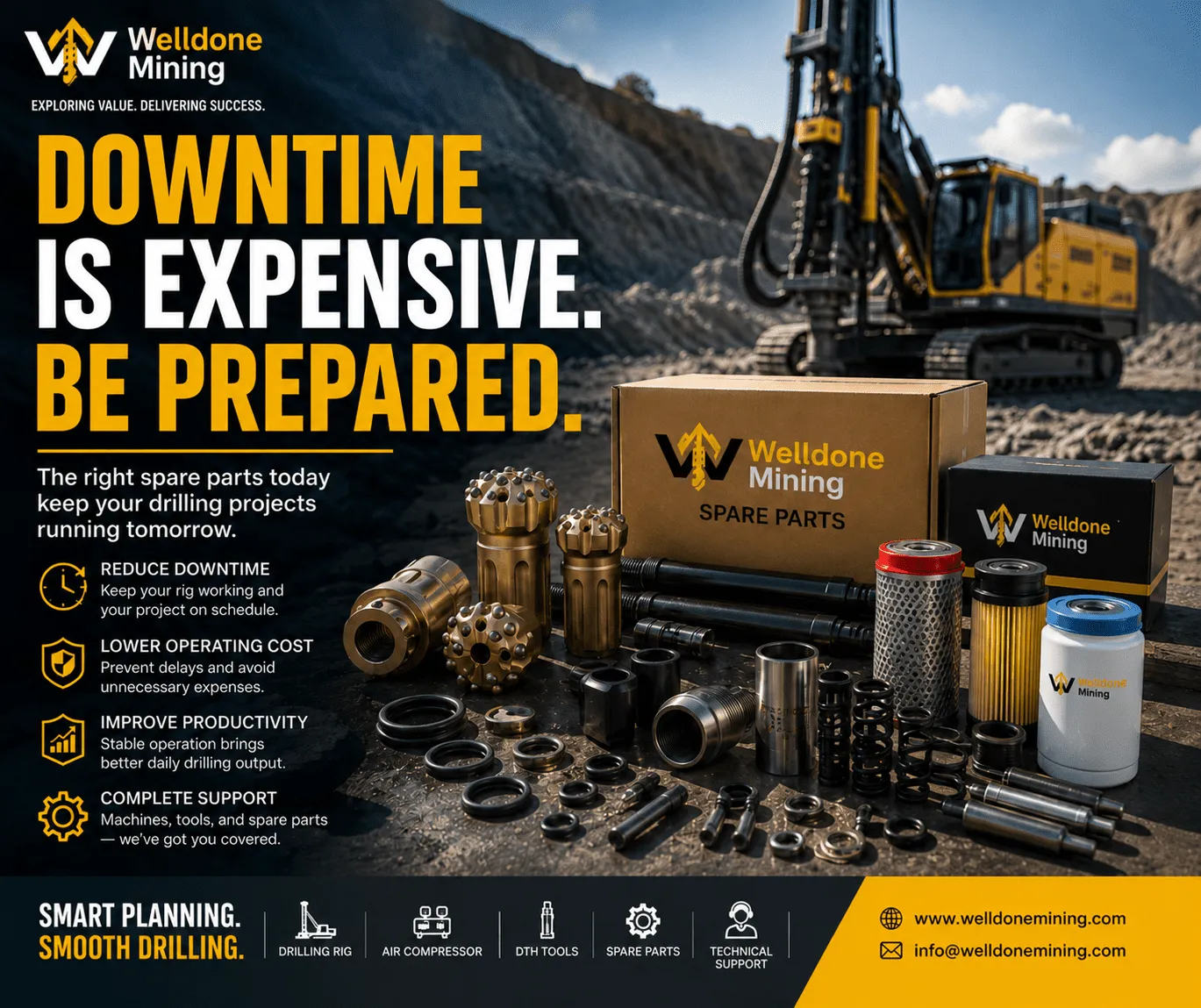
For quarry, mining, water well, and construction drilling projects, downtime can be one of the most expensive problems.
A small missing part can stop the whole drilling operation, delay project progress, increase labor cost, and reduce daily drilling output.
That is why spare parts planning for drilling projects should not be treated as an after-sales detail.
It should be considered before delivery, together with drilling rig selection, air compressor matching, DTH tools, drill rods, and maintenance support.
Why Downtime Is Expensive in Drilling Projects
Drilling projects depend on continuous operation.
Once the drilling rig stops, the cost is not only the broken part itself.
The real cost may include waiting time, labor cost, delayed project schedule, urgent shipping cost, and lost production capacity.
In quarry and mining projects, downtime may affect blasting plans, production schedules, and material output.
In water well drilling projects, downtime may delay project delivery and reduce the number of completed wells.
For remote sites, spare parts may not be available locally, which makes the problem even more serious.
In real drilling projects, a small spare part can sometimes decide whether the drilling team keeps working or waits for several days.
Machine Price vs. Downtime Cost
Some buyers compare drilling equipment mainly by machine price.
However, a lower initial price may not save money if the spare parts plan is weak or the after-sales support is slow.
| Cost Item |
What Buyers Often See |
What Actually Affects Project Cost |
| Machine Price |
Initial quotation amount |
Only the first part of the project investment |
| Spare Parts |
Sometimes treated as optional accessories |
Affects operation continuity and maintenance speed |
| Downtime |
Often not calculated before purchase |
Can delay the whole project and increase hidden cost |
| Urgent Replacement |
Usually appears after a problem happens |
May increase shipping cost and waiting time |
| After-Sales Support |
Sometimes ignored during price comparison |
Affects troubleshooting and long-term operation stability |
Common Reasons for Drilling Project Downtime
Downtime may come from different parts of the drilling system.
In many cases, the problem is not caused by one big failure.
It is caused by a small wearing part that was not prepared before operation.
- Drill bit wear or damage
- DTH hammer parts wear
- Drill rod or joint problems
- Air compressor filter blockage
- Lubrication and maintenance parts shortage
- Hydraulic hose or sealing parts damage
- Common bolts, adapters, and connectors missing
- Lack of technical guidance during troubleshooting
For overseas projects, these problems can become more difficult because replacement parts may need international delivery.
Preparing the right spare parts before shipment is usually cheaper and faster than waiting for urgent replacement after the machine stops.
Main Spare Parts Buyers Should Prepare
A practical spare parts package should be prepared according to the project type, drilling method, rock condition, working intensity, and expected project duration.
| Spare Parts Category |
Common Items |
Why It Matters |
| Drilling Tools |
Drill bits, DTH hammer, drill rods, shank adapter |
Directly affects drilling speed and hole quality |
| DTH Hammer Parts |
Piston, valve, chuck, cylinder, seals |
Helps maintain hammer impact performance |
| Air Compressor Parts |
Air filter, oil filter, separator, lubricant |
Supports stable air supply and compressor maintenance |
| Drilling Rig Parts |
Hydraulic parts, hoses, seals, crawler parts, connectors |
Reduces machine downtime during site operation |
| Wearing Parts |
O-rings, bolts, joints, adapters, coupling parts |
Prevents small part shortage from stopping the project |
| Maintenance Items |
Grease, lubricants, filters, common tools |
Improves daily maintenance and long-term equipment life |
Spare Parts Planning for Quarry Drilling
Quarry drilling usually involves hard rock, limestone, granite, blasting holes, and continuous outdoor operation.
In this type of project, drilling tools and wearing parts are consumed regularly.
For quarry projects, buyers should prepare drill bits, DTH hammer parts, drill rods, compressor filters, lubricants, and common maintenance parts.
If the quarry is located in a remote area, the spare parts package should be more complete.
A practical quarry drilling solution should not only include the drilling rig.
It should also include the right air compressor, DTH tools, drill rods, and spare parts plan.
Spare Parts Planning for Water Well Drilling
Water well drilling projects may face changing ground conditions, including soil, gravel, limestone, sandstone, and mixed rock layers.
These changes can affect drill bit wear, DTH hammer performance, and maintenance frequency.
For water well contractors, spare parts planning is important because the machine may move between different sites.
If a key part is missing, the team may lose working time and delay the project schedule.
A complete water well drilling solution should match drilling rig, air compressor, DTH tools, drill rods, and spare parts according to real ground conditions.
Spare Parts Planning for Remote and Overseas Projects
For remote mining areas, mountain sites, desert areas, and overseas drilling projects, spare parts planning becomes even more important.
Local supply may be limited, and urgent international shipping can take time.
Before delivery, buyers should confirm which parts are easy to wear, which parts are difficult to buy locally, and which parts are critical for continuous operation.
| Remote Site Challenge |
Possible Risk |
Better Preparation |
| Long distance from supplier |
Slow replacement and longer downtime |
Prepare common wearing parts before shipment |
| Limited local parts supply |
Wrong or unsuitable replacement parts |
Use matched original parts and technical guidance |
| Harsh working environment |
Faster wear of tools and filters |
Prepare filters, lubricants, and tool spare parts |
| Continuous operation demand |
Small failure may stop production |
Build a preventive maintenance parts package |
How to Build a Practical Spare Parts Package
The spare parts package should not be copied from another project.
It should be planned according to the actual drilling requirement and site condition.
Before preparing spare parts, buyers should confirm the following information:
- Project type: quarry, mining, water well, construction, or exploration
- Required hole diameter
- Required drilling depth
- Rock hardness and abrasiveness
- Drilling method and DTH hammer size
- Air compressor model and working pressure
- Expected daily working hours
- Project duration and site location
- Local spare parts availability
- Maintenance ability of the project team
With this information, the supplier can recommend a more practical spare parts package instead of a general accessory list.
Common Mistakes in Spare Parts Planning
Many downtime problems can be reduced if buyers avoid these common mistakes before delivery.
| Common Mistake |
Possible Result |
Better Solution |
| Only buying the main machine |
No parts available when the first problem happens |
Prepare spare parts together with the machine order |
| Ignoring drill bit consumption |
Fast tool wear stops operation |
Prepare drill bits according to rock condition |
| No DTH hammer parts plan |
Hammer performance drops and troubleshooting becomes difficult |
Prepare common hammer wearing parts |
| Ignoring compressor maintenance |
Air supply becomes unstable |
Prepare filters, oil, separator, and maintenance parts |
| No remote support plan |
Problem diagnosis takes too long |
Confirm after-sales communication and technical support before delivery |
Why Spare Parts Planning Should Be Part of the Complete Drilling Solution
A drilling project is not only about buying one drilling rig.
It is about keeping the whole system working steadily under real site conditions.
The drilling rig provides mobility, feed force, and rotation.
The air compressor provides air pressure and air volume.
The DTH hammer provides impact energy.
The drill bit breaks the rock.
The drill rods transfer torque and air.
Spare parts keep the system running when wear and maintenance happen.
As I see it, spare parts planning is not only a service issue.
It is part of cost control, project planning, and long-term operation.
How Welldone Mining Helps Buyers Reduce Downtime
Welldone Mining provides drilling equipment solutions for quarry, mining, water well, construction, and customized drilling projects.
We help buyers match drilling rigs, air compressors, DTH tools, drill rods, and spare parts according to real project conditions.
Our support can include equipment selection, compressor matching, DTH hammer and drill bit configuration, drill rod planning, spare parts preparation, delivery support, and after-sales guidance.
| Welldone Mining Support |
How It Helps Buyers |
| Project Condition Analysis |
Confirms application, hole diameter, drilling depth, rock condition, and site environment |
| Complete Equipment Matching |
Matches drilling rig, air compressor, DTH hammer, drill bit, drill rods, and accessories |
| Spare Parts Planning |
Prepares wearing parts and maintenance parts according to project duration |
| Downtime Reduction Support |
Helps avoid stoppage caused by missing small parts |
| After-Sales Guidance |
Supports technical communication, troubleshooting, and maintenance advice |
| Export Project Experience |
Helps overseas buyers prepare equipment packages more efficiently before shipment |
What Information Should Buyers Provide?
To recommend a suitable spare parts package, buyers should provide clear project information.
This helps avoid unnecessary parts and also reduces the risk of missing important parts.
- Project type: quarry, mining, water well, construction, or exploration
- Required hole diameter
- Required drilling depth
- Rock or ground condition
- DTH hammer model or expected hammer size
- Air compressor model or required air pressure and air volume
- Daily working hours and project duration
- Site location and local spare parts availability
- Expected maintenance ability of the project team
Conclusion
Downtime is one of the most expensive costs in drilling projects.
A worn drill bit, a damaged hammer part, a missing filter, or a small maintenance part can stop the whole operation.
For quarry projects, spare parts planning helps protect production efficiency.
For water well projects, it helps contractors keep project delivery on schedule.
For remote and overseas projects, it reduces waiting time and urgent replacement pressure.
The smarter choice is not only buying the drilling rig.
The smarter choice is preparing a complete drilling equipment package with the right machine, tools, spare parts, and after-sales support.
If you are planning a drilling project, you can share your project type, hole diameter, drilling depth, rock condition, DTH hammer size, working hours, and project duration.
Welldone Mining can help you match the suitable drilling rig, air compressor, DTH hammer, drill bit, drill rods, spare parts, and after-sales support for your project.
Website: www.welldonemining.com
Email: info@welldonemining.com