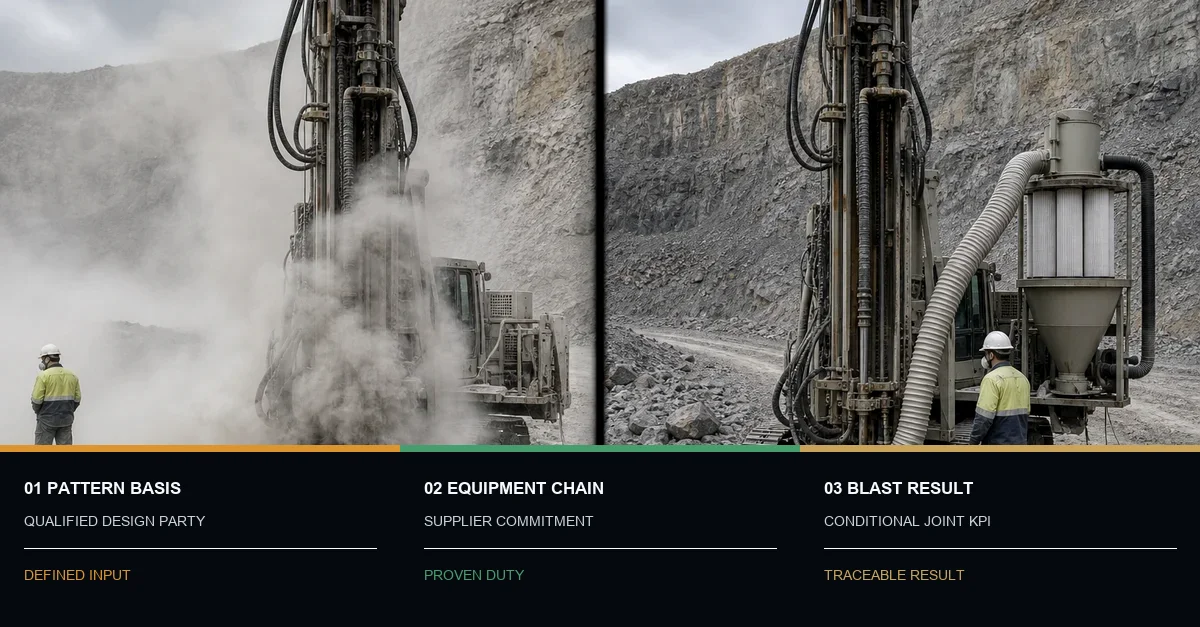
Quarry Turnkey Performance Guarantee: Hole Pattern, Equipment List, and Blast Efficiency
A quarry buyer may ask one supplier to “guarantee the blast result.” The request sounds reasonable, but the result is created by geology, pattern design, as-drilled accuracy, equipment condition, regulated blast inputs, and downstream operation. A workable guarantee separates those responsibilities before attaching a remedy.
Table of Contents
The Contract Meeting Stopped at One Word
The quarry owner wanted “guaranteed fragmentation.” The equipment supplier asked for the geological model, approved hole pattern, regulated blast plan, and crusher-feed requirement. None had been frozen.
The contractor offered a rig, compressor, hammer, bits, and rods. The owner expected the package to deliver a defined muckpile. The licensed blasting team had not yet joined the discussion.
Everyone wanted accountability. Nobody had separated control from influence.
The real question is not whether the project needs performance guarantees. It is whether each guarantee is assigned to the party that controls the input, can produce the evidence, and has the authority to correct the failure.
One Turnkey Clause Contains Three Different Promises
“Turnkey performance” often hides three contracts inside one phrase. The first concerns the design basis for the holes. The second concerns the supplied drilling package. The third concerns the combined result after drilling and regulated blasting.
These promises should not use the same wording. A supplier can warrant that listed equipment meets an agreed specification and passes defined tests. The supplier can support verification of drilled-hole evidence. It cannot independently control unknown geology, explosive selection, charging, initiation, exclusion zones, weather, or crusher operation.
Making the broadest party responsible for the broadest outcome creates an impressive contract sentence but an unusable remedy.
Guarantee Layer
Primary Control
Evidence
Reasonable Commitment
Pattern design basis
Qualified designer using verified site inputs
Controlled drawing, assumptions, survey reference, geological information, and revision record
The design basis is defined, reviewed, and suitable for field setting-out under stated conditions
As-drilled delivery
Drilling contractor, crew, survey control, and drilling package
Hole IDs, collar checks, depth records, deviation or inclination evidence, and exceptions
Drilled holes are measured against agreed tolerances and deviations are traceable
Equipment performance
Supplier for supplied scope; owner for stated site inputs and utilities
Configuration, inspection, commissioning, operating conditions, service records, and exclusions
The connected package performs the agreed drilling duty when stated conditions are met
Blast and downstream result
Joint outcome involving geology, drilling, licensed blasting, loading, and crushing
As-drilled data, regulated blast records, muckpile observations, loading response, and crusher evidence
A conditional KPI evaluation with agreed responsibilities, method, and retest rules
Hole Pattern Design: Guarantee the Basis and Delivery Separately
The hole pattern is not an equipment specification. It is a site-specific design that connects bench geometry, formation, free face, hole diameter, depth, inclination, burden, spacing, and the regulated blast plan.
The design party should own the assumptions and controlled drawing. The drilling side should own its ability to set up, access the collars, drill the specified geometry, record exceptions, and provide as-drilled evidence.
This distinction matters when the blast leaves toe or oversize. If the holes did not match the approved geometry, the team first investigates field delivery. If the holes were within the agreed tolerance, the qualified design and blasting parties review the design basis and regulated inputs.
In my view, “pattern compliance” is a better contractual term than “perfect holes.” It gives the project a measurable comparison without pretending that natural ground behaves like a machined component.
The verified quarry blast hole pattern design guide explains how burden, spacing, subdrill, stemming, deviation, air demand, and equipment configuration interact. Site-specific blast design and approval remain with qualified professionals under local law.
Pattern Item
What Must Be Defined
Who Provides the Evidence
Guarantee Boundary
Collar positions
Grid, survey reference, bench access, and agreed position tolerance
Survey and drilling records
Verification depends on available control points and accessible collar locations
Hole depth
Planned depth, reference elevation, measurement method, and blocked-hole rule
Drilling log and independent checks where required
Ground collapse or obstruction must be recorded and handled through the agreed exception process
Inclination and deviation
Target angle, measurement method, sampling frequency, and tolerance
Drilling crew, survey team, or agreed measurement provider
Accuracy is evaluated under stated ground, setup, and measuring conditions
Replacement holes
Approval authority, distance rule, identity link, and closure of the original hole
Drilling contractor and responsible design party
A replacement is not evidence of compliance unless it remains traceable to the controlled plan
Equipment List: Warrant a Matched Duty, Not an Isolated Machine
The equipment guarantee begins with the duty. Formation, target hole range, working depth, bench access, expected schedule, altitude, temperature, dust, available fuel or power, and maintenance resources determine what the package must do.
The list then connects the rig, compressor, hammer, bit, rods, adapters, hoses, lubrication, dust control, handling tools, service tools, starter spares, and training. A machine-only warranty does not prove that this chain can perform the required duty.
More importantly, the guarantee should identify owner inputs. Prepared access, suitable fuel or power, specified lubricants, trained operators, scheduled maintenance, and approved operating limits influence performance. If those conditions are missing, the test result needs qualification rather than automatic blame.
Welldone Mining’s verified customized drilling solution describes rig, compressor, bits, rods, hammers, accessories, spares, and support as a connected configuration based on depth, diameter, formation, air demand, and site conditions.
Equipment Commitment
Supplier Can Warrant
Required Test Condition
Typical Exclusion or Qualification
Scope completeness
All contracted items, quantities, interfaces, documentation, and starter packages are delivered
Approved bill of materials and receipt inspection
Owner-supplied utilities, civil work, consumables, or local permits listed in the contract
Configuration compatibility
Contracted components connect and are suitable for the agreed duty
Correct formation, diameter, depth, air path, tooling connection, and approved operating setup
Unreported change in hole duty, unsupported tooling, or altered interface
Functional operation
Specified systems operate and pass agreed inspection or commissioning checks
Prepared site, correct fluids, qualified personnel, and defined test period
Damage, misuse, contaminated inputs, unauthorized modification, or missed maintenance
Drilling duty
Capability against an agreed test method and stated conditions
Comparable formation, defined hole range, measured operating time, and recorded delays
Unknown geology, non-equipment delays, access restrictions, or changed operating method
Support response
Defined remote or on-site support deliverables within the contracted service scope
Complete fault record, operating data, safe access, and available site contact
Customs, travel restrictions, unavailable parts outside the agreed stock plan, or incomplete diagnostics
Blast Efficiency: Use Conditional KPIs, Not an Unqualified Promise
Blast efficiency is a combined outcome. Geology, actual hole geometry, explosives, charging, initiation, stemming, weather, face condition, loading method, and crusher operation can all influence what the quarry sees after firing.
An equipment supplier can support the drilling side: equipment suitability, air and tooling match, recorded hole delivery, operator guidance, and investigation of drilling-related exceptions. It should not sign an unconditional fragmentation guarantee when it does not control the regulated blast inputs.
The better clause defines conditional KPIs. It states which inputs must be within the approved range, how the result is measured, which party records each input, and what happens when a condition is missing.
A common mistake is to make one visible output the whole guarantee. Fragmentation may improve while toe, flyrock risk, loading, or crusher interruptions worsen. The KPI set must reflect the quarry’s actual production and compliance constraints.
The verified guide to quarry blast efficiency evaluation covers fragmentation, oversize, toe, muckpile response, and repeatable assessment at the loading and crushing stages.
Blast KPI
Measurement Basis
Preconditions
Responsibility Boundary
Floor and toe
Defined bench area, observation method, cleanup record, and affected hole IDs
Approved design, traceable depth and deviation evidence, and regulated blast records
Investigate drilling conformity separately from design, geology, and regulated blast inputs
Fragmentation
Agreed image, sampling, or operational method with consistent scale and location
Comparable material zone, traceable as-drilled geometry, and consistent evaluation method
No single supplier controls the full result; corrective action follows the identified cause
Oversize handling
Defined counting, volume, time, or secondary-handling method
Comparable loading area and agreed definition of oversize
Separate blast-generated oversize from contamination, stockpile mixing, or measurement changes
Muckpile and loading
Access, bucket fill, digging resistance, travel, and truck-position observations
Comparable loader, route, operator context, and bench condition
Loading method and traffic constraints are not solely drilling-equipment effects
Crusher response
Feed restriction, interruptions, manual intervention, and consistent plant context
Known crusher condition, comparable feed path, and traceable blast batch
Plant faults and stockpile blending must be separated from upstream contribution
Write the Test Conditions Before the Remedy
A performance clause fails when the target is clear but the test is not. The contract should define the test area, duration or batch, formation, hole range, equipment configuration, operating crew, site inputs, measuring method, excluded delays, data owner, and decision authority.
Testing also needs a stop rule. Unsafe conditions, unverified geology, missing utilities, uncontrolled pattern revisions, or absent regulated records should pause the test without creating an automatic failure.
A short witnessed test protocol is more useful than a page of ambitious adjectives. It lets both parties reproduce the evidence and decide whether the result is valid.
Test Clause
Define Before Mobilization
Invalid-Test Trigger
Site duty
Formation, depth, diameter, inclination, access, environment, and operating schedule
Test duty differs materially from the contracted basis without approved revision
Equipment setup
Rig, air source, tools, settings, fluids, accessories, and owner-supplied inputs
Unapproved component, unsuitable input, or incomplete installation changes the setup
Time and delays
Start and stop points, planned breaks, excluded delays, and record method
Downtime cannot be assigned to equipment, site, logistics, or regulated operations
Measurement
Instrument or observation method, sampling, responsibility, and data format
Method changes during the comparison or required evidence is missing
Acceptance and retest
Decision rule, cure period, retest scope, witness, and closure evidence
A party changes the pass criterion after seeing the result
Match Each Failure to the Party That Can Correct It
A remedy should follow control. Missing equipment calls for delivery or replacement. A configuration mismatch calls for correction and retest. Drilling outside tolerance calls for investigation and redrilling or another agreed response. A design issue returns to the qualified design party. A regulated blasting issue stays with the licensed responsible party.
Do not jump directly from a poor crusher shift to a supplier penalty. First preserve the batch identity, compare the approved inputs with actual delivery, and identify which condition failed.
A joint result needs a joint root-cause process. Without it, every party optimizes its own evidence while the quarry continues to pay for the same bottleneck.
Failure Evidence
First Review
Possible Remedy
What Not to Assume
Contracted item missing or incompatible
Approved equipment list, interface schedule, receipt, and commissioning record
Supply, replace, correct the interface, and repeat the affected test
That the downstream result proves the exact missing component caused every loss
Holes outside agreed tolerance
Plan, as-drilled record, measurement validity, geology, and equipment condition
Correct the execution cause, redrill where approved, train, or revise the method
That every deviation is a machine defect
Equipment stops during valid duty
Fault data, operation, maintenance, inputs, exclusions, and service history
Repair, replace, adjust configuration, provide support, or retest
That all lost time belongs to the equipment supplier
Blast KPI outside agreed range
Geology, approved design, as-drilled geometry, regulated inputs, measurement, loading, and crusher context
Cause-specific correction and a controlled retest
That one party controls the entire blast-to-crusher chain
Why Welldone Mining
Welldone Mining supports guarantees that can be tested. The discussion starts with application, formation, depth, diameter, air demand, access, environment, and working schedule before the connected drilling package is defined.
Defined scope: Rig, compressor, hammer, bit, rods, interfaces, accessories, spares, commissioning, and training can be itemized.Duty-based matching: Configuration is tied to stated site and hole requirements instead of a model name alone.Traceable support: Inspection, operating records, maintenance information, and troubleshooting evidence support cause-based correction.
For quarry drilling applications, methods, equipment categories, and operating conditions, review the verified quarry drilling solution .
Conclusion
A credible turnkey guarantee does not avoid accountability. It makes accountability executable.
The pattern clause separates design responsibility from as-drilled delivery. The equipment clause ties the complete package to an agreed duty. The blast-efficiency clause uses conditional, traceable KPIs because the outcome crosses geology, drilling, regulated blasting, loading, and crushing.
If your draft contract says “guaranteed blast result,” can every party point to the exact input it controls, the evidence it must provide, and the remedy it can actually perform?
Frequently Asked Questions
Can a drilling-equipment supplier guarantee quarry fragmentation?
Not unconditionally. The supplier can warrant the contracted drilling package and support as-drilled evidence. Fragmentation also depends on geology, pattern design, regulated blast inputs, and measurement conditions controlled by other parties.
What should a hole-accuracy guarantee include?
Define the controlled drawing, survey reference, collar, depth, inclination or deviation method, tolerance, sampling, exception rule, and site conditions. Avoid an undefined promise of “perfect accuracy.”
What can be guaranteed in the equipment list?
The contract can cover scope completeness, interface compatibility, functional testing, capability under an agreed duty, documentation, training, spares, and support. Preconditions and exclusions should be listed beside each commitment.
How should blast-efficiency acceptance be written?
Use a conditional KPI set with defined measurement methods, valid-input conditions, data ownership, joint cause review, cure period, and retest rules. Keep regulated blast responsibilities with licensed professionals.
Can Welldone Mining help define equipment-side guarantees?
Welldone Mining can review the supplied rig, compressor, drilling tools, interfaces, accessories, spares, commissioning, training, and agreed drilling duty. Final contract wording should be reviewed by the project’s legal and qualified technical teams.
Write a Guarantee That Can Be Tested
Send the formation, hole range, bench conditions, operating schedule, proposed pattern basis, equipment scope, available utilities, and required downstream evidence. Welldone Mining can help define the equipment-side commitment and test conditions.
Website: www.welldonemining.com
Email: info@welldonemining.com