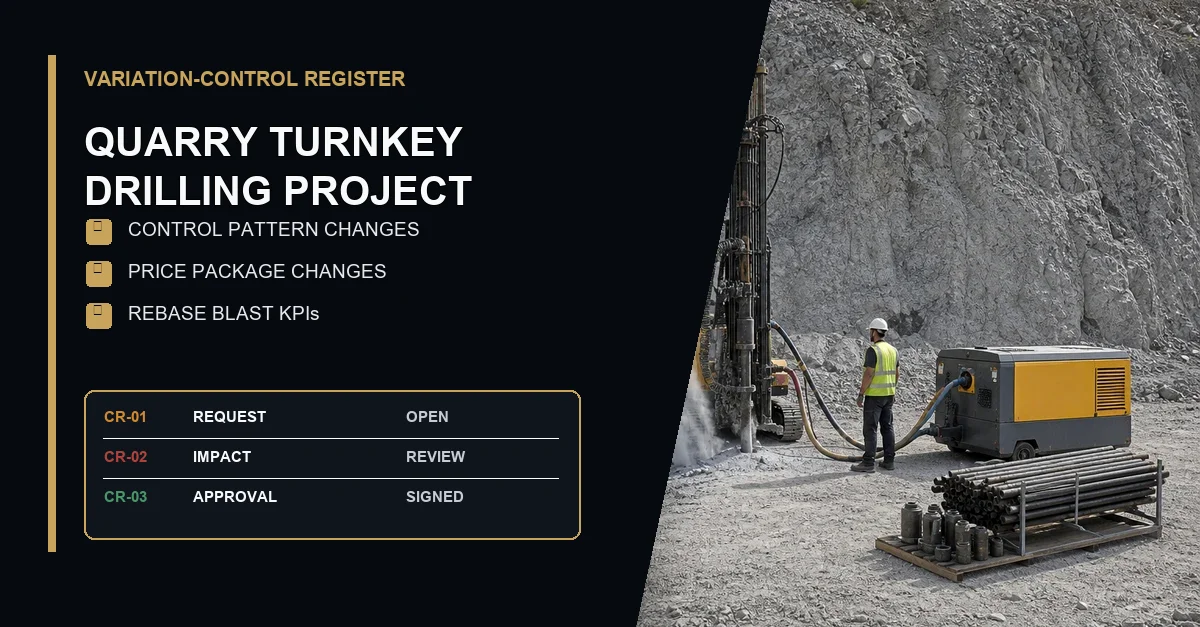
Quarry Turnkey Drilling Variation Control: Pattern Changes, Equipment Scope, and Blast KPIs
A quarry project rarely reaches production exactly as tendered. Rock conditions change, benches expose new constraints, tooling wears differently, and trial results challenge the original assumptions. The project stays controlled only when every change carries a technical reason, commercial impact, approval owner, and revised acceptance baseline.
Table of Contents
The First Change Arrived Before the First Baseline Closed
The first trial row exposed harder and more fractured rock than the tender description. The site team asked for a revised hole pattern, different tooling, and additional air support. Operations wanted the change immediately because the next bench was waiting.
Procurement asked who would pay. Engineering asked which drawing controlled the work. The project manager asked whether the original blast-efficiency target still applied after three variables changed together.
The change was technically reasonable. The process was not ready.
The real question is not whether a quarry project will change. It is whether the project can change without losing control of scope, cost, schedule, responsibility, and the evidence needed to judge the next result.
Why Turnkey Projects Need a Variation Register
A variation-control register is the project’s single list of proposed, approved, rejected, and completed changes. Each entry links the original baseline to the reason for change, affected documents, equipment impact, commercial effect, authorization, implementation record, and revised acceptance criteria.
The register prevents three separate conversations from developing. The field team should not operate from a verbal instruction while procurement waits for a price and engineering edits an uncontrolled drawing. One change ID must follow the issue through every function.
A common mistake is to treat every site adjustment as routine contractor coordination. A replacement fitting may be routine. A new hole diameter, revised pattern, different compressor duty, added rig, or changed blast-evaluation method can alter the project basis and requires formal review.
Register Field
Required Entry
Why It Matters
Hold Condition
Change ID and originator
Unique number, date, requesting party, and site reference
Prevents parallel instructions from becoming separate versions of the same change
The request cannot be traced to an accountable originator
Baseline affected
Drawing, equipment list, interface schedule, programme, or KPI revision
Shows what approved condition will be replaced
The current controlled baseline cannot be identified
Technical reason
Observed condition, evidence, risk, and proposed response
Separates a necessary correction from an undocumented preference
The request has no field evidence or technical rationale
Impact assessment
Scope, cost, time, safety, performance, documentation, and responsibility effects
Prevents approval of one benefit while hiding another consequence
A material impact remains unreviewed
Approval and closeout
Decision authority, status, implementation proof, and revised baseline
Confirms whether the field may proceed and which evidence now governs acceptance
Work is requested before the authorized decision is recorded
Step 1: Protect the Signed Baseline
Change control begins with a baseline that can be named. The pattern drawing needs a revision. The equipment package needs an approved bill of materials and interface schedule. The trial plan needs a defined evaluation method. The programme and commercial scope need dates and ownership.
If the team cannot point to the current baseline, it cannot prove that a variation occurred. Every disagreement then becomes a memory contest: one person recalls a meeting, another forwards an email, and the field follows the most recent instruction.
The baseline should also record assumptions. Formation descriptions, bench access, hole range, operating schedule, site utilities, owner-supplied items, and support expectations influence the package. When an assumption changes, the team can assess the consequence rather than arguing about whether the supplier “should have known.”
In my view, the assumption register is as important as the equipment list. Equipment is selected against conditions; when those conditions move, the selection logic must be reviewed.
Step 2: Control Hole-Pattern Changes
A hole-pattern change can affect more than collar positions. Revised depth, diameter, inclination, row geometry, access, or survey control may change rig setup, feed travel, rod handling, air demand, tooling quantities, drilling time, and the method used to record actual holes.
The request should identify the trigger. Was the original geological assumption wrong? Did the free face change? Is the rig unable to reproduce the drawing safely? Did the first trial show toe, oversize, backbreak, or poor muckpile movement? The reason determines who must review the change.
The pattern revision should carry a drawing number, affected area, implementation date, cancelled revision, and exception process. The field team should never receive a screenshot with altered dimensions but no revision status.
Use the verified guide to quarry blast hole pattern design when reviewing burden, spacing, free face, deviation, and muckpile response. Site-specific regulated blast design remains with qualified and licensed professionals.
Pattern Change
Evidence Required
Equipment Question
Acceptance Consequence
Hole diameter
Reason, affected rows, formation observations, and approved revised drawing
Does the hammer, bit, rod, air path, and handling system still match?
Tooling and drilling conformity baseline must be revised
Depth or inclination
Bench geometry, target floor, access condition, and survey reference
Can the rig set up, feed, add rods, and maintain the required control?
Planned-versus-actual checks and productivity assumptions change
Burden or spacing
Responsible designer’s approval and affected blast area
Does the revised hole count alter drilling metres, move cycles, tooling use, or programme?
The trial result cannot be compared with the old pattern without qualification
Replacement holes
Original hole ID, failure reason, replacement location, and approval record
Did blockage, deviation, collapse, or equipment access cause the replacement?
As-drilled records must preserve the relationship between original and replacement holes
Step 3: Price Equipment-Scope Changes
An equipment variation should describe the operating problem before naming the requested machine. “Add a compressor” is incomplete. The request must state which drilling duty cannot be met, which existing interface is affected, and whether the change is temporary, optional, or permanent.
The review must follow the entire drilling chain. A larger air source may require different hoses, fittings, lubrication, transport, fuel planning, maintenance capacity, and operating procedures. A new bit size may affect the hammer, rods, adapters, inventory, and hole-pattern basis.
The equipment change needs an itemized price, lead time, delivery responsibility, commissioning impact, warranty effect, required site work, spare-parts implication, and revised documentation. Otherwise, the approved headline item creates another set of unapproved interfaces.
Welldone Mining’s verified customized drilling solution shows how rigs, compressors, bits, rods, DTH hammers, accessories, and support are matched around depth, diameter, formation, air demand, and site conditions.
Scope Change
Direct Item
Interfaces to Recheck
Commercial Record
Different drilling platform
Rig configuration or additional unit
Transport, access, setup area, air, tooling, operator training, service tools, and spares
Price delta, lead time, cancelled scope, and revised acceptance tests
Revised air system
Compressor or operating-air package
Hoses, fittings, pressure loss, lubrication, drainage, fuel, maintenance, and safety controls
Ownership, site preparation, commissioning duty, and operating-cost responsibility
Tooling revision
Hammer, bit, rods, adapters, or handling tools
Connection compatibility, storage, wear stock, lifting, operator method, and replacement supply
Starter quantity, returned items, new price, and replenishment basis
Additional support
Field engineer, training, supervision, or trial support
Travel, accommodation, permits, working hours, language, owner resources, and sign-off authority
Rate basis, duration, mobilization, extension rules, and deliverable records
Step 4: Assess Cost, Time, and Risk Together
A technically valid change can still create an unacceptable programme or commercial effect. The impact assessment should be completed before approval, not reconstructed after the invoice arrives.
Cost review should separate equipment, freight, duties where applicable, site work, contractor labour, utilities, consumables, supervision, and future stock implications. Time review should cover engineering, approval, manufacturing, transport, mobilization, installation, retraining, retesting, and the effect on the drilling sequence.
Risk review asks what happens if the change is approved, rejected, or delayed. Continuing with the old basis may create poor drilling or unusable blast evidence. Changing too quickly may introduce an untested interface. Waiting may stop the bench. The register makes that trade-off visible to the authorized decision maker.
Approving a change because its direct purchase price is small can hide the larger operating effect. A low-cost adapter change can still stop production if it invalidates the available tooling stock or arrives after the scheduled trial.
Impact Area
Assessment Question
Evidence
Decision Output
Technical
Does the change solve the observed problem without creating a new mismatch?
Revised calculation, configuration check, drawing, interface review, or controlled trial plan
Accept, revise, test first, or reject
Commercial
Which existing item is added, removed, replaced, returned, or made redundant?
Itemized quotation, credit, owner cost, payment trigger, and validity
Approved value and cost owner
Programme
What activity moves, stops, or requires resequencing?
Updated dates, dependencies, resource plan, and recovery action
Approved time effect and revised milestone
Operations
What training, spares, maintenance, utilities, and procedures change?
Readiness checklist, updated manuals, stock list, and operator record
Conditions required before field use
Acceptance
Can the existing KPI baseline still be used?
Change-to-KPI mapping and revised comparison method
Retain, qualify, or reset the baseline
Step 5: Approve Before Execution
The register should identify technical review, commercial approval, schedule approval, and field-release authority. These roles may belong to different people. A site supervisor can confirm urgency without holding authority to change contract value or blast-design responsibility.
Emergency work needs a defined route, not an exemption from control. The project can permit a temporary safe action while requiring rapid written confirmation, capped exposure, and a deadline for full technical and commercial review.
Verbal approval should be recorded immediately with the approver, time, scope limit, and reason. If the change exceeds that limit, work returns to hold status.
The approval question is simple: does the authorized person understand what is changing, what it costs, what it delays, who owns the new risk, and which evidence will close the change?
Status
Meaning
Field Action
Required Record
Open
Change requested but not yet assessed
Continue only within the existing approved baseline
Request, originator, reason, affected scope, and urgency
Under review
Technical, commercial, programme, and acceptance effects are being assessed
Affected work remains on hold unless a temporary action is authorized
Impact assessment and outstanding questions
Approved
Authorized change may be implemented within defined limits
Issue revised documents and brief affected teams
Signed approval, price, time effect, responsibilities, and implementation date
Rejected
Original baseline remains in force
Remove uncontrolled instructions and confirm the valid revision
Decision reason and any alternative action
Closed
Change is implemented and the new baseline is issued
Use the revised records for operation and acceptance
As-built evidence, training or test records, and superseded-document list
Rebase Blast KPIs Without Erasing History
A changed pattern or equipment configuration can make the original trial result unsuitable as a direct comparator. The project should not delete the old data. It should preserve it, record the changed variables, and state whether the next result is a continuation, qualified comparison, or new baseline.
The review should connect the revised pattern and as-drilled condition to floor and toe, fragmentation, oversize, muckpile behaviour, loading, crusher interruptions, feed stability, and required compliance records. Measurement locations and methods should remain consistent where practical.
More importantly, do not change several variables and claim that one of them caused the improvement. If hole geometry, tooling, compressor duty, operator method, and regulated blast inputs all move together, the result may support production release but not a clean technical conclusion.
The verified guide to quarry blast efficiency evaluation explains how fragmentation, toe, oversize, muckpile, and crusher response can be reviewed through repeatable evidence.
Changed Variable
Old Baseline Use
New Evidence Needed
Reporting Rule
Pattern geometry
Reference only for the prior layout and geological area
Approved revision, as-drilled conformity, and downstream observations
State the affected rows and do not merge unlike layouts without qualification
Drilling platform or air duty
Retain for historical productivity and condition context
Configuration, operating records, tooling, downtime , and hole conformity
Separate equipment effects from pattern and geological changes
Tooling
Retain wear and drilling records for the previous connection and bit setup
New item identity, reason, holes drilled, wear observations, and operating context
Do not compare service life across different duties without stating the change
Evaluation method
Historical result remains valid only under its original method
New method, sampling rule, scale, location, and responsible reviewer
Do not present a method change as a performance improvement
Why Welldone Mining
Welldone Mining starts configuration discussions with the drilling application, formation, depth, diameter, site condition, air requirement, and working environment. This input-led method makes the original selection logic visible when a later change request appears.
Connected scope: Rig, compressor, hammer, bit, rods, adapters, accessories, starter items, and support are reviewed as one operating chain.Traceable revision: A requested configuration change can be tied back to the site duty and affected interfaces instead of becoming an isolated replacement item.Implementation support: Inspection, commissioning guidance, operator training, maintenance planning, and spare-parts preparation can be revised with the equipment scope.
For quarry applications, drilling methods, equipment categories, and operating inputs, review the verified quarry drilling solution .
Conclusion
A turnkey quarry project does not stay controlled by preventing every change. It stays controlled by preserving the baseline, assessing each variation across the complete drilling chain, authorizing cost and time before execution, and resetting acceptance evidence when the technical basis moves.
No silent changes. No orphan costs. No false KPI comparison.
If your site issued a pattern or equipment change tomorrow, could your team identify the old baseline, the approving authority, the total commercial effect, and the exact blast evidence that must be collected again?
Frequently Asked Questions
What counts as a variation in a quarry turnkey drilling project?
A variation is any approved departure from the controlled technical, equipment, commercial, programme, responsibility, or acceptance baseline. Not every field adjustment needs a contract change, but every material effect needs documented review.
Can urgent field work proceed before final commercial approval?
Only under a predefined temporary authorization route. The instruction should state the safety basis, scope limit, capped exposure, responsible approver, and deadline for full technical and commercial confirmation.
Who should approve a hole-pattern change?
The responsible qualified parties should approve the technical and regulated blasting implications under local law. Separate commercial and programme approvals may also be required before the drilling contractor executes the revised work.
When should blast-efficiency KPIs be reset?
Reset or qualify the baseline when a material change makes the old and new results non-comparable. Preserve the historical data, identify changed variables, and document the measurement method used for the new baseline.
Can Welldone Mining support equipment-scope variations?
Welldone Mining can review changes to the supplied rig, compressor, drilling tools , accessories, interfaces, spares, commissioning, and training scope against the updated drilling duty. Regulated blasting decisions remain with licensed professionals.
Control the Change Before It Reaches the Bench
Send the current drilling basis, observed site condition, proposed change, affected equipment, operating schedule, and required support. Welldone Mining can review the connected equipment impact and prepare an itemized scope response.
Website: www.welldonemining.com
Email: info@welldonemining.com