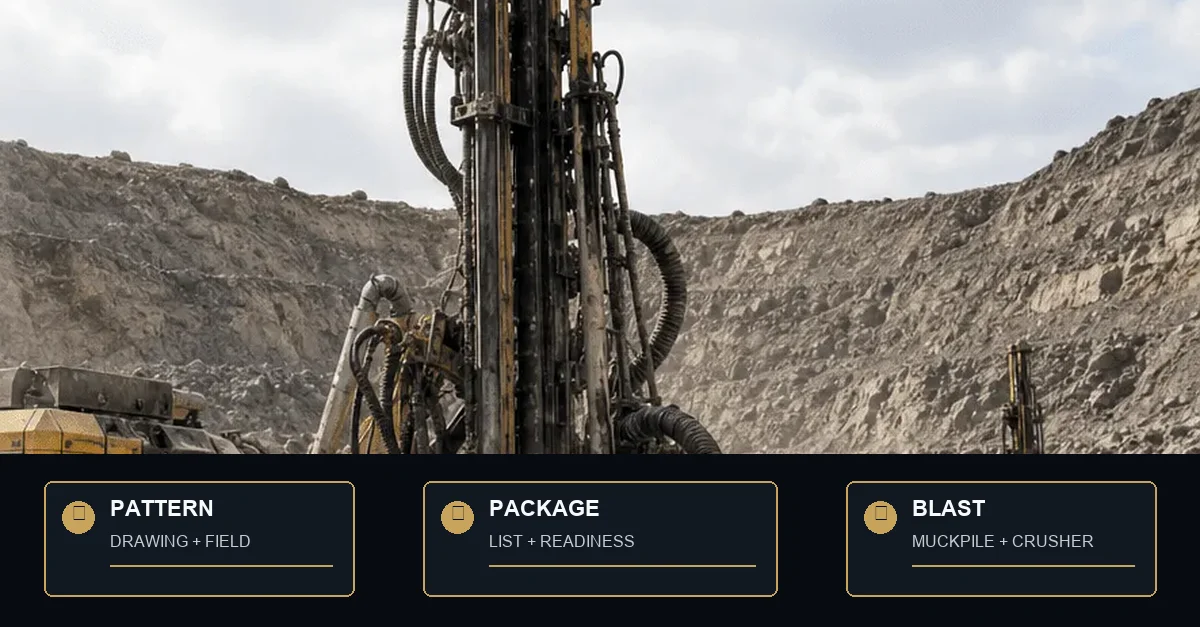
Quarry Turnkey Drilling Owner Acceptance Matrix: Pattern, Equipment, and Blast KPIs
An owner should not accept a quarry drilling project because the rig arrived, the crew completed the holes, or the blast looked energetic. Acceptance requires three linked proofs: the approved pattern was drillable, the complete equipment package was production-ready, and the blasted rock met the agreed downstream operating criteria.
Table of Contents
The Inspection Meeting With Three Different Answers
The owner’s representative arrived at the bench with an acceptance sheet. Procurement said the package was complete because every crate on the packing list had arrived. The drilling contractor said the work was complete because every planned hole had a depth entry. The quarry manager pointed to fresh oversize beside the loader and refused to release the system to routine production.
All three teams were using the word “complete.” They were measuring different outcomes.
The real question is not whether each contractor finished its own activity. It is whether the owner has enough verified evidence to accept the pattern, the drilling package, and the blast result as one operating system.
Build the Matrix Around Decisions, Not Documents
An owner acceptance matrix turns a technical scope into a set of release decisions. Each line identifies the item under review, the required evidence, the field verification, the responsible signatory, and the condition that places the project on hold or causes rejection.
The matrix should be agreed before procurement release or field mobilization. If the acceptance language is written after the result is visible, a technical review becomes a negotiation about what the contract “probably meant.”
A common mistake is to list deliverables without defining their decision value. A pattern drawing, compressor certificate, drilling log, and blast photograph may all exist while no document states which evidence authorizes production release.
Acceptance Block
Document Evidence
Field Verification
Owner Decision
Hole pattern
Approved revision, assumptions, hole schedule, survey reference, and exception procedure
Collars, depths, inclinations, hole IDs, conditions, and replacement-hole records match the controlled plan
Release the drilled row, hold for correction, or return the pattern for review
Equipment package
Matched bill of materials, interfaces, inspection results, commissioning plan, spares, and training records
The connected rig, air, tooling, support, and operator system can execute the approved drilling duty
Accept as production-ready, hold open items, or reject a material mismatch
Blast efficiency
Approved evaluation method, as-drilled reference, inspection forms, and required monitoring records
Floor, fragmentation, oversize, muckpile, loading, crusher response, and compliance evidence meet site criteria
Release to production, repeat the trial, or revise a controlled variable
Acceptance Block 1: Approve a Pattern That Can Be Verified in the Field
The pattern line should begin with a controlled drawing revision. It needs a survey reference, bench and free-face assumptions, hole identifiers, planned collar positions, depths, inclinations, and the process for wet, blocked, abandoned, or replacement holes.
Design acceptance and field acceptance are different. The drawing may be technically approved, yet the row should remain on hold if collar positions cannot be established, the rig cannot set up safely at edge holes, or the as-drilled record cannot identify field departures.
The owner should request a comparison between planned and actual conditions. That comparison does not need to become a complicated software project. It needs consistent hole IDs, recorded exceptions, and a signed statement showing which revision governed the work.
In my view, the most valuable pattern criterion is traceability. When hard toe appears, the owner must be able to locate the affected holes and review their actual condition instead of debating a perfect drawing that may not describe the bench.
The verified guide to quarry blast hole pattern design explains the relationship between burden, spacing, deviation, free face, and muckpile response.
Pattern Check
Accept
Hold
Reject or Redesign
Controlled revision
One approved revision is issued to the field team
A revision is pending signature or distribution
Conflicting drawings are being used for the same drilling round
Drillability
The proposed rig and setup method can access and reproduce the planned holes
Bench preparation or survey control is incomplete
The layout cannot be executed safely or consistently with the selected system
As-drilled evidence
Actual hole status and approved exceptions are recorded against unique IDs
Records are incomplete but can be recovered before regulated blasting work
The completed holes cannot be traced to the approved pattern
Acceptance Block 2: Inspect the Complete Equipment Chain
The equipment list must be derived from the approved drilling duty. It should cover the drilling platform, air supply, hammer, bit, rods, adapters, hoses and fittings, lubrication, dust or water controls, service tools, lifting needs, starter consumables, critical spares, training, and maintenance handover.
A packing list answers what was shipped. An acceptance list answers whether the connected system can drill the specified holes under the stated site conditions. Those are not the same document.
More importantly, the matrix should separate “delivered,” “tested,” and “production-ready.” A compressor may pass a standalone test while the operating air path still has an unresolved connection. A rig may move and rotate while the required adapter or replacement bit is unavailable.
The field inspection should follow the operating chain from power or fuel to the bit face. Every interface must have an owner. If the project needs a site-supplied hose, lifting device, utility, or consumable, that exclusion should appear beside the acceptance line rather than in a remote quotation note.
Welldone Mining’s verified customized drilling solution describes matching rigs, compressors, drill bits, rods, DTH hammers, accessories, and support around depth, diameter, formation, air demand, and site conditions.
Package Module
Evidence
Field Check
Hold Condition
Rig and mast
Configuration and inspection record tied to the approved duty
Setup, mobility, feed, rotation, positioning, rod handling, controls, and visible condition
The system cannot reproduce the required access, depth, inclination, or control
Air and connections
Matched-duty statement, connection layout, and maintenance requirements
Compressor, hoses, fittings, lubrication, drainage, and operating stability
Any unresolved interface prevents stable operation of the drilling chain
Tooling
Approved hammer, bit, rods, adapters, and connection list
Compatibility, wear condition, handling tools, protection, and replacement availability
A connection mismatch or missing wear item can stop the planned work
Support readiness
Training, starter stock, critical spares, service tools, and escalation contacts
People, parts, records, and response process are available for the initial operating period
The machine can start but the project cannot sustain production or document exceptions
Acceptance Block 3: Measure the Blast at the Muckpile and Crusher
Blast acceptance should be defined before the first trial. The quarry’s qualified and licensed parties must establish the site-specific criteria, measurement methods, authorizations, exclusion zones, and required environmental or safety monitoring under local law.
The owner’s matrix should connect the approved pattern and as-drilled record to downstream observations. Review floor and toe condition, fragmentation, material requiring secondary breaking, backbreak where relevant, muckpile profile and diggability, loader behaviour, crusher interruptions, feed stability, and the required compliance evidence.
A dramatic heave is not an acceptance criterion. Fine-looking material at one inspection point is not a fragmentation distribution. The sampling position, reference scale, equipment conditions, and reporting method need to remain consistent enough for one trial to be compared with the next.
The correct disposition may be acceptance, a repeat trial because evidence is incomplete, or a controlled revision. Where practical, change one variable at a time. Otherwise, the next blast may improve while the project loses the reason.
The verified guide to quarry blast efficiency evaluation covers fragmentation, oversize, toe, powder factor , flyrock, vibration, and repeatable post-blast review.
Blast KPI
Owner Evidence
Operational Consequence
Disposition Question
Hole conformity
Approved pattern compared with collar, depth, inclination, status, and exception records
Separates drilling departures from later blast or geological effects
Is the as-drilled condition complete enough to evaluate the result?
Fragmentation and oversize
Repeatable sampling or image method plus secondary-breaking record
Controls loader handling, breaker work, and crusher feed risk
Does the material fit the site’s agreed loading and crushing envelope?
Toe and floor
Survey or consistent inspection against the planned floor condition
Affects excavation, bench preparation, and the next drilling cycle
Can the next cycle proceed without unplanned secondary work?
Muckpile and crusher response
Diggability observations, loading behaviour, bridging events, interruptions, and feed stability
Tests whether the upstream system improved the actual production bottleneck
Did the blast deliver usable crusher feed rather than only an acceptable photograph?
Compliance
Records required by the approved blast plan and local regulation
Protects people, neighbouring receptors, and the quarry’s authority to operate
Are all mandatory limits, authorizations, and monitoring records satisfied?
Define Accept, Hold, and Reject Before Mobilization
Acceptance language should describe the next action. “Accept” means the evidence and field result satisfy the agreed condition. “Hold” means the item cannot be released until a correctable open point is closed. “Reject” means a material mismatch or untraceable result requires redesign, replacement, or another contract-defined remedy.
Conditional acceptance should be used carefully. It is appropriate only when the remaining action does not compromise safe use, legal compliance, the approved drilling duty, or the integrity of future evidence. Every condition needs an owner and a closeout date.
The matrix should also identify who has stop-work authority. If the field crew finds a conflicting drawing, unsafe setup, incompatible connection, or undocumented replacement hole, schedule pressure should not override the hold condition.
Assign One Signatory to Each Decision
Several teams may contribute evidence, but each acceptance line needs one named decision owner. The equipment supplier can sign its inspection and commissioning scope. Quarry operations can confirm site utilities and field readiness. The owner’s representative can release the commercial milestone defined in the contract.
Explosive selection, charging, initiation, blast authorization, exclusion zones, and required monitoring must remain with qualified and licensed professionals under local law. The equipment supplier supports drilling readiness; it should not be presented as approving regulated blasting work.
A responsibility matrix should show who prepares, checks, approves, witnesses, and receives each record. When one person appears in every column, the control is weak. When nobody appears in the approval column, the document has no release authority.
Connect the Matrix to Commercial Release
Commercial milestones should reference technical evidence rather than calendar events alone. Shipment can trigger a delivery milestone. Commissioning requires signed tests and open-item records. Production readiness requires the complete package and trained operating system. Trial acceptance requires the agreed downstream evidence.
This structure does not make the supplier responsible for every quarry result. It makes the boundaries visible. A drilling-equipment issue, site-provided interface, geological change, operating departure, or regulated blasting decision can be reviewed against the correct owner and record.
Price comparisons also become more reliable. Two quotations that both say “turnkey” may include different inspections, starter stock, spares, training, records, trial support, and acceptance duties. The matrix exposes those differences before the lower price becomes an expensive gap.
Why Welldone Mining
Welldone Mining’s verified solution pages begin with application, formation, hole depth, diameter, air demand, working environment, and support requirements. That input-led process allows an owner to connect each equipment decision to a stated project duty.
Configuration evidence: Rig, compressor, drill string, accessories, and site interfaces can be reviewed as one matched package.Readiness evidence: Testing, inspection, commissioning guidance, operator training, starter stock, and maintenance support can be included in the acceptance discussion.Operating continuity: Tooling, critical spares, replacement responsibilities, and escalation paths are considered before routine production begins.
For quarry applications, drilling methods, rig categories, and operating inputs, review the verified quarry drilling solution .
Conclusion
An owner acceptance matrix turns “turnkey” from a sales description into a controlled project decision. It verifies the approved pattern, the complete equipment chain, and the downstream blast result through evidence that can be signed, held, corrected, or rejected.
One matrix. Three acceptance blocks. No hidden definition of complete.
If your supplier requested final acceptance tomorrow, could your team point to the exact evidence that proves the planned holes were drilled, the complete package was production-ready, and the crusher received acceptable material?
Frequently Asked Questions
When should the owner acceptance matrix be agreed?
Agree it before procurement release or mobilization. The contract should identify the required evidence, field checks, signatories, hold conditions, remedies, and relationship between technical acceptance and payment.
Does equipment delivery equal acceptance?
No. Delivery confirms physical receipt. Equipment acceptance should also verify configuration, interfaces, inspection results, connected operation, tooling, support items, training, records, and readiness for the approved drilling duty.
What makes a hole pattern acceptable?
The controlled design must be technically approved by the responsible parties, drillable on the actual bench, issued as one revision, and supported by an as-drilled method that records hole identity and exceptions.
Who sets the numerical blast-efficiency limits?
The quarry’s qualified and licensed parties should set project-specific limits using the actual geology, bench geometry, explosive system, loading fleet, crusher, nearby receptors, approved blast plan, and local regulation. Generic limits should not be copied into the contract without review.
Can Welldone Mining support the equipment acceptance block?
Welldone Mining can support the matched equipment list, interfaces, testing and inspection evidence, commissioning guidance, operator training, tooling, spares, and maintenance handover for the supplied scope. Regulated blasting approval remains with the responsible licensed professionals.
Define Acceptance Before You Release the Order
Send your drilling application, formation, bench conditions, planned hole depth and diameter, operating schedule, available power or fuel, and support requirements. Welldone Mining can structure a matched package and readiness scope around those verified inputs.
Website: www.welldonemining.com
Email: info@welldonemining.com