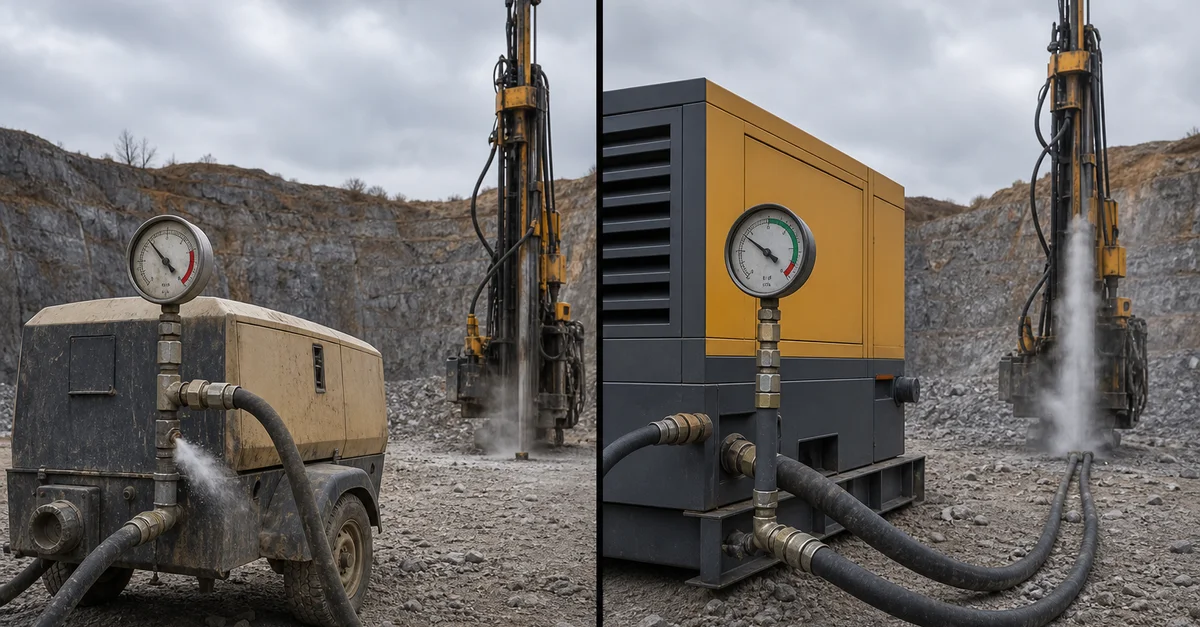
Quarry Air Demand: Why the Compressor Is the Real Bottleneck
A quarry buys a faster drill rig, puts it on the bench, and watches the metres stay exactly where they were. The rig is not the problem, and neither is the bit. The problem is the air — the compressed air system was sized for the old machine, and the new one starves on it. This article is about sizing quarry air demand as a system, not as a rig accessory, and about the gap between the air a rig is rated for and the air it actually receives.
The Bigger Rig That Didn't Drill Faster
A site replaced an older drill rig with a new one rated for a noticeably higher penetration rate, and expected the bench to move. It did not. The new rig drilled at almost the same pace as the old one, the drillers complained the bit was dull within hours, and the operator was blamed for not pushing hard enough.
The real cause was sitting a hundred metres away, chugging under the same load it had always carried. The compressor was sized for the old rig, and the new rig needed more air than the old one to reach its rated performance. The machine was starving — the hammer was not receiving the air volume it was designed for, the cuttings were not being cleared, and the bit was grinding in its own rock. The rig was faster on paper. The air system made sure the paper never reached the bench.
This is the most common and least visible bottleneck in quarry drilling, because air is invisible and the symptoms appear everywhere except at the compressor. The fix is not a better bit or a harder-working operator. It is air, and until the air is right, everything downstream of it is throttled.
Air Is the Energy Carrier, Not a Detail
In down-the-hole drilling, compressed air is not a convenience. It is the energy carrier. The air drives the hammer piston that breaks the rock, and it flushes the broken rock out of the hole so the bit can keep cutting fresh ground. A rig's rated penetration rate assumes a specific volume of air at a specific pressure, delivered at the hammer — not at the compressor outlet, and not in the catalogue.
That distinction is where most sizing goes wrong. The air number on a rig's specification is the demand. The air number on the compressor's specification is the supply, measured at the compressor, under the conditions it was rated for. Between the two sits a chain of losses — altitude, temperature, leaks, pipe restriction, and age — and every link in that chain takes a cut. The rig receives what is left, and it drills at the rate that leftover air allows. Buy a rig and a compressor by matching the two catalogue numbers, and you have matched the demand to a supply that will never actually arrive.
The Derating Stack
Compressor output is rated under standard conditions, and the site almost never matches them. The gap is a stack of deratings, each one small, that together cut the delivered air well below the nameplate.
Altitude is the first. A compressor rated at sea level delivers less air as the site climbs, because the inlet air is thinner. Temperature is the second — hot intake air holds less oxygen and expands, cutting the mass of air delivered for the same volume. Inlet restriction is the third, and it is self-inflicted: a clogged intake filter or a restricted inlet throttles the machine at the very point it breathes. Age and wear follow, as clearances open and the compressor works a little less efficiently than it did new. Then come the losses in the delivery system — leaks, long undersized pipe runs, and pressure drop across fittings — which spend the air before it ever reaches the hammer.
None of these shows up as a fault light. Each is a percentage, and percentages compound. The compressor that should deliver full volume, by the time the air reaches the hammer at altitude on a hot day through a leaky line, is delivering a fraction of it — and the rig is drilling at the rate that fraction allows. The penetration rate gap this produces is exactly the kind of silent erosion described in our penetration rate guide.
Leaks and Pressure Drop: The Silent Thief
Of all the losses between the compressor and the hammer, the two that quarry sites underestimate most are leaks and pressure drop, because both are invisible and both are continuous.
A small leak at a hose coupling — the faint hiss that everyone has learned to ignore — bleeds air for every hour the system runs, not just while drilling. A long run of undersized pipe, or a chain of quick-couplings and elbows, drops the pressure at the far end well below what the gauge at the compressor reads. The compressor is working to fill a system that is quietly leaking and resisting it, and the rig at the end of the line is the one that pays.
The practical point is that delivered air should be measured at the hammer, or as close to it as practical, before any decision is made about the rig or the bit. A compressor gauge that reads healthy at the machine says almost nothing about what the hammer is receiving, and quarries routinely chase bit and operator problems for months while the real fault is a two-millimetre hole in a hose fitting twenty metres away.
Sizing the Whole Site, Not One Rig
Most sizing errors come from asking the question about one machine at a time. The right question is about the site: how much air does the quarry need at peak, all at once, under worst-case conditions — and what happens when it doesn't get it.
The demand is not the sum of one rig's catalogue number. It is the sum of everything that can run at the same moment — the drill rigs, plus the flushing air, plus any other air users — at the moment of highest simultaneous demand, which is rarely the moment anyone planned around. Average demand is almost meaningless for sizing, because the system does not run on the average; it runs on the worst hour, and if the compressor cannot meet the worst hour, that hour is lost production.
Then comes headroom. A compressor running flat out, at the edge of its rating, has no margin for a hot day, a dirty filter, a leak, or a second rig coming online. It also has no room for the natural decline that comes with age, and it has no duty-and-standby logic — no ability to take one machine offline for service without stopping the bench. A correctly sized air system has headroom built in, because the alternative is a bench that idles every time the air system breathes hard.
From Rated Air to Real Metres: A Worked Example
Illustrative example only. The values are assumed to show the shape of the losses — substitute your own altitude, temperatures, and measured pressure before using the result.
| Stage |
Assumed condition |
Effect on delivered air |
Running figure |
| Compressor nameplate |
Rated at sea level, 20 °C |
— |
100% |
| Altitude |
1,800 m elevation |
−18% |
82% |
| High ambient temperature |
38 °C intake air |
−7% |
76% |
| Inlet restriction |
Partly clogged intake filter |
−5% |
72% |
| Leaks and pressure drop |
Worn couplings, long undersized line |
−8% |
66% |
Read the final row. The compressor that left the factory delivering full rated volume is delivering two-thirds of it by the time the air reaches the hammer — a loss of a third, before a single operating decision was made. That is the difference between a rig drilling at its rated rate and a rig grinding slowly while the drillers change bits and the schedule slips.
Notice also that three of the four losses are recoverable, and none of them requires a bigger compressor. Altitude is fixed, but the temperature, the inlet restriction, and the leaks are all maintenance and system-design problems. The cheapest way to get more air to the hammer is often to stop losing it, not to buy more of it. The hole-level side of that same arithmetic is in our bit and compressor matching guide, and the air-quality side — what the air carries with it — is in our compressed air treatment guide.
The Decision: Build the Air System First
The order of decisions in quarry drilling is usually wrong. The rig is chosen first, then the compressor is found to feed it, then the site lives with whatever air system results. The correct order is the reverse: size the air system for the site's peak demand, then choose the rigs that the system can feed, then let the air system have headroom for the future.
A quarry that sizes its air first makes every later decision easier. The rig is matched to a known air supply, so its rated rate is actually achievable. The compressor is sized for peak simultaneous demand, not for one machine's catalogue number, so the worst hour is covered. And the headroom means a second rig, a hot season, or a service outage does not stop the bench. The cost is in the capital of the air system up front — but that capital is the one that determines whether every other machine on the bench earns its keep.
The running cost of the air system is also where the electric-versus-diesel choice plays out, and it is a bigger line than most sites count. The trade-off is set out in our electric vs diesel running cost guide — and for the air system specifically, the same logic applies a level up.
Why Welldone Mining
Welldone Mining supplies the air system alongside the rig, because a rig without its air is a parked machine. We size the compressor for the site's real demand, under its real conditions, rather than matching two catalogue numbers and hoping.
What a quarry operator gets:
- Air sized to the site, not the rig. Send your rig fleet, simultaneous demand, altitude, ambient temperatures, and future plans, and we return the compressor capacity with each derating stated — so the delivered air at the hammer matches what the rigs were rated for.
- The derating made explicit. Altitude, temperature, and inlet losses are calculated, not ignored, so the nameplate number is corrected to the air that will actually arrive on your bench.
- A system, not a machine. Compressor, air treatment, and delivery pipe sized together, so the pressure at the hammer — not just at the compressor outlet — is the number the system is built around.
Related Solutions
Conclusion
The compressor is the least glamorous machine on the bench and the one that decides how fast every other machine works. A rig is only as good as the air that reaches its hammer, and the air is only as good as the system that carries it — through altitude, heat, leaks, and undersized pipe, all the way from the compressor to the bottom of the hole.
Size the air system for the site, derate it honestly, and stop the leaks before buying more capacity. The quarry that gets its air right stops chasing bits and operators and schedules, because the metres it was losing were never in the rock — they were in the air.
One question for your own bench: when the last new rig failed to drill faster, did anyone measure the air pressure at the hammer — or did the bit, and then the operator, take the blame for a compressor that was quietly starving them?
Website: www.welldonemining.com
Email: info@welldonemining.com
Frequently Asked Questions
Why does my new drill rig drill at the same speed as the old one?
The most common cause is air, not the rig. A rig's rated penetration rate assumes a specific air volume delivered at the hammer, and if the compressor was sized for the old machine, the new rig is starving. The hammer does not receive the air it was designed for, the cuttings are not cleared, and the bit grinds in its own rock. Measure the air at the hammer before blaming the rig or the bit.
How much air does my quarry compressor actually deliver?
Less than the nameplate, almost always. The rated output is measured at sea level and standard temperature, and the site subtracts from it: altitude, hot intake air, a clogged inlet filter, age, and leaks all take a cut. The stack compounds, and a compressor rated at full volume can easily deliver two-thirds of it by the time the air reaches the hammer. The delivered number should be measured at the hammer, not read off the compressor gauge.
Should I size my compressor for the average air demand?
No. Size it for peak simultaneous demand — the moment when the most machines are running at once, under the worst conditions. The system does not run on the average; it runs on the worst hour, and if the compressor cannot meet that hour, that hour is lost production. Build in headroom for hot days, filter fouling, leaks, and a second rig coming online, plus duty-and-standby so one machine can be serviced without stopping the bench.
Are air leaks really worth chasing?
Yes, and they are usually the cheapest performance gain on the bench. A small leak at a hose coupling bleeds air for every hour the system runs, not just while drilling, and a long run of undersized pipe drops pressure at the far end. Fixing leaks and pressure drop costs far less than buying more compressor capacity, and it delivers air to the hammer that you were already paying to compress and then throwing away.
Can Welldone Mining size the air system for my quarry?
Yes. We supply the air system alongside the rig, sized to the site rather than to a single machine. Send your rig fleet, simultaneous demand, altitude, ambient temperatures, existing pipe layout, and any future expansion to info@welldonemining.com. We return the compressor capacity with each derating stated, the air treatment, and the delivery pipe sized together, so the pressure at the hammer is the number the system is built around.