Quarry Drilling Dust Control: Dry Collection, Water Injection, and What Each One Costs You Downhole
Drilling dust is usually filed as a health and compliance item, which is correct and incomplete. On a working bench it is also a production item — it stops loaders for visibility, it wears the rig's own air system, and the method chosen to suppress it reaches all the way down the hole to the bit face. This article compares the two practical options against the costs that show up on the shift log, not just the ones on the inspection report.
The Plume That Crossed the Haul Road
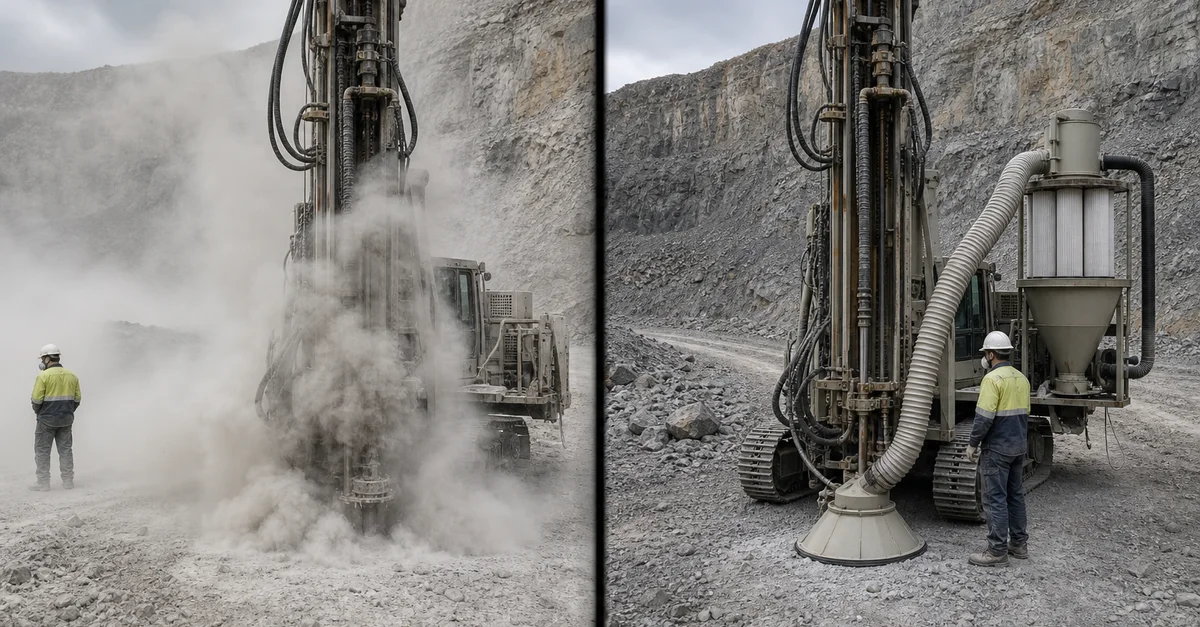
A rig was collaring blast holes on a limestone bench, and the wind was pushing the collar plume sideways across the haul road behind it. Twice in the shift the loader operator stopped at the crossing — not to give way, but to wait for enough visibility to move.
By the end of the shift the driller's respirator filter had gone grey, and the rig's own intake filter was on its second change that week. Nobody logged any of it as a dust cost. The stopped loader was recorded as a haul delay. The filters went on the consumables line. The respirator went on the safety budget.
Three separate lines, one cause. That is the first thing to understand about drilling dust: it does not appear in the accounts as dust. It appears as everything it touches, which is why it is chronically under-costed and why the decision about how to control it usually gets made on the price of the equipment alone.
What the Exposure Limits Actually Say
Crushed rock dust matters most where the formation carries crystalline silica — granite, quartzite, sandstone and many mixed hard rocks — because the respirable fraction of that dust is the regulated hazard, not the visible cloud.
The numbers in force depend on the jurisdiction, and they should be read from your own regulator rather than from a supplier's brochure. As reference points: in the United States, OSHA sets a permissible exposure limit for respirable crystalline silica of 50 micrograms per cubic metre as an 8-hour time-weighted average, with an action level of 25 micrograms per cubic metre at which monitoring obligations begin, and the US mining regulator has aligned its own limits to the same values. The ILO's guideline value sits at the same 0.05 mg/m³. Other jurisdictions set their own figures, and some are less strict — but the direction of travel over the last decade has been consistently downward.
Two practical points follow. First, the action level matters as much as the limit, because it is the threshold that triggers monitoring and paperwork, and it is half the limit. Second, these are personal exposure figures averaged over a shift — they are measured on the worker, not at the hole. A dramatic-looking plume that blows away from the operator can matter less than a modest one that sits in the cab's air path. Which is why the control method is chosen for where the dust goes, not for how the collar looks.
Dry Collection: Capture It at the Collar
A dry dust collection system seals a hood around the hole collar, pulls the dust-laden air off through a suction duct, and separates the solids in a cyclone and filter stage before venting clean air. The dust ends up in a hopper as a dry solid, which can be dropped on the bench or collected.
What it does well: it captures the dust at the point it is produced, which is the only place capture is efficient. It leaves the hole dry, so nothing interferes with what the compressed air is doing downhole. It works where there is no water, where water freezes, and where the collected fines have to be contained rather than dispersed. Our heavier integrated rigs carry hydraulic dry dust collection for exactly this reason — on a 24/7 production bench, a dry system does not depend on a resource the site has to truck in.
What it costs: filter elements, which are consumables with a service life, and a hood seal that has to actually seal — a worn or badly fitted collar hood leaks, and a leaking hood is a system that costs money and controls very little. Add the maintenance attention the cyclone and hopper need, and the power the fan draws.
Water Injection: Suppress It in the Hole
Water injection introduces a small water flow into the air stream so the cuttings are wetted as they are lifted, and the dust is suppressed before it can leave the collar. The hardware is simple, cheap, and hard to break.
What it does well: it is inexpensive to fit and to run where water is already on site, it needs almost no consumables, and it also suppresses the fine dust that a collar hood can miss when wind is moving across the bench. On a site with water and no freezing, it is genuinely the efficient answer.
What it costs is where the comparison usually goes wrong, and it is not the hardware. It is water logistics — a supply, a tank, a pump, and on a remote or arid site, trucking. It is the mud at the collar, which is a housekeeping and access problem on a bench that has to be walked and driven on. It is freezing, which takes the system out of service for part of the year in cold climates. And it is what happens downhole, which deserves its own section.
The Downhole Cost Nobody Puts on the Comparison
A DTH hammer works by percussion at the bit face, and the compressed air does two jobs at once: it drives the hammer, and it lifts the cuttings out of the hole. That second job is the one water can interfere with.
Add water in moderation and the cuttings are damped and still lift cleanly. Add too much, or add it in a formation that produces fine rock flour, and the cuttings and the water combine into a paste at the bottom of the hole. Paste does not lift the way dry cuttings do. It circulates at the bit face, and the carbide is then being ground by the material it has already cut rather than cutting fresh rock — the same recirculation mechanism that turns a starved compressor into a bit-life problem, which we set out in our guide to bit and compressor matching.
The symptoms are recognisable: penetration rate drops without an obvious cause, the returns at the collar turn wet and rounded rather than sharp and dry, and bit life comes in short. Those first two are also the early symptoms of hammer trouble, which is why a water-injection site that is over-dosing can spend weeks diagnosing the wrong component.
My view is that water injection is genuinely cheaper only where the water is already on the site and the flow is set conservatively. Where either of those is untrue, the saving on the collection hardware gets taken back out of the bit line — and the bit line is a monthly cost, while the collector was a one-off. The metres-per-bit tracking that would catch this early is in our guide to quarry drilling consumables.
Comparing the Two on the Lines That Move
| Line |
Dry collection |
Water injection |
| Capital cost |
Higher — hood, ducting, cyclone, filter housing, fan |
Low — pump, line, and a metering valve |
| Running consumables |
Filter elements on a service life, hood seals |
Water, and the fuel or power to move it |
| Site resource needed |
None beyond power for the fan |
A reliable water supply at the bench |
| Effect on hole cleaning |
None — the hole stays dry |
Neutral if dosed conservatively; harmful if over-dosed |
| Cold weather |
Unaffected |
Freezes — out of service or needs heating |
| Bench housekeeping |
Dry fines to contain at the hopper |
Mud at the collar and on the working area |
| Wind on an open bench |
Hood can be defeated if the seal is poor |
Handles drifting fines well — dust is wetted at source |
| Containment of the dust |
Collected as a solid — can be removed from site |
Dispersed on the bench as damp fines |
Read the table as two profiles rather than a winner. Dry collection buys independence from a site resource and protects the hole, at the cost of consumables and maintenance attention. Water injection buys simplicity and low capital cost, at the cost of a water supply and a risk downhole that only appears if the dosing is wrong.
Which One Fits Your Site: Five Questions
- Is there reliable water at the bench? If water has to be trucked, the running cost of injection is not low, and a dry system stops depending on a delivery schedule.
- Does the site freeze? If part of the year is below freezing, an injection system needs heating or a seasonal alternative — which usually means owning both.
- What is the silica content of the formation? High-silica granite and quartzite raise the health stakes and typically justify capture-and-contain over disperse-on-the-bench.
- Where does the dust go, and who is in its path? A bench near a haul road, a plant building, a boundary or a settlement is a containment problem, and dispersing damp fines does not solve it.
- How tight is your bit-life margin already? If metres-per-bit is under pressure from the formation or the air supply, adding water to the hole is the wrong time to experiment.
Two answers frequently point in opposite directions, and that is normal. A site with abundant water but a boundary close to the working bench has a cheap suppression option that does not solve its containment problem. The resolution is usually to fit the dry system on the rigs that work the sensitive benches and keep injection for the interior ones — not to pick one method for the whole site because it is simpler to buy.
Verify It at Acceptance, Not at the First Inspection
Whichever method is specified, the dust system is part of the equipment package and should be checked at handover with everything else. The collar hood should seal against the bench, the fan should pull, and the filter service interval and spare elements should be in the parts list rather than ordered after the first blockage. For an injection system, the metering valve should be adjustable and the initial dose set conservatively, with the first bit inspected for wet, rounded returns.
Actually, the most common failure of a dust system is neither of these. It is that the crew disables it. A hood that fouls the collaring routine, a duct that has to be moved by hand at every hole, an injection line that ices up — each of these gets bypassed at the third or fourth hole of a night shift, and after that the site owns compliance equipment it is not using. Any dust system that adds handling time to every hole will lose that argument eventually, which is a reason to check the workflow at commissioning and not only the hardware. The rest of that handover checklist is in our guide to drill rig site acceptance and commissioning.
Why Welldone Mining
Welldone Mining specifies the dust method with the rig rather than as an accessory, because the choice interacts with the air system and the tooling that we also supply. When the site has no water, we do not sell an injection kit and leave the logistics to the buyer.
What a quarry operator gets:
- Dust method matched to the site, not the catalogue. Send the water situation, the climate, the formation silica content, and what sits downwind of the working bench, and the recommendation comes back with the reason — including the case for fitting different methods on different rigs.
- Integrated dry collection where production justifies it. Our heavier integrated rigs carry hydraulic dry dust collection built into the machine rather than bolted on, so the collar hood and the ducting are part of the drilling workflow.
- Filter elements in the parts plan. Dust filters are consumables with a service life, and they belong in the spare parts package with the bits and the hammer internals rather than being discovered when the collector blocks.
Related Solutions
Conclusion
Dust control is bought as a compliance item and paid for as a production one. The plume that crosses the haul road costs loader hours. The fines that reach the rig's intake cost filters. And the water added to suppress the cloud, if it is dosed by feel rather than by result, costs bit life at the bottom of a hole nobody is looking at.
Choose the method from the site's water, climate, formation and neighbours rather than from the capital cost, verify it at handover, and watch the first bit for wet, rounded returns if you are injecting. The compliance case for dust control is well established and getting stricter. The production case is the one that is usually missing from the decision, and it is the one that decides whether the system stays switched on.
One question for your own bench: if you added up the loader hours lost to visibility, the intake filters changed this quarter, and the metres-per-bit you are actually getting on the wet holes, would the cheaper dust method still be the cheaper one?
Website: www.welldonemining.com
Email: info@welldonemining.com
Frequently Asked Questions
Dry dust collection or water injection — which should I choose?
Start from the site, not the price. Dry collection suits sites with no reliable water, freezing climates, high-silica formations, and benches near a boundary, haul road or plant where the dust has to be contained rather than dispersed. Water injection suits sites where water is already available, the climate does not freeze, and the dust simply needs suppressing at source. Many operations end up running both, fitted to different rigs for different benches.
Can water injection damage my drilling performance?
Over-dosing can. The compressed air in DTH drilling both drives the hammer and lifts the cuttings; too much water combines with fine rock flour into a paste that does not lift cleanly, recirculates at the bit face, and grinds the carbide. The signs are a falling penetration rate, wet and rounded returns at the collar, and short bit life. Dose conservatively, inspect the first bits, and treat a drop in metres-per-bit as a dosing question before blaming the bit.
What are the exposure limits for silica dust in quarry drilling?
They vary by jurisdiction, so confirm against your own regulator. As reference points, OSHA in the United States sets a permissible exposure limit of 50 micrograms of respirable crystalline silica per cubic metre over an 8-hour shift, with an action level of 25 micrograms at which monitoring duties begin, and the ILO guideline value is the same 0.05 mg/m³. Note that these are measured on the worker over a shift, not at the collar — which is why where the dust travels matters more than how the plume looks.
Are dust collector filters a consumable I need to plan for?
Yes. Filter elements have a service life that depends on the formation's fineness and the hours run, and a blocked collector is a rig stop just like any other. They belong in the spare parts package alongside bits and hammer internals, sized against the project duration and the site's lead time rather than reordered when the collector chokes. Our consumables guide covers how to size that line.
Can Welldone Mining specify the dust system with our rig?
Yes. Send the site's water availability, whether the climate freezes, the rock type and silica content, the hole diameter and depth, and what sits downwind of the working bench — a haul road, plant building, boundary or settlement — to info@welldonemining.com. We return the dust method matched to those conditions with the reasoning, the filter service interval where a dry system applies, and the consumable quantities for the parts plan.