Drill Rig Site Acceptance and Commissioning: The Physical Checklist That Catches a Configuration Error Before Production
A delivery can be complete and still be wrong. Acceptance is where that gap shows up, and it is also the last cheap place to close it. This article treats site acceptance as what it actually is — a short, free window in which a starved compressor, a mismatched bit gauge, or an altitude derate that was never calculated can still be caught at the cost of a conversation — before it becomes what it is always going to become: a stopped rig and a bit order that doubled.
The Delivery That Signed Off Clean
A crawler DTH rig and its compressor arrived on a limestone bench. The crates came off the flatbed, the count matched the packing list, nothing was dented. The buyer's engineer and the supplier's representative walked the machine, looked at it, and signed the delivery note. By lunch it looked accepted.
Three days later, on the first full drilling shift, the crew noticed the rig was taking longer per hole than the plan assumed. Nobody was alarmed yet — first shifts are always slow. But the slowness had a cause, and that cause was sitting in the air line where nobody had gone to look.
The compressor was sized for the rock on paper, not for the hole and depth the quarry actually intended to drill. It could not clear the cuttings at the bit face. The rig was not broken. It was starved, and it was signed off as clean. The difference between those two states is exactly what a physical acceptance is supposed to establish — before the first production shift blurs it.
Acceptance Is a Window, Not a Signature
A signature closes a commercial obligation. It says the quantity arrived. It does not say the system is matched. Those are two different claims, and most delivery notes only support the first one.
Between the rig arriving on site and the first hole drilled for production, there is a window — a few days, sometimes less — in which every component is still at a price of a conversation. The compressor is still the supplier's to fix or swap. The tooling is still a specification issue, not a stock issue. The altitude assumption, if it was wrong, is still a datasheet correction and not a lost month.
Once production starts, the same problem changes its invoice. A starved air line stops being a configuration error and starts being bit wear. A wrong gauge stops being a spec line and starts being a part in the scrap bin. My view is that most acceptance sign-offs fail for one reason: they verify the paperwork, not the physics. The paperwork was correct. The machine was not right for the job, and the paper never said it would be.
This is the same boundary problem our guide to the quarry turnkey drilling project lays out, aimed at one moment in time: the moment the equipment first stands on your bench and you decide what "delivered" actually means.
What Physical Verification Actually Means
A physical acceptance is a set of measurements taken at the rig, against the purchase order, while the system can still be moved. Four of them carry most of the weight.
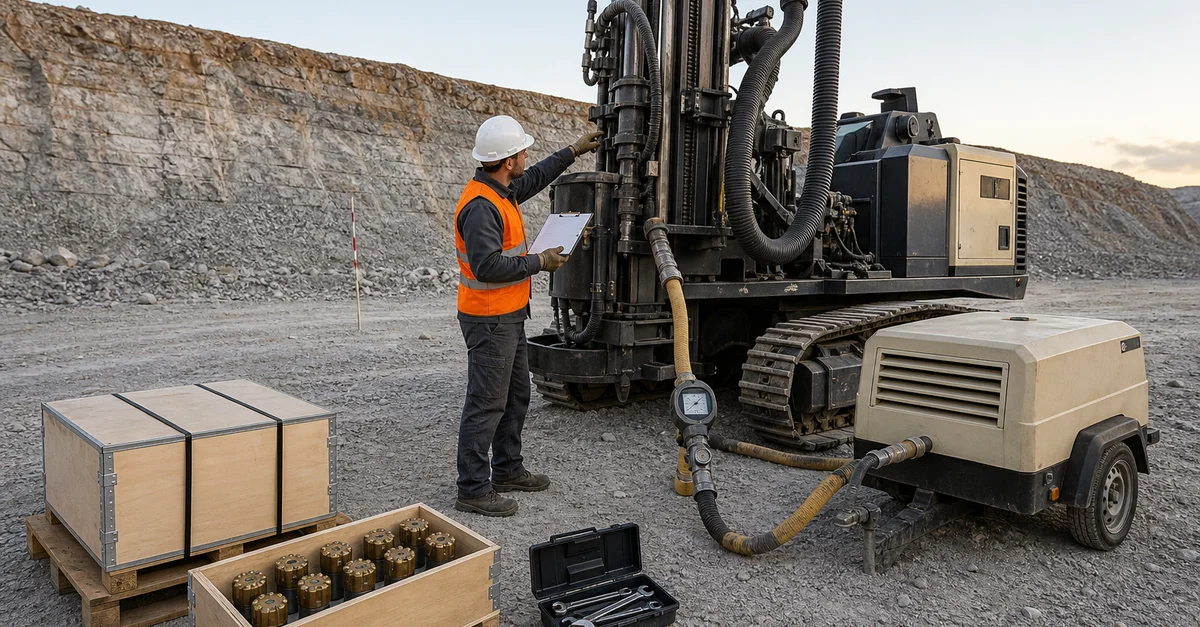
- Air at the coupling, not on the nameplate. Clamp a flow gauge on the hose at the rig's inlet, with the hammer running at full rotation and feed. Read the actual CFM and bar under load. A nameplate rating is a promise at a test condition; the number on the gauge is the number the hole will see. This single measurement is the difference between a matched system and a starved one, and the full logic of how to size that air is in our guide to bit and compressor matching.
- The first hole's geometry, not the spec sheet. Collar the first hole at the planned position and inclination, drill it, and survey the offset at the bottom. A DTH system should hold tight to plan; the gap between planned and measured at the toe is your earliest, cheapest signal of a setup or method problem. It is a number you can only get by drilling, which is why it belongs in acceptance and not in a document review.
- Tooling gauge against the hammer, on a micrometer. Measure the bit's gauge diameter against the hammer's output diameter. A mismatch of a few millimetres produces uneven button wear and bits that fail far short of their expected life — a defect you will not see in a crate, only in a metre count later. Confirm the match before the first bit ever enters a hole.
- Parts count and spec against the plan, on the pallet. Open the consumables case and check it line by line against the quantities you planned for the project, not the round number on the box. What is short or wrong here becomes a stock-out on a remote site, which is when a missing part costs a full rig-stop day instead of a shipping line. The sizing logic for that first shipment is in our guide to spare parts planning for drilling downtime.
None of these four requires a lab. They require a gauge, a survey marker, a micrometer, and thirty minutes that the delivery note does not schedule. That is the whole trick of acceptance: it is work, and it does not happen on its own.
The First-Shift Ramp-Up Plan
Commissioning is not one event; it is a ramp. The first shift should not be a production shift. It should be a measurement shift — deliberately running the system and recording what it does, at partial load where the plan allows, because the goal is data, not metres.
The five numbers below are what to write down, and what each one rules out if it is not where it should be.
| Metric |
How to measure at acceptance |
A poor result points to |
| Air at coupling (CFM & bar) |
Flow gauge on the inlet hose, hammer at full rotation and feed |
Compressor undersized, or line loss from hoses and fittings |
| Penetration per shift (m) |
Total drilled metres over the first full shift, all holes |
System match, rock-versus-spec, or feed discipline |
| Hole deviation, first hole |
Surveyed offset at the toe versus the planned position |
Levelling and collaring setup, or method versus depth |
| First bit face condition |
Inspect the first bit pulled — button wear pattern and gauge |
Geometry/formation fit, cuttings recirculation, or gauge mismatch |
| Parts on hand vs plan |
Count the open case against the consumables plan |
A first-fill gap and a lead-time exposure on a remote site |
I would rather run that first shift at half speed with a gauge on the line than run it flat out and discover in week three that the system was starved all along. The half-speed shift costs a few metres. The late discovery costs a month of the wrong bit order and a rework of a specification nobody can easily unwind.
Site Conditions That Change the Checklist
The four measurements above are the base checklist. Three site conditions add or sharpen lines on it, and all of them should be known before the rig is unpacked.
Elevation. A compressor rated at sea level produces less air at altitude, because thinner air means less mass per stroke and the engine itself derates on top of that. A package specified at sea-level figures will underperform on a high site, and the correction has to be applied before the air measurement, not discovered by it. The derating method and what to physically verify on a high-altitude delivery is set out in our guide to high altitude DTH drilling and compressor derating.
Power availability. If there is no grid at the bench, the diesel supply — rig engine and compressor — becomes part of what you accept. Fuel logistics, tank capacity, and generator dependency move from an operating detail into the acceptance scope, because a package that assumes a power feed the site does not have is not a complete package.
Bench width and access. A rig that cannot reach the collar positions on your benches is a rig you cannot operate, whatever its rating. The levelling range, track spread, and mast geometry have to be checked against the actual bench, which is why the first-hole survey doubles as a reach test — the machine has to physically get to where the hole is planned.
Who Runs Acceptance, and What Changes When It Is Remote
Two models exist, and the choice is a cost-and-speed trade, not a quality one done carefully.
An engineer on site runs the checklist physically, makes the adjustments in the moment, and trains the operator while the hands are on the machine. It is the most complete form, and it is the right call where the site is remote, the conditions are unusual, or the operator team is new to the rig. It costs more and takes longer to arrange.
Remote, video-guided commissioning has the engineer watching and directing while your crew performs the measurements. It is legitimate, often sufficient, and faster to start. Actually, for most standard quarries it is the right choice — provided one thing is understood: remote commissioning still requires the measurements to be taken on site and reported back. The video does not hold the gauge. If the crew is not reading the air under load and surveying the first hole, then "remote commissioning" is just a phone call, and the window is spent without being used.
Whichever model you choose, the ownership is the same: the measurements belong to the buyer, because the buyer is the one who will live with the result. The supplier's role is to be able to answer, quickly, when a number comes back off plan.
Reading the Results Before You Sign Off
A measured number that is off plan is not a failure of acceptance. It is the point of it. The discipline is in what you do with it.
Air short at the coupling is a compressor or line problem, and it is still fixable for the cost of a swap while the system is in front of you. A hole that deviates at the toe is a setup or method problem, correctable with levelling practice or a different approach to the depth. A bit that shows a wear pattern the formation should not produce is a geometry or gauge mismatch, still a specification conversation. Each of these has a cheap fix on day three and an expensive one on week eight.
When the internal readings come back — a penetration drop with a lightening rotation, cuttings that turn wet and rounded — that is the hammer telling you something before it stops. Those symptoms, and how to read the wear pattern to separate a seal issue from scoring, are covered in our guide to DTH hammer failure modes. Catching them at acceptance means you never have to catch them mid-shift.
Why Welldone Mining
Welldone Mining manufactures the hammer, builds the bit, and specifies the compressor, so the acceptance numbers come from the same matched system rather than from four suppliers each defending their own line item. When a measurement at the coupling is off, we are not the party to negotiate with — we are the party that can fix it.
What a quarry operator gets at acceptance:
- A physical acceptance checklist against the exact package you bought. Not a generic sign-off sheet, but the specific measurements for your rig, compressor, and tooling — air at the coupling under load, first-hole survey, gauge match, and parts count against the plan.
- Commissioning that matches your site. On-site engineer where the conditions or the distance justify it, video-guided where they do not — with the measurements taken either way, and the ramp-up run at a load the data can support.
- A 48-hour response when a number comes back off plan. If the first-shift readings do not track the specification, the diagnosis is part of the service, and the fix happens while the configuration is still cheap to change.
Related Solutions
Conclusion
Acceptance is the only moment in the project where a wrong specification is still a specification. After the first production shift, it is a wear pattern, a stock-out, and a month of output that is quietly lower than it should be. The rig arrived complete. The question was never whether everything shipped — it was whether everything shipped was right for this hole, in this rock, at this elevation, with this power and this bench.
Run the first shift as a measurement shift. Read the air at the coupling under load, survey the first hole, check the gauge with a micrometer, and count the parts against the plan. Those four numbers, written down while the window is open, are the difference between a delivery and an acceptance.
One question to take to your bench: if you compared the air the rig actually pulled on its first shift with the rating on the compressor's nameplate, how far apart would they be — and do you know the answer, or only the nameplate?
Website: www.welldonemining.com
Email: info@welldonemining.com
Frequently Asked Questions
What should a drill rig site acceptance actually check?
Four physical measurements, taken at the rig against the purchase order: air flow and pressure at the inlet coupling under full drilling load, the surveyed deviation of the first hole at its toe, the bit gauge diameter against the hammer output on a micrometer, and the consumables count and specification against the project plan. These are measurements, not document checks — a clean packing list does not confirm the system is matched.
How long should the commissioning or ramp-up phase last?
Enough to complete at least one full measurement shift and to run the system at a load the data supports before scaling to full production — for most quarry packages that is the first day or two, not a fixed calendar. The phase ends when the air, penetration, deviation, and first-bit readings all track the specification, not when the delivery note is signed.
Remote commissioning or an engineer on site — which should I choose?
On-site engineer where the site is remote, the conditions are unusual, or the crew is new to the rig. Video-guided where a standard quarry can safely perform the measurements itself. Either way the measurements are taken on site and reported — remote commissioning does not remove the need to read the air under load, and a phone call without data is not commissioning.
What is the single most important measurement at acceptance?
Air flow and pressure at the coupling, with the hammer running at full rotation and feed. It is the fastest and cheapest way to find a starved system, and it is the one measurement a nameplate cannot substitute for. A compressor sized for the technical minimum will pass every document check and still leave the bit face uncleared — the air gauge is the only thing that catches that. The sizing method is in our bit and compressor matching guide.
Can Welldone Mining support acceptance and commissioning for our delivery?
Yes. Send the site elevation, rock type and hardness, hole diameter and depth, whether grid power is available at the bench, and the bench geometry, to info@welldonemining.com. We provide a physical acceptance checklist specific to your package, the commissioning mode that fits your site, and a 48-hour response if the first-shift readings come back off plan.