Quarry Drilling Consumables: Bit Life, Hammer Service, and the Real Cost per Drilled Meter
Every quarry drilling budget has a line that looks small on the purchase order and large in the ledger: consumables. Bits, hammer internals, drill rods, seals. They are bought in quantities that seem trivial next to the rig, and they are the first thing to break the economics of a project that was specified in a hurry. This article treats consumables the way a project manager should treat them — as a system with a planned output, measured in metres, from the first shift.
The Workbench That Tells the Truth
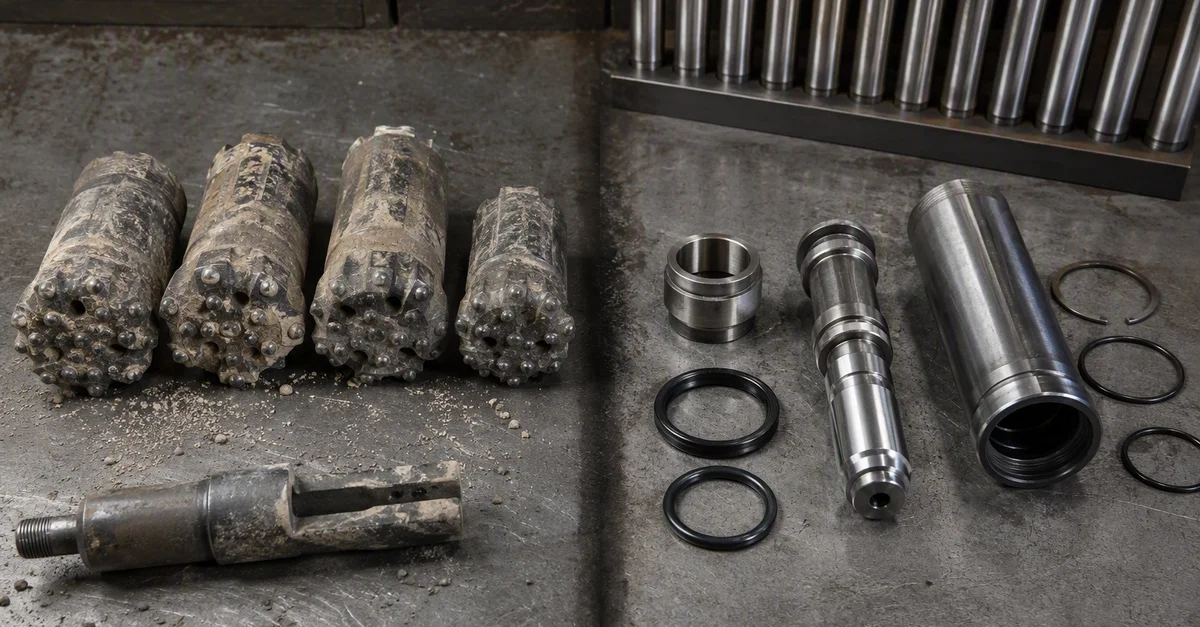
On a granite quarry bench, a crew laid out a row of four spent DTH bits on a steel workbench. Each one had done different work: one had lost two of its carbide buttons early, one had worn into a cone, one had worn evenly but short. The shift log next to them said the same thing every line said — bits changed every 180 metres, where the design life was 900.
Everyone had a theory. The rock got harder. The operator pressed too deep. The supplier batch was bad. Theories are cheap at a workbench. Diagnosis is a different matter, and it starts with one question: were these bits worn by rock, or by the system running them?
Consumables are where that question gets answered, because wear is the only honest data a drilling system produces. The rig can be cleaned, the log can be formatted, the schedule can be adjusted. A bit face cannot be persuaded.
Four Consumption Lines, One Budget
Quarry drilling consumables fall into four lines, and they fail in different rhythms. Treating them as one "spares" line is how the budget loses its meaning.
| Line |
What actually wears |
Main wear driver |
Rhythm |
| Bits |
Carbide buttons, button seats, gauge diameter |
Rock UCS and silica, plus cuttings recirculation when air is short |
Every few hundred metres — the fastest line |
| Hammer internals |
Piston, O-ring seals, retainer ring |
Blow count, seal condition, contamination in the air line |
Every few thousand metres, or by symptom |
| Drill rods |
Tool joints, threads, wall fatigue |
Torque cycling, handling, thread make-up discipline |
Slow — one joint at a time, until it is not slow |
| Air-line parts |
Hoses, couplings, fittings, compressor seals |
Abrasion, vibration, pressure cycling |
Irregular — usually found after it stops the rig |
The air-line parts are the most neglected line, and the irony is that the air line is the fastest way to damage the other three. An undersized or dirty supply does not show up on the consumables list as its own cost. It shows up as shorter bit life, a hotter hammer, and rods that fatigue earlier. The invoice just says "bit".
Bit Life Is a System Output, Not a Part Property
The most common misunderstanding in consumables planning is treating bit life as a property of the bit. The catalogue will give you an expected life. The catalogue is quoting a system: a matched hammer, a compressor that clears the hole, a formation at a stated hardness.
Our record on a Saudi granite quarry shows the range this produces. A 6-inch rig in 220 MPa granite was changing bits every 180 metres against an expected 900 — a 40 percent wear rate nobody could assign to the rock. The compressor on the purchase order was rated 400 CFM at 25 bar, where the bit face needed 550 to 600 CFM to clear cuttings. The cuttings recirculated at the face and ground the carbide down faster than the rock was cutting it. The compressor was swapped for a matched 600 CFM unit. Bit life reached 950 metres within the first week. Same rock, same operator, same hammer body. Cost per meter dropped 62 percent.
That case is detailed in our guide to bit and compressor matching, and the reference table there is the one to pin above the workbench:
| Rock |
UCS (MPa) |
Bit approach |
Realistic bit life (m) |
| Soft limestone |
50 – 100 |
Convex face, standard carbide |
1,800 – 2,400 |
| Dolomite / basalt |
100 – 180 |
Mixed face geometry |
1,000 – 1,500 |
| Medium granite |
180 – 220 |
Balanced buttons, high-impact carbide |
700 – 1,000 |
| Hard granite |
220 – 300 |
High-impact tolerance carbide, dense layout |
500 – 750 |
| Quartzite / chert |
Above 300 |
Ballistic design |
300 – 500 |
Figures are indicative — hole depth, jointing, and bit brand move them. But the shape is the point: below 500 metres in hard granite is rarely a bit problem. It is a system signal, and the cheapest place it can be caught is before the bit order doubles, not after.
The Bit Itself: What the Purchase Order Should Say
Once the system is assumed sound, the bit is back on its own merits, and three specifications matter more than the brand column on the comparison sheet.
Button geometry versus formation. Ballistic layouts and high-impact carbide for high-silica granite; convex faces that clear cuttings in sedimentary rock. A geometry chosen for a different formation wears like one, regardless of price.
Gauge match to the hammer. A mismatch of even 3 mm produces uneven wear on one side of the bit, and bits that fail at 30 percent of expected life. This is a specification check that takes one line on a datasheet and is routinely skipped in price-led buying.
Initial quantity from expected life, not round numbers. If the expected life in your formation is 900 metres and the first month plans 7,000 drilled metres, the first fill is eight bits — not five, because the catalogue page said five. My view is that a bit price comparison which ignores air volume is a comparison of two different jobs. Two quotes for "6-inch DTH bit, 100 units" are not comparable until the rock and the air behind them are stated.
Drill Rods and Air-Line Parts: the Quiet Lines
Rods do not fail dramatically. A tool joint wears, a thread is made up by feel, a joint flexes under torque on every pass. Each event is small. At depth, over thousands of passes, the fatigue is what retires the joint — and the retirement arrives as a parted rod in a hole, which is a full rig-stop day, not a consumables line item.
Wall thickness is the specification that prevents most of it: thin-wall pipe flexes under torque, and the stress cycling shortens life. For quarry depths above 15 metres, pipe should carry at least 20 percent margin above the rotation head's peak torque. Thread make-up torque discipline at the bench prevents the rest, and it is a habit, not a part — which is why it belongs in operator training rather than in a purchase order.
The air line deserves the same attention in reverse: it wears slowly, fails suddenly, and its failure mode is a starved hammer. Hoses abrade where they rub the mast; couplings work loose where they vibrate; fittings leak where they were assembled in a hurry. None of it is expensive to fix on schedule. All of it is expensive to find at 6 a.m. when the shift is waiting.
Hammer Internals: the Consumable You Do Not See Until It Stops
The DTH hammer is usually treated as equipment, so its internals are not planned as consumables. That is a category error. The piston, the O-ring set, and the retainer ring are wear parts, and a hammer that has not seen internals service in 30 hours is not a coincidence — on a high-silica formation it is a pattern. Our diagnosis guide covers the three failure modes in detail, including how to read a piston's wear pattern to tell seal failure from scoring: DTH hammer failure modes.
Two rules keep this line honest. First, a hammer service interval is an operating-hours number, and it should be written on the machine or the logbook, not left to the supplier's catalogue default, which assumes a formation softer than most quarries. Second, three symptoms mean pull the hammer now, before the failure becomes a broken one in the hole: penetration rate dropping about 20 percent in a shift with the rotation feeling light, return cuttings turning wet and rounded, and the drill-pipe joint above the hammer too hot to touch.
Planning Consumables for the Project, Not Per Order
The unit of consumables planning is the project, in operating hours and drilled metres. Per-order buying means every order starts from scratch, every arrival is a small emergency, and the first stock-out on a remote site costs a day of drilling to resolve.
The working sequence is short:
- Drilled metres over the project duration — from the production target, not from optimism.
- Bits: metres per bit in your formation, rounded up, plus one. First fill and replenishment split at realistic intervals.
- Hammer internals: service kits per operating hours, one kit on site at all times on remote deployments.
- Rods: a small standing number of joints to rotate before failure, sized to the longest replacement lead time.
- Air line: hose lengths, couplings, fittings, and compressor seals against a wear schedule, not an incident.
The sizing logic in more depth — including why the first parts shipment is the only one guaranteed to arrive on time — is in our guide to spare parts planning for drilling downtime. The consumables plan is the same instrument, aimed at the fast-wear lines.
Real Cost per Drilled Meter: A Working Example
Illustrative example only — replace with your own prices and formation data.
Take a 6-inch DTH programme in hard granite, first month, 7,000 drilled metres. Two scenarios, everything identical except bit life.
| Item |
Scenario A — bit life 300 m |
Scenario B — bit life 900 m |
| Bits used |
24 |
8 |
| Bit cost (assumed $450 each) |
$10,800 |
$3,600 |
| Bit cost per metre |
$1.55 |
$0.51 |
| Bit-change downtime (15 min per change) |
6.0 rig-hours |
2.0 rig-hours |
| Hammer internals service (assumed $120 kit per 1,500 m) |
$0.06 / m |
$0.06 / m |
| Rod loss (assumed 1 joint per 4,000 m, $60) |
$0.02 / m |
$0.02 / m |
| Consumables per metre, before air and fuel |
≈ $1.63 / m |
≈ $0.59 / m |
Same rock, same rig, same shift. The difference is a compressor sized for the hole and the discipline to keep the system matched. That is the size of the consumables question, and it is why cost per meter deserves a definition that includes the consumables behind every metre, not just the machine. The full breakdown is in our guide to the real cost per drilled meter.
Five Numbers to Track From the First Shift
A consumables system is only managed if it is measured. Five numbers cover it, all writable on a logbook page:
| Metric |
How it is measured |
What a poor result points to |
| Metres per bit |
Drilled metres at change ÷ bit count |
Air volume, geometry/formation mismatch, gauge fit, or feed pressure discipline |
| Bit cost per metre |
Bit spend ÷ drilled metres, monthly |
The money version of the line above — the number to put in front of management |
| Hammer service interval |
Operating hours at each internals service |
Air-line contamination, seal quality, or running the hammer starved of air |
| Rods rejected per 1,000 m |
Joints retired per thousand drilled metres |
Torque loading, thread make-up, or handling |
| Consumables cover days |
Stock on hand ÷ 30-day average burn rate |
A restock decision that is already an emergency on a remote site |
The first month is the measurement that matters, because it is the last month where a wrong specification is still cheap to correct. I would rather find a consumables problem in month one of a project than in month six — same problem, very different price.
Why Welldone Mining
Welldone Mining manufactures the hammer and the bit and specifies the compressor, which means the consumables question is ours to answer rather than a four-supplier dispute. When we quote a consumables plan, the expected metres per bit comes from the same matched-system test that produced the air figure.
What quarry operators get:
- A consumables plan in metres, not units. Send your formation, hole diameter, depth, and project duration, and we return bit, internals, rod, and air-line quantities sized to expected life — with the expected life stated and the assumption behind it.
- First-month tracking support. If metres per bit is not tracking to the quoted range in the first month, the diagnosis is part of the service, with a 48-hour engineer response, not a second invoice.
- Parts that fit the machine they ship with. Hammer internals, seals, and tooling specified to the exact hammer in your package — the 3 mm mismatch class of failure does not survive a single-supplier parts plan.
Related Solutions
- Quarry Drilling Solution — Rig models, DTH versus top hammer, and complete packages for granite, limestone, and aggregate production.
- Quarry Turnkey Drilling Project — Sizing the whole package from production target: pattern, equipment list, and first-month benchmarks.
- Bit and Compressor Matching — The four-component match, the UCS reference table, and the retrofit trap.
- DTH Hammer Failure Modes — Piston, O-ring, and retainer diagnosis, service intervals, and the three pull-the-hammer-now symptoms.
- The Real Cost per Drilled Meter — What belongs in the cost-per-metre number, and why the quote version is not it.
- Customized Drilling Solution — Non-standard formations and geometries where the standard consumables table is a starting point, not an answer.
Conclusion
Consumables are the part of a drilling project that cannot be managed from a purchase order. They are managed from a logbook: metres per bit, service hours, rejected joints, cover days. The rig is the visible machine. The consumables system is the one that decides whether the visible machine earns its keep.
Plan them in metres against your formation, measure them from the first shift, and treat a short first month as a system question rather than a parts problem. The row of spent bits on the workbench is not waste waiting to be sold as scrap. It is the report your drilling system is writing, in a language most budgets never learn to read.
One question worth taking to your own bench this week: if your bit life doubled, what would the consumables line do to your cost per metre — and do you actually know what your current metres per bit is, or only what the catalogue promised?
Website: www.welldonemining.com
Email: info@welldonemining.com
Frequently Asked Questions
What is a realistic DTH bit life in hard granite?
For a 6-inch bit in 200 to 250 MPa granite with a properly matched compressor and hammer, 700 to 1,000 metres is the realistic range. Below 500 metres is a system signal — most often air volume — rather than a bit defect. In our recorded Saudi case, moving a starved 400 CFM compressor to a matched 600 CFM unit took bit life from 180 to 950 metres in the same rock within a week.
Which consumables should be stocked on site versus ordered on demand?
Fast-wear, short-lead items stay on site: bits at the expected quantity, one hammer internals kit, a small standing number of drill joints, and hose and coupling spares. Everything else — full hammer rebuilds, pipe replenishment — can be ordered on demand if the lead time is shorter than the planned service interval. On remote sites the rule inverts: anything whose lead time exceeds a planned shutdown window belongs on site.
How do I know whether my hammer needs internals service or a full replacement?
Service when the interval comes or when a symptom appears: penetration rate down about 20 percent in a shift with light rotation, wet rounded cuttings, or an overheated pipe joint above the hammer. Rebuild is standard for piston, O-ring, and retainer wear. Full replacement is the call when the hammer body itself shows scoring, cracking, or repeated rebuilds inside short intervals — the diagnosis logic is in our hammer failure modes guide.
Do drill rods really wear out, or do they just get damaged?
Both, in different proportions. Handling and thread make-up errors retire joints early and unevenly — that is damage, and it is preventable. But even with perfect handling, tool joints fatigue from torque cycling, and fatigue retires them on a schedule that only a per-1,000-metre count will surface before it becomes a parted rod in a hole.
Can Welldone Mining build a consumables plan for our project?
Yes. Send rock type and hardness (UCS if you have it), silica content, hole diameter and depth, expected drilled metres over the project, and your compressor rating, to info@welldonemining.com. We return quantities for bits, hammer internals, rods, and air-line parts sized to expected life in your formation, with the first-month tracking metrics to verify it is holding.