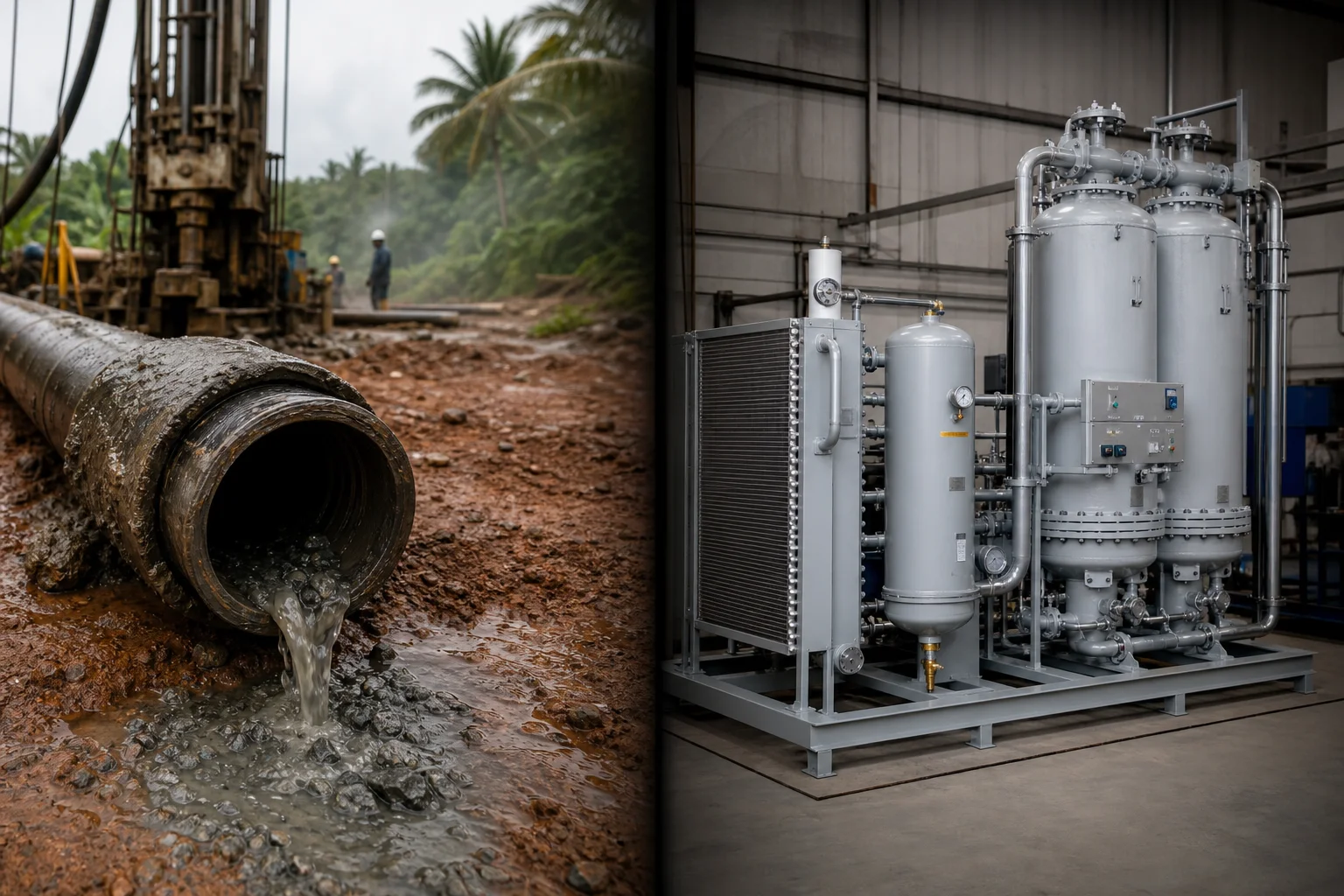
Compressed Air Treatment for Drilling: Why Water Forms Inside Your Drill Pipe and What Actually Removes It
Every air compressor draws in atmospheric moisture and concentrates it. On a humid site, a 20 m³/min compressor can deliver over 100 litres of water per day into the drill string — and most of that water condenses inside the pipe rather than at the compressor. This article — Part 3 of our air compressor series — explains where the water actually forms, what an aftercooler and separator each remove, and when a dryer earns its cost on a drilling project.
Three Hammers in Two Weeks During an Indonesian Wet Season
A water well crew in Sumatra was drilling 200-metre boreholes during the wet season. Ambient humidity above 90 percent, ambient temperature around 32°C. Their compressor had a factory-fitted aftercooler, so nobody considered moisture a risk.
Within two weeks they had failed three hammers. The symptom was consistent: cuttings returning as wet grey slurry instead of dry angular chips, penetration collapsing after the first 40 metres of each hole, and hammer internals showing rust staining and hardened O-rings when opened on the bench.
The aftercooler was there. It was also completely blind — its finned core packed solid with red laterite dust from the access track, insulating the heat exchanger to the point where discharge air left the compressor at roughly ambient temperature instead of being cooled. An aftercooler that does not cool is a pressure drop with a part number.
The water was going straight into the drill string, and it was condensing at depth. The crew were replacing hammers that had been drowned rather than worn out.
Where the Water Actually Comes From
Atmospheric air contains water vapour. When a compressor takes in that air and compresses it, the water comes along — but the compressed air can hold far less moisture per unit volume than the original atmospheric air could. The excess has to go somewhere.
The quantity surprises people who have not calculated it. Air at 32°C and 90 percent relative humidity holds roughly 30 grams of water per cubic metre. A compressor moving 20 m³/min of free air draws in about 1,200 m³ per hour, which carries approximately 36 litres of water per hour into the machine. Over a ten-hour shift, that is 360 litres — more than a full oil drum of water pushed into the air system every day.
Almost all of that must be removed, or it travels down the drill pipe and does its damage there.
Pressure Dew Point: The Number That Predicts Where Water Appears
Pressure dew point is the temperature at which water vapour in compressed air begins to condense into liquid, measured at the system's operating pressure. It is the single most useful number in air treatment, and almost no drilling contractor knows theirs.
The relationship works like this: if your compressed air has a pressure dew point of +15°C, then any point in the system where the air drops below 15°C will produce liquid water. Above 15°C, the moisture stays as vapour and causes no immediate problem.
This explains something that puzzles crews on tropical sites. Bottom-hole rock temperature at 200 metres is typically 18 to 22°C — apparently above the dew point, so no condensation should occur. But the water appears anyway.
The reason is expansion cooling. As compressed air travels down the drill string and expands through the hammer and bit orifices, it cools sharply. That temperature drop can take air well below its dew point regardless of the surrounding rock temperature. The condensation is happening inside the drill pipe and at the hammer, which is exactly where it does the most harm — mixing with cuttings to form the slurry that packs the bit face and prevents cutting.
Lower the pressure dew point far enough and the expansion cooling no longer reaches it. That is what air treatment buys you.
The Aftercooler: Removes the Bulk, Requires Maintenance
An aftercooler is a heat exchanger that cools compressed air immediately after the compression stage. It is the first and most important treatment component, and on a well-functioning system it removes the majority of the water load.
The mechanism is simple. Compression heats air substantially — discharge temperatures of 90 to 120°C are normal. Hot air holds moisture as vapour. The aftercooler drops that air toward within 10 to 15°C of ambient temperature, and as it cools, most of the water condenses into droplets that can be physically separated downstream.
Two practical points determine whether an aftercooler actually performs.
It cannot cool below ambient. An air-cooled aftercooler is limited by the air temperature around it. On a 45°C day in the Gulf or the Sahel, the best it can achieve is roughly 55 to 60°C outlet temperature — which is still well above the dew point of the surrounding conditions. Aftercooling alone does not produce dry air in hot climates. It reduces the load for whatever comes next.
Fouling destroys it silently. This is the Sumatra failure. A cooler core packed with dust loses most of its heat transfer capability, and there is no alarm and no gauge that tells the operator. The machine runs, the compressor delivers air, and the water goes downstream. Weekly cooler inspection on dusty sites is covered in our compressor maintenance guide, and it is the highest-return five minutes in a drilling maintenance routine.
The Water Separator: Removes Liquid, Not Vapour
A water separator — sometimes called a moisture trap or centrifugal separator — removes the liquid droplets that the aftercooler condensed. It does not remove water vapour. This distinction causes a great deal of confusion in equipment purchasing.
The mechanism is mechanical. Air enters the separator vessel and is forced into a spiral path. The water droplets, being far denser than air, are thrown outward by centrifugal force, collect on the vessel wall, and drain to the bottom where an automatic or manual drain expels them. Efficient separators remove 90 percent or more of the liquid water present.
Critically, whatever remains as vapour passes straight through. If the air leaving the separator has a pressure dew point of 40°C, it will still condense further downstream whenever the air drops below 40°C — which, given expansion cooling in the drill string, it certainly will.
Two failure modes are worth knowing. Automatic drains fail closed, which fills the vessel with water until air pushes it downstream in slugs. Manual drains fail because nobody drains them. Either way, a separator with a full vessel is worse than no separator, because it periodically delivers a concentrated slug of liquid water into the air line rather than a steady mist.
Draining the separator is a daily task. On humid sites it is a twice-daily task.
The Dryer: When It Is Worth the Cost
A dryer is the only component that removes water vapour and genuinely lowers the pressure dew point. It is also the most expensive treatment component and the one most drilling operations skip.
Two types are relevant to drilling.
Refrigerated dryers chill the air to around 3 to 5°C, condensing out most remaining vapour, then reheat it. They typically achieve pressure dew points of 3 to 10°C. They are simpler, cheaper, and consume moderate power. Their limitation is that they cannot go below freezing without icing up, which caps how dry the air can get.
Desiccant dryers pass air through a bed of adsorbent material — activated alumina or molecular sieve — that captures water vapour directly. Twin-tower designs alternate: one tower drying while the other regenerates. They achieve pressure dew points of -20°C to -40°C. The cost is desiccant replacement and, on purge-regenerated designs, a percentage of your compressed air diverted to regeneration — which reduces the volume reaching the drill.
Whether a dryer is justified depends on three conditions. If you drill in high humidity, if you drill deep holes where expansion cooling is significant, or if you have a recurring history of wet cuttings and hammer moisture damage, a dryer typically pays for itself in hammer life alone. If you drill shallow holes in arid conditions, aftercooling and separation are usually sufficient and a dryer is capital that would work harder elsewhere.
The honest position is that most drilling operations in arid regions do not need a dryer, and most operations in tropical wet seasons should have one.
Matching Treatment to Site Conditions
| Site Condition |
Minimum Treatment |
Recommended Addition |
| Arid, shallow holes under 100 m |
Aftercooler + separator |
None required |
| Arid, deep holes over 200 m |
Aftercooler + separator |
Refrigerated dryer if wet cuttings appear |
| Humid tropical, any depth |
Aftercooler + separator |
Refrigerated dryer, minimum |
| Humid tropical, deep holes |
Aftercooler + separator + dryer |
Desiccant dryer for wet season |
| Cold climate, freezing risk |
Aftercooler + separator + dryer |
Desiccant dryer, line antifreeze injection |
Cold climates deserve a specific warning. If ambient temperature falls below freezing and the pressure dew point is above it, water condenses and then freezes inside the air line, hose couplings, and hammer. Ice blockages in a drill string are difficult to clear and can rupture hoses. In freezing conditions, a desiccant dryer producing sub-zero dew point is not an efficiency measure — it is what keeps the system operable.
Diagnosing Moisture Problems from Field Symptoms
- Cuttings returning wet, rounded, and grey in dry formation = liquid water reaching the bit face. Check aftercooler cleanliness and separator drain first — both are free to fix.
- Rust staining inside a hammer at teardown = sustained moisture in the air supply. The hammer was operating wet for an extended period, not just one shift.
- Water discharging from the drill pipe when a connection is broken = free liquid accumulating in the string. Treatment is failing upstream, and the volume tells you roughly how badly.
- Ice at hose couplings or the hammer sub in cold conditions = pressure dew point above ambient temperature. Requires a dryer, not a bigger separator.
- Separator vessel that never needs draining on a humid site = the automatic drain has failed open, wasting air, or the separator is not receiving condensate because the aftercooler is not cooling.
The last item is worth flagging because it inverts the usual assumption. On a humid site, a separator that never produces water is not evidence that the air is dry. It is evidence that something upstream is broken.
Why Welldone Mining
Welldone Mining specifies air treatment as part of the compressor package rather than as an accessory list, because the treatment requirement is determined by the same site conditions that determine compressor sizing.
What our compressor customers get:
- Treatment specified against your site climate and hole depth. Tell us your typical ambient temperature and humidity range, your hole depth, and your seasonal variation, and we specify the treatment train that produces workable air — including telling you when a dryer is not necessary.
- Aftercooler sizing corrected for ambient temperature. An aftercooler rated at 20°C ambient performs differently at 45°C. Our quotations state the expected outlet temperature at your site conditions, not at test-bench conditions.
- Maintenance schedule built for your dust conditions. Cooler cleaning intervals and separator draining frequency set against your site's actual dust and humidity, not a generic manual figure.
Related Solutions
Conclusion
Air treatment is invisible until it fails, and when it fails the symptoms appear in the hammer and the bit rather than at the compressor. That displacement is why crews replace tools for months before anyone opens the aftercooler.
The physics is straightforward. Every compressor concentrates atmospheric moisture. The aftercooler condenses most of it, the separator removes the liquid, and only a dryer removes the vapour that remains. Expansion cooling in the drill string then determines whether that remaining vapour becomes water where it matters.
The Sumatra crew did not have a hammer quality problem. They had a blocked heat exchanger, and it cost them three hammers before anyone looked at it. A five-minute weekly cooler inspection would have prevented all three.
Website: www.welldonemining.com
Email: info@welldonemining.com
Frequently Asked Questions
How much water does a drilling compressor actually produce?
It depends on air volume, ambient temperature, and humidity. As a working figure, a 20 m³/min compressor operating at 32°C and 90 percent relative humidity draws in roughly 36 litres of water per hour — over 350 litres across a ten-hour shift. In arid conditions the figure drops substantially, but it is never zero.
Is an aftercooler enough on its own?
No. An aftercooler condenses water but does not remove it — you need a separator downstream to physically extract the liquid. And in hot or humid conditions, an aftercooler cannot cool below ambient temperature, so significant vapour remains in the air. Aftercooler plus separator is the minimum viable configuration; whether you need a dryer beyond that depends on climate and hole depth.
What pressure dew point should I target for drilling?
For general drilling in moderate conditions, a pressure dew point below ambient minimum temperature prevents liquid formation in the air line. For deep holes where expansion cooling is significant, target lower. For freezing conditions, a sub-zero dew point from a desiccant dryer is required to prevent ice blockages in hoses and the hammer.
How often should the water separator be drained?
Daily at minimum, twice daily in humid conditions, and check the automatic drain weekly to confirm it is functioning. A separator with a full vessel delivers slugs of liquid water into the air line, which is worse for the hammer than a steady mist. If your separator on a humid site never produces water, investigate — it usually means the aftercooler has stopped cooling.
Can Welldone Mining specify air treatment for our site conditions?
Yes. Send your typical ambient temperature and humidity range, seasonal variation, hole depth range, and compressor model to info@welldonemining.com, and we will specify the treatment train required — including advising when your current configuration is already adequate and a dryer would not earn its cost.