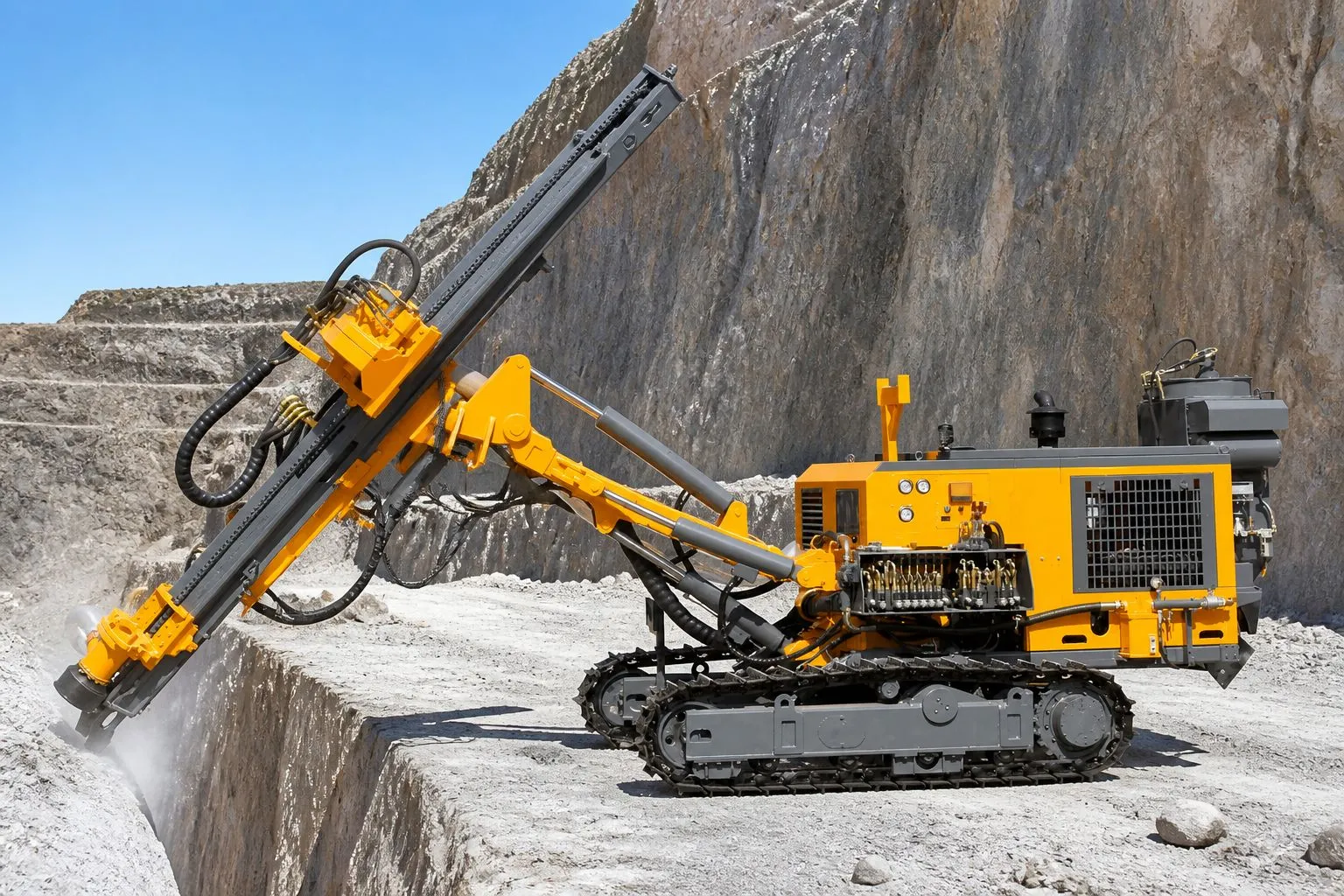
Drill Rig Mast and Boom Articulation: What 185 Degrees of Feed Pitch Actually Lets You Drill
Buyers compare drilling rigs by hole diameter, depth, and compressor match — and discover after delivery that the rig physically cannot reach a third of the holes the project requires. Inclined pre-split holes, low horizontal pipe-roof holes, and holes on uneven bench ground are all articulation problems, not power problems. This article — Part 2 of our crawler drilling rig series — explains the four articulation parameters that define what a rig can physically reach, using real specification data from production crawler rigs.
The 15-Degree Hole a Rig Could Not Drill
A quarry contractor in Saudi Arabia won a contract that included pre-split blasting along a final wall — a row of inclined holes at 15 degrees from vertical, drilled to leave a clean, stable face. His crawler rig was correctly sized for the rock and the hole diameter. The compressor was matched. The bits were right.
The rig's feed could tilt forward 50 degrees from horizontal — more than enough, he assumed. The assumption was wrong in a specific way: the 15-degree pre-split angle was measured from vertical, which means the feed needed to tilt 15 degrees from vertical, and that was within range. What was not within range was doing it while keeping the bit on the collar position at the bench edge. The feed geometry put the bit contact point half a meter behind where the hole needed to start.
His operator solved it the way operators solve articulation problems: he tilted the whole machine on the bench, packed rock under one track, and drilled at an angle that was close but not correct. The surveyor rejected the row. Hole deviation exceeded the pre-split tolerance, the face came out ragged, and the client withheld payment on that section until the wall was re-cut.
The rig had not failed. The rig's articulation envelope had never been checked against the hole geometry the contract required. That check takes fifteen minutes with a specification sheet. The re-cut took three weeks.
The Four Numbers That Define What a Rig Can Reach
Every crawler drill rig carries four articulation specifications, and together they define the envelope of physically reachable holes. Buyers who read only hole diameter and depth are reading half the machine.
Feed pitch — the forward and backward tilt of the feed beam. On a production crawler rig, this typically runs from 135 degrees below horizontal to 50 degrees above, a total sweep of 185 degrees. This is the parameter that governs inclined holes: pre-split rows, buffer holes, and any angle other than vertical. It also governs whether the feed can fold down flat enough for transport height.
Feed swing — the left and right rotation of the feed beam. Typically asymmetric: 100 degrees one way, 45 the other, a total of 145 degrees. This is what lets a rig drill a row of holes along a bench edge without repositioning the whole machine for every hole. A wide swing range converts repositioning time into drilling time.
Boom pitch and swing — the articulation of the arm carrying the feed. Boom pitch typically spans 75 degrees total, boom swing around 89. The boom positions the feed over the target; the feed then sets the hole angle. The two systems work in series, and their combined envelope is what matters — not either one alone.
Feed compensation stroke — the floating travel of the feed relative to the boom. Typically around 900 millimeters. This is the least understood and most underrated specification on the sheet, and it gets its own section below.
Feed Compensation: The 900 Millimeters Nobody Asks About
Feed compensation is the ability of the feed beam to slide forward and backward relative to the boom while the boom stays fixed. On a typical rig this stroke is 900 millimeters. Buyers routinely skip it because it does not sound like capability. It is capability.
Its first job is ground following. Quarry benches are not machined surfaces. The ground under a rig is blasted rock, ridges, and loose fill. When the feed is positioned over a collar on uneven ground, the compensation stroke lets the bit reach the rock without the operator repositioning the tracks for every few centimeters of ground height variation. Without adequate stroke, the operator is constantly shuffling the machine on the bench — and every shuffle is non-drilling time.
Its second job is load smoothing. When the bit rides over a ridge at the collar, a rigid feed transmits the ridge directly into bit load: the load spikes as the bit climbs, drops as it falls off. The hammer sees shock loading instead of steady pulldown, and button life suffers accordingly. A floating compensation stroke absorbs the ridge, holding bit load close to constant through the first critical meters of the hole.
Its third job is reach extension. The 900-millimeter stroke extends the feed forward to reach collars that the boom geometry alone cannot place the bit on — which is exactly the problem the Saudi contractor hit at his bench edge, solved the wrong way.
When comparing two rigs with identical hole diameter and compressor specifications, the one with the longer compensation stroke will drill more holes per shift on real ground. It is one of the few specifications where more is unambiguously better.
Horizontal Hole Height: The Range That Opens or Closes Applications
Two numbers on the specification sheet define the rig's horizontal drilling envelope: the lowest and highest horizontal hole height above ground. On a production crawler rig these typically run from 350 millimeters to 2,750 millimeters.
The lower number decides whether the rig can drill horizontal or near-horizontal holes close to the ground — the geometry required for pipe-roof support at tunnel portals, slope anchor holes at the toe of a cut, and foundation anchoring at floor level. A rig whose lowest horizontal hole is 350 millimeters can serve most portal work; a project requiring holes at 200 millimeters cannot be served by that rig at all, regardless of its power.
The upper number decides reach into high faces — anchor rows on tall benches, scaling support holes, and upper pipe-roof positions. 2,750 millimeters covers the large majority of surface applications, but infrastructure projects with tall cut faces should verify the number against the anchor pattern before purchase.
These two numbers are hard mechanical limits. No operator skill, no packing, no improvisation changes them. They are the first articulation specification to check against a project's hole schedule, because they are binary: the rig reaches the hole or it does not.
Track Levelling: The Second Levelling System
Some crawler rigs in this class add a track levelling function — typically plus or minus 10 degrees — that tilts the upper structure relative to the tracks. It exists for one reason: benches are rarely level, and the feed's pitch range is measured from the machine's frame, not from gravity.
On a bench that slopes 8 degrees, a rig without levelling loses 8 degrees of its effective pitch envelope in one direction. A hole angle that was within range on flat ground falls outside range on the slope. The operator then packs rock under a track — the same improvisation that produced the rejected pre-split row in Saudi Arabia.
Track levelling restores the envelope on sloped ground and keeps the machine's centre of gravity where the stability calculation expects it. For projects on irregular terrain, it is worth specifying. For flat-bench quarry work, it is a cost item that can be declined.
Reading a Specification Sheet Against a Hole Schedule
The correct way to evaluate articulation is to work from the project's hole schedule backward, not from the specification sheet forward. The sequence takes about an hour for a typical contract.
- Step 1 — List every distinct hole geometry in the contract: vertical blast holes, inclined pre-split angles, horizontal anchor heights, and the collar positions relative to bench edges.
- Step 2 — Check the binary limits first: lowest and highest horizontal hole height against the anchor schedule. If any hole falls outside, the rig is eliminated regardless of everything else.
- Step 3 — Check feed pitch against the steepest required inclination, measured the same way on both sides of the comparison — from vertical or from horizontal, not mixed.
- Step 4 — Check the combined boom-and-feed envelope against collar positions at bench edges, where reach matters. This is the check the Saudi contractor skipped.
- Step 5 — Check feed compensation stroke against your ground reality: rough blasted benches reward long stroke; machined or well-prepared pads reward it less.
- Step 6 — If the site slopes, check track levelling against the worst bench gradient, and confirm the effective pitch envelope after levelling, not before.
A rig that passes all six steps will physically reach every hole in the schedule. A rig that fails any step will force improvisation on site — and improvisation on a drilling site is where deviation, rejected rows, and re-cuts come from.
Why Welldone Mining
Welldone Mining manufactures crawler drilling rigs with articulation envelopes specified against real project geometry — 185 degrees of feed pitch, 145 degrees of feed swing, 900 millimeters of feed compensation, horizontal hole coverage from 350 to 2,750 millimeters, and optional plus-or-minus-10-degree track levelling for sloped-ground programmes.
What quarry and infrastructure customers get:
- Hole-schedule verification before quotation. Send us the contract's hole schedule — angles, heights, and collar positions — and we verify every geometry against the rig's articulation envelope in writing, before you commit.
- Envelope diagrams, not just numbers. Combined boom-and-feed reach diagrams for the configurations you are evaluating, so bench-edge collars are checked against geometry rather than against isolated angle figures.
- Application-matched configuration. Track levelling, dust collection, and feed stroke options specified against your terrain and hole schedule — not sold as a bundle.
Related Solutions
- Quarry Drilling Solution — Complete blast hole packages including pre-split and buffer hole geometry, with rig, compressor, hammer, and drill string matched to the blast design.
- Customized Drilling Solution — Non-standard hole angles, tunnel portal pipe-roof work, or rigs configured around an existing compressor fleet.
- Quarry Drilling in Hard Rock: Middle East Applications — Rig selection for granite and limestone quarries across Saudi Arabia, Egypt, and the wider region.
- Drilling Cost Per Meter in Mining Projects — How articulation, repositioning time, and rejected holes feed into the cost number that actually decides project profitability.
Conclusion
Hole diameter and compressor match decide whether a rig can drill your holes efficiently. Articulation decides whether it can reach them at all. The two questions look similar on a specification sheet and behave completely differently in the field — because articulation failures are binary and mechanical, and no amount of power compensates for a feed that cannot tilt to the angle the contract specifies.
The Saudi pre-split row was rejected not because the rig was weak, but because nobody checked a 15-degree angle against an envelope diagram before the purchase order. The check would have taken fifteen minutes. The re-cut took three weeks and a withheld payment.
The real question when specifying a drill rig is not how many degrees the brochure claims. It is whether every hole geometry in your contract has been verified against the rig's combined reach envelope — in writing, before signature.
Website: www.welldonemining.com
Email: info@welldonemining.com
Frequently Asked Questions
What does feed pitch range mean in practical terms?
Feed pitch is the forward and backward tilt of the feed beam, typically quoted as a total sweep — for example 185 degrees, spanning 135 degrees below horizontal to 50 degrees above. Practically, it defines the range of hole inclinations the rig can drill: vertical blast holes at one end, steeply inclined pre-split and buffer holes at the other. Verify your steepest required angle against it, measured consistently from the same reference.
Why is feed compensation stroke important?
It lets the feed slide forward and backward relative to the boom — typically around 900 millimeters. That stroke absorbs ground height variation on rough benches, smooths bit load over collar ridges so the hammer sees steady pulldown instead of shock loading, and extends reach to collars the boom geometry alone cannot place the bit on. Longer stroke means less machine shuffling and longer button life on real ground.
Can a crawler drill rig drill horizontal holes for tunnel pipe-roof support?
Yes, if the rig's lowest horizontal hole height is below the required hole position. Production crawler rigs typically reach horizontal holes from around 350 millimeters above ground up to around 2,750 millimeters. Portal pipe-roof patterns vary, so check the specific hole height against the rig's lower limit before purchase — this is a hard mechanical limit that cannot be improvised around on site.
Does track levelling matter on flat quarries?
On consistently flat, well-prepared benches, track levelling adds cost without much benefit. On irregular or sloped terrain it matters, because the feed's pitch envelope is measured from the machine frame: on an 8-degree slope without levelling, you lose 8 degrees of effective envelope in one direction. Specify it against your worst bench gradient, not your average.
How do I verify a rig can reach my pre-split hole geometry?
Send the hole schedule — inclination angles, collar positions relative to bench edges, and hole lengths — to info@welldonemining.com. We verify each geometry against the combined boom-and-feed envelope and return the result in writing before quotation. This is the check that takes fifteen minutes and prevents the three-week re-cut.