How to Start a Water Well Drilling Business: Equipment, Costs, and the Mistakes That End Most First-Year Contractors
Water well drilling is one of the few equipment-based businesses where a single wrong purchase decision can end the venture before the second contract. This guide walks through what the work actually involves, what the equipment costs, how contractors get paid, the hydrogeology you need to understand before buying anything, and the specific errors that put first-year operators out of business.
Two Entrepreneurs, Two Very Different First Years
A man in southeastern Nigeria spent his savings and a family loan on a used water well rig. Good-looking machine, low hours on the meter, priced well below new. He took his first contract in a village 30 kilometers from home.
At 40 meters, the bit hit granite. His rig did not have the pulldown capacity to load the bit properly in hard rock, and his compressor could not deliver the pressure the depth required. He drilled for nine days, reached 52 meters, found no water, and abandoned the hole. He never recovered the cost.
Another contractor in the same region did something unremarkable before buying anything. He spent two weeks talking to every borehole owner, hand-pump mechanic, and village chief within 50 kilometers. He wrote down what depth people were hitting water at, what rock they were going through, and what the going rate per meter was. Then he bought equipment matched to those specific conditions.
He drilled roughly 60 holes in his first year.
The difference was not capital, experience, or luck. One bought a machine and then went looking for holes. The other understood the holes and then bought the machine.
What the Work Actually Involves
Before evaluating whether this business suits you, understand the operational reality. A water well project runs through five phases, and equipment is only relevant to two of them.
Site assessment and siting. Determining where to drill, based on geology, existing borehole data, and where the client needs water. Getting this wrong means a dry hole, and a dry hole is usually unpaid work.
Mobilization. Moving rig, compressor, support truck, drill pipe, casing, and crew to site. On rural projects this can consume a full day each way and is a real cost that inexperienced contractors leave out of their quotes.
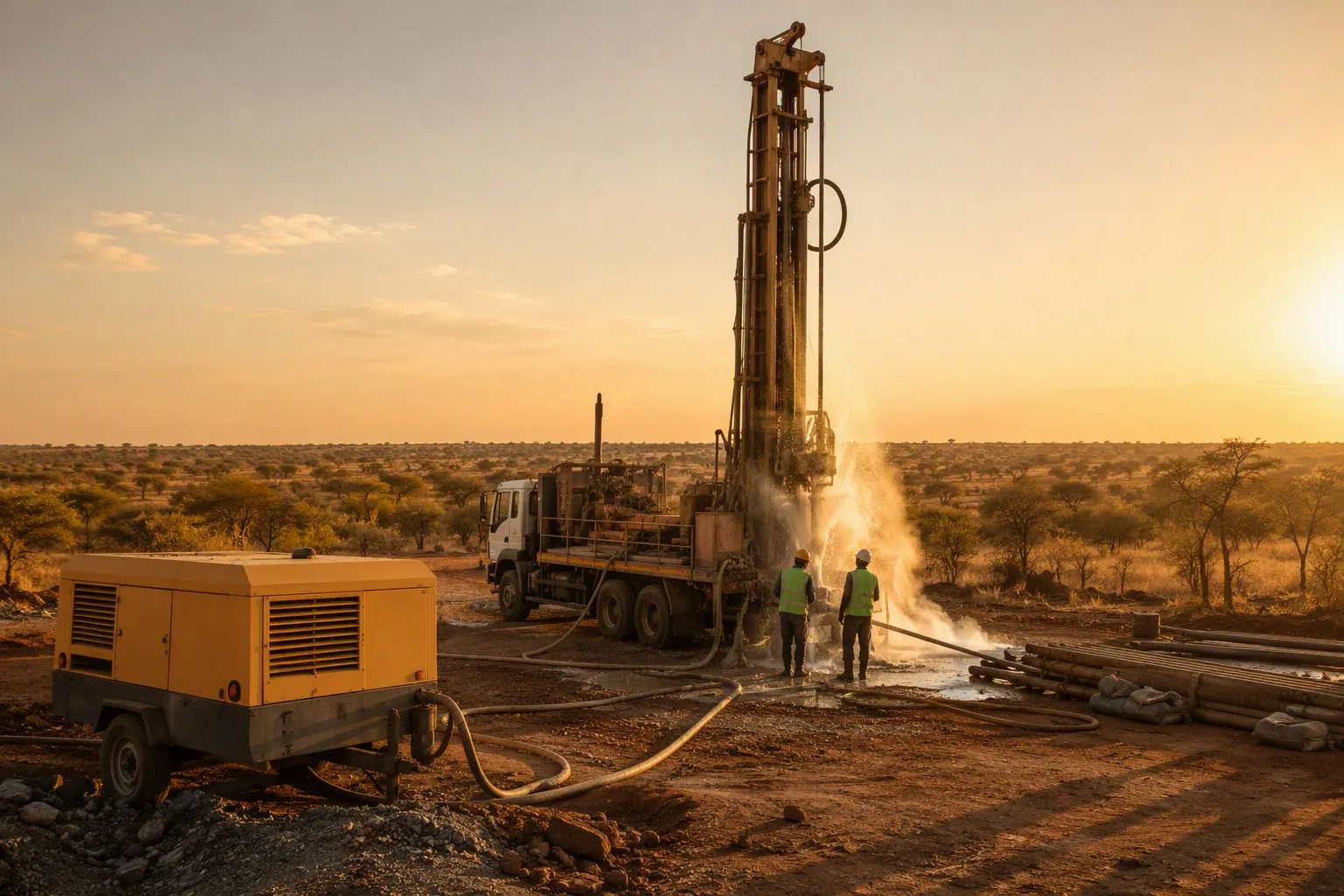
Drilling. The part everyone thinks about. Depending on depth and formation, a borehole takes anywhere from one day to a week.
Completion. Installing casing and screen, gravel packing, developing the well to clear fines, and testing yield. This is skilled work, and doing it badly produces a well that silts up within a year — which destroys your reputation in a market that runs almost entirely on word of mouth.
Pump installation and handover. Sometimes included in the contract, sometimes a separate trade. Either way, the client judges you on whether water comes out of the tap.
Note that two of the five phases determine whether you get paid, and neither of them is drilling. Siting decides whether you find water. Completion decides whether the well still works in two years.
Understanding the Ground Before You Understand the Equipment
This is the part most new entrants skip, and it is the reason most of them buy the wrong rig. You cannot specify drilling equipment until you know what you are drilling through.
Unconsolidated formations — sand, gravel, clay, alluvial deposits. Common in river valleys and coastal plains. These drill quickly but the hole collapses easily, so you need casing advanced as you drill or a mud rotary system to hold the walls. Water is often shallow, 20 to 60 meters.
Sedimentary rock — sandstone, limestone, shale. Moderate hardness, generally stable holes. Water is held in pore spaces and fractures. Depths commonly 50 to 150 meters. Air rotary with a DTH hammer handles this efficiently.
Crystalline basement — granite, gneiss, schist. Covers vast areas of Africa and parts of South Asia. This rock holds no water in itself; water exists only in fracture zones and the weathered layer above the fresh rock. Drilling is slow and hard, depths run 60 to 120 meters, and siting is critical because a hole missing the fracture zone by 20 meters is a dry hole.
Volcanic formations — basalt, tuff. Variable and unpredictable. Can be extremely hard, can be fractured and cavity-ridden. Common in the East African Rift.
Your local geology determines rig type, hammer size, compressor capacity, and whether you need mud circulation capability. A contractor in an alluvial plain and a contractor in granite basement need different machines. Buying general-purpose equipment for a specific geology is how the first entrepreneur in this article lost his savings.
The practical research step costs nothing: ask existing borehole owners in your target area what depth they hit water at and what the drillers went through. Ten conversations will tell you more about your equipment requirement than any catalog.
The Equipment You Actually Need
A functioning water well drilling operation is not one machine. It is a set of machines that must match each other, and the total is considerably more than the rig price that first attracts new buyers.
- Drilling rig. Truck-mounted or crawler-mounted. Must have adequate pulldown for your formation hardness, mast height for your pipe length, and rotary torque for your hole diameter and depth. Rigs range widely — a light unit for shallow alluvial work and a heavy unit for deep basement drilling are different classes of machine.
- Air compressor. For air rotary and DTH drilling, this is not an accessory — it is the machine that determines whether you drill or merely turn steel. Undersized compressors are the single most common equipment error in this industry. Covered in detail in our compressor selection guide.
- DTH hammer and bits. Sized to your hole diameter and matched to formation hardness. Bits are consumables and a recurring cost — budget for them the way you budget for fuel, not the way you budget for equipment.
- Drill pipe. Enough length for your maximum planned depth, plus spares. Wall thickness and thread type must carry your rig's torque output.
- Support vehicle. To carry casing, pipe, tools, water, and crew. Rural sites are not served by delivery vans.
- Well completion materials. Casing, screen, gravel pack, grout. These are per-project consumables, purchased against each contract.
- Development and testing equipment. Airlift or submersible pump for well development and yield testing. Skipping this means handing over an unproven well.
The mistake pattern is consistent: buyers allocate most of their budget to the rig because it is the visible machine, then buy whatever compressor the remaining money covers. That sequence produces an underperforming operation. Size the air first, then match the rig to the system — the same principle we covered in the DTH system selection guide.
How Water Well Contractors Get Paid
Understanding the revenue model matters more than understanding the equipment, because it tells you which capabilities actually generate income.
Per-meter pricing is the dominant model. The contractor quotes a rate per meter drilled, often with different rates for overburden and hard rock, plus separate line items for casing, screen, gravel pack, and development. Mobilization is usually a fixed fee.
Turnkey pricing quotes one figure for a completed, water-producing well. Higher risk for the contractor, higher margin, and generally only viable once you know your geology well enough to predict success rates.
Dry hole terms are the clause that decides whether a bad month is survivable. Some contracts pay full rate regardless of water; some pay a reduced rate; some pay nothing. Never sign a no-water-no-payment contract in geology you have not drilled before.
Here is the economics point that new entrants consistently miss. In most East African markets, water well work prices somewhere between USD 40 and USD 90 per meter, and the spread has very little to do with equipment quality. It is about success rate. A contractor who finds water on nine holes out of ten can charge close to double the contractor who finds it on five, using functionally identical rigs.
Which means the highest-return investment in this business is not a better rig. It is better siting — geological knowledge, local borehole records, and where budget allows, a geophysical survey before drilling.
Cost Structure and What Actually Consumes Your Margin
New contractors typically model fuel and bits, then get surprised by everything else. A realistic per-project cost model includes:
- Fuel — rig engine plus compressor. On remote sites, add delivery cost, not pump price. This is frequently the largest single variable cost.
- Bits and consumables — bit life varies enormously with formation. In abrasive granite, budget conservatively; a bit that drills 150 meters in limestone may manage 60 in quartzite.
- Hammer and compressor servicing — hour-based and unavoidable. Separator elements, filters, oil. Cheap parts whose neglect destroys expensive tools, as covered in our compressor maintenance guide.
- Casing and completion materials — passed through to the client in most contracts, but you finance them until payment.
- Crew wages — including travel and subsistence on remote projects.
- Mobilization — fuel, time, and vehicle wear moving between sites. On a scattered rural contract portfolio, this is a much larger cost than most first-year quotes assume.
- Equipment finance — if the rig is financed, the payment continues during rainy season, equipment breakdown, and slow payment periods.
The cash flow trap deserves specific mention. Water well work is frequently paid on completion, sometimes 30 to 90 days after completion, and government or NGO contracts can run longer. Meanwhile fuel, wages, and consumables are paid weekly. Contractors with healthy order books fail on working capital far more often than they fail on technical capability.
New or Used Equipment: A Decision Most People Get Backward
Used equipment is the natural instinct for a first-time buyer, and it is not automatically wrong. But the risk is asymmetric in a way that catches people out.
A used rig with a worn rotary head or a tired mast still looks like a working rig in a yard. The problems appear at 80 meters in hard formation, on a client's site, with a crew standing around. Repair means parts on international lead times and a rig sitting idle. For an operation with one machine and no cash reserve, a six-week parts wait is often terminal.
If you buy used, three checks matter more than the hour meter: verify the rotary head and pulldown system under load rather than idling in a yard, confirm parts availability in your country before purchase, and price a realistic first-year repair budget into your capital plan.
The compressor is where I would be most cautious about buying used. It is the machine that determines drilling capability, it degrades invisibly, and a compressor that has been run with neglected separator elements and fouled coolers may have airend wear that no visual inspection reveals.
Permits, Licensing, and Water Rights
This varies enormously by country and even by region, so verify locally rather than assuming. In most jurisdictions you will encounter some combination of the following.
Drilling contractor license. Registration with a water resources authority, sometimes requiring demonstrated technical capability or a qualified hydrogeologist on staff.
Borehole permit per well. Often the client's responsibility, but the contractor is frequently expected to manage the application. Drilling without one can void payment and attract penalties.
Water abstraction license. Governs how much water may be extracted, usually the well owner's obligation but relevant to what you design and install.
Borehole completion reporting. Many countries require drillers to submit a log of the formations encountered, water strike depth, and yield test results. Beyond compliance, these records accumulate into your own geological database — which, as established above, is the asset that actually raises your success rate and your rates.
Five Mistakes That End First-Year Contractors
Mistake 1 — Buying the rig first and the compressor with what's left
The compressor determines whether you can drill your local formation to your local water depth. Size it first. A modest rig with adequate air outperforms an impressive rig that is starved.
Mistake 2 — Equipment sized for average conditions instead of worst-case conditions
Your equipment must handle the hardest formation and deepest water table in your service area, not the typical one. The hole that breaks your business is the difficult one, and you cannot decline it without damaging your reputation.
Mistake 3 — Quoting without mobilization and dry-hole risk priced in
New contractors quote aggressively to win early work, then discover the margin was consumed by a 60-kilometer mobilization and one unpaid dry hole. Price both explicitly.
Mistake 4 — No working capital buffer
Between doing the work and being paid, you fund fuel, wages, and materials. Plan for at least three months of operating cost in reserve, independent of the equipment budget.
Mistake 5 — Treating well completion as an afterthought
A poorly developed well silts up and stops producing. The client does not distinguish between a bad well and a bad driller, and in a referral-driven market that judgment travels fast. Completion quality is marketing.
A Practical Sequence for Entering the Business
- Step 1 — Map your geology and your market. Interview borehole owners, pump mechanics, and existing drillers within your intended service radius. Record water strike depths, formations encountered, and prevailing rates.
- Step 2 — Define worst-case drilling requirements. Deepest likely water table, hardest likely formation, largest likely hole diameter. These three numbers drive every equipment decision.
- Step 3 — Size the air package. CFM and bar required at the bit, at your worst-case depth and diameter, corrected for your site elevation and ambient temperature.
- Step 4 — Match rig, hammer, bits, and pipe to that air package. The rig is specified last, against the system it must serve.
- Step 5 — Build the full capital plan. Equipment, support vehicle, initial consumables, spare parts holding, and three months of working capital. If the plan only covers the equipment, the plan is incomplete.
- Step 6 — Secure your first contracts before final purchase where possible. Even letters of intent change your risk profile considerably, and they sharpen your specification because you know the actual holes.
Why Welldone Mining
Welldone Mining works with contractors entering the water well business as well as established operators expanding fleets. For a first-time buyer, the specification conversation matters more than the machine list — because the wrong specification is not recoverable within a first-year budget.
What first-time water well contractors get from us:
- Geology-first specification, at no cost before quoting. Tell us your target service area, typical water strike depth, and formation type, and we will return a system specification — rig, compressor, hammer, bits, and pipe — sized against those conditions rather than against a budget figure.
- Complete package quoting including consumables and spares. Our quotes include a recommended initial spare parts holding and first-year consumable estimate, so the capital plan reflects the real cost of operating rather than just the cost of buying.
- Commissioning support and operator training. Equipment arrives with commissioning assistance and crew training on drilling technique, well development, and maintenance scheduling — the operational knowledge that separates a working contractor from an owner of idle machinery.
Related Solutions
Contractors scoping an entry into water well drilling typically review these together:
- Water Well Drilling Solution — Complete water well packages for depths from 80 to 400 meters, with rig, compressor, hammer, and drill string matched to formation and target diameter.
- Customized Drilling Solution — Mixed formation conditions, high-altitude sites, or building a package around equipment you already own. One engineering owner from specification to acceptance.
- Quarry Drilling Solution — For contractors considering diversification into blast hole drilling alongside water well work, which shares much of the same equipment base.
Conclusion
Water well drilling rewards operators who understand the ground and punishes those who only understand machines. The equipment is expensive and the learning is unforgiving, but the fundamental requirement is not complicated: know what you are drilling through, size the air for it, match everything else to the air, and hold enough working capital to survive the gap between doing the work and being paid.
The contractors who build durable businesses in this industry are rarely the ones who started with the most capital. They are the ones who spent two weeks asking questions before spending anything, and who kept a record of every formation they drilled through afterward.
The real question for anyone entering this business is not which rig to buy. It is whether you know your geology well enough to know which rig the geology requires.
Website: www.welldonemining.com
Email: info@welldonemining.com
Frequently Asked Questions
How much capital is realistically needed to start a water well drilling business?
It varies substantially by geology and target depth, because those determine equipment class. Rather than a single figure, build the number from your requirements: rig and compressor sized for your worst-case formation and depth, plus support vehicle, initial consumables, spare parts holding, and at least three months of operating capital. Send your target depth and formation type to info@welldonemining.com and we will return a specification and package quotation you can build a capital plan around.
Can I start with a smaller rig and upgrade later?
Yes, provided the smaller rig genuinely covers the worst-case conditions in your service area. What does not work is buying a rig sized for typical conditions and hoping the hard holes do not come. They come, usually early, and declining them damages a reputation you have not yet built.
Do I need a hydrogeologist on staff?
Not necessarily on staff, but you need access to hydrogeological judgment — through a consultant, a partnership, or your own accumulated experience and borehole records. Siting accuracy is the single largest driver of profitability in this business, and in crystalline basement geology it is the difference between a viable operation and a failing one.
What is the difference between air rotary and mud rotary drilling, and which do I need?
Air rotary with a DTH hammer is efficient in consolidated rock and is the dominant method for hard-rock water wells. Mud rotary circulates drilling fluid to carry cuttings and support the borehole wall, which suits unconsolidated sand and gravel formations where an air-drilled hole would collapse. Your local geology determines the answer, and some contractors in mixed geology need both capabilities.
How long does it take to drill a typical water well?
Highly dependent on depth and formation. A 60-meter hole in weathered sedimentary rock might take one to two days including completion. A 120-meter hole in fresh granite can take five days or more. Build your project scheduling and pricing around your local worst case, not your local average.