Diesel, Electric, or Booster: How to Choose an Air Compressor for Drilling Projects Without Losing 40% of Your Margin to Energy Cost
Most drilling contractors choose a compressor by comparing CFM, bar, and purchase price across two or three quotations. The decision that actually determines project profitability is never on those spec sheets: delivered energy cost per drilled meter across the full project duration. This article — Part 1 of our air compressor series — walks through the diesel-versus-electric calculation, the altitude and temperature corrections almost every buyer skips, and the specific case where a booster is the right answer instead of a bigger primary unit.
Two Contractors, Two Correct Decisions, Two Failed Budgets
A contractor running a rural water well program in Ethiopia bought a diesel compressor. Solid unit, correct CFM for his 152mm holes, right working pressure. The nearest reliable fuel station was 80 kilometers from site.
Two tanker deliveries per week. Fuel, plus transport, plus driver time, plus the losses that happen to diesel between the depot and the wellhead, ran roughly USD 5,000 per month above what his budget assumed. Over a fourteen-month program, that gap consumed about 40 percent of his margin.
Another contractor in the same region reasoned his way to the opposite conclusion. Fuel logistics were the problem, so he bought electric and ran a cable to the nearest grid connection. His site power dropped three times a day. Every drop meant a restart cycle, a re-pressurization sequence, and roughly twenty minutes before the hammer was drilling again. Over a month, he lost more productive hours to power interruptions than the first contractor lost to fuel runs.
Neither of them chose wrong in principle. Both of them chose without running the two or three numbers that decide this question — and those numbers are not on any compressor data sheet.
The Three Numbers That Actually Decide Diesel vs Electric
Before comparing any two compressor quotations, get these three figures for your specific project. They will usually make the decision obvious, and they take an afternoon to gather.
Number one: delivered diesel cost per liter at the wellhead. Not the pump price in the nearest city. The pump price plus transport, plus the tanker driver's time, plus the fuel the tanker itself burns getting to you, plus realistic loss allowance. On remote African and Central Asian projects, this figure routinely runs 30 to 60 percent above pump price. On a compressor burning 40 to 70 liters per hour, that difference compounds fast.
Number two: measured grid uptime over a full month. Not the utility's published availability. A data logger on the line, recording for at least 30 days, capturing every dip and outage. Grid power that is available 94 percent of the time sounds excellent until you convert it: that is roughly 43 hours of downtime per month, and each interruption costs you a restart cycle, not just the outage duration.
Number three: project mobility profile. How many separate drilling locations, how far apart, and how long at each. Electric infrastructure — transformers, cable runs, switchgear — is a sunk cost that does not move with the rig. A program with one location for eighteen months and a program with twelve locations over eighteen months are completely different problems, even at identical total meters.
Diesel: Where It Wins and What It Actually Costs
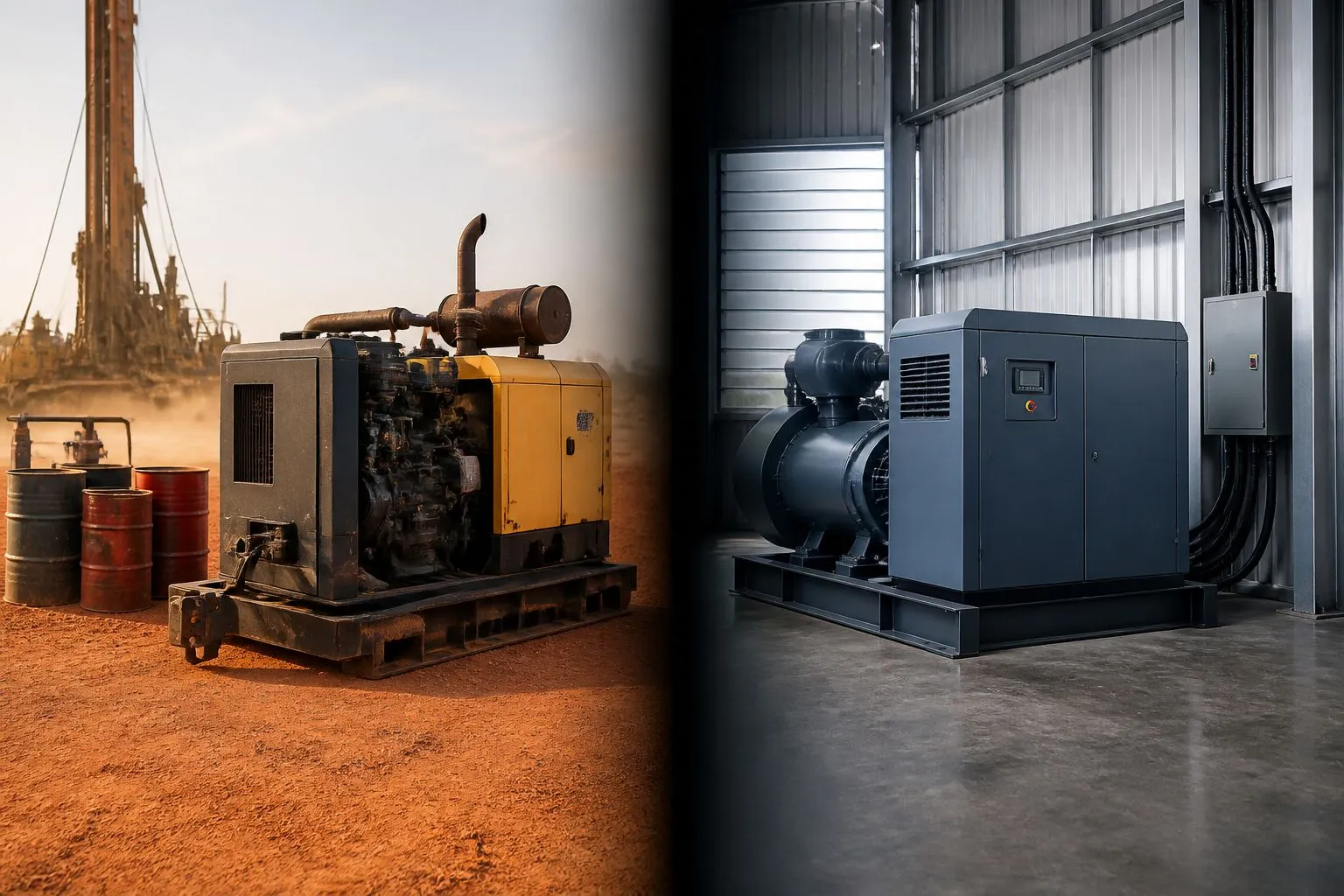
Diesel-driven portable compressors dominate drilling for a straightforward reason: the rig moves, and the compressor has to move with it. No infrastructure, no permits, no utility negotiation. Drive it in, level it, connect the hose, drill.
The operating cost model, however, is more complex than fuel burn multiplied by hours.
- Fuel consumption scales with load, not rating. A compressor rated at 1,150 CFM burns substantially less when running at 70 percent load than at full output. Sizing a unit with adequate headroom often costs less in fuel over a project than running a smaller unit at continuous full load.
- Service intervals are hour-based and non-negotiable. Oil, filters, separator elements. On a unit running 10 hours per day, service comes every 50 days at a 500-hour interval. Budget for the parts and the downtime, and confirm parts availability in-country before purchase.
- Fuel logistics carry hidden headcount. Somebody manages tanker scheduling, receipt verification, and on-site storage security. On remote sites, that is frequently a dedicated part-time role nobody budgets for.
- Resale value holds well. Portable diesel compressors have a deep secondary market across Africa, the Middle East, and South Asia. On a project of defined duration, factor realistic resale into total cost.
Electric: Lower Running Cost, Higher Dependency
Electric-driven compressors typically run at 30 to 50 percent lower energy cost per cubic meter of compressed air than diesel, where grid power is stable and reasonably priced. They are quieter, produce no on-site emissions, and have longer service intervals because there is no engine to maintain.
Every one of those advantages depends on a single assumption: reliable power.
The dependency is harder than most buyers expect. A drilling compressor draws heavy startup current. Weak grids that handle steady loads adequately will sag or trip on compressor startup, and repeated brownout conditions damage motor windings over time. Before committing to electric, you need not just uptime data but voltage stability data — measured at the point of connection, under load, not at the substation.
Electric makes clear sense in three situations: a stationary quarry operation with an established grid connection; a project inside or adjacent to an industrial area with commercial-grade supply; or a site with existing generator infrastructure sized to carry the compressor load. Outside those cases, the infrastructure cost and the reliability risk usually outweigh the energy saving.
Altitude and Temperature: The Corrections Almost Nobody Applies
This is where I see more compressor undersizing than anywhere else, and it is entirely avoidable. Compressor output is rated at sea level and standard temperature. Real project sites are frequently neither.
Altitude reduces free air delivery. Above roughly 1,500 meters, output drops approximately 3 percent per 300 meters of additional elevation. On the Ethiopian highlands at 2,500 meters, a compressor rated at 900 CFM delivers closer to 810. On the Andean altiplano at 3,800 meters, that same unit delivers around 700 CFM. If your hammer needs 900, you are starving it by 200 CFM and the driller will spend six months blaming bits.
Ambient temperature reduces both output and cooling margin. Compressor ratings assume around 20°C intake air. At 45°C — routine in Gulf and Sahel summer conditions — output falls several percent further, and the aftercooler works closer to its limit, which raises moisture carryover into the air line. That moisture ends up in the hammer.
The two corrections stack. A high-altitude site in a hot climate can lose 20 percent or more of rated capacity. Any supplier who quotes a compressor without asking your site elevation and typical ambient temperature is not sizing your system — they are reading a catalog. This is the same interlock logic we covered across the DTH system selection guide: change one condition and the requirement moves.
When a Booster Is the Right Answer — and When It Is Not
Boosters are widely misunderstood, and the misunderstanding is expensive in both directions. Contractors buy boosters that do not solve their problem, and contractors replace entire primary compressors when a booster would have been sufficient.
The distinction is simple once stated clearly: a booster raises pressure. It does not create volume. A booster takes the air your primary compressor already delivers and compresses it further, typically adding 10 to 25 bar on top of the primary discharge pressure. The volume passing through is the volume the primary supplied — minus what the booster itself consumes.
A booster is the right answer when: your CFM is adequate for the hole diameter but your pressure is insufficient for the hole depth. This happens frequently on projects that extend deeper than originally planned. The compressor was correctly sized for 150 meters; the client now wants 280 meters; you need pressure, not volume.
A booster is the wrong answer when: your hammer is starving on CFM. Adding a booster to an under-volume system gives you higher-pressure air in an insufficient quantity. The hammer still starves — it just starves at higher pressure. You have added capital cost, fuel consumption, and a maintenance item without fixing the constraint.
The diagnostic is straightforward. Measure discharge pressure at the hammer sub and compare against the hammer's specification for your hole depth. Pressure short but volume adequate means booster. Volume short means a larger primary unit or a second unit in parallel. Both short means the system was never sized for this hole.
Building the Cost-Per-Meter Comparison
This is the calculation that should drive the purchase decision, and it takes about two hours with a spreadsheet. Run it for both options across the full project duration.
- Capital cost — purchase price, plus electrical infrastructure for electric (transformer, cable, switchgear, installation, permits), minus realistic resale value at project end
- Energy cost — for diesel: consumption at expected load factor multiplied by delivered cost per liter multiplied by projected running hours. For electric: kW draw multiplied by tariff multiplied by running hours, including any demand charges
- Maintenance cost — parts and labor at the manufacturer's service intervals, plus in-country parts availability risk
- Downtime cost — for diesel: fuel delivery interruptions and engine service stops. For electric: measured grid outage hours multiplied by restart cycle time, valued at your rig's hourly operating cost
- Logistics cost — fuel management headcount for diesel; relocation cost per move for electric infrastructure
Divide the total by projected drilled meters. That single number — cost per meter — is the honest comparison. In my experience it inverts the intuitive answer on roughly one project in three, most often on remote sites where the delivered fuel cost turns out far higher than the buyer assumed.
Three Questions for Your Next Compressor Supplier
Question 1 — "What is your quoted output at my site elevation and ambient temperature?"
Any supplier who quotes only sea-level rated output has not sized for your project. Ask for the corrected figure in writing, with the correction factors shown.
Question 2 — "What CFM and bar will actually arrive at the hammer sub at my maximum hole depth?"
Compressor outlet output is not what the hammer receives. Drill string pressure loss runs roughly 1 to 2 bar per 30 meters. A supplier who cannot produce this calculation is quoting a machine, not a drilling capability.
Question 3 — "What is the in-country parts and service situation for this unit?"
A compressor waiting six weeks for a separator element is not a compressor. Confirm parts availability, typical lead time, and whether any local partner can perform warranty service before you sign.
Why Welldone Mining
Welldone Mining sizes compressors as part of the drilling system, not as a standalone machine purchase. Site elevation, ambient temperature, hole diameter and depth, hammer specification, and drill string configuration all feed the calculation before we quote anything.
What our compressor customers get:
- Altitude- and temperature-corrected sizing in writing. The output figure we quote is the output at your site, with correction factors shown, not the sea-level catalog number.
- Cost-per-meter comparison across diesel, electric, and booster configurations. Built against your project's actual duration, mobility profile, and delivered energy costs — so the decision rests on total cost, not purchase price.
- Honest booster assessment. If your existing compressor can be brought to specification with a booster, we will quote the booster. We do not sell replacement units to solve pressure problems that a booster handles at a fraction of the cost.
Related Solutions
Compressor selection sits inside a broader drilling system decision. Buyers scoping a full program typically review these together:
- Water Well Drilling Solution — Complete water well packages for depths from 80 to 400 meters, with compressor, rig, hammer, and drill string sized against formation and target diameter.
- Quarry Drilling Solution — Blast hole drilling packages for hard-rock quarries, including stationary electric compressor configurations where site power supports them.
- Customized Drilling Solution — High-altitude corrections, booster integration, mixed diesel-electric fleets, or fitting a new compressor to equipment you already own. One engineering owner from spec to acceptance.
Conclusion
The compressor is usually the second-largest line item in a drilling equipment purchase and the largest recurring operating cost across the project's life. Buyers spend weeks comparing rigs and an afternoon comparing compressors — then spend the next two years paying for that imbalance.
The decision is not diesel versus electric in the abstract. It is delivered energy cost per drilled meter, at your site, over your project duration, with your mobility profile and your grid reality. Two contractors 200 kilometers apart can reach opposite conclusions and both be right.
The real question is not which compressor type is better. It is whether anyone has calculated what your air will actually cost per meter — before the tanker schedule or the grid outage log answers it for you.
Website: www.welldonemining.com
Email: info@welldonemining.com
Frequently Asked Questions
How much does altitude actually reduce compressor output?
Approximately 3 percent per 300 meters above 1,500 meters elevation. At 2,500 meters, a nominal 900 CFM unit delivers roughly 810 CFM. At 3,800 meters, closer to 700 CFM. High ambient temperature compounds this further. Always specify site elevation and typical ambient temperature in the technical agreement so the supplier sizes against corrected output rather than catalog output.
Can I run a drilling compressor from a diesel generator instead of grid power?
Technically yes, but it rarely makes economic sense. You are converting diesel to electricity to compressed air, and each conversion loses energy. A directly diesel-driven compressor is more efficient than an electric compressor running off a diesel generator. Generator-fed electric compressors make sense mainly when a generator is already on site for other loads and has substantial spare capacity.
What is the typical fuel consumption of a portable drilling compressor?
Depends heavily on rating and load factor. As a planning figure, units in the 750 to 1,200 CFM range typically consume 40 to 70 liters per hour at working load. Sizing with headroom and running at 70 to 80 percent load is generally more fuel-efficient than running a smaller unit at continuous full output.
How do I know whether I need a booster or a larger primary compressor?
Install a pressure gauge at the hammer sub and measure during drilling at your maximum depth. If pressure is below the hammer's specification but cuttings evacuation is adequate, a booster solves it. If cuttings are wet and rounded and up-hole velocity has collapsed, you are short on volume and a booster will not help. Send your measurements to info@welldonemining.com and we will tell you which one you need.
Does Welldone Mining supply compressors separately, or only as part of a package?
Both. We supply standalone compressors and boosters, and we will size them against your existing rig, hammer, and drill string at no charge — including equipment purchased from other suppliers. Send your hammer model, hole diameter and depth range, site elevation, and drill pipe specification, and we will return a corrected sizing calculation before quoting.