DTH Drilling System Selection: Why Five Correctly-Specified Components Can Still Drill at Half Speed
Most DTH buyers purchase five components from three suppliers, each one correctly specified against its own catalog. Assembled on site, the system underperforms — and no single supplier is at fault. This article — Part 6 and the closing piece of our DTH drilling series — maps how rig, compressor, hammer, drill pipe, and bit parameters lock together, why changing one number moves four others, and the single calculation sheet that separates a drilling system from a pile of compatible parts.
Three Quotes, Three Suppliers, One Hole at Half Speed
A contractor in Tanzania showed me three quotations last month. Rig from one supplier. Compressor from another. Hammer, bit, and drill pipe from a third. Every quotation was competitive. Every component met its published specification. He had done more due diligence than most buyers.
Assembled on site, the system drilled 152mm holes at 8 meters per hour. He had budgeted 20.
The rig supplier had sized pulldown correctly for the rig. The compressor supplier had sized CFM correctly at the compressor outlet. The drill tools supplier had matched thread type and hole diameter correctly. Three correct answers to three separate questions — and nobody had asked the fourth question: what happens when all of this runs together at 210 meters in fractured granite?
Nobody was at fault. That is exactly why it took him four months and three site visits to diagnose.
The Five Components Are Locked Together by Physics, Not Catalogs
Here is the concept that almost no DTH buyer is told before signing a purchase order: the five main components of a DTH drilling system are not independently selectable. They are constrained by each other through physical relationships that no catalog cross-reference table captures.
Change one number and four others move. Not a little — sometimes by 30 to 40 percent.
Raise hole diameter from 152mm to 203mm, and you do not simply order a bigger bit. You need roughly 40 percent more CFM delivered at the bit to maintain up-hole velocity in a larger annulus. You need a heavier hammer to deliver the impact energy required by the larger bit face area. You need thicker-wall drill pipe to carry the higher rotational torque without approaching yield. And you need a rig with roughly 30 percent more pulldown capacity to keep that larger bit properly loaded against the rock.
Miss any one of those four and the system underperforms. But here is the part that costs contractors months of diagnosis: the failure almost never appears at the component you got wrong. It appears three components downstream.
Where the Symptoms Actually Show Up
This mapping is the single most useful thing in this article. When a DTH system underperforms, the visible symptom and the actual root cause are usually in different places.
- Symptom: slow penetration, bit blamed. Actual cause is usually insufficient CFM or bar at the bit — the hammer is delivering short strokes. The bit is fine. See Part 2 on compressor matching for the sizing calculation.
- Symptom: short bit life, carbide grade blamed. Actual cause is usually poor cuttings evacuation — inadequate flushing means the bit re-grinds its own dust, driving insert temperature past the point where carbide degrades. That is an airflow problem presenting as a bit problem.
- Symptom: repeated hammer failures, manufacturer blamed. Actual cause is usually air starvation or contamination — the piston strokes short, generates friction heat, and cooks the O-rings. See Part 5 on hammer failure modes.
- Symptom: drill pipe fatigue failures, pipe quality blamed. Actual cause is often sub-critical resonance between rig rotation speed and string harmonic frequency — a rig-and-pipe interaction that neither supplier calculated. See Part 4 on drill pipe failure.
- Symptom: hole deviation beyond tolerance, rig blamed. Actual cause is frequently insufficient pulldown for the hole diameter, or a bit-to-formation mismatch causing the bit to walk. The rig is delivering what it was specified for.
Every one of these is a system-level problem presenting as a component-level symptom. Which is why buying from three suppliers who each optimize their own component produces a system that nobody owns.
The Parameter Interlock Chain
Working from the hole outward, here is how the five components constrain each other. This is the reasoning chain a competent supplier should be able to walk you through in fifteen minutes.
Hole diameter drives bit selection, and bit face area drives required impact energy. A 203mm bit has roughly 78 percent more face area than a 152mm bit. Breaking rock across that larger area requires proportionally more energy per blow, which means a physically larger and heavier hammer piston.
Hammer size drives CFM demand. A larger piston displaces more air per cycle. At the same blow frequency, a 6-inch hammer consumes substantially more air than a 4-inch. If the compressor cannot deliver that volume at working pressure, the piston strokes short — and short strokes mean the hammer runs hot while penetration collapses.
Hole diameter and depth drive up-hole velocity requirements. Cuttings must be lifted out of the annulus between the drill pipe and the hole wall. A larger hole means a larger annulus, which requires more air volume to maintain the velocity that keeps cuttings moving. Insufficient velocity means cuttings fall back and get re-ground at the bit face.
Hole depth drives pipe tensile and torque requirements. The deepest joint carries the weight of the entire string below it. Deeper holes and heavier hammers both increase the tensile load on that top joint. Larger diameters increase rotational drag, which increases torque through every joint.
Everything drives rig capacity. Pulldown must keep the bit loaded against the rock at the required weight-on-bit. Rotary torque must overcome string drag plus bit torque. Pullback must lift the entire string plus a safety margin for a mild stuck condition. Mast height must handle the pipe length you plan to run.
Five components, four interlocks, one system. Break any link and the chain does not carry load.
The One Sheet That Separates a System from a Pile of Parts
Before you sign a purchase order for a DTH package — whether from one supplier or three — ask for a single sheet of paper containing these calculations, for your target hole diameter, your maximum hole depth, and your specific formation:
- CFM required at the bit (not at the compressor outlet), including pressure loss through the drill string at maximum depth
- Bar required at the hammer sub, with the drill pipe pressure loss calculated for your string length
- Impact energy per blow from the specified hammer, against the bit face area at your target diameter
- Rotational torque at the pipe's most-loaded joint, versus the pipe's rated torque capacity with a stated safety factor
- Tensile load at the top joint at maximum depth, versus the pipe's rated tensile capacity
- Rig pulldown, pullback, and rotary torque versus the calculated system demands, with margin stated
- Sub-critical resonance chart showing rotation speeds to avoid at each string length
Seven numbers. One page. If your supplier can produce it, you are buying a drilling system. If nobody can — if each supplier says "our component meets spec, ask the others about theirs" — you are buying five parts and hoping they cooperate.
In my experience, the ability to produce that sheet is the single most reliable predictor of how a DTH project will perform in its first year. Not brand. Not price. Not delivery time.
How to Size a System from a Project Budget
Most buyers approach this backward: they set a budget, shop for the biggest rig that fits it, then buy whatever drill tools remain affordable. That sequence guarantees a mismatched system, because the rig is usually the most expensive line item and it absorbs budget that the compressor needs.
The correct sequence works from the hole outward:
- Step 1 — Define the hole. Target diameter, maximum depth, formation type and UCS, expected annual meters. These four inputs are non-negotiable project facts, not preferences.
- Step 2 — Size the air. Calculate CFM and bar required at the bit for that hole geometry and depth. This number sets your compressor, and the compressor is frequently the largest single constraint on system performance.
- Step 3 — Select hammer and bit. Match hammer size to the air you can actually deliver, and bit face design to the formation. Do not select a hammer the compressor cannot feed.
- Step 4 — Specify the pipe. Wall thickness and thread type to carry the torque and tensile loads at maximum depth, with resonance checked against the rig's rotation range.
- Step 5 — Match the rig. Pulldown, pullback, torque, and mast height to serve the system defined above. The rig is the last decision, not the first.
A contractor who follows this sequence with a USD 400,000 budget will outdrill a contractor who spent USD 550,000 buying the biggest rig first. I have watched this happen on adjacent sites. The difference is not equipment quality. It is sequence.
Three Questions That Expose a Supplier Who Cannot Deliver a System
Question 1 — "What is the CFM at the bit, not at the compressor outlet, at my maximum depth?"
A supplier who quotes only outlet CFM has not calculated pressure loss through the drill string. Every 30 meters of pipe consumes roughly 1 to 2 bar. At 210 meters, that is a substantial difference between what the compressor produces and what the hammer receives.
Question 2 — "What rotation speeds should my operators avoid, and at what string lengths?"
This is the resonance question. A supplier who has not calculated it will not have an answer, and drill pipe fatigue failures will follow within the first year of operation.
Question 3 — "If penetration underperforms, who is accountable and what is the diagnostic procedure?"
With three suppliers, the answer is nobody, and the procedure is four months of finger-pointing. With one integrated supplier, the answer should be a named engineer and a documented diagnostic sequence. Get it in the technical agreement, not in an email.
Why Welldone Mining
Welldone Mining quotes DTH packages as engineered systems. Rig, compressor, hammer, drill pipe, and bit are calculated together against one set of project inputs — hole diameter, depth, formation, and annual meters — before anything ships.
What our DTH system customers get:
- One calculation sheet, one accountable engineer. All seven system numbers on one page, signed by the engineer who calculated them. No cross-supplier finger-pointing when a hole underperforms — there is one throat to choke.
- Sequence-correct specification. We size from the hole outward: air first, tools second, rig last. Buyers frequently end up with a smaller rig and a larger compressor than they expected — and substantially better penetration rates for the same budget.
- 48-hour engineer response for system diagnostics. When a system underperforms, our engineer arrives on site within 48 hours of a confirmed request, with pressure logging equipment. Diagnostic reports identify the root cause component, not just the symptom.
Related Solutions
System-level DTH specification applies across every drilling application. Buyers scoping a complete drilling program typically start here:
- Water Well Drilling Solution — Complete water well packages for depths from 80 to 400 meters, with all five components calculated against formation and target diameter.
- Quarry Drilling Solution — Blast hole drilling packages for hard-rock quarries, with high-pressure compressors, heavy-duty hammers, and hole-deviation control.
- Customized Drilling Solution — Mixed hole diameters, non-standard depth targets, altitude corrections, or integrating equipment you already own into a new system. One engineering owner from spec to acceptance.
Conclusion
This closes our six-part DTH drilling series. Across compressor matching, bit selection, drill pipe failure, and hammer diagnostics, one theme has repeated in every article: the component that fails is rarely the component that caused the problem.
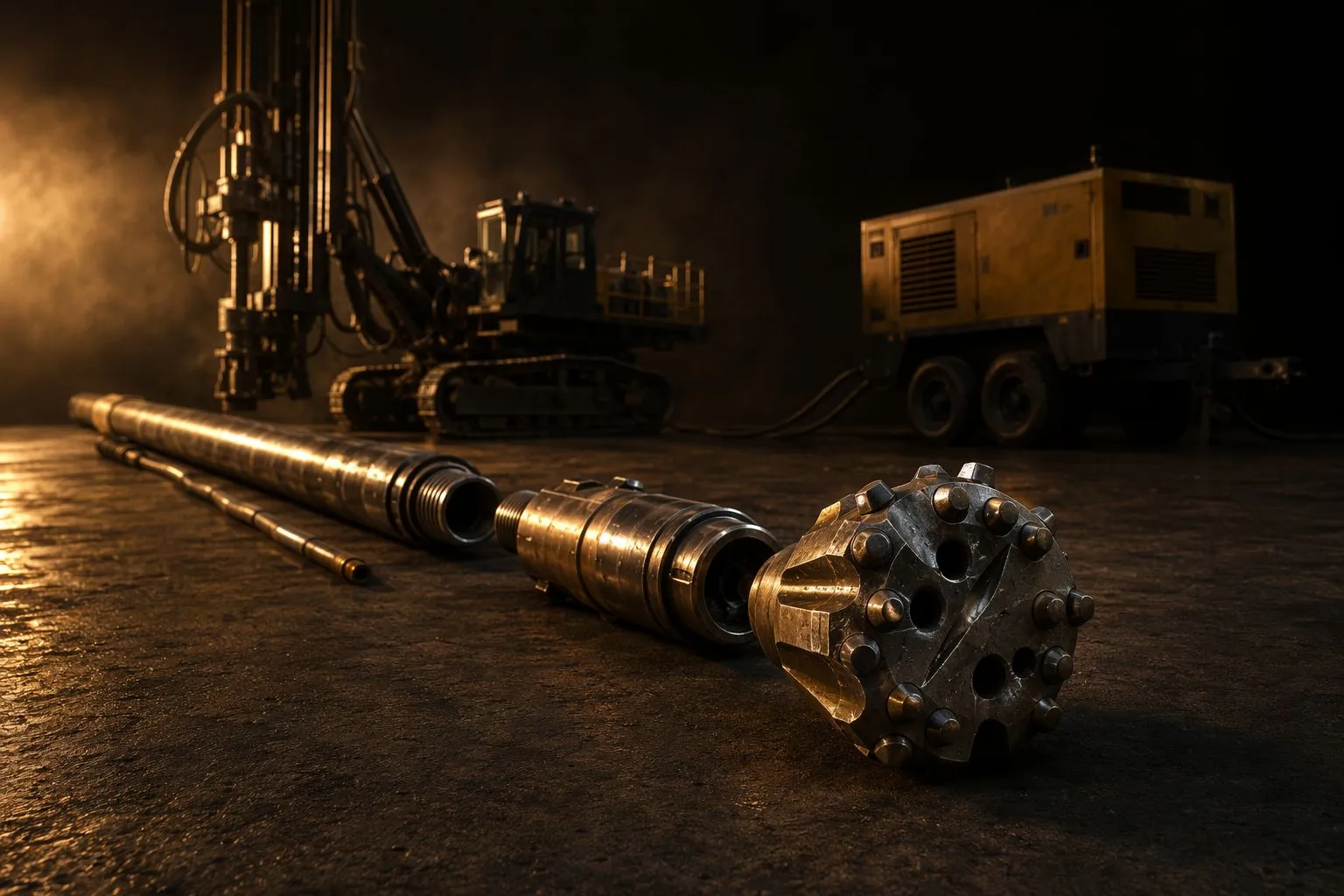
A DTH drilling system is five pieces of steel connected by physics. The rig loads the bit. The compressor feeds the hammer. The hammer drives the bit. The pipe carries the torque and the air. The bit breaks the rock. Every one of those relationships is a constraint, and every constraint is a number somebody should have calculated before the purchase order was signed.
The contractors running the lowest cost per meter are not the ones who bought the most expensive equipment. They are the ones who made one supplier accountable for one calculation sheet covering all five components. That is the whole difference.
The real question is not which brand of rig, hammer, or bit is best. It is whether anyone has calculated what happens when yours run together — at your hole diameter, your depth, and your formation.
Website: www.welldonemining.com
Email: info@welldonemining.com
Frequently Asked Questions
Is it always better to buy a complete DTH package from one supplier?
Not always, but it is always better to have one party accountable for the system calculation. Some contractors successfully buy components separately when they have in-house drilling engineers who can run the interlock calculations themselves. Without that internal capability, splitting the purchase across three suppliers means nobody owns system performance — and diagnosis of an underperforming hole becomes a months-long process.
Can I integrate equipment I already own into a new DTH system?
Yes, provided the existing equipment's capacity matches the system requirements. The most common integration is an existing compressor into a new rig package. We publish the CFM and bar calculation in advance so you can verify your unit against the drilling target. If the existing equipment is under-matched, we will say so rather than shipping a package the numbers cannot support.
What is the most common system-level mistake in DTH equipment purchasing?
Buying the rig first and letting it absorb the budget. The compressor is frequently the binding constraint on penetration rate, and buyers who spend heavily on rig capacity often end up with an under-sized air package. Size the air first, then match the rig to the system it needs to serve.
How much performance margin should a DTH system have?
Fifteen to twenty percent above calculated requirement on CFM and bar, to absorb altitude effects, temperature variation, and future depth extension. On pipe torque and tensile capacity, a safety factor of at least 1.5 against calculated maximum load. On rig pulldown and rotary torque, ten to fifteen percent. Margins below these leave no room for the conditions real projects encounter.
How long does a full system specification take?
With complete project inputs — hole diameter, maximum depth, formation type and UCS, altitude, and annual meters — a full seven-number calculation sheet takes our engineering team two to three working days. Send your project parameters to info@welldonemining.com and we will return the calculation before quoting equipment.