DTH Drill Pipe Failure Modes: How Thread Galling, Sub-Critical Resonance, and Storage Corrosion Kill Pipes Long Before Their Fatigue Life
The drill pipe is the highest-torque, highest-fatigue, most-abused component in a DTH drill string — and it is almost always specified last. Buyers spend three weeks comparing hammers, then pick pipes by "what fits the API thread." This article — Part 4 of our DTH drilling series — explains the three failure modes that drop pipes into wells years before their published fatigue life, and gives you the specification questions every drilling contractor should be asking their supplier before the next order.
The USD 380 Pipe That Cost USD 24,000 in Zambia
A drilling contractor in Zambia lost a drill pipe at 210 meters last month. Not a bit. Not a hammer. A pipe. The pin end sheared off at the thread root and everything below it — hammer, bit, three joints — dropped into the well.
The fishing operation took nine days and cost him USD 24,000 in rig time, third-party recovery tools, and a delayed project milestone. The pipe itself had cost USD 380.
When we pulled the fractured pin from the fishing basket, the failure mode was written across the thread root in a single arc of fatigue striations. Not overload. Not a manufacturing defect. Cyclic fatigue — the pipe had been loaded and unloaded above its endurance limit for weeks, and the crack had propagated one hair-thickness per rotation until the last remaining metal snapped.
The pipe was rated for that hole depth. The rig was rated for that torque. But the combination of rig rotation speed, pipe wall thickness, and hole depth had put the pipe into sub-critical resonance for three shifts running. Nobody at the site knew. The pipe just failed one Tuesday morning.
Failure Mode 1: Thread Galling from Dry Make-Up
This is the most common failure mode I see in the field, and it looks like nothing on day one. It looks like a warranty case on day 90.
Every time you connect a pin and box under load without clean thread grease — the kind formulated with copper or zinc particles, not just chassis grease from the workshop bucket — tiny metal particles from the pin and box surfaces cold-weld to each other under the make-up torque. The next disconnect requires 30 to 40 percent more torque to break, because you are shearing those cold-welded points, not just unscrewing threads.
Six trips later, the thread root has been stretched past its yield point. The threads still look intact to the operator. But the metal in the root has micro-cracks radiating outward, and the joint will now fail at 60 percent of its rated tensile load. The next time the driller pulls the string against a mild bind, the pipe parts at the thread root and the fishing job begins.
The fix is administrative, not mechanical. One printed instruction on the rig: clean the threads with a wire brush and rag before every make-up, apply API-compliant thread compound to the pin (not the box), torque to the manufacturer's specified value with a torque wrench (not by feel). Ten seconds per connection. It prevents the single most expensive failure mode on the entire drill string.
Failure Mode 2: Sub-Critical Resonance
This is the failure mode nobody warns buyers about because it does not show up in the pipe catalog. It is a system-level problem — a specific combination of rig rotation speed, pipe length, pipe wall thickness, and hole depth that puts the pipe into harmonic vibration with the rotary drive.
Here is what happens: the drill string has a natural harmonic frequency, determined by its length, diameter, wall thickness, and elastic modulus. When your rig's rotation speed hits an integer multiple of that frequency, the whole string vibrates like a tuning fork. The operator will not hear it — it happens above the ambient rig noise. The bit will not show it — penetration continues normally. But the pin thread root sees peak stress on every single rotation, and fatigue cracks that would normally initiate at hour 4,000 initiate at hour 40.
The pipe fatigue life curve is not linear. Doubling the cyclic stress does not halve the life — it cuts it by a factor of ten or more. Sub-critical resonance is exactly the kind of hidden stress amplifier that turns a properly-specified pipe into a fishing job.
The fix is a spec sheet, not a product change. Before you buy pipes for a project, your supplier should be able to hand you a resonance chart for your specific rig and hole depth range — a printed graph showing which rotation speeds to avoid at each string length. Almost no drilling contractor asks for this. Almost no supplier offers it unprompted. Which is exactly the specification gap the customized drilling solution was built to close.
Failure Mode 3: Storage Corrosion at the Sealing Shoulder
The third failure mode kills more pipes than any drilling operation ever will. It happens in the pipe yard, months before the pipe sees a hole.
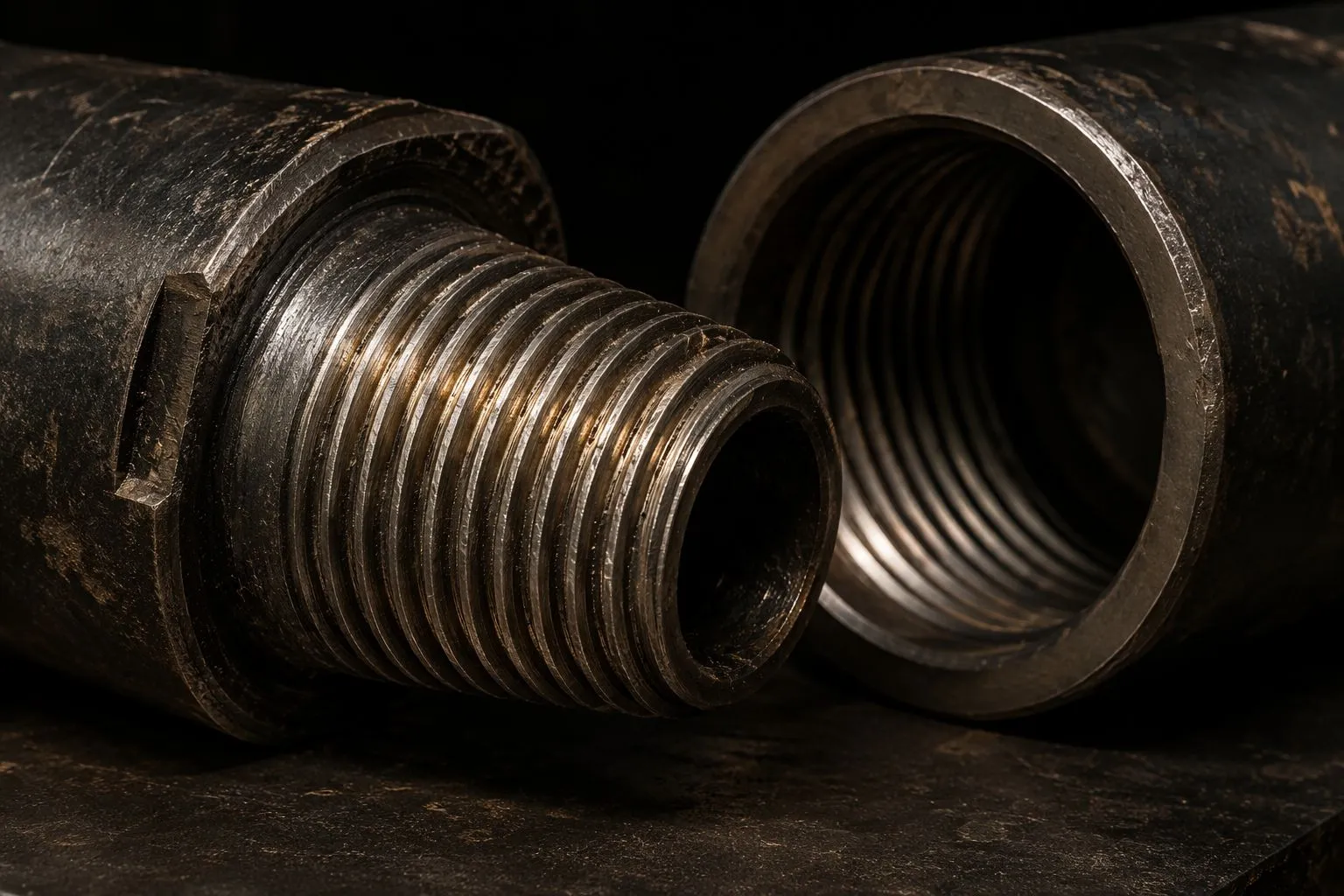
A drill pipe left three months on damp ground, with the standard thin plastic thread protector, develops microscopic corrosion pits on the pin's sealing shoulder — the machined face just behind the last thread that seats against the box shoulder under torque. Those pits are invisible to the naked eye. You need magnification to see them.
The first time that pipe is torqued into a hole, the sealing shoulder does not seat cleanly. Compressed air begins leaking past the seal every rotation. Within one shift, the leaking high-velocity air erodes the shoulder metal — a process called "gas cutting" — and the joint is finished. It cannot be re-torqued to hold pressure. The pipe is scrap on trip one.
Prevention is straightforward and almost universally ignored: heavy steel or composite thread protectors (not the thin plastic caps the pipe shipped with), a light coating of preservative oil on every pin and box before storage, and pipes stored on wooden dunnage above ground level with drainage. Total cost per pipe: less than USD 5. Failure cost per pipe: USD 380 plus whatever it damages downstream.
Read the Fracture: What a Failed Pipe Tells You
Every failed drill pipe writes its cause on the fracture surface. The pattern is unmistakable if you know what to look for. Before you throw the pin in the scrap bin, spend two minutes reading it.
- Fine concentric arc lines radiating from one point on the thread root = cyclic fatigue. The joint saw repeated stress cycles above its endurance limit. Cause is usually sub-critical resonance or over-torquing on connection.
- Rough, granular fracture with visible metal deformation = single-event overload. Something jammed the string, torque spiked past yield, and the weakest joint parted. Cause is usually a stuck bit or a formation change the operator did not respond to.
- Cross-hatched wear pattern on thread flanks, with metal transfer between pin and box = galling from dry make-up. Cause is the thread compound routine, not the pipe.
- Eroded, washed-out appearance on the sealing shoulder = gas cutting from a shoulder that failed to seat. Cause is storage corrosion or a damaged shoulder from a previous connection.
- Deep gouges or cracks originating on the outside diameter = mechanical damage from the pipe rack, tongs, or catwalk. Cause is handling procedure, not the pipe itself.
Photograph every failed pipe, log the failure mode, and track the pattern across your drilling program. Over a year, that log will tell you exactly which operating condition is driving your pipe replacement cost — and it is almost never the pipe itself.
Specifying Pipes the Right Way: Five Numbers Your Supplier Needs
Most buyers order drill pipes by outside diameter and thread type. That is not a specification. That is a part number. A proper spec requires five numbers, and any supplier who cannot process all five is not specifying pipes — they are shipping catalog stock.
- Rig rotary torque output (Nm) at working RPM. This sets the minimum wall thickness. Under-spec the wall, and the pipe yields at the first bind.
- Maximum planned hole depth (meters). This sets the pipe's required tensile capacity — the weight of the string below any given joint. The deepest joint sees the highest tensile load.
- Rig rotation speed range (RPM). This drives the sub-critical resonance calculation. Without it, resonance cannot be predicted and pipes will fail early on specific combinations.
- Formation type (soft/medium/hard, fractured/solid). Fractured formations produce shock loads on the string. Fatigue life at shock loads is a fraction of steady-state life.
- Operating environment (humidity, storage conditions, transport distance). A pipe destined for outdoor storage in a tropical climate needs different protective packaging than one going into a covered warehouse.
If your pipe supplier does not ask for these five numbers, they are not calculating anything. They are picking a part from a shelf. Which is fine for a bit or a hammer consumable — but a drill pipe that fails is not a consumable failure, it is a project failure.
Three Field Checks Before Every Trip
Any drilling foreman can prevent 80 percent of pipe failures with three quick checks between trips. None of them require special tools.
Check 1 — Thread inspection under a shop light
Wipe the pin threads clean with a rag. Rotate the pipe under a strong light. Look for shiny galled patches, torn thread crests, or discoloration in the thread root. Any of these means the joint is compromised — do not run it back in the hole. The five minutes you spend now saves nine days on a fishing job later.
Check 2 — Sealing shoulder condition
The machined face just behind the last thread on the pin must be smooth, flat, and free of pitting, gouges, or corrosion. A fingernail run across the shoulder should not catch on anything. If it does, the shoulder is damaged and gas cutting will finish the joint in one shift.
Check 3 — Make-up torque logged, not felt
Every connection torqued to the manufacturer's specification using a calibrated torque wrench. Not felt by the driller, not tightened until the tongs jump. Logged. If you cannot produce a torque log for each connection, you do not know which joints are under-torqued (leak-prone) or over-torqued (fatigue-prone).
Why Welldone Mining
Welldone Mining specifies drill pipes as part of an engineered drill string, not as a catalog line item. Rig torque, hammer, compressor, formation, and hole depth all feed into the pipe specification — so the pipes we ship are matched to the actual operating conditions, not sized against a generic API standard.
What our DTH drill pipe customers get:
- Resonance chart with every order. A printed graph showing which rotation speeds to avoid at each string length for your specific rig — the calculation almost no supplier offers unprompted.
- Heavy-duty thread protectors and preservative packaging as standard. Every pin and box shipped with steel or composite protectors and preservative oil, not the thin plastic caps that fail during transit.
- Fracture analysis service. Send us a photograph of any failed pipe from any supplier, and our engineering team will identify the failure mode and root cause at no cost. Over three or four failures, the pattern tells you which operating condition is actually killing your pipes.
Related Solutions
Drill pipe specification is inseparable from the rest of the drill string. Buyers evaluating a pipe order typically look at these solution pages together:
- Water Well Drilling Solution — Complete water well drilling packages for depths from 80 to 400 meters, with rig, hammer, compressor, and drill pipe matched to formation and target diameter.
- Quarry Drilling Solution — Blast hole drilling packages for hard-rock quarries, with high-pressure compressors, heavy-duty DTH hammers, and drill string engineered for shock-load formations.
- Customized Drilling Solution — Non-standard hole diameters, mixed depth targets, and resonance-critical rig-pipe combinations. One engineering owner from spec to acceptance.
Conclusion
The drill pipe is the cheapest structural component in the drill string and the most expensive one to fail. A USD 380 pipe that drops a hammer and bit into a 210-meter hole costs the contractor USD 24,000 and nine days of downtime. That math never gets better.
Buying pipes right is not about paying more — it is about specifying against the five numbers your rig and project actually generate, then handling the pipes on site with two minutes of discipline per connection. Contractors who do this run four to eight times the pipe life of contractors who order by part number and torque by feel. Same pipes, same steel, same threads. Different outcomes.
The real question is not which pipe brand lasts longest. It is whether anyone in your supply chain calculated the resonance chart for your rig — or whether the pipes on your rack are running blind against a system they were never sized for.
Website: www.welldonemining.com
Email: info@welldonemining.com
Frequently Asked Questions
What is the typical fatigue life of a DTH drill pipe under normal operating conditions?
Well-specified and well-maintained pipes typically deliver 4,000 to 8,000 rotating hours before fatigue retirement, depending on wall thickness, thread type, and formation shock loading. Pipes exposed to sub-critical resonance, dry make-up, or repeated over-torquing can fail well before 500 hours. The gap between catalog fatigue life and field fatigue life is almost entirely operating discipline, not pipe quality.
How can I tell if my rig is putting drill pipes into sub-critical resonance?
Symptoms include unexplained pipe failures at fatigue lives well below rated, fractures with concentric arc patterns at the thread root, and pipe vibration that changes character at specific rotation speeds. The reliable diagnosis is a resonance calculation using your rig's rotation speed range, string length, and pipe wall thickness. Contact us at info@welldonemining.com with your rig model and typical hole depth for a resonance chart.
What thread compound should I use on DTH drill pipe connections?
Use API-compliant thread compound formulated for rotary shouldered connections — the type containing copper, zinc, or graphite particles that prevent galling under high make-up torque. Do not substitute chassis grease, general-purpose lubricants, or engine oil. The wrong compound is worse than none — it may lubricate the make-up but fails to prevent metal-to-metal cold welding on disconnect.
Can a galled drill pipe thread be repaired, or should the pipe be scrapped?
Minor galling limited to thread flanks can sometimes be dressed with a thread file and returned to service for shallow-hole applications. Galling that reaches the thread root, or any damage to the sealing shoulder, means the pipe should be scrapped. The cost of an in-hole failure vastly exceeds the cost of the pipe — do not extend the life of a compromised joint.
How should drill pipes be stored between projects?
On wooden dunnage above ground level, with heavy steel or composite thread protectors on both pin and box, a light coating of preservative oil on all machined surfaces, and covered against rain if possible. Pipes stored on damp ground with thin plastic protectors will develop shoulder corrosion within three months and fail on the first trip of the next project. Send us your storage conditions at info@welldonemining.com for a preservation protocol matched to your climate.