DTH Hammer Failure Modes: How to Diagnose Piston Scoring, O-Ring Hardening, and Retainer Wear Before They Cost You a Hammer
Most drilling contractors never inspect a DTH hammer until it stops working. By then, the hammer is not the problem — it is where the damage from something upstream became visible. This article — Part 5 of our DTH drilling series — walks through the three failure modes that kill hammers before their data-sheet life, the real service interval on a working project, and the six-minute check sheet that prevents 70% of premature failures we see in the field.
The Hammer That Died at 30 Hours in Nampula
A drilling contractor in northern Mozambique had a 6-inch DTH hammer on his workshop bench, split open like a fish. Thirty hours of runtime. New hammer, new bit, compressor overhauled the previous year. He wanted me to confirm it was a manufacturing defect.
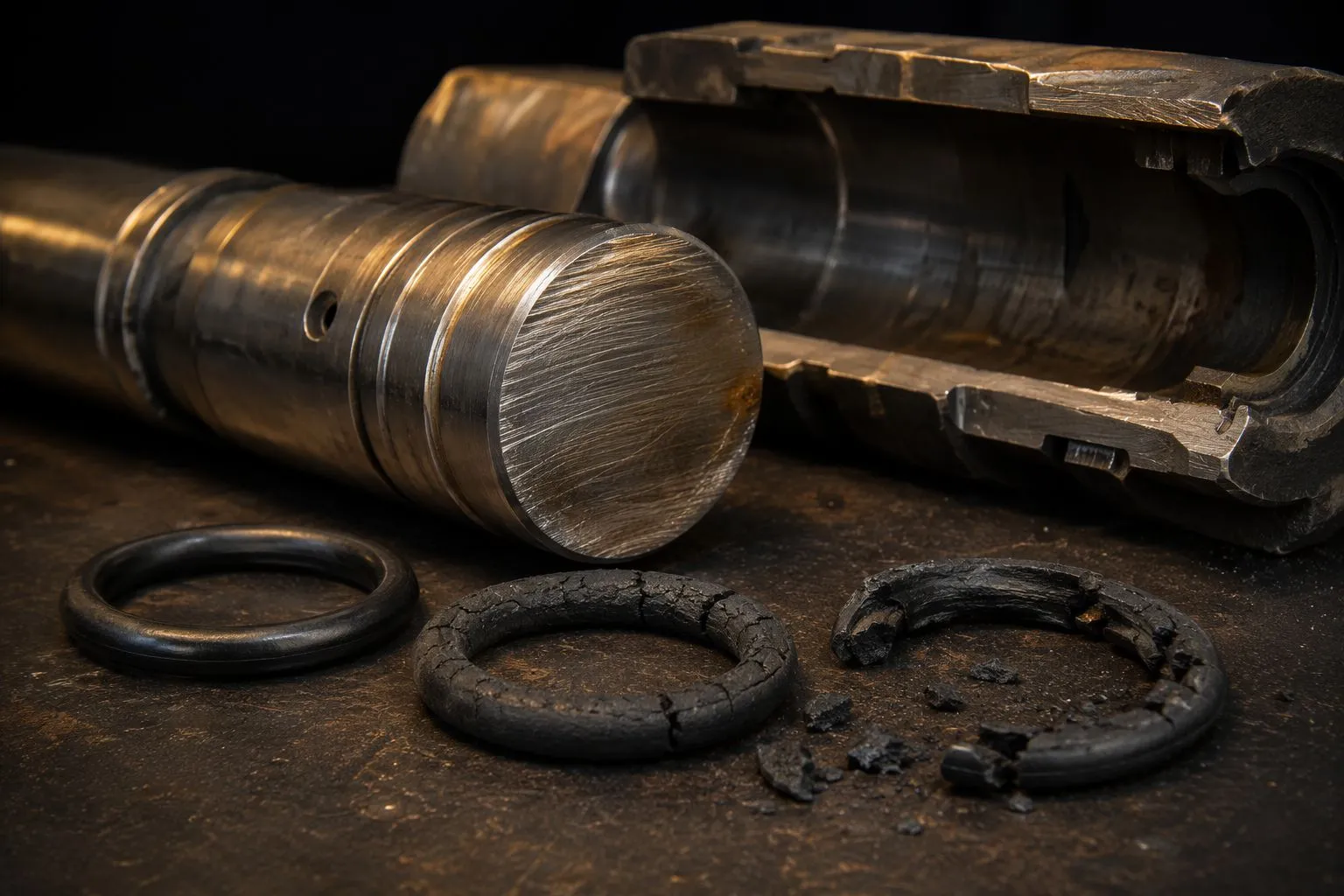
I looked at the piston first. Four thin circumferential scratches near the head — the kind you can feel with a fingernail but not see clearly under overhead light. Then the O-rings. Two were still soft. One had hardened to the density of a fingernail with a fine crack along its inner face. The fourth had disintegrated; the mechanic had picked the fragments out with a magnet.
The hammer was not defective. Something upstream had cooked it, dried it out, or fed it dirty air. The hammer is just where the damage becomes visible. In seven out of ten early-failure cases I diagnose, there is no warranty case to make — the tool was killed by operating conditions the buyer never wrote into the specification.
Failure Mode 1: Piston Scoring
Look at the piston head first, every time. Fine circumferential scratches — feelable with a fingernail — mean the piston was running dry. That is not a hammer defect. That is a lubricator problem.
Most DTH hammers need 30 to 60 grams of rock drill oil per hour, injected into the airline through an in-line lubricator. Too little and the piston runs metal-on-metal against the cylinder wall. Too much and the excess oil coats the flushing holes, slowing cuttings evacuation and choking the bit. The lubricator itself is a USD 200 component. The hammer it protects is a USD 3,000 component. The math is not complicated.
Deep gouges rather than fine scratches mean something else — usually water condensate in the airline that flashed to steam when it hit the hot piston. In humid climates without an aftercooler on the compressor or a water separator downstream, you are pushing atomized water through the hammer at 25 bar. Every cycle carries an abrasive slug of water and dust into the piston chamber.
Failure Mode 2: O-Ring Hardening
Standard DTH O-rings are nitrile or hydrogenated nitrile. They stay elastic up to about 100°C continuous, 120°C intermittent. Above that threshold, the rubber cross-links tighten, the ring hardens, and the sealing lip loses contact with the piston wall. Air begins blowing past the seal every stroke.
What happens next unfolds in a specific order:
- Hammer output drops 15 to 30 percent, silently — no audible change for the first 15 minutes
- Piston speeds up because it is no longer working against full back-pressure — cadence sounds faster, not slower
- Bit penetration collapses because the piston is now delivering half-strokes with half the impact energy
- The operator replaces the bit, blames the carbide grade, and the cycle continues until the hammer seizes
A hardened O-ring is not a manufacturing defect. It is a temperature history. If you find one on your bench, the hammer saw 130°C or higher for a sustained period — almost always from a starved-air scenario where the piston was stroking short and generating friction heat instead of transferring energy to the rock. Which points back to the compressor sizing question we covered in Part 2 of this series.
Failure Mode 3: The Piston Retainer Ring
This one is boring and it costs contractors more money than the other two combined. The piston retainer is a small circlip or wear ring that holds the piston in its return-stroke position. When it wears past a certain tolerance, the piston overtravels on the return stroke and slams into the back head. Each slam is a shock load through the entire hammer body.
You will not hear it. You will not see it in penetration data for the first 20 hours. By hour 40, the back head shows stress fractures. By hour 60, the hammer is a paperweight. A USD 12 retainer ring, replaced at the 100-hour service interval, prevents a USD 3,000 tool failure. Almost nobody replaces it on schedule because almost nobody thinks to check.
The reason this failure mode is invisible is that it does not affect performance until the last hour of the hammer's life. Everything looks fine. Then the back head cracks and the tool is done.
Read Your Piston: What Wear Patterns Actually Tell You
This is the highest-value 10-minute inspection in DTH drilling, and almost nobody does it before ordering a replacement hammer. Pull the piston, wipe it clean, and look at the surface under good light.
- Fine circumferential scratches near the head = lubricator flow rate too low, or lubricator not primed. Check the oil reservoir and flow indicator before you condemn the hammer.
- Deep axial gouges the length of the piston = water or dust contamination in the airline. Fix the compressor's water separator and inline filter, not the hammer.
- Blue or straw-colored heat discoloration on the piston head = sustained overheating. Cross-reference against O-ring condition — if the O-rings are also hardened, this is a starved-air problem, not a hammer defect.
- Cracked or chipped piston head = the piston was overtravelling and slamming the back head. The retainer ring failed. Replace both, and shorten the retainer-ring inspection interval on future hammers.
- Even wear with no scratches or discoloration = normal service life. Reassemble, replace consumables, log the hours.
Photograph the piston before you send the hammer for rebuild. Over three or four hammer cycles, the pattern will tell you which upstream problem is actually killing your tools — and it is almost never the tool itself.
What a Real Hammer Service Interval Looks Like
Most catalogs list a DTH hammer's service interval as 300 to 500 hours. That number assumes clean, dry air; correct oil injection; matched compressor pressure at the hammer sub; and no starvation events. On a well-controlled project with all four conditions met, 500 hours is realistic.
On a real African or Middle Eastern water-well project, with mixed operators, marginal compressors, and inconsistent oil supply, the practical interval is closer to 150 to 200 hours. That is not a hammer quality problem — it is an operating-condition problem. Buyers who plan a two-year drilling program on the 500-hour figure end up short one hammer per year, and they usually spend the difference blaming the supplier.
The honest way to size a hammer inventory for a multi-year project is to assume the practical interval, not the catalog interval, and add one spare hammer per rig per year. If your operating conditions actually deliver the 500-hour figure, you have inventory buffer. If they do not, you have not shut down a rig waiting for a rebuild.
Three Field Symptoms That Mean Pull the Hammer Now
Any driller can catch a dying hammer before it becomes a workshop rebuild if he watches for three signs.
Symptom 1 — Penetration rate drops 20% within one shift, with lighter drill-pipe rotation
Lighter rotation with slower penetration means the hammer is not transferring energy to the bit. Instead, it is dissipating energy as heat inside the tool. Pull the hammer, split it, and inspect the piston and O-rings before you finish that day's holes. What you save on the next rebuild is worth the shift.
Symptom 2 — Return cuttings turn wet, rounded, and dust-heavy
Cuttings that were dry and angular this morning and are now wet and rounded mean up-hole velocity has collapsed. On a healthy compressor and a properly-selected bit, that is a hammer output problem — the piston is delivering half-blows and the airflow through the bit face has dropped below the threshold that clears cuttings.
Symptom 3 — Drill pipe joint above the hammer is too hot to touch
After a 20-minute drilling run, if you cannot keep your hand on the pipe joint above the hammer for five seconds, the hammer is running well above 120°C internally. Whatever O-rings you have inside are being cooked in real time. Every minute you keep drilling shortens the seals' remaining life by hours.
The 6-Minute Check Sheet That Prevents 70% of Failures
Most premature hammer failures I diagnose in the field trace back to one root cause: nobody at the contractor's site owns the hammer's maintenance schedule on paper. The rig operator assumes the workshop supervisor is checking it. The workshop supervisor assumes the rig operator is logging hours. Nobody is. The hammer runs until it stops.
The fix is administrative, not technical. Assign one named hammer owner per rig, per shift, and put a printed check sheet in the rig cab. Six items, six minutes, signed at hour 50, 100, and 200 of hammer runtime:
- Lubricator oil reservoir level and flow indicator working
- Compressor discharge pressure at hammer sub within 2 bar of target
- Water separator drained and inline filter inspected
- Retainer ring inspection at hour 100 (visual, no dial gauge required)
- O-ring set replacement at hour 200 (or earlier if pipe joint runs hot)
- Photograph of piston head at every teardown, filed against hammer serial number
That is the whole checklist. It fits on one printed page. It prevents seven out of ten early failures I see in the field. The alternative is calling your supplier every 30 to 60 hours to argue about warranty on a hammer that was killed by operating conditions.
Why Welldone Mining
Welldone Mining works with drilling contractors who need the hammer to be part of an engineered system, not a consumable ordered against a catalog. Hammer, drill pipe, compressor, and bit come out of one engineering team, so the operating conditions the hammer will actually see are calculated before the tool ships.
What our DTH hammer customers get:
- Hammer specification against your project's real conditions. Formation type, hole depth range, compressor CFM/bar, altitude, and climate — sized against the practical service interval, not the catalog figure.
- Piston and O-ring failure analysis service. Send us photos of a failed hammer's piston. Our engineering team reads the wear pattern and identifies the upstream cause — lubricator, compressor, water contamination, or genuine tool defect. No cost, no obligation.
- Printed 6-minute check sheet with every hammer shipped. Standardized inspection template you can put in the rig cab on day one, so hammer ownership starts before the first hour of runtime is logged.
Related Solutions
DTH hammer performance is one element of a full drilling system. Buyers running a multi-year drilling program typically look at these solution pages together:
- Water Well Drilling Solution — Complete water well drilling packages for depths from 80 to 400 meters, with rig, hammer, compressor, and drill pipe matched to formation and target diameter.
- Quarry Drilling Solution — Blast hole drilling packages for hard-rock quarries, with high-pressure compressors, heavy-duty DTH hammers, and hole-deviation control.
- Customized Drilling Solution — Complex formations, mixed hole diameters, non-standard depth targets, or hammer-inventory sizing for multi-rig programs. One engineering owner from spec to acceptance.
Conclusion
The DTH hammer is the smallest, cheapest tool in your drill string. It is also the one that decides whether the rig, the compressor, and the bit deliver what their data sheets promise. When a hammer fails at 30 hours, the hammer is almost never the reason — the reason is upstream, and the hammer is just where you first see it.
The contractors who run the lowest cost per meter are not the ones with the most expensive hammers. They are the ones with a named hammer owner, a six-minute check sheet, and a photograph of every piston they retire. That is not maintenance culture. That is engineering discipline.
The real question is not which hammer brand lasts longest. It is whether anyone at your site owns the hammer's operating conditions on paper — or whether the tool is running blind until it stops.
Website: www.welldonemining.com
Email: info@welldonemining.com
Frequently Asked Questions
How do I know if my hammer failure is a warranty case?
Split the hammer, photograph the piston and O-rings, and log the runtime hours plus operating conditions (compressor discharge pressure at hammer sub, lubricator flow rate, water separator drain schedule). If the piston shows uniform wear with no scoring, no heat discoloration, and no retainer damage, and the failure occurred well below the practical service interval — that is a warranty case. Fine scratches, hardened O-rings, or overtravel damage on the piston head almost always trace to operating conditions rather than manufacturing.
What is the difference between catalog service interval and practical service interval?
Catalog intervals (typically 300 to 500 hours) assume laboratory operating conditions — clean, dry, matched air; correct lubrication; no starvation. Practical intervals on real project sites, especially in humid or dusty regions with variable operator quality, are 150 to 200 hours. Plan hammer inventory against the practical interval, not the catalog figure, or you will run rigs short.
Can a DTH hammer be rebuilt, or should I replace it?
Most DTH hammers can be rebuilt two to three times before the outer casing tolerances fall outside spec. Rebuild economics depend on piston condition — if the piston is scored beyond honing tolerance, or the back head is cracked, the rebuild cost approaches new-hammer cost and replacement is the better decision. Send us the piston photograph before you commit either way; we can usually tell you within an hour whether rebuild is worth it.
How often should I replace the O-ring set on a DTH hammer?
At every scheduled service interval, or immediately if the drill pipe joint above the hammer is running hot. O-rings are inexpensive; the damage a failed seal causes to the piston and hammer body is not. Do not extend O-ring life to save cost — the math never works out.
Does Welldone Mining offer failure analysis for hammers from other suppliers?
Yes. Send us clear photographs of the piston, O-rings, and back head, plus your operating conditions and runtime hours. We will identify the failure mode and the upstream cause at no cost, regardless of brand. Contact us at info@welldonemining.com with the images and hammer serial number.