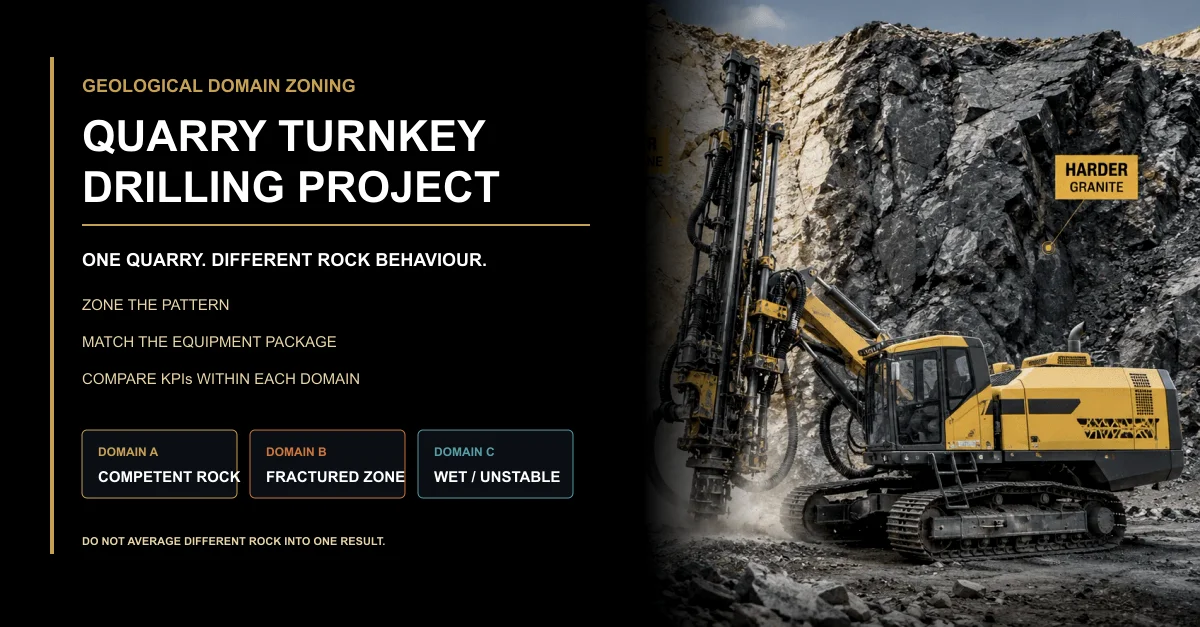
Aggregate Quarry Drilling — Why Bit and Compressor Matching Decides Your Cost per Meter
Most quarry buyers ask how fast their DTH hammer can drill. The real question is whether the hammer, bit, compressor, and drill pipe on their purchase order are actually matched — or whether they are four line items from four different specifications that will fight each other underground. This article explains why aggregate quarry drilling costs are almost always a system-matching problem, and how to specify a rig that gives you a predictable cost per meter instead of a moving target.
The Cost per Meter Problem Nobody Puts on the Quote
When a quarry operator asks for a quote on a new drill rig, most suppliers respond with the same three numbers — hammer diameter, drill speed, and rated air pressure. What almost never appears on that quote is the number that actually matters: expected cost per meter drilled in your specific rock, at your specific hole depth, over the expected bit life.
There is a reason for that. Most suppliers cannot answer the question. They sell a hammer, they sell a bit, they sell an air compressor. They do not sell the matched system that connects them. And matching is exactly where the real cost is decided.
What Went Wrong in Saudi Arabia — A Real Project
I've seen this before. Last month a customer in Saudi Arabia commissioned a new drill rig for a granite aggregate quarry west of Riyadh. The rock properties were straightforward on paper — UCS around 220 MPa, silica content above 70%, hole diameter 6 inches, blast hole depth 12 meters. Standard hard-rock quarry conditions for that region.
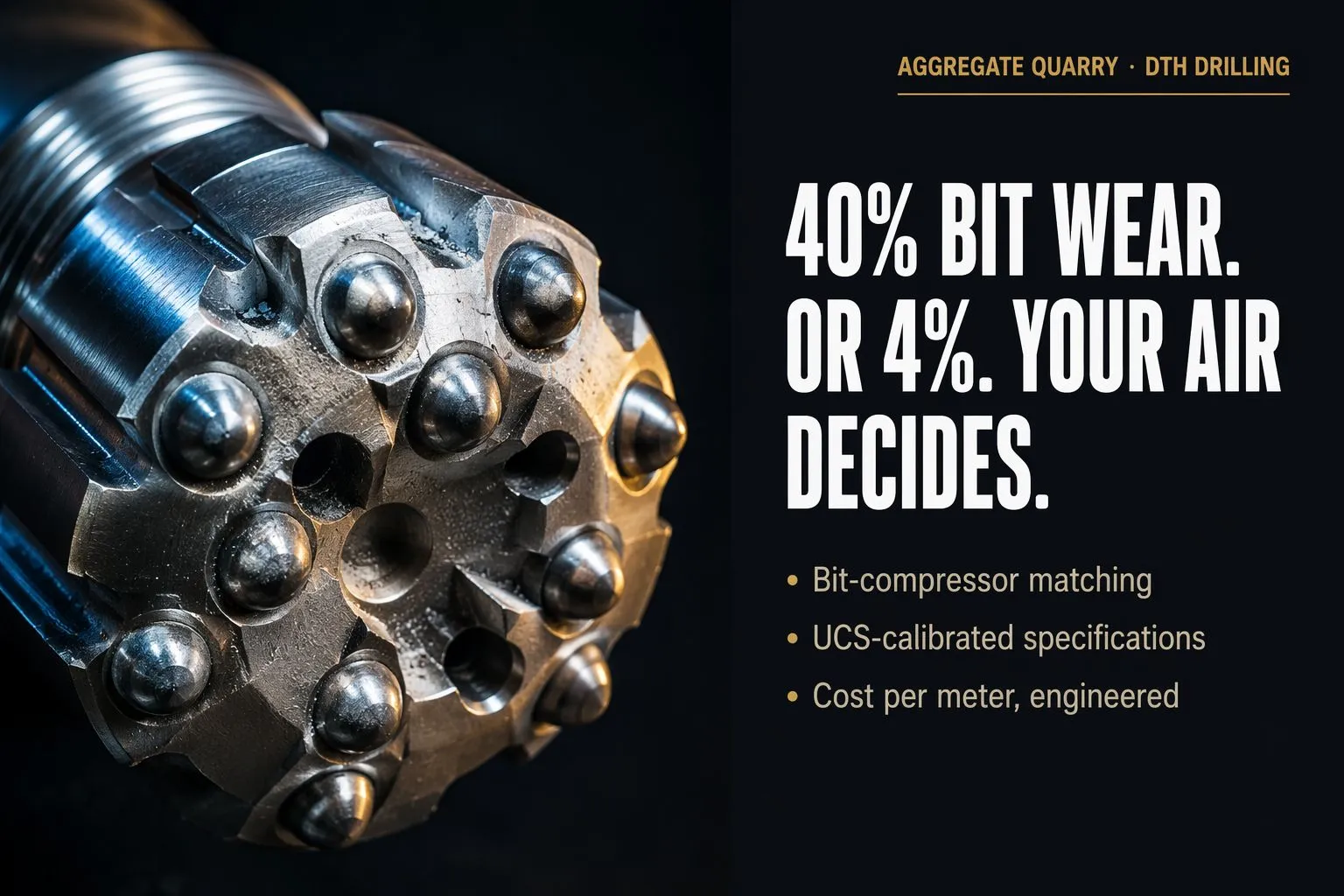
By the end of week one, the operator was replacing bits every 180 meters instead of the expected 900 meters. Bit wear rate was near 40%. The customer's site manager blamed the rock; the drilling contractor blamed the operator; the supplier blamed the material batch. Everyone had a theory, no one had a diagnosis.
Actually, the problem was in a component nobody was looking at — the air compressor on the quote was rated 400 CFM at 25 bar. For a 6-inch DTH hammer drilling 220 MPa granite, the bit face needs at least 550 to 600 CFM at 24 bar to keep cuttings fully evacuated from the hole. The compressor on the rig was 25% undersized. The cuttings were not being cleared out fast enough, so they recirculated at the bit face — and the tungsten carbide inserts were being ground down by the debris they had just cut, not by the rock itself.
We swapped in a matched 600 CFM compressor. Bit life jumped from 180 meters to 950 meters within the first week. Same rock. Same operator. Same hammer body. Different air. Cost per meter dropped 62%.
The Four Components That Have to Match
1. DTH Hammer
The hammer is the impact source — it delivers percussive energy to the bit at 20 to 40 blows per second. Hammer selection is driven by hole diameter and rock hardness. A 4-inch hammer will physically fit inside a 4.5-inch hole; a 6-inch hammer needs 6.5 to 7 inches. The mistake most buyers make is over-sizing the hammer to "handle harder rock" — but oversized hammers demand more air, and if the compressor cannot keep up, the hammer strokes weakly and the bit does most of the work.
2. DTH Bit
The bit is the wear component. Bit geometry (flat face, convex, concave, or ballistic) is selected based on rock UCS and silica content. High-silica granite needs ballistic tungsten carbide inserts with high impact tolerance; sedimentary rock benefits from convex bits that clear cuttings faster. Bit gauge diameter must match the hammer output diameter exactly — a mismatch of even 3 mm creates uneven wear on one side of the bit, and the bit fails at 30% of its expected life.
3. Air Compressor
The compressor is the single most under-specified component in the industry. The rule of thumb for aggregate quarry drilling: at 6-inch hole diameter and hard rock (above 180 MPa UCS), you need at least 500 CFM at 24 bar to keep the bit face swept clean. Larger hole diameters or deeper holes need proportionally more air. Suppliers who quote 400 CFM for a 6-inch hammer are quoting on the technical minimum, not on production reality.
4. Drill Pipe
The drill pipe transmits torque from the rotation head to the hammer, and it delivers air from the compressor to the hammer. Pipe wall thickness matters — thin-wall pipes flex under torque at depth, which introduces stress cycling that shortens fatigue life. For quarry drilling above 15 meters hole depth, use API-grade drill pipe with wall thickness rated for at least 20% margin above the peak torque of your rotation head.
The UCS Chart Every Quarry Buyer Should Have on the Wall
Before you sign a drill rig quote, you should be able to fill in a table like this for your specific rock:
| Rock Type |
UCS (MPa) |
Silica % |
Recommended Hammer |
Min. Compressor (CFM @ bar) |
Expected Bit Life (m) |
| Limestone (soft) |
50 – 100 |
Below 10% |
4" DTH |
350 @ 20 |
1,800 – 2,400 |
| Dolomite / Basalt |
100 – 180 |
10 – 40% |
5" – 6" DTH |
450 @ 22 |
1,000 – 1,500 |
| Granite (medium) |
180 – 220 |
40 – 70% |
6" DTH |
550 @ 24 |
700 – 1,000 |
| Granite (hard) |
220 – 300 |
Above 70% |
6" – 8" DTH |
650 @ 25 |
500 – 750 |
| Quartzite / Chert |
Above 300 |
Above 90% |
8" DTH ballistic |
800 @ 25 |
300 – 500 |
Numbers in this table are indicative — actual figures depend on hole depth, joint spacing, water table, and bit brand. But the shape of the relationship is universal: harder rock and higher silica demand more air, not more hammer force.
The Retrofit Trap in Quarry Drilling
A lot of quarry operators try to upgrade an existing rig by putting a bigger hammer on it. In most cases, this makes things worse rather than better. The bigger hammer demands more air, but the existing compressor was sized for the smaller hammer. Result: the bigger hammer runs starved, delivers less impact energy per blow, and wears faster than the hammer it replaced.
The economics are counter-intuitive but clear: it is cheaper to upgrade the compressor before the hammer than the other way around. A properly sized compressor lets your existing hammer perform at 100% of its rated impact energy. An oversized hammer on an undersized compressor performs at 60 to 70% of rated energy, and wears bits at double the rate.
Questions to Ask Before You Sign a Quarry Drilling Quote
- At my rock's UCS and silica content, what CFM and bar rating does the bit face actually require?
- Is the hammer diameter and the bit gauge diameter matched to within 1 mm?
- What is the expected bit life in my specific rock, and what does the supplier base that number on?
- Is the drill pipe wall thickness rated for at least 20% margin above the rotation head's peak torque?
- What is the total expected cost per drilled meter, all components included, over the first 12 months?
- If bit life comes in below spec in the first month, what is the supplier's diagnostic and replacement policy?
If any of these questions gets a vague answer, the quote is not engineered for your project — it is generic hardware assembled from a catalog.
Why Welldone Mining
Welldone Mining is a manufacturer of DTH drilling systems, not a distributor. We build the hammer, we build the bit, we specify the compressor, and we test the four-component match in our factory before the equipment ships. When we tell a Saudi quarry operator "your 6-inch hammer needs 600 CFM at 24 bar for that rock", it comes from actual test data on 220 MPa granite — not from a chart in a brochure.
What our aggregate quarry customers get:
- UCS-calibrated system quotes. Send us your rock properties, we send back a matched hammer + bit + compressor + pipe specification with an expected cost per meter number.
- 48-hour engineer response. If your first-week bit wear rate is not tracking to spec, we send a drilling engineer on-site within 48 hours to diagnose whether the fault is in the equipment, the operator, or the rock.
- Quarry-specific solutions library. Our quarry drilling solutions page covers granite, limestone, basalt, and mixed-rock quarry configurations from projects across the Middle East, North Africa, and South Asia.
Related Solutions
Aggregate quarry drilling is one of several project categories Welldone Mining serves. Buyers evaluating a full drilling program typically look at these solution pages together:
Conclusion
Aggregate quarry drilling economics are decided by system matching, not by hammer horsepower. Every project that has come to us complaining about high cost per meter has turned out to have the same root cause — the four components on the original purchase order were specified in isolation, and they never worked as a matched system in the field.
The real question is not how fast your hammer drills. It is whether the four components you bought were engineered to work together in your rock.
Website: www.welldonemining.com
Email: info@welldonemining.com
Frequently Asked Questions
What is the single most common mistake in quarry drilling equipment procurement?
Undersizing the air compressor. Roughly 70% of the quarry projects we audit have compressors specified for the technical minimum air flow, not for the production-reality air flow needed to keep the bit face swept clean at their rock UCS. This single mistake typically doubles bit wear rate and increases cost per meter by 40 to 60%.
Can I use my existing water well DTH rig for quarry blast hole drilling?
In most cases, no. Water well rigs are optimized for depth (single 200-meter hole) rather than throughput (dozens of 12-meter holes per shift). The compressor duty cycle, mast setup speed, and pipe change mechanism on a water well rig are wrong for quarry production. Please see our water well drilling solution to understand the specification differences.
How do I calculate the CFM my hammer actually needs?
The practical formula is: hole diameter (in inches, squared) times rock hardness factor times depth factor. For 6-inch holes in hard granite at 12 meters depth, that works out to approximately 550 to 600 CFM. Send us your rock properties and hole geometry and we will give you the exact figure for your project.
What is a realistic bit life expectation in hard granite quarries?
For 6-inch DTH bits in 200 to 250 MPa granite with properly matched compressor and hammer: 700 to 1,000 meters is realistic. Below 500 meters means something is wrong with the system match, not with the bit. Above 1,200 meters usually means the rock is softer than the buyer thought, or the bit is running at less than optimal impact energy.
Does Welldone Mining support quarry projects outside China?
Yes. Our largest quarry-drilling customer bases are in Saudi Arabia, Egypt, South Africa, Morocco, Pakistan, and Indonesia. We ship complete matched systems (hammer + bit + compressor + pipe) and provide on-site commissioning and 48-hour engineer response for the first 6 months after equipment arrives. Contact info@welldonemining.com with your project details.