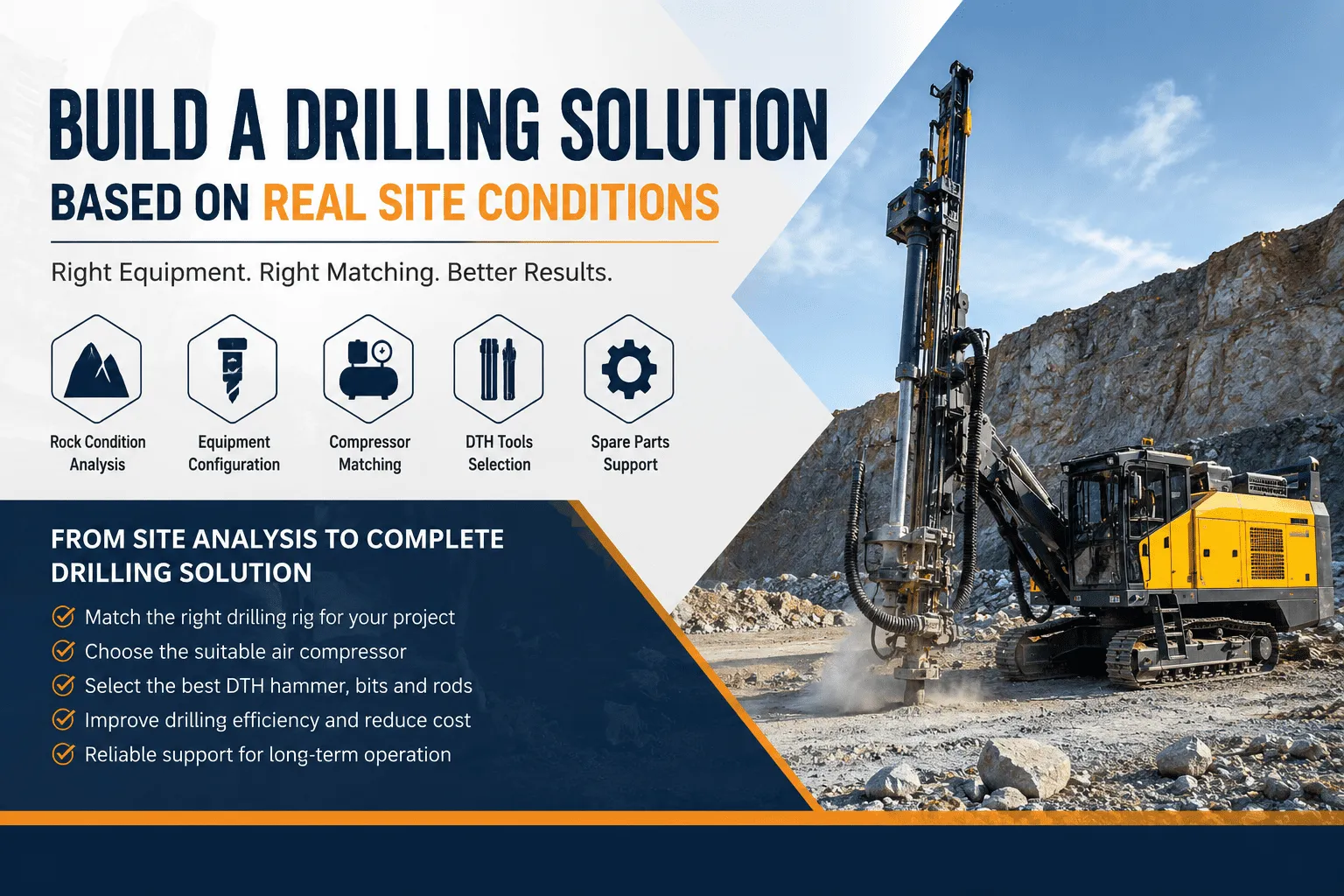
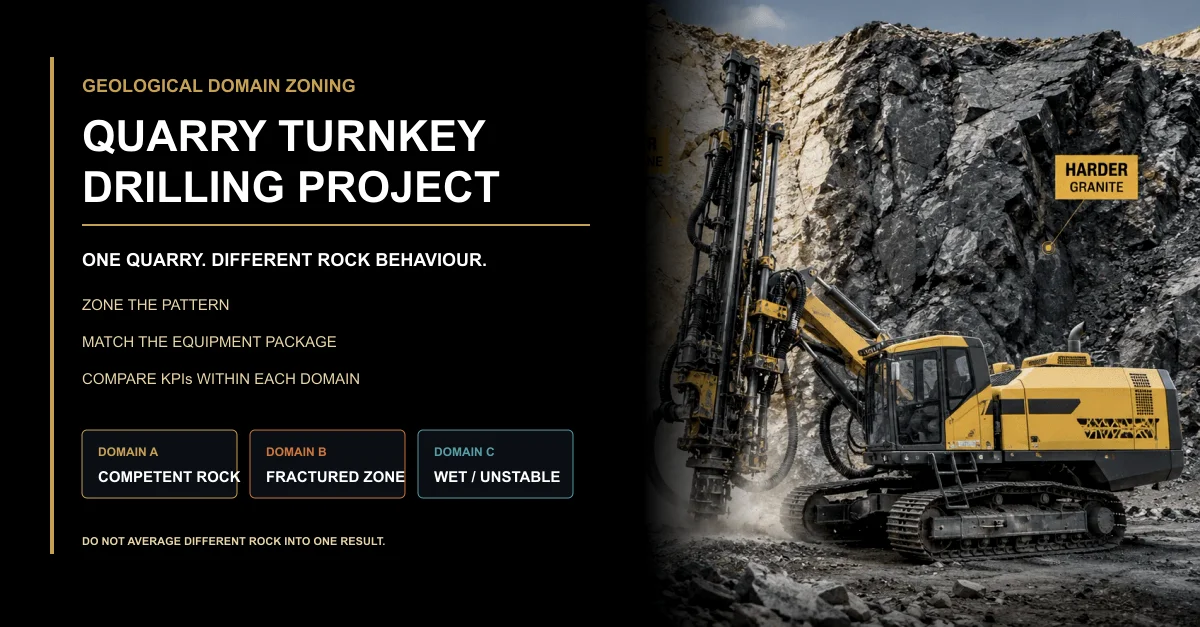
A successful drilling project should not start from choosing the biggest drilling rig or the lowest price.
It should start from the real site conditions.
Hole diameter, drilling depth, rock hardness, terrain, power condition, and working environment all affect the final drilling performance.
For quarry, mining, water well, and construction drilling projects, the right solution is not only a single machine.
It is a complete equipment configuration that includes the drilling rig, air compressor, DTH hammer, drill bit, drill rods, spare parts, and after-sales support.
In this article, we explain how to build a practical drilling solution based on real site conditions, so buyers can reduce wrong equipment selection, improve drilling efficiency, and control long-term operating cost.
Why Real Site Conditions Matter in Drilling Projects
Every drilling site is different.
Even when two customers need the same drilling depth, their equipment configuration may still be different because of rock hardness, road access, power supply, working space, and local maintenance ability.
For example, a quarry project in hard limestone may require a crawler DTH drilling rig with a high-pressure air compressor and durable drill bits.
A water well project in mixed soil and rock layers may need a rig with stronger depth capacity and better adaptability to changing ground conditions.
More importantly, drilling equipment that looks suitable on paper may not perform well if it is not matched with the real job site.
Main Site Conditions That Affect Drilling Solution Design
Before recommending a drilling rig model or air compressor, the project conditions should be clearly analyzed.
These factors help determine the drilling method, machine type, compressor capacity, drilling tools, and spare parts package.
| Site Condition |
Why It Matters |
Impact on Drilling Solution |
| Hole Diameter |
Determines drill bit size, DTH hammer size, and air demand |
Affects drilling rig model, compressor matching, and tool selection |
| Drilling Depth |
Defines required drilling capacity and rod system |
Affects mast design, feed force, rod length, and rig stability |
| Rock Hardness |
Different rock formations require different drilling methods |
Affects DTH hammer, drill bit design, air pressure, and tool life |
| Terrain Condition |
Mountain roads, slopes, soft ground, and narrow sites affect mobility |
Affects crawler design, machine size, and transportation plan |
| Power Supply |
Some sites have stable electricity, while others are remote |
Affects diesel or electric compressor selection |
| Project Duration |
Long-term projects require stronger maintenance and spare parts planning |
Affects spare parts package and after-sales support plan |
Start With the Project Type
The first step is to define the drilling application.
Different projects have different priorities, so the drilling solution should be designed around the actual working purpose.
Quarry and Hard Rock Drilling
For quarry drilling, limestone drilling, granite drilling, and open-pit mining projects, the main concern is drilling efficiency in hard rock.
Buyers should focus on hole diameter, blasting hole depth, rock hardness, air compressor pressure, DTH hammer performance, and drill bit durability.
For this type of project, a complete quarry drilling solution usually includes a crawler DTH drilling rig, high-pressure air compressor, DTH hammer, drill bits, drill rods, and wearing parts.
Water Well Drilling
For water well drilling projects, the working conditions are often more complex.
The ground may include soil, sand, gravel, limestone, or mixed rock layers.
The required depth may also vary from shallow irrigation wells to deep community water supply wells.
A practical water well drilling solution should consider drilling depth, hole diameter, ground layers, local road condition, compressor matching, and future maintenance needs.
Customized Drilling Projects
Some projects cannot be solved by a standard product recommendation.
For example, the buyer may have limited working space, special depth requirements, remote site conditions, or mixed applications such as quarry drilling and water well drilling together.
The real issue is not whether one machine looks powerful, but whether the whole configuration can work smoothly under the customer’s real site conditions.
How Hole Diameter and Drilling Depth Affect Equipment Selection
Hole diameter and drilling depth are two of the most important technical details.
They directly affect the drilling rig model, DTH hammer size, drill bit type, drill rod strength, and air compressor capacity.
| Project Requirement |
What to Check |
Recommended Focus |
| Small Hole Diameter |
Lower air demand and smaller tool size |
Compact rig, suitable hammer, efficient compressor matching |
| Large Hole Diameter |
Higher air demand and stronger hammer impact |
More powerful compressor, larger DTH hammer, stronger rig capacity |
| Shallow Drilling |
Shorter drilling cycle and lower rod requirement |
Flexible rig movement and efficient tool setup |
| Deep Drilling |
Higher demand for stability, rods, and slag discharge |
Stronger feed system, suitable rod package, reliable compressor support |
A common mistake is choosing equipment only based on maximum drilling depth.
Actually, the buyer should check whether the equipment can maintain stable performance at the required hole diameter, rock condition, and working depth.
Rock Condition Decides the Drilling Method and Tool Configuration
Rock condition has a direct impact on drilling efficiency and tool wear.
Soft soil, limestone, granite, sandstone, and abrasive rock require different drilling methods and tool combinations.
For hard rock drilling, DTH drilling is often a practical choice because it can deliver impact energy directly at the bottom of the hole.
However, DTH performance depends heavily on air compressor matching, hammer size, drill bit design, and stable slag removal.
| Ground / Rock Condition |
Possible Challenge |
Solution Focus |
| Soil and Soft Layers |
Hole collapse, unstable drilling, mixed ground changes |
Suitable drilling method, casing support if needed, stable rig control |
| Limestone |
Medium to hard drilling condition and tool wear |
DTH hammer matching, durable drill bits, correct air pressure |
| Granite |
Hard rock penetration and high tool consumption |
High-pressure compressor, strong hammer, wear-resistant drill bits |
| Abrasive Rock |
Fast drill bit wear and higher replacement cost |
Better bit design, spare bits preparation, tool life evaluation |
| Mixed Layers |
Changing drilling resistance and unstable performance |
Flexible drilling configuration and experienced technical matching |
Air Compressor Matching Should Follow the Real Working Condition
For DTH drilling, the air compressor is not just an accessory.
It provides compressed air for hammer impact and cuttings removal, so it directly affects drilling speed, fuel cost, and operation stability.
If the air pressure is too low, the hammer may not provide enough impact power.
If the air volume is too small, cuttings may not be discharged smoothly.
If the compressor is too large, the customer may face unnecessary fuel cost and transportation pressure.
In most cases, the right compressor is not always the largest one.
It should be selected according to hole diameter, depth, hammer size, rock condition, and site power availability.
Terrain and Site Access Also Affect Machine Selection
Many buyers focus only on technical parameters, but real job sites also bring practical challenges.
Mountain roads, narrow access, muddy ground, steep slopes, high temperature, dust, and remote locations can all affect equipment selection.
- Remote sites may require diesel-powered equipment and more spare parts
- Mountain or quarry roads may require better crawler mobility
- Narrow working areas may require compact machine size
- Dusty environments may require stronger maintenance planning
- Long-term projects may require more wearing parts and service support
That is why real site analysis should be done before finalizing the drilling equipment package.
Recommended Equipment Configuration Process
A practical drilling solution should follow a clear configuration process.
This helps avoid random machine selection and makes the quotation more useful for the buyer.
| Step |
What to Confirm |
Result |
| 1. Project Analysis |
Application, location, drilling target, site environment |
Define the basic drilling direction |
| 2. Technical Requirement |
Hole diameter, drilling depth, rock hardness, working cycle |
Confirm machine capacity and tool demand |
| 3. Rig Selection |
Drilling method, mobility, power, depth capacity |
Choose suitable drilling rig model |
| 4. Compressor Matching |
Air pressure, air volume, diesel or electric type |
Match air supply with drilling performance |
| 5. Tool Configuration |
DTH hammer, drill bit, drill rods, adapters, wearing parts |
Build a complete drilling tool package |
| 6. Spare Parts Planning |
Project duration, local supply condition, maintenance ability |
Reduce downtime during operation |
Common Mistakes When Building a Drilling Solution
Some equipment problems are not caused by machine quality alone.
They are caused by wrong configuration at the beginning of the project.
- Choosing a drilling rig before confirming rock condition
- Ignoring the real hole diameter and drilling depth requirement
- Using an air compressor that does not match the DTH hammer
- Selecting drill bits without considering rock abrasiveness
- Buying machines and tools from different suppliers without matching support
- Not preparing enough spare parts before project start
- Ignoring site access, terrain, and transportation conditions
- Only comparing purchase price instead of total operating cost
How Welldone Mining Builds a Customized Drilling Solution
Welldone Mining provides drilling solutions for quarry, mining, water well, construction, and customized drilling projects.
Instead of only recommending one machine, we help buyers match the complete drilling system according to real working conditions.
Our customized drilling solution can include drilling rig selection, air compressor matching, DTH hammer and drill bit configuration, drill rod planning, spare parts preparation, delivery support, and after-sales guidance.
| Welldone Mining Support |
How It Helps Buyers |
| Site Condition Analysis |
Helps understand project type, rock condition, hole diameter, and depth |
| Equipment Matching |
Matches drilling rig, air compressor, DTH tools, and spare parts together |
| Configuration Recommendation |
Provides a practical solution instead of only a product list |
| Spare Parts Planning |
Reduces downtime and supports long-term operation |
| After-Sales Support |
Supports technical communication, commissioning guidance, and maintenance advice |
| Export Project Experience |
Helps overseas buyers manage delivery, equipment package, and project preparation |
What Information Should Buyers Provide?
To build a suitable drilling solution, buyers should provide complete project information.
This helps avoid general recommendations and improves configuration accuracy.
- Project type: quarry, water well, mining, construction, or exploration
- Required hole diameter
- Required drilling depth
- Rock or ground condition
- Project location and site environment
- Power condition: diesel preferred or electric power available
- Expected working hours and project duration
- Spare parts and maintenance requirements
Conclusion
Building a drilling solution should always start from real site conditions.
The right equipment package depends on project type, hole diameter, drilling depth, rock hardness, terrain, power condition, and long-term operation needs.
For quarry projects, hard rock drilling efficiency and tool durability are critical.
For water well projects, depth capacity and ground adaptability matter more.
For customized projects, the whole configuration should be built around the customer’s actual site conditions.
As I see it, the safest choice is not simply buying the biggest drilling rig or the cheapest equipment package.
The better choice is building a complete drilling solution that matches the real project environment.
If you are planning a drilling project, you can share your project type, hole diameter, drilling depth, rock condition, terrain, power condition, and site location.
Welldone Mining can help you match the suitable drilling rig, air compressor, DTH hammer, drill bit, drill rods, spare parts, and after-sales support for your project.