Electric vs Diesel Drill Rig: Where the Running Cost Gap Actually Comes From
On a quotation, the electric rig is usually the cheaper machine to run — fewer wear parts, no fuel system, quieter on the bench. The number that decides whether that claim survives the first month is not on the quotation at all. It is where the power comes from: a grid, or a generator. This article walks the decision the way a site budget should, line by line, and says plainly which costs disappear and which quietly come back.
Two Rigs, One Bench, Two Different Ledgers
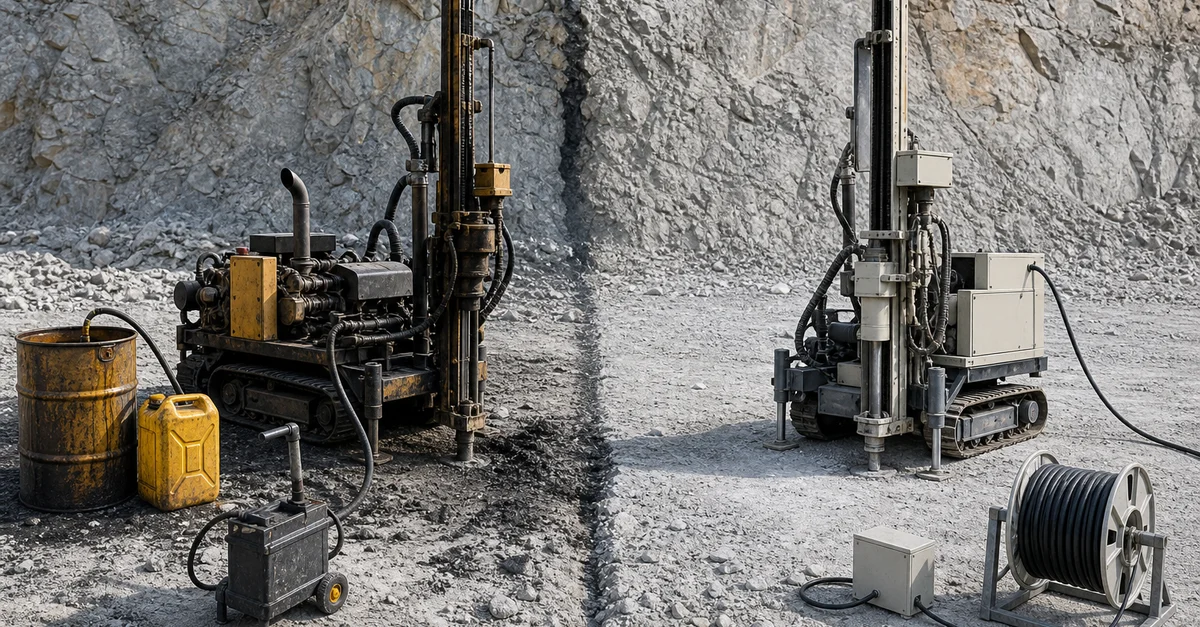
At a high-altitude basalt aggregate quarry with no grid power, a crew ran the same shift with two power setups on the bench. The diesel rig carried its own engine: a drum of fuel by the mast, the stack blackening a patch of bench rock, a grease gun on a small trolley. The electric rig had no stack and no drum of its own — but it had a power cable running forty metres off the bench to a generator that a driver topped up two hours before the shift started.
Both rigs drilled comparable metres. On the shift log they looked like a tie. On the month's cost sheet they were not — and the difference sat almost entirely in one line: who was burning fuel, and to feed what.
The electric rig looked like the saving on paper. What the paper did not show was that its "free" power was being generated on site, and the generator was drinking the fuel the diesel engine would have drunk anyway. The saving had not disappeared. It had moved from one fuel line to another, and in doing so it had also moved past the maintenance that a diesel engine needs and an electric drive does not.
What "Electric" Actually Changes
It is worth being precise here, because the loose version of the argument misleads. An electric DTH rig like our light HB70 is rated at a small motor — 3 kW on the HB70 — and it weighs on the order of a couple of hundred kilograms, not the multi-tonne crawler of a diesel unit. It does not work by making electricity cheaper than diesel. It works by removing a whole line of the machine.
That line is the diesel engine itself: its oil and filters, its fuel system and injectors, its exhaust, its heavier chassis, its noise. An electric drive has no engine to service, no fuel to filter or leak, and a smaller footprint that reaches benches a crawler cannot. Those removals are real and they are permanent — they hold whether the power comes from a grid or from a generator.
My view is that the "electric is cheaper" claim only survives contact with the site's power source. On a grid-fed bench it usually holds, and by a wide margin, because the grid power is cheap and the removed engine line is not replaced by anything. Off-grid, the engine line is replaced by a generator — which brings back the fuel cost and most of the noise it removed. The two cases are different decisions wearing the same label.
The Variable That Decides It: Where the Power Comes From
This is the number the quotation cannot carry, and it should be the first question on any electric-versus-diesel comparison.
Grid power at the bench. If the site has reliable electricity, the electric rig's running cost is the electricity it draws plus its wear parts. There is no fuel line at all. This is where the electric rig is usually the clear running-cost winner, and the gap is large enough to matter over a project, not just a month.
Generator power. If there is no grid, the "electric" rig is powered by a diesel generator. The fuel moves from the rig's engine to the generator's engine, and the diesel maintenance the electric drive was chosen to avoid reappears — in the generator, with its own oil, filters, and running hours. The electric rig still wins on the drill side (no engine on the rig, less noise at the bench, lighter machine), but the total fuel bill is close to what a diesel rig would have spent, because the site is still burning diesel to drill.
The crossover. Somewhere between a cheap grid and a far, expensive, fuel-hungry generator, the advantage narrows. The distance the cable runs, the generator's fuel efficiency, and the price of fuel at the site set where it lands. Two quarries both "off-grid" can sit on opposite sides of that line and make opposite correct choices.
A Running-Cost Framework: Which Lines Change
Before any number is put on the table, it helps to list the lines that actually move between the two power choices. The rest — bits, rods, hammer internals, operator — are the same either way and cancel out.
| Cost line |
Diesel rig |
Electric rig on grid |
Electric rig on generator |
| Fuel / power |
Diesel burned in the rig's own engine |
Electricity drawn from the grid, usually the cheapest line |
Diesel burned in a separate generator |
| Engine maintenance |
Oil, filters, injectors, exhaust, higher hours |
None on the rig — the main saving |
Shifts to the generator; the rig itself stays engine-free |
| Noise at the bench |
Engine plus drilling noise |
Drilling noise only |
Drilling noise, plus the generator if it is on the bench |
| Footprint / access |
Heavier crawler, larger bench and access needed |
Lighter, reaches narrow benches |
Lighter, but a cable and a generator pad to place |
| Setup / relocation |
Self-contained — fuel and machine move together |
Needs a power drop at the collar |
Generator and cable repositioned with every move |
Notice what the table says at the far right: put the electric rig on a generator and the two columns start to look like each other again, because the site is still burning diesel and still servicing an engine — just a different one. That resemblance is the whole story.
A Worked Monthly Comparison
Illustrative example only. The figures below are assumed values to show the shape of the calculation — replace them with your own fuel price, electricity tariff, and operating days before using the result.
Assume a small production rig, one 8-hour shift, 26 operating days a month, drilling on a bench where grid power is available. The question is only the power and the engine line — the consumables are the same in every case.
| Line (monthly) |
Diesel rig |
Electric rig, grid |
| Fuel / electricity |
Assumed $3,900 diesel |
Assumed $450 electricity |
| Engine service (oil, filters, upkeep) |
Assumed $600 |
$0 |
| Noise / emissions handling |
Costs where regulated or near settlements |
None on the rig |
| Subtotal, power + engine line |
≈ $4,500 |
≈ $450 |
| If the electric rig runs off a generator instead |
— |
Fuel for the generator returns most of the gap; only the engine-service and rig-side noise lines stay saved |
The grid column is the case where the decision is easy. The last row is the case where it is not: off-grid, the fuel the generator burns is the same diesel a diesel rig would burn, so the "saving" collapses to the engine-service line and the rig-side noise, and the purchase-price logic takes over again. I would only run diesel where the off-grid generator option was genuinely ruled out on its own merits — not assume the electric rig carries the advantage that a grid gives it.
When Diesel Is the Right Answer
The electric rig is not the default-correct choice. It is the correct choice under a set of conditions, and diesel wins the ones it does not cover.
No reliable power and no room for a generator. If the site cannot run a grid and a generator's fuel and pad do not fit the operation, a self-contained diesel rig is often simply the practical machine, and its all-in cost is lower than an electric rig dragged to a generator that doubles the logistics.
Heavy rock, deeper holes, more impact energy. The electric rigs in the light duty class are built for narrower applications and shallower holes. Where the bench needs the sustained output of a larger diesel crawler to cut the tonnage, matching the job to the machine matters more than the power label. The duty the rock actually demands comes first; the power source is chosen to serve it.
Frequent relocation on rough access. A diesel rig carries its power with it. An electric rig on a generator carries a machine, a cable, a drum, and a fuel supply — and repositions all of it every move. Where the bench moves often over rough ground, the self-contained diesel unit can relocate faster despite being heavier, and that speed is a real cost line.
Noise, Access, and the Narrow-Bench Case
Two reasons the electric rig wins even when the fuel maths are a draw deserve to be stated on their own, because they do not show up in a monthly fuel column at all.
The first is access. Our light electric DTH units have a footprint that reaches benches too narrow for a crawler. On a high-altitude basalt quarry with no grid power, compact electric DTH units ran on on-site generator supply across 6-metre-wide benches that the crawler could not reach at all. The bench was the constraint, not the power source, and only a small machine got to it. Where a bench is narrow, the electric rig is not the cheaper option — it is the only option.
The second is the noise and air-quality line. An electric drive removes the engine at the collar, which matters where the bench is near a settlement, a plant building, or a regulated noise limit. That line is often a compliance cost, not a preference, and it does not appear on a fuel invoice. The air quality the compressor and the bit face produce is a separate matter — treated in our guide to compressed air treatment for drilling — but the engine's noise and emissions are removed by the drive choice itself.
How to Price the Decision on Your Own Site
The comparison is a short one once the power source is known. Four inputs set it:
- Does the bench have grid power? If yes, the electric rig is usually the running-cost winner by a wide margin and the debate is over. If no, continue.
- If no grid, what does a generator cost per hour at your fuel price, and can it sit where the collar is? Work the generator's hourly fuel burn over your operating days. That number is the one that decides how much of the electric advantage survives.
- Does the duty fit a light electric rig, or does the rock need a larger diesel unit? Match the machine to the tonnage and depth first, then to the power. A light electric rig that cannot cut the bench is not a saving; it is a bottleneck.
- How often does the bench move, and how wide is it? Narrow, rarely moved benches favour the compact electric unit. Wide, frequently moved rough-ground benches can favour the self-contained diesel unit.
The full cost structure behind these lines — fuel, bit life, air matching, downtime — is broken out in our guide to the real cost per drilled meter. The power-source question is the first one on it, and it is the one that most quotations skip. The site-conditions that feed all four inputs, including power availability and access, are where a quarry turnkey drilling project is supposed to start from, because they are the conditions that make two identical purchase orders produce different running costs.
Why Welldone Mining
Welldone Mining manufactures both the diesel and the electric DTH platforms, so the power decision is not a supplier pushing one machine — it is an engineering match to the site's actual power, duty, and access. When we quote a rig, the power source is asked before the model, because it changes the answer.
What a quarry operator gets:
- A power-first specification. Send the site's power situation — grid or none, fuel price, generator availability — and the duty, and we return the drive choice that is the right one for that site, stated with the reason, not a catalogue default.
- Electric where it is genuinely right. Light DTH units in the HB70 class for narrow benches and grid-fed sites, specified so the power drop and footprint are part of the plan rather than an afterthought.
- A running-cost comparison in your numbers. Before you commit, we put the diesel and electric options side by side on your fuel price, tariff, and operating days, so the decision is made on the ledger, not on the label.
Related Solutions
Conclusion
The electric rig is not cheaper because electricity is cheap. It is cheaper because it removes a diesel engine from the machine — and that saving is permanent only where the power comes from somewhere that is not a generator. On a grid, the engine line stays removed and the advantage is large. Off-grid, the engine reappears as a generator, the fuel comes back, and the decision narrows to the maintenance and noise lines plus the access the electric footprint alone can reach.
So the comparison is not "electric versus diesel." It is "where does the power come from, and does the duty and the bench fit the machine you get from that answer?" Get those two right and the ledger does the rest. The quotation cannot. It was never going to.
One question to put in front of the next purchase: if you priced the power line over a full year at your actual fuel price and tariff, with the generator hours counted honestly, would the cheaper rig on paper still be the cheaper rig on the bench — or did the advantage move to the machine that was always going to win at your site?
Website: www.welldonemining.com
Email: info@welldonemining.com
Frequently Asked Questions
Is an electric drill rig always cheaper to run than a diesel one?
No. It is usually cheaper where the bench has grid power, because the rig's engine — and its fuel, oil, filters, and noise — are removed and the power is cheap to draw. Where there is no grid and the electric rig runs off a generator, the site is still burning diesel, so the fuel cost returns and the running-cost gap narrows to the engine-service and noise lines plus the access advantage. The power source, not the label, decides it.
What does "electric" actually remove from the machine?
The diesel engine and everything attached to it: the fuel system and its leaks, the oil and filter service, the exhaust, the higher noise at the collar, and the heavier crawler chassis. A light electric DTH unit also weighs far less, which is what lets it reach narrow benches a crawler cannot. Those removals hold regardless of where the power comes from.
When is a diesel rig the better choice?
When the site has no reliable grid and a generator does not fit the operation, when the rock and hole depth need the sustained output of a larger crawler that a light electric unit cannot match, or when the bench moves often over rough access and a self-contained machine repositions faster than a generator-and-cable setup. Match the machine to the duty first, then to the power.
Can an electric rig work where there is no grid power?
Yes — it can be fed by an on-site generator, which is how compact electric DTH units have run on narrow, no-grid benches that a crawler could not reach. The trade is that the generator burns diesel, so the fuel cost returns to the ledger. The electric rig still wins on rig-side noise, engine-free maintenance, and the footprint that got it to the bench; the fuel line is where the two converge. How to work that generator cost out is in our cost per meter guide.
Can Welldone Mining tell me which power choice fits my site?
Yes. Send the site's power situation (grid or none, generator availability, fuel price), the rock and duty, the hole diameter and depth, the bench width and how often it moves, and your operating days, to info@welldonemining.com. We return the drive choice for that site with the reason, and a running-cost comparison in your own numbers before you commit.