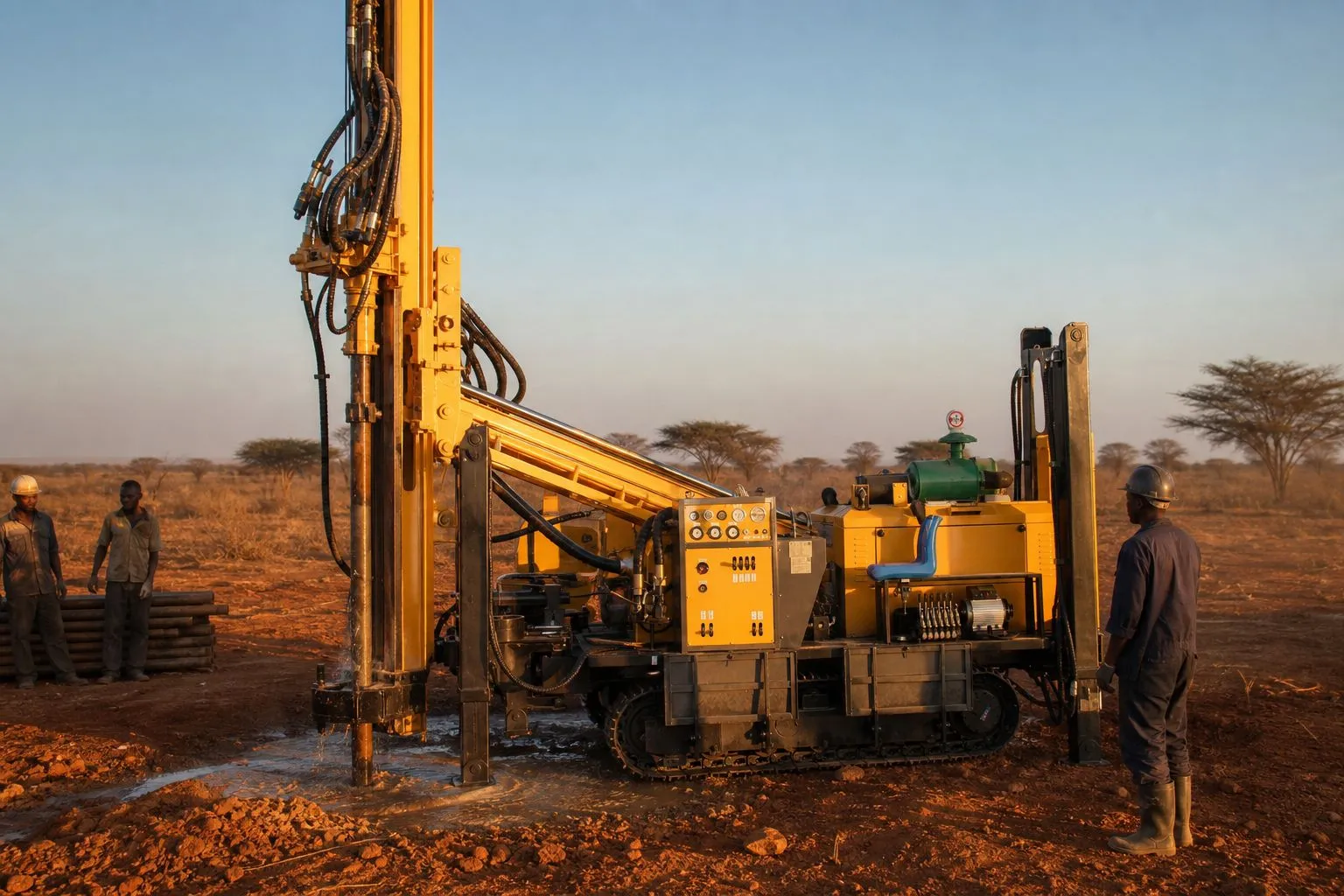
Water Well Drilling Rig Selection by Depth: Why a 350-Meter Rig Stops at 240 Meters
Rig model numbers advertise a depth rating, and buyers treat that number as a capability guarantee. It is not. Rated depth assumes a matched air package, a specific hole diameter, and drill string weight the pullback system can recover. This guide walks through what actually changes as target depth rises from 180 to 500 meters — pullback capacity, rotary torque, air demand, and drill pipe diameter — using real specifications from four rig classes.
A 350-Meter Rig That Stopped at 240 Meters
A contractor bought a rig rated to 350 meters for a programme targeting 300-meter boreholes. Sensible margin, on paper. He paired it with a 580 CFM compressor delivering 17 bar, which his supplier confirmed was within the rig's published air specification.
At 240 meters, penetration collapsed. The hammer was audible but not cutting. He added rotation speed, increased pulldown, changed the bit twice, and lost nine days before calling us.
The rig's air specification read "17 to 36 m³/min." He had read the lower bound as the requirement. It is not a requirement — it is the range across which the rig can operate, and the low end corresponds to shallow holes with small-diameter hammers. At 300 meters with a 6-inch hammer, the actual demand sits near the top of that range, and drill string pressure loss over 300 meters of pipe consumes another 3 to 4 bar before the air reaches the piston.
His compressor delivered 18 m³/min at 17 bar. At the bit, after pressure loss, he had roughly 13 bar. The hammer needed above 20.
The rig was never the constraint. But the rig is what he blamed, because the rig is what carried the depth rating on its nameplate.
What "Rated Depth" Actually Means
A rig's depth rating is a structural and mechanical statement, not a drilling guarantee. It says the mast, pullback system, and rotary head can handle a drill string of that length under defined conditions. Those conditions include a specific pipe diameter, a specific hole diameter, and an air supply matched to the hammer at that depth.
Change any one of those and the practical depth changes with it. A rig rated to 350 meters drilling 140mm holes with 89mm pipe may reach 200 meters when drilling 305mm holes, because the larger hole demands far more air volume and the larger hammer demands more pressure.
Depth rating is best read as a ceiling under favorable conditions — never as a specification you can plan a programme against without checking the four parameters below.
Parameter 1: Pullback Capacity — The Number That Decides Recovery
Pullback is the force the rig can exert lifting the drill string out of the hole. It matters for two reasons, and only one of them is routine.
The routine reason is string weight. Three hundred meters of 89mm drill pipe plus a DTH hammer and bit is several tonnes of steel, and the rig lifts all of it on every trip.
The non-routine reason is why pullback capacity is worth paying for. When a hole caves, when cuttings pack around the string, when the bit binds in a fracture zone — pullback is what recovers your drill string. A rig with marginal pullback in a stuck-pipe situation leaves you with two options: abandon the string, or bring in a heavier rig to fish it out. Both cost more than the pullback margin would have.
Across a typical rig range, pullback scales steeply with depth class:
| Depth Class |
Pullback |
Rotary Torque |
Drill Pipe Diameter |
Engine Power |
| 180 m |
12 T |
3,200 – 4,600 N·m |
76 / 89 mm |
55 kW |
| 280 m |
17 T |
4,500 – 6,000 N·m |
76 / 89 mm |
75 kW |
| 350 m |
22 T |
6,200 – 8,500 N·m |
89 / 102 mm |
91 kW |
| 500 m |
26 T |
7,500 – 10,000 N·m |
102 / 108 / 114 mm |
118 kW |
Note that pullback slightly more than doubles between the 180 m and 500 m classes while rotary torque roughly triples. That is not arbitrary. Deeper strings generate more rotational drag against the hole wall, and torque demand grows faster than weight does.
Parameter 2: Rotary Torque — Why It Scales Faster Than Depth
Rotary torque turns the drill string against the friction of the entire hole wall. At 100 meters, that friction is modest. At 400 meters in a slightly deviated hole through fractured ground, it is substantial — and it grows non-linearly, because a longer string contacts more wall and deviates more.
Insufficient torque produces a specific and recognizable symptom: the rig rotates fine when running free, then stalls or slows sharply once the bit is loaded at depth. Operators often read this as a hammer or bit problem. It is a rotary head problem, and no bit change will fix it.
The practical rule is to specify torque against your deepest planned hole in your most difficult formation, not against your average. Torque is also the parameter that punishes you for buying a rig sized to the programme's typical borehole — because the difficult holes are the ones that generate stuck-string incidents, and those are exactly the holes where torque margin matters.
Parameter 3: Air Demand — Where Most Depth Failures Originate
This is the parameter that stopped the contractor at 240 meters, and it causes more depth shortfalls than the rig itself ever does.
Two variables drive air demand, and they move independently:
Hole diameter drives volume. Cuttings must be lifted through the annulus between drill pipe and hole wall. A 254mm hole has a far larger annulus than a 140mm hole, and clearing it requires proportionally more air volume. This is why a rig's air range spans so widely — the low end serves small holes, the high end serves large ones.
Hole depth drives pressure. Air must reach the hammer piston at the pressure the hammer requires. Every 30 meters of drill pipe consumes roughly 1 to 2 bar. At 300 meters, that is 10 to 20 bar of loss before the air does any work. A compressor rated at 17 bar cannot deliver a hammer's 20-bar requirement at 300 meters — the arithmetic does not permit it, regardless of how the rig is rated.
Matching a compressor to a deep-well rig therefore means reading the rig's air specification as a range tied to hole geometry, then adding drill string loss on top. For 300-meter-plus work, high-pressure compressors in the 23 to 25 bar class exist specifically because standard 17-bar units run out of pressure at depth.
The compressor selection logic is covered in full in our air compressor selection guide, including altitude and temperature corrections that reduce delivered output further.
Parameter 4: Drill Pipe Diameter — The Constraint Buyers Never Check
Pipe diameter rises with depth class for two reasons that reinforce each other.
Larger pipe carries more torque without approaching yield, which matters because torque demand grows with depth. Larger pipe also has a larger internal bore, which reduces air pressure loss along the string — directly addressing the pressure problem described above.
The practical consequence: pipe is not interchangeable across depth classes. A contractor upgrading from a 280-meter programme to a 400-meter programme cannot carry his 76mm pipe inventory across. It will not deliver the air, and it will fatigue at the thread root under the higher torque. Budget pipe replacement into any depth-class upgrade, or the new rig will underperform on old pipe.
Drill pipe failure modes at depth — thread galling, sub-critical resonance, and storage corrosion — are covered separately in our drill pipe failure guide.
Selecting by Programme, Not by Nameplate
The sequence below produces a specification that holds up in the field. It takes an afternoon and it is the difference between a rig that meets its rating and one that stops 100 meters short.
- Step 1 — Establish deepest expected water strike across the whole service area, not the average. Add 20 to 25 percent margin. If your deepest known strike is 260 meters, specify against 320 to 330 meters.
- Step 2 — Establish largest required finished hole diameter, driven by the pump and casing the client needs. This drives air volume more than depth does.
- Step 3 — Calculate air demand at that diameter and depth, including drill string pressure loss at maximum depth, corrected for site elevation and ambient temperature.
- Step 4 — Select the compressor against that corrected figure, not against the rig's published lower bound.
- Step 5 — Confirm pullback exceeds string weight with recovery margin, sized for a stuck-string event rather than a routine trip.
- Step 6 — Confirm rotary torque against the deepest hole in the hardest formation, and specify drill pipe diameter to carry that torque with a safety factor.
Notice that the rig is selected at steps five and six — after the hole and the air are defined. Buying the rig first and fitting the air package to the remaining budget is the sequencing error behind most depth shortfalls, and it is the same principle set out in our DTH system selection guide.
Three Questions Before You Sign
Question 1 — "What air volume and pressure does this rig require at my maximum hole diameter and depth?"
A single figure is the wrong answer. The correct answer is a figure tied to your specific hole geometry, with drill string loss stated separately. If the supplier quotes only the rig's published range, they have not calculated your case.
Question 2 — "What is the drill string weight at my maximum depth, and what pullback margin does that leave?"
String weight is arithmetic — pipe weight per meter multiplied by depth, plus hammer and bit. A supplier who cannot produce this in five minutes has not thought about recovery scenarios.
Question 3 — "What pipe diameter is required, and does my existing inventory work?"
Ask before purchase, not after delivery. Discovering that a new rig needs 102mm pipe when you own 76mm is an unbudgeted cost that frequently exceeds the price difference between rig classes.
Why Welldone Mining
Welldone Mining manufactures hydraulic water well drilling rigs across the full depth range, from 180-meter units for shallow alluvial work to 1,000-meter units for deep basement programmes, alongside the high-pressure compressors and drill string those depths require.
What water well rig customers get:
- Specification against your deepest and largest hole, not the programme average. Send us your target depth range, finished hole diameter, formation type, and site elevation, and we return a matched rig, compressor, hammer, and pipe specification before quoting.
- Air demand calculated at the bit, with drill string loss shown. The compressor we quote is sized against pressure at the hammer sub at your maximum depth — the figure that determines whether the rig reaches its rating.
- Full depth-class range from one manufacturer. Rigs from 180 m to 1,000 m, high-pressure compressors to 25 bar, DTH hammers, and drill pipe in matched diameters — so the interlock between components is calculated once, by one engineering team.
Related Solutions
Conclusion
A rig's depth rating describes what its mast and pullback system can structurally handle. It does not describe what your air package can feed, what your pipe can carry, or what your formation will resist. Those three things decide the depth you actually reach.
The contractor who stopped at 240 meters did not buy the wrong rig. He bought the right rig and starved it, then spent nine days looking for the problem at the bottom of the hole instead of at the compressor. That sequence — blame the bit, blame the hammer, eventually check the air — is the most expensive diagnostic habit in this industry.
The real question when specifying a water well rig is not how deep it is rated. It is whether every component between the compressor outlet and the bit face has been sized for the deepest hole you intend to drill.
Website: www.welldonemining.com
Email: info@welldonemining.com
Frequently Asked Questions
Why does a rig rated to 350 meters sometimes stop short of that depth?
Almost always air supply. Rated depth assumes a matched air package at the hole diameter being drilled. If the compressor cannot deliver required pressure at the hammer after drill string loss — roughly 1 to 2 bar per 30 meters of pipe — the hammer delivers short strokes and penetration collapses well before the rig's structural limit is reached.
How much pullback capacity do I need above the drill string weight?
Enough to recover a stuck string, not merely to lift a free one. Calculate string weight at maximum depth, then confirm the rig's pullback provides meaningful margin above it. Marginal pullback is adequate for routine tripping and inadequate for the caving or binding events that actually threaten your drill string.
Can I use my existing drill pipe when upgrading to a deeper rig?
Usually not. Deeper depth classes require larger pipe diameter for two reasons: higher torque capacity, and a larger internal bore to limit air pressure loss along the string. Running an old smaller-diameter inventory on a new deep rig typically produces both air starvation and thread-root fatigue. Confirm pipe requirements before purchase.
What compressor pressure is needed for drilling beyond 300 meters?
It depends on hammer requirement plus drill string loss, but standard 17-bar units frequently run short at that depth. High-pressure units in the 23 to 25 bar class exist specifically for deep-well work. Send your target depth, hole diameter, and hammer model to info@welldonemining.com and we will calculate the pressure required at the hammer sub.
How much depth margin should I specify above my deepest known water strike?
Twenty to twenty-five percent is a reasonable planning figure. Water tables drop in drought years, and the deepest borehole in a programme is rarely the one surveyed first. Specifying to the deepest known strike with no margin means the difficult districts in a multi-year programme will eventually exceed your equipment.