Water Well Turnkey Projects: What the Scope Actually Includes, Why Quotes Differ by 130%, and the Acceptance Clauses That Decide Whether You Get Water
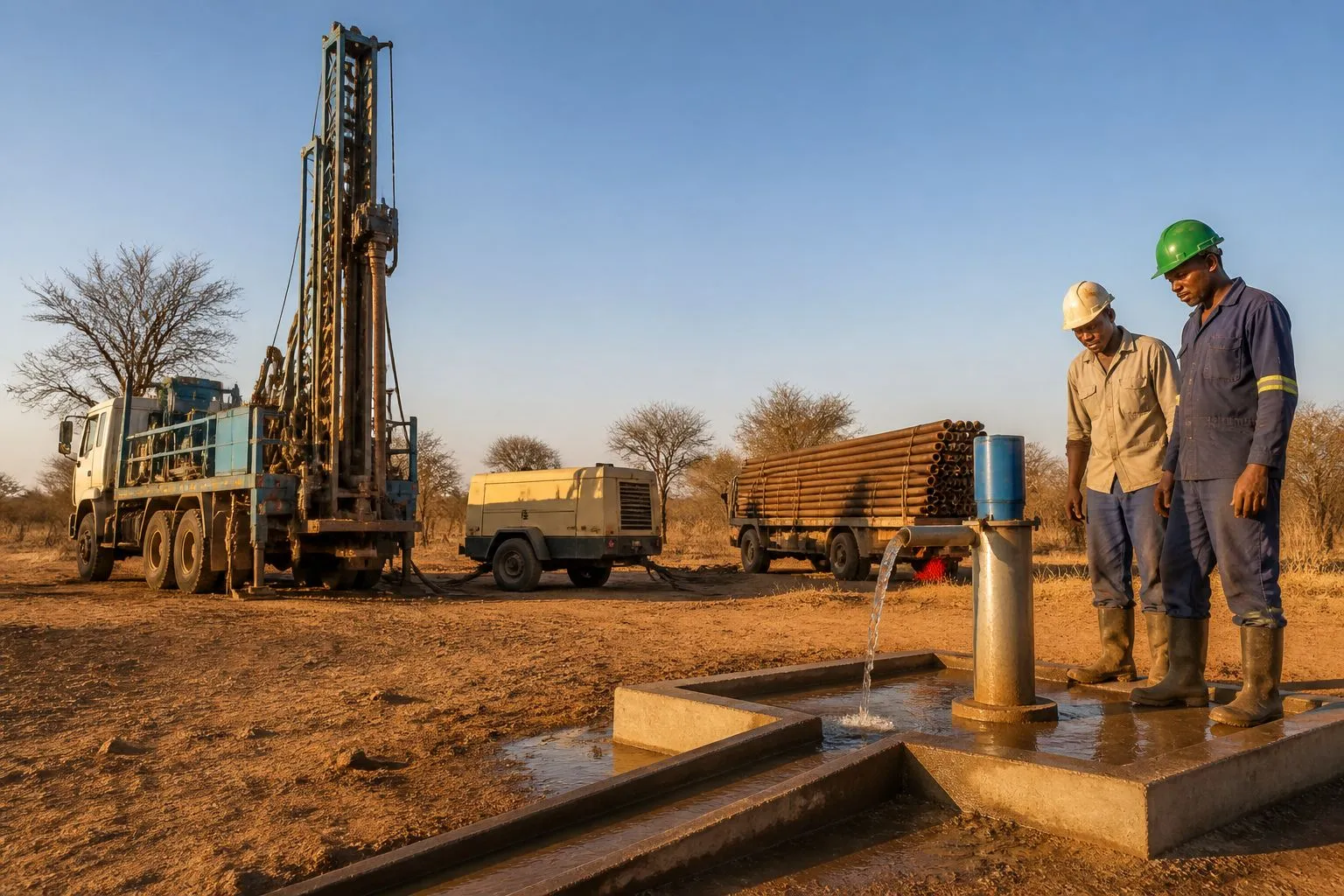
Three contractors quote the same fifty-borehole programme at USD 180,000, USD 290,000, and USD 410,000. All three are quoting honestly. The spread comes from scope boundaries, yield guarantees, and dry-hole terms that most tender documents never define. This guide explains what a water well turnkey project actually contains, how to read a quotation properly, and the contract language that determines whether you take delivery of working water points or expensive holes in the ground.
Fifty Boreholes, Three Quotes, One Confused Procurement Manager
A programme manager at a water NGO showed me three tender responses for the same rural water project. Fifty boreholes across four districts. Identical scope document, identical technical annex, identical submission deadline.
The quotations came in at USD 180,000, USD 290,000, and USD 410,000. A spread of 128 percent on what was supposed to be the same work.
He assumed two of the three were either incompetent or dishonest. They were neither. The cheapest bid excluded pump supply, priced dry holes as billable, and defined a successful borehole as any hole reaching target depth. The most expensive included pumps, aprons, water quality testing, a twelve-month defect liability period, and guaranteed a minimum sustainable yield with dry holes at contractor risk.
Both bidders answered the tender they were given. The tender simply had not asked the questions that separate a hole from a water point.
That gap is where most water well programmes lose money, and it is almost never the contractor's fault.
What a Turnkey Water Well Project Actually Contains
"Turnkey" is used loosely in this industry. Before comparing any two quotations, establish which of the following twelve elements each one includes. Every element is a real cost, and any element left undefined becomes a variation order later.
- Hydrogeological survey and siting — desk study, field reconnaissance, and where budget allows, geophysical resistivity survey to locate fracture zones. In crystalline basement geology this is the single largest determinant of success rate.
- Permits and regulatory compliance — drilling permits, abstraction licences, and borehole completion reporting to the water authority. Sometimes client responsibility, sometimes contractor, frequently assumed by neither.
- Community engagement and site access — negotiating land access, agreeing the exact well position with the community, and arranging site clearance. Skipping this produces wells nobody uses or wells sited where no one can reach them.
- Mobilisation and demobilisation — moving rig, compressor, support vehicles, and crew to each site. On dispersed rural programmes this is a substantial cost line that thin quotes often bury or omit.
- Drilling to target depth — the part everyone thinks of as the project. Typically 20 to 35 percent of total programme cost.
- Casing, screen, and gravel pack — material specification matters enormously here. uPVC versus steel casing, slot size matched to formation grain size, gravel pack gradation. Cheap specification here produces wells that silt up within two years.
- Well development — airlifting or surging to clear fines from the formation until water runs clear. Under-developed wells produce sand, which destroys pumps.
- Pump testing and yield determination — step test and constant-rate test, typically 8 to 24 hours, with recovery monitoring. This is what establishes sustainable yield rather than instantaneous yield.
- Water quality sampling and analysis — laboratory testing against national or WHO standards. A high-yielding borehole with fluoride or arsenic above limits is not a water point.
- Pump supply and installation — hand pump, solar submersible, or grid-powered submersible. Frequently excluded from "drilling" contracts and then discovered as a gap at handover.
- Wellhead completion and civil works — sanitary seal, concrete apron, drainage channel, soakaway, fencing where required.
- Documentation and handover — borehole log, as-built drawings, pump test data, water quality certificate, operation and maintenance manual, and community training.
A quotation covering elements five through eight is a drilling contract. A quotation covering all twelve is a turnkey project. Comparing one against the other on price alone is the most common procurement error in this sector.
Why Identical Scopes Produce Wildly Different Prices
Beyond scope inclusion, four variables drive most of the remaining price spread. Each is worth interrogating during tender evaluation.
Dry hole risk allocation. If the contractor carries dry hole risk, that risk is priced into every borehole. On a programme in fractured basement geology with a realistic 70 percent success rate, the contractor must recover the cost of three failed holes across every ten quoted. If the client carries the risk, unit prices drop sharply and the client absorbs the variance. Neither model is wrong, but they are not comparable prices.
Yield guarantee level. A contract guaranteeing 0.5 cubic metres per hour is a very different technical undertaking from one guaranteeing 3 cubic metres per hour, because the second may require deeper drilling, more siting investment, and more abandoned holes. The guarantee level should be set by what the water point actually needs to serve, not by convention.
Material specification. uPVC casing versus stainless steel screen, locally fabricated versus imported slotted screen, gravel pack versus formation pack. Specification differences can shift material cost per borehole by a factor of three, and the cheap option frequently has a shorter service life than the programme's intended lifespan.
Defect liability period. A contractor warranting well performance for twelve months prices differently from one whose obligation ends at handover. This single clause often explains a large share of the gap between the cheapest and most expensive bid.
Acceptance Criteria: The Clause That Decides Whether You Get Water
This section matters more than everything above it, because a well-specified project with vague acceptance criteria still fails.
I have seen a programme accept twelve boreholes that met every contractual requirement and served nobody. The contract defined a successful borehole as one reaching target depth and producing water. It did not define how much water, measured how, or sustained for how long. The contractor delivered holes producing roughly two cubic metres per day — enough to satisfy the wording, nowhere near enough for the communities they were built for. Both parties were technically correct. The villages still walked to the river.
A defensible acceptance clause specifies all five of the following:
- Minimum sustainable yield, in cubic metres per hour, demonstrated by a constant-rate pump test of stated duration — typically 8 to 24 hours — with drawdown stabilising rather than continuing to fall.
- Recovery criterion — water level must recover to a stated percentage of static level within a stated period after pump shutdown. A borehole that yields well but recovers slowly is being over-pumped and will fail in dry season.
- Water quality compliance against a named standard, with sampling protocol and accredited laboratory specified. Name the standard; "potable" is not a specification.
- Sand content limit after development, typically expressed in parts per million at the test discharge. Sand destroys pumps, and this is the clause that forces proper well development.
- Verticality and diameter tolerance — a hole that deviates beyond tolerance may not accept the pump. This is checked at completion, not discovered at pump installation.
Write these five into the tender document rather than the contract negotiation. Bidders price against what the tender asks. If the tender is vague, you will receive vague bids and the cheapest vague bid will usually win.
Programme Design: Sizing Equipment Against the Whole Contract
For clients procuring equipment rather than services — government water departments, large contractors building in-house capability — the equipment specification follows from the programme, not the other way round.
Three programme parameters drive the entire equipment decision:
Deepest expected water strike across the whole service area. Not the average. The equipment must handle the difficult districts, because those are exactly the districts that generate the most political pressure when they go unserved.
Hardest formation across the whole service area. A programme spanning alluvial plains and granite basement needs equipment capable of both, or two different rigs. Underestimating this is how programmes end up with rigs that cannot complete a third of their assigned boreholes.
Annual borehole target and site dispersion. This determines fleet size and mobilisation burden. Fifty boreholes clustered in two districts and fifty boreholes spread across four provinces are entirely different logistical problems at identical borehole counts.
From those three numbers, the specification sequence runs outward from the hole: define hole diameter and depth, calculate the air requirement, select hammer and bits, specify drill pipe for the torque and tensile loads, and match the rig last. This is the same interlock logic set out in our DTH system selection guide, and inverting it — buying the rig first and fitting the programme around it — is the most expensive sequencing error in this industry.
Realistic Programme Timelines
Timeline slippage on water programmes is usually predictable and usually caused by the same four factors. Build them into the schedule rather than discovering them.
- Seasonality. In much of sub-Saharan Africa and South Asia, rainy season makes rural sites inaccessible to heavy vehicles for two to four months. A twelve-month programme frequently has eight or nine working months.
- Siting throughput. Geophysical survey teams typically work faster than drilling crews, but if siting starts at the same time as drilling, the rig will eventually wait on survey results. Front-load siting by at least several weeks.
- Community and permit lead times. Land access agreements and drilling permits move at institutional speed regardless of programme urgency. Start both well before mobilisation.
- Equipment downtime. On remote programmes, a compressor separator element on international lead time can idle a rig for weeks. Spare parts holding is a schedule input, not just a cost line — a point covered in detail in our compressor maintenance guide.
Evaluating a Turnkey Bidder: Questions Beyond Price
Question 1 — "What was your success rate on your last three programmes in comparable geology?"
Ask for borehole counts, not percentages, and ask what they define as success. A bidder who cannot produce this from their own records has not been keeping completion logs — which means they are not building the geological knowledge that raises success rates.
Question 2 — "Show me a completed borehole file from a previous programme."
Borehole log, pump test data, water quality certificate, as-built drawing. The quality of that file tells you exactly what documentation you will receive at handover. It is the single most revealing document in a bidder evaluation.
Question 3 — "What is your equipment's capability at the deepest and hardest site in this programme?"
Not their standard capability. The specific worst-case site in your scope. A bidder who has not looked at your geology annex closely enough to answer this has priced the average and will struggle on the difficult districts.
Question 4 — "Who carries dry hole cost, and at what success rate did you price?"
This question surfaces the assumption underlying their price. A bidder who priced 90 percent success in geology that historically delivers 65 percent will either make a loss or seek variations. Neither outcome serves the programme.
Why Welldone Mining
Welldone Mining supplies the equipment side of water well programmes — for contractors bidding turnkey work, for government water departments building in-house drilling capability, and for NGOs equipping implementing partners.
What programme-scale customers get:
- Equipment specified against the programme's worst-case site, not its average. Send us your geology annex and depth range and we will specify against the hardest and deepest boreholes in the scope, so the difficult districts do not become variation orders.
- Fleet sizing and spare parts planning for the full contract duration. Number of rigs against annual borehole target and site dispersion, plus a spare parts holding list sized to your logistics reality rather than to a generic service schedule.
- Commissioning, crew training, and 48-hour engineer response. Equipment arrives with drilling technique and well development training, and for complex formations our engineer reaches site within 48 hours of a confirmed request.
Related Solutions
Programme managers and contractors scoping water well work typically review these together:
Conclusion
A water well turnkey project succeeds or fails on two documents written before anyone mobilises: the scope definition and the acceptance criteria. Everything else — equipment quality, crew experience, contractor reputation — operates inside the boundaries those two documents set.
A 128 percent price spread across three bidders is not evidence of dishonesty. It is evidence that the tender left too much undefined, and each bidder resolved the ambiguity differently. Define the twelve scope elements, write the five acceptance criteria, state who carries dry hole risk, and the spread collapses to something you can actually evaluate.
The real question is not which bidder is cheapest. It is whether your tender document asks for water points or merely for holes — because you will receive precisely what you specified.
Website: www.welldonemining.com
Email: info@welldonemining.com
Frequently Asked Questions
What should a water well turnkey contract include as a minimum?
At minimum: siting, permits, drilling, casing and screen, gravel pack, well development, pump testing with stated acceptance criteria, water quality analysis, wellhead civil works, and a documented handover file. Pump supply and installation should be explicitly included or explicitly excluded — leaving it ambiguous is the most common source of post-award disputes.
Who should carry dry hole risk in a water well contract?
It depends on siting responsibility. If the contractor does the hydrogeological siting, contractor risk is reasonable and appropriate. If the client dictates borehole positions, client risk is fairer. What does not work is client-dictated positions with contractor-carried risk — bidders will either price very high or dispute every dry hole.
How long should a pump test run to establish sustainable yield?
For community water supply boreholes, a constant-rate test of 8 to 24 hours with recovery monitoring is common practice, with the duration set by the intended abstraction and the aquifer type. Short tests measure instantaneous yield, which frequently overstates what a borehole sustains through dry season. Specify duration and recovery criteria explicitly in the contract.
Can equipment be specified before the geology survey is complete?
Partially. Depth range and formation hardness are the two inputs that drive specification, and both can usually be estimated from existing borehole records and regional geological mapping before a full survey. We routinely specify against preliminary geology and refine once survey data arrives. Send what you have to info@welldonemining.com and we will indicate where the specification is firm and where it depends on survey results.
Does Welldone Mining execute drilling programmes, or supply equipment only?
We supply equipment, commissioning, training, and technical support — including engineer attendance for complex formations. Drilling execution is carried out by our customers: contractors, government water departments, and NGO implementing partners. For programme managers, that means we can specify and support the equipment side without competing with the contractors bidding your work.