Air Compressor Maintenance for Drilling: Why Three Neglected Service Items Show Up as Hammer and Bit Failures
Compressor maintenance failures almost never present as compressor problems. They present three components downstream — in the hammer, in the bit, in the drill string — and contractors spend thousands replacing tools that were never defective. This article — Part 2 of our air compressor series — covers the three service items that cause most air-related tool failures, how to read the symptoms before they cost you a hammer, and the service schedule that actually holds up on remote sites.
Four Hammers in Three Months, and the Filter Nobody Checked
A drilling contractor in northern Kenya was replacing DTH hammer O-rings every two weeks. Four complete hammer rebuilds in three months. By the time he called us, he was convinced his supplier had shipped counterfeit tools.
I asked one question: when did you last replace the oil separator element on the compressor?
He pulled the service log. Eleven hundred hours since the last change. The manufacturer's interval was 500.
A saturated separator element stops separating. Compressor lubricating oil carries over into the compressed air stream, travels 200 meters down the drill string, and coats every internal surface of the hammer. Rock drill oil is formulated to survive that environment. Compressor oil is not — it breaks down at hammer operating temperature and chemically attacks nitrile seals.
The element cost USD 180. He had spent roughly USD 9,000 on hammer rebuilds chasing a failure that lived at the other end of the air line.
Why Compressor Neglect Presents as Tool Failure
This is the structural reason compressor maintenance gets deprioritized on drilling sites: the compressor keeps running. It does not stop, it does not throw obvious errors, and to the operator it sounds normal. Meanwhile the air it delivers has quietly changed — contaminated with oil, carrying moisture, or short on volume — and everything downstream absorbs the consequence.
The diagnostic chain almost always runs backward. The bit dulls early, so the contractor blames carbide grade. The hammer seals fail, so he blames the hammer manufacturer. Penetration drops, so he orders a different bit face design. Three purchase decisions, none of which touch the actual cause.
I have walked onto sites where a contractor had changed bit supplier twice and hammer supplier once, all within six months, without anyone opening the compressor's service log. The log is usually the fastest diagnostic in the entire yard, and it takes ninety seconds to read.
Failure Item 1: Oil Separator Element Saturation
The separator element removes lubricating oil from the compressed air before it leaves the compressor. In a rotary screw compressor, oil is injected into the airend for cooling and sealing, so every cubic meter of air leaving the machine has passed through an oil mist. The separator's job is to strip that oil out and return it to the sump.
As the element loads up, two things happen simultaneously, and only one of them is visible.
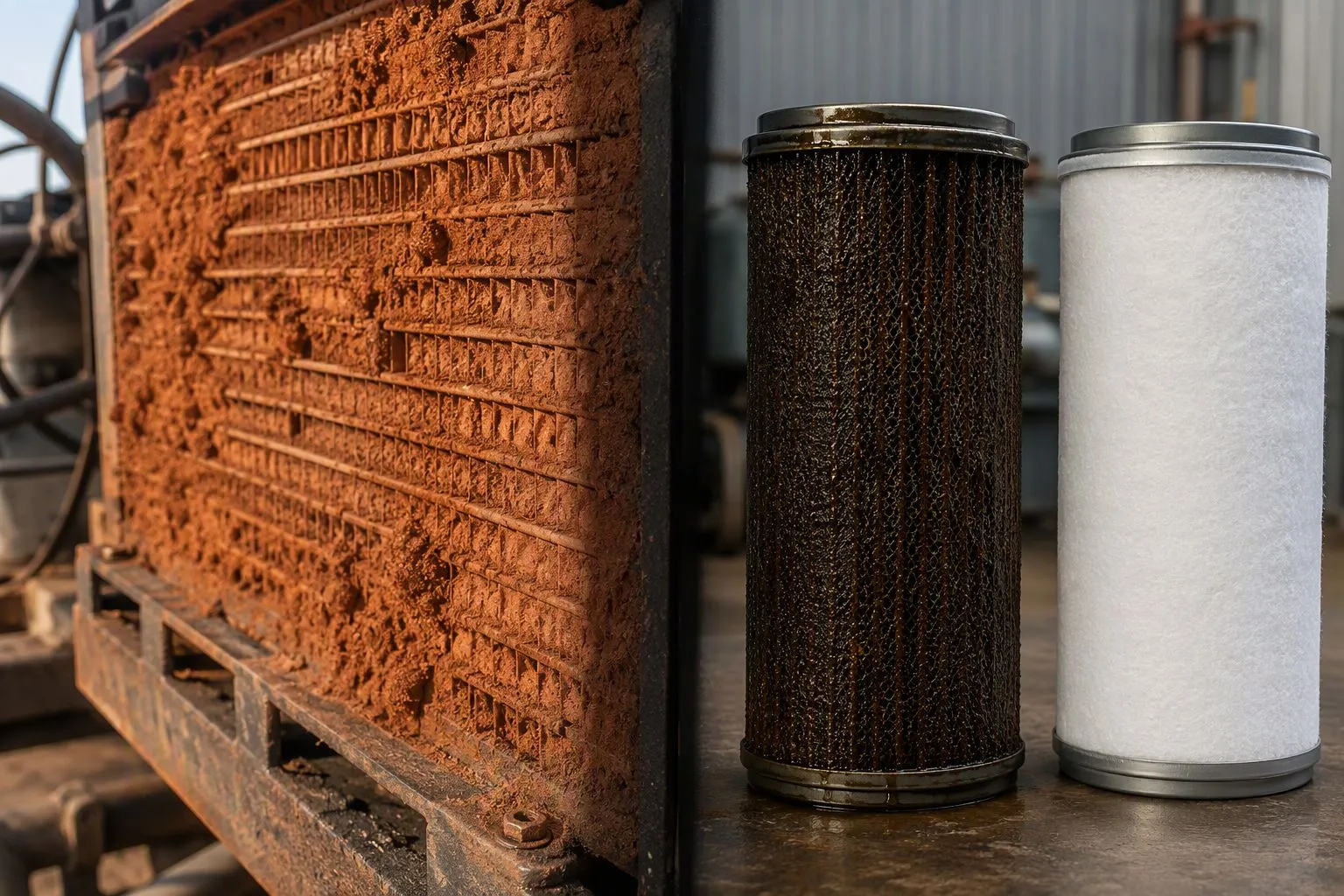
Oil carryover into the air line. A new element holds carryover to roughly 3 to 5 parts per million. A saturated element can pass ten to twenty times that. The oil coats the drill string interior, reaches the hammer, and degrades seals designed for rock drill oil rather than compressor lubricant.
Rising pressure differential. A loaded element restricts flow. The compressor must generate 0.5 to 1 bar of additional internal pressure to push air through it, and that extra pressure costs fuel every single hour. On a unit running ten hours a day, a saturated element quietly burns fuel worth several times the element's price before anyone notices.
Most units have a differential pressure gauge across the separator. If it reads above 1 bar, the element is already overdue. If your unit does not have that gauge, fit one — it costs very little and it converts an invisible failure into a visible number.
Failure Item 2: Cooler Core Fouling
The aftercooler drops compressed air temperature before it enters the air line. This matters for two reasons: hot air carries more moisture, and hot air entering the drill string keeps the hammer running hotter than it should.
On red-soil sites in East Africa, sand-heavy sites in the Gulf, or any quarry with active crushing nearby, cooler fins clog in weeks rather than months. The dust packs between the fins, insulates the core, and cooling capacity collapses. Discharge temperature climbs, and the moisture that should have condensed in the aftercooler stays in the air stream and travels down the drill pipe instead.
Then comes the part that turns a maintenance issue into a machine loss. When discharge temperature crosses the threshold, the high-temperature switch trips and shuts the compressor down. On a site under schedule pressure, the reflex is to bypass the switch and keep drilling.
That switch is the only protection standing between a hot compressor and a seized airend. An airend rebuild costs a substantial fraction of a new compressor, and the failure typically happens at the worst possible moment on the project timeline. Clean the cooler. Do not bypass the switch.
On dusty sites, inspect the cooler core weekly and clean with compressed air blown from the outlet side back toward the intake side. Blowing the wrong direction packs the dust deeper into the core rather than clearing it.
Failure Item 3: Air Intake Filter Restriction
This one produces no dramatic failure and no alarm. It simply makes everything slightly worse, permanently, until somebody changes the filter.
A restricted intake filter forces the compressor to work harder to draw the same volume of air. Fuel consumption rises. Free air delivery falls. The hammer receives less CFM than the specification assumed, penetration rate drops modestly, and nobody connects the two — because the compressor is still running and its gauges still look normal.
On dusty drilling sites, intake filters load far faster than the manufacturer's hour-based interval assumes. That interval was written for reasonable operating conditions. A quarry access road in dry season is not reasonable operating conditions.
Fit a filter restriction indicator if the unit does not have one, and inspect weekly on dusty sites. Do not clean paper intake elements with compressed air — it opens the media pores and lets fine dust through to the airend, which causes wear that costs far more than the filter.
Read the Air: Diagnosing Compressor Health from Downstream Symptoms
These are the field observations that point back to compressor problems rather than tool problems. Any drilling foreman can check all of them in a shift.
- Oil film on the drill pipe interior, or oil visible in the cuttings = separator element saturated or ruptured. Check the differential gauge and replace the element before running another hole.
- Hammer O-rings failing repeatedly at short intervals = oil carryover attacking the seals, or excessive air temperature from a fouled cooler. Both trace to the compressor, not the hammer.
- Water visible at the collar, or wet cuttings in dry formation = moisture carryover from inadequate aftercooling or a saturated water separator downstream. Check cooler cleanliness and drain the separator.
- Penetration rate declining gradually over weeks with no formation change = intake filter restriction reducing free air delivery. Compare current fuel consumption against baseline; a rise with falling output confirms it.
- Compressor tripping on high discharge temperature = cooler fouling, low oil level, or ambient conditions exceeding design. Never bypass the switch; diagnose the cause.
- Fuel consumption up with no change in drilling activity = separator differential, intake restriction, or both. Each forces the machine to work harder for the same output.
A Service Schedule That Survives a Remote Site
Manufacturer service intervals assume a maintained yard, available parts, and moderate operating conditions. Remote drilling projects have none of those. The schedule below is what we recommend to contractors running in dusty, hot, or logistically isolated conditions.
- Daily, before start: oil level, coolant level, visible leaks, drain water separator. Under five minutes.
- Weekly: inspect cooler core and clean if dust is visible between fins; check intake filter restriction indicator; check separator differential pressure gauge; inspect hoses and couplings.
- Every 250 hours (dusty sites): replace intake filter element regardless of appearance; sample compressor oil if oil analysis is available.
- Every 500 hours: replace oil separator element and oil filter; change compressor oil unless oil analysis supports extension; inspect airend for abnormal noise or vibration.
- Every 1,000 hours: full service including belt inspection, safety valve test, temperature switch verification, and pressure regulation calibration.
- Always on site: one spare separator element, two intake filters, one oil filter, and enough compressor oil for a full change. On a remote project, a six-week parts lead time turns a USD 180 item into a stopped rig.
The parts holding matters more than the schedule. A contractor with a perfect schedule and no spare element on site will run past the interval — because the alternative is stopping the rig. Stock first, then schedule.
Three Questions Worth Asking Before You Buy
Question 1 — "What are the consumable part numbers, and can I source them in-country?"
Separator elements, oil filters, and intake filters are the parts you will buy repeatedly for the compressor's entire life. If they are proprietary and only available on six-week lead times from overseas, factor that into the purchase decision. It is a bigger long-term constraint than most buyers realize.
Question 2 — "Does the unit have a separator differential gauge and an intake restriction indicator as standard?"
Both are inexpensive instruments that turn invisible degradation into a readable number. Units without them require the operator to guess, and operators under schedule pressure guess optimistically.
Question 3 — "What is the recommended service interval under high-dust and high-ambient conditions?"
A supplier who quotes only the standard interval has not thought about your site. Ask for the derated interval in writing, and use it for planning your parts holding.
Why Welldone Mining
Welldone Mining supplies compressors with the assumption that they will run on remote sites, in dust, at temperature, far from a parts counter. That shapes what we specify and what we ship with the machine.
What our compressor customers get:
- Condition-derated service schedule with every unit. Not the generic catalog interval — a schedule adjusted for your site's dust level, ambient temperature, and daily running hours, with a recommended parts holding list.
- Starter consumable package as standard. Spare separator element, intake filters, oil filter, and oil shipped with the compressor, so the first service does not depend on an international order.
- Air-quality diagnostics for downstream tool failures. When hammers or bits fail repeatedly, send us the compressor service log and photographs of the failed components. We identify whether the cause is air quality, air volume, or the tool itself — at no cost, regardless of who supplied the equipment.
Related Solutions
Compressor condition affects every component downstream. Buyers scoping or troubleshooting a drilling program typically review these together:
- Diesel vs Electric Air Compressor Selection — Part 1 of this series: delivered energy cost per meter, altitude and temperature corrections, and when a booster is the right answer.
- DTH Hammer Failure Modes — Piston scoring, O-ring hardening, and retainer wear, including how to distinguish tool defects from air-quality damage.
- Water Well Drilling Solution — Complete water well packages with compressor, rig, hammer, and drill string sized and serviced as one system.
- Customized Drilling Solution — High-dust and high-altitude configurations, air treatment specification, and integrating maintenance planning into the equipment package.
Conclusion
The compressor is the least-inspected machine on most drilling sites and the one whose neglect costs the most, because the cost lands somewhere else. A USD 180 separator element destroyed USD 9,000 of hammers in Kenya, and the contractor spent three months certain his hammer supplier was the problem.
Three items — separator element, cooler core, intake filter — cause the large majority of air-related tool failures I diagnose. None of them are complicated. All of them are cheap. What makes them expensive is that their symptoms appear in a different machine, three components downstream, where nobody thinks to look for a compressor problem.
The real question is not which hammer or bit brand holds up best on your site. It is whether the air reaching them is clean, dry, and cool enough that the tool ever gets a fair chance.
Website: www.welldonemining.com
Email: info@welldonemining.com
Frequently Asked Questions
How do I know if my compressor is passing oil into the air line?
Disconnect the hose at the hammer sub and hold a clean white cloth over the outlet for a few seconds while the compressor runs unloaded. A light haze of moisture is normal. Visible oil staining is not — it means the separator element is saturated or has failed. Also check the differential pressure gauge across the element; above 1 bar indicates the element is overdue.
Can I clean and reuse an oil separator element?
No. Separator elements use coalescing media that cannot be restored by cleaning. Attempting to clean one typically damages the media and increases carryover. Replace at the manufacturer's interval, or earlier if the differential pressure gauge indicates loading.
How often should the cooler be cleaned on a dusty site?
Inspect weekly and clean whenever dust is visible between the fins — on red-soil or sand sites, that is frequently every one to two weeks. Blow compressed air from the outlet side back toward the intake side; blowing the same direction as normal airflow packs debris deeper into the core.
Is it safe to keep drilling if the high-temperature switch trips occasionally?
No. An occasional trip means the compressor is running at the edge of its thermal limit, and the next stage is airend damage. Find the cause — usually a fouled cooler, low oil level, or ambient temperature above design — and correct it. Bypassing the switch to finish a shift risks a repair cost many times higher than the delay.
Can Welldone Mining help diagnose repeated hammer failures on equipment we bought elsewhere?
Yes. Send us your compressor service log, the separator element hours, and photographs of the failed hammer components to info@welldonemining.com. Our engineering team will identify whether the root cause is air quality, air volume, or the tool itself, at no cost and regardless of the original supplier.