Here is a pattern I have seen dozens of times.
A contractor wins a drilling tender. The formation description in the bid documents was general — "hard rock" or "medium-hard formation." The depth range was a range, not a specific number. The daily production target was set by the client based on their project schedule, not by the contractor based on realistic drilling rates in that geology.
The contract gets signed. Mobilization begins. And only now does the contractor start seriously evaluating what rig, compressor, hammer, and bit combination they actually need for this specific project.
By that point, three things have already happened. The equipment budget was set based on the tender price — which was calculated before the true equipment requirements were known. The timeline was set based on assumed penetration rates — which have not been validated for the actual formation. And the supplier selection is happening under time pressure — because mobilization is now a countdown to a fixed delivery date agreed with the client.
This sequence is the single biggest reason drilling contractors end up with equipment that is not quite right for their project. Not because they made bad decisions. Because they made those decisions at the wrong point in the project cycle.
The Four Phases of a Drilling Project — and Where the Equipment Decision Actually Belongs
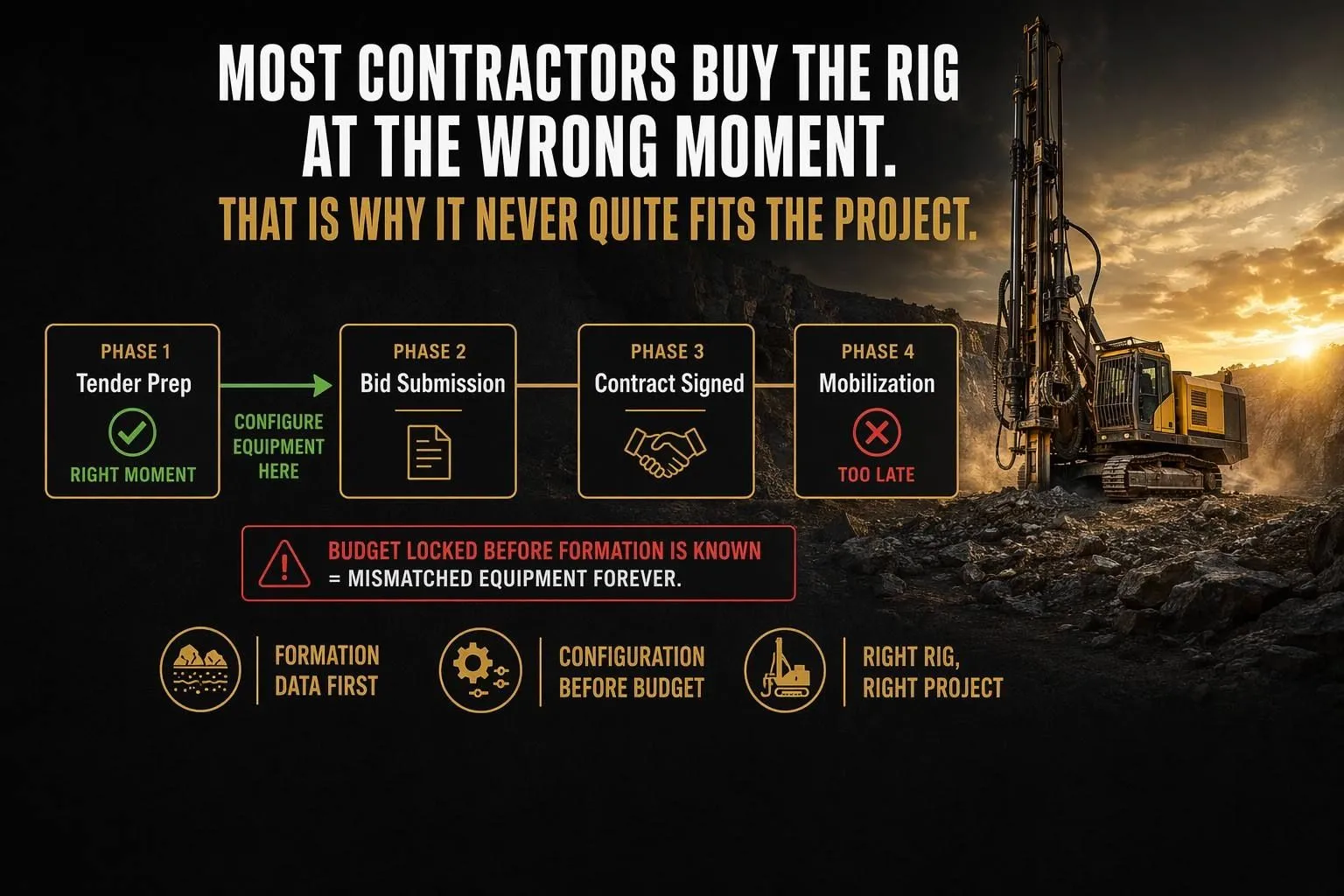
Every drilling contract passes through four distinct phases: tender preparation, bid submission, contract signing, and mobilization. The equipment configuration decision can be made in any one of these phases. The phase you choose determines almost everything about how the project unfolds.
Most contractors make the configuration decision during the mobilization phase — after the contract is signed and the countdown to first drilling has started. This is the worst possible timing. Budget flexibility is already gone. Timeline flexibility is already gone. Supplier options are limited to whoever can deliver on the mobilization date. The technical requirements are being evaluated against constraints that were fixed before those requirements were understood.
Contractors who consistently deliver profitable drilling projects make the configuration decision during tender preparation — before the price is committed. At that point, formation data can still drive the budget. Equipment options can still be evaluated on technical fit rather than delivery speed. Realistic penetration rates can still shape the daily production commitment in the bid.
| Project Phase |
Equipment Decision Quality |
Financial Impact |
| Tender preparation |
Best — budget and timeline still flexible |
Configuration matches project; margins protected |
| Bid submission |
Good — pricing can still reflect real requirements |
Budget aligns with equipment capability |
| Contract signing |
Compromised — budget now locked |
Configuration constrained by tender-set budget |
| Mobilization |
Worst — budget, timeline, supplier all locked |
Forced compromises on technical fit; margin erosion |
What Actually Happens When Configuration Is Rushed at Mobilization
The mobilization-phase configuration decision typically follows a familiar sequence. The contractor calls three or four suppliers. Each supplier quotes based on the equipment they can deliver within the mobilization window. The contractor selects based on some combination of price, availability, and past relationship — because there is not time to do detailed formation matching for each option.
Two weeks later, equipment arrives at the site. The compressor was sized for water well drilling at 17 bar. The formation turns out to be hard basalt requiring 24 bar at the hammer. The bit was a standard medium-formation grade. The rock has silica content that destroys standard bits in four days.
The contractor now faces a choice with no good options. Send back the compressor and wait three weeks for a replacement — burning through the project window. Run the project with the mismatched equipment and absorb the penetration rate hit — burning through the margin. Or negotiate a scope change with the client — burning through the customer relationship.
None of these outcomes reflect the contractor's operational capability. They reflect the timing of the configuration decision.
Why Formation Data Is a Tender-Phase Input, Not a Mobilization-Phase Discovery
The single most important piece of information for drilling equipment configuration is formation data — specifically UCS (Unconfined Compressive Strength) values, silica content, and formation variability across the project depth range. This data determines bit grade, hammer selection, compressor pressure requirement, and expected penetration rate.
In most tender packages, formation data is either general ("hard rock formation") or absent entirely. Contractors treat this as normal and move forward. They shouldn't.
Before submitting a bid on any drilling contract, the contractor should have specific answers to five formation questions:
- What is the confirmed UCS range at target depth?
- What is the silica content of the dominant formation type?
- What is the expected formation variability across the project sites or bench depths?
- What water-bearing conditions can be expected in the drilling zones?
- What local drilling records exist from previous contractors in the same geology?
If the tender document does not provide this data, the contractor has two options. Request a pre-tender site visit and hydrogeological briefing from the client, or build a formation risk factor into the bid price to absorb the uncertainty. What contractors typically do — submit based on general assumptions and hope for the best — is neither of these options. It is a bet, and the odds are not favorable.
The Compressor Sizing Decision: A Tender-Phase Calculation
Compressor sizing depends on three variables that must be known before equipment can be correctly specified: target hole depth, hole diameter, and hammer inlet pressure requirement.
Hole depth determines the pressure loss through the drill string — the deeper the hole, the more pressure the compressor must deliver at surface to maintain adequate pressure at the hammer face. A hammer requiring 22 bar inlet pressure at 100 meters depth may need 26 bar at the compressor outlet to compensate for pipe friction losses. At 200 meters, the same hammer may need 30 bar.
Hole diameter determines the airflow volume required for cuttings removal. Larger holes generate more cuttings and require higher airflow to maintain the minimum uphole velocity that keeps the hole clean. A hole diameter increase from 89mm to 115mm typically requires 40 to 60 percent more airflow at the same drilling rate.
Hammer inlet pressure requirement depends on the formation. Hard rock hammers require higher inlet pressure to deliver rated impact energy. If the formation is harder than assumed at tender time, the compressor selected during mobilization may be undersized even for a hole depth that was correctly estimated.
| Compressor Sizing Input |
Source |
Tender-Phase Availability |
| Target hole depth |
Tender documents or client briefing |
Available if requested |
| Hole diameter |
Tender documents or drilling specification |
Usually available |
| Formation UCS at depth |
Hydrogeological survey or local records |
Requires client cooperation or independent research |
| Hammer inlet pressure requirement |
Derived from formation UCS and hole diameter |
Calculable if formation data is available |
| Ambient temperature range |
Project site location |
Available immediately |
Every input on this table is available or obtainable during tender preparation. None of them require waiting until mobilization to be resolved. Contractors who ask for this data during the tender phase get equipment configurations that work. Contractors who wait for mobilization get equipment configurations that mostly work.
Bit Selection: The Consumable Cost That Should Be Priced Into the Bid
DTH drill bit consumption is the largest ongoing operating cost in a hard rock drilling project. Bit life varies from 200 meters in the wrong formation-grade combination to 600 meters or more in the right one. A three-times difference in bit life translates directly into a three-times difference in consumable cost per meter drilled.
A contractor who prices a bid using generic consumable rates from a previous project — without matching bit grade to the actual formation of the new project — is either bidding too high (losing to competitors who did the analysis) or too low (winning at a price that will not cover the consumable cost when actual bit life turns out shorter than assumed).
The tender-phase bit analysis is not complicated. Formation UCS and silica content indicate the required carbide grade. Hole diameter indicates the bit size. Expected penetration rate indicates the consumption volume. These three inputs produce a consumable cost per meter that can be defended in bid pricing — and that will actually match the field results when drilling begins.
Delivery Timeline: Building Realistic Mobilization Windows Into the Bid
Standard shipping times for DTH drilling equipment from Asian suppliers to East Africa, the Middle East, or South Asia typically run 25 to 45 days depending on port and destination. Adding customs clearance and inland transport, 45 to 60 days from order to on-site is a realistic mobilization window for equipment that is not held in stock.
Many drilling tenders specify mobilization windows of 30 days or less. Contractors bidding on these tenders sometimes commit to the timeline without confirming equipment availability — assuming they can source what they need locally or from stock at their standard suppliers.
When the actual project requires a specific compressor pressure rating, a specific hammer size, or a specific bit grade that is not immediately available, the mobilization commitment becomes impossible to meet without compromising the equipment configuration. The contractor either delays the project (contract penalty), accepts substitute equipment (technical compromise), or forfeits the contract (worst outcome).
Working with the supplier during tender preparation reveals equipment availability constraints before they become contractual problems. It also enables the supplier to prepare stock or accelerate production for specific equipment items if the tender is likely to be won.
Working With Suppliers During the Tender Phase — Not Just After
Most suppliers respond to two contact points from contractors: initial technical inquiries months before a project, and urgent orders after a contract is signed. The middle phase — active tender preparation for a specific project — is where the supplier relationship provides the most value, and where most contractors underuse it.
During tender preparation, a supplier can provide realistic performance data for the target formation, verify equipment availability against the mobilization window, quote consumable costs based on expected bit life in the specific geology, and identify configuration options that the contractor may not have considered.
None of this requires a firm order. It requires an open conversation between the contractor and the supplier during the phase when the tender pricing and equipment strategy are being developed.
At Welldone Mining, we routinely support contractors during tender preparation — reviewing formation data, running compressor sizing calculations, verifying equipment lead times, and helping contractors build defensible consumable cost estimates for their bids. When those contractors win, the mobilization is straightforward because the equipment specification was validated months earlier.
Framework: What to Do Differently on Your Next Tender
The following framework changes the timing of the equipment configuration decision without adding operational complexity. It moves the analytical work forward by 30 to 90 days — from mobilization to tender preparation — and produces a bid that reflects real equipment requirements.
Step 1: Confirm formation data before bid pricing
Request formation UCS data, silica content, and depth profile from the client. If not available, request a pre-tender site visit. If neither is possible, build a formation risk factor of 15 to 25 percent into your equipment consumable estimate.
Step 2: Run configuration analysis for the actual project
Match hammer size to hole diameter. Calculate compressor pressure requirement at target depth. Select bit grade based on formation UCS. Verify equipment availability against the mobilization window. Do this before the bid price is finalized.
Step 3: Build bid pricing from real equipment costs
Consumable cost per meter should reflect realistic bit life for the specific formation. Equipment capital cost should reflect the actual configuration the project requires. Do not use generic historical data as a substitute for project-specific analysis.
Step 4: Coordinate mobilization timeline with supplier lead times
Confirm delivery windows with your supplier before committing to a mobilization date in the bid. If the supplier cannot deliver on the client's timeline, either negotiate the timeline in the bid or accept that you may lose this specific tender.
Step 5: Contract signing to mobilization is execution, not analysis
Once the contract is signed, the equipment decision should already be made. The mobilization phase should be about logistics, not about figuring out what equipment to buy. If you are still evaluating equipment options after contract signing, the tender analysis was insufficient.
What Welldone Mining Provides at Each Project Phase
Welldone Mining supports drilling contractors across every phase of the project cycle — not just when the purchase order arrives.
Tender preparation phase: Formation data review, compressor sizing calculations, bit grade recommendations, and consumable cost estimation for the specific project. This support is provided without requiring a purchase commitment — because our objective is to help contractors win bids they can profitably execute.
Bid submission phase: Equipment quotation with detailed technical specifications, delivery timeline confirmation, and consumable stock recommendations that can be referenced in the bid pricing.
Contract execution phase: Production scheduling coordinated with the contractor's mobilization timeline, spare parts and consumable starter kits, and shipping documentation prepared for the destination country's customs requirements.
Mobilization and drilling phase: On-site installation guidance, operator training if requested, and remote technical support during the ramp-up period and throughout the project duration.
Contractors working with Welldone during tender preparation get to the mobilization phase with equipment that was configured for their actual project — not equipment that was selected under time pressure after the contract was already signed.
You can explore our drilling solution frameworks that align with common project types:
- Customized Drilling Solution — formation-specific DTH system configurations combining compressor, hammer, bit, and drill pipe selection for complex or variable geology projects.
- Quarry Drilling Solution — blast hole and hard rock quarry configurations for construction aggregate and open-pit mining applications.
- Water Well Drilling Solution — configured systems for borehole and deep well projects across East Africa, South Asia, and the Middle East.
Related Equipment
Crawler DTH Drilling Rig — available in configurations for water well, quarry, and blast hole applications with feed force and rotation speed matched to hole diameter and formation hardness.
Air Compressor (Diesel and Electric) — sized to hammer inlet pressure requirement at target depth. High-pressure configurations for hard rock quarry and deep borehole applications. Diesel for remote and mobile sites.
DTH Hammer (Low, Medium, and High Pressure) — matched to compressor output and formation impact energy requirement. Available in 3.5-inch through 8-inch sizes for hole diameters from 76mm to 215mm.
DTH Drill Bit (Formation-Matched) — button bits in standard, hard rock, and premium carbide grades. Formation-specific selection prevents premature wear and maintains penetration rate across the project depth range.
Drill Pipe and Accessories — matched to rig thread type, hammer connection, hole diameter, and target depth. Stabilizers, sub-adapters, and crossover subs for different configuration requirements.
Conclusion
The equipment that arrives at your project site is a direct reflection of when the configuration decision was made. Equipment configured during mobilization reflects the constraints of the mobilization phase — locked budget, fixed timeline, limited supplier options. Equipment configured during tender preparation reflects the requirements of the project — formation, depth, production target, realistic economics.
The contractors who consistently deliver profitable drilling projects are not necessarily the ones with the best equipment. They are the ones who make the equipment decision at the right point in the project cycle — before budget and timeline lock in constraints that force technical compromises.
Your next tender is the opportunity to change this pattern. Formation data, compressor calculations, bit selection, and delivery timing all fit into the tender preparation phase. They do not have to wait for mobilization. And when they do wait, the project pays the difference.
If you are preparing a drilling tender in the next 30 to 90 days, share your project type, target market, expected hole diameter and depth range, formation description, and mobilization timeline. Welldone Mining will help you validate the equipment configuration and build defensible cost estimates for your bid — before the contract is signed.
Website: www.welldonemining.com
Email: info@welldonemining.com